Introduction
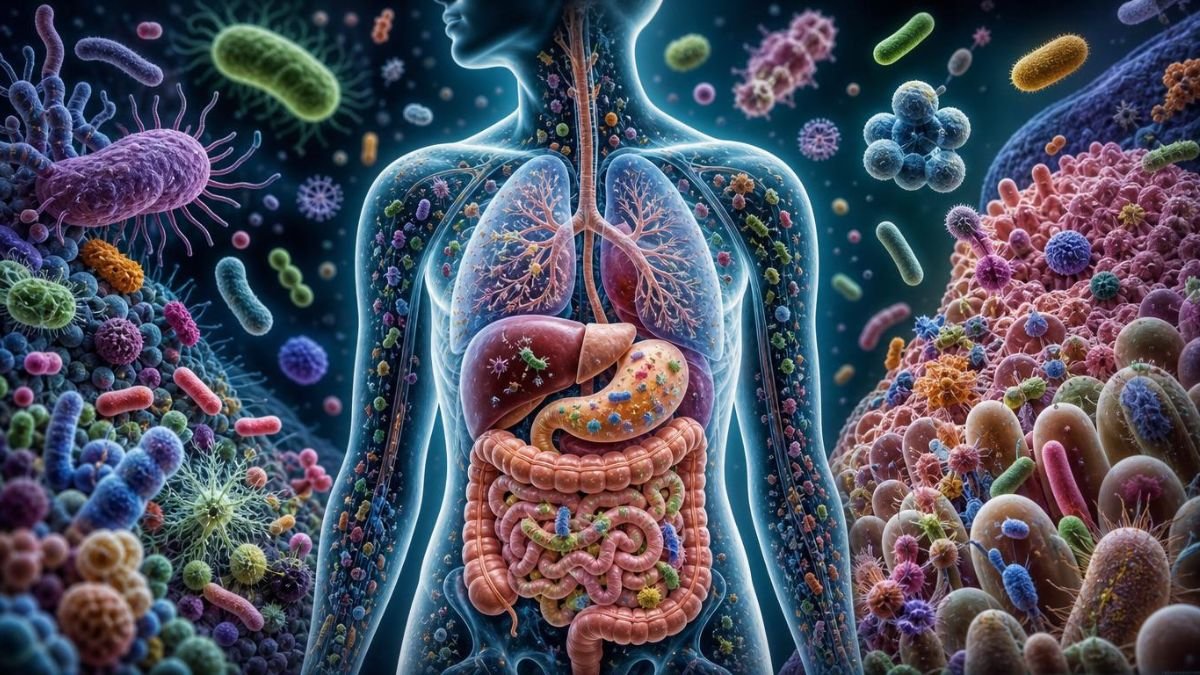
You have been thinking about yourself wrong. Not in a self-esteem kind of way — in a biological one. You probably think of your body as a discrete, singular organism: your skin, your organs, your cells, your DNA. But the reality is considerably stranger and more interesting. You are, in the most literal sense, an ecosystem — a host to approximately 38 trillion microbial organisms that live in and on your body, many of which you could not survive without, and whose collective genome contains far more genetic information than your own human DNA.
This community of microorganisms — bacteria, fungi, viruses, archaea, and others — is called the human microbiome, and it is one of the most rapidly evolving fields in modern science. What researchers have discovered over the past two decades has fundamentally altered the way biologists think about the human body: not as a standalone organism but as a superorganism — a system that includes microbial life as a functional component, not merely as a passenger. The implications reach far beyond digestion and immunity into mental health, autoimmune disease, obesity, cancer, and possibly even personality and behavior.
Why are we reading about this closely today? Because science writing — the kind that must translate genuinely complex, rapidly evolving research into language that an intelligent non-specialist can follow — is a specific genre with specific tools. It uses analogy, it hedges carefully to reflect the actual state of knowledge, it manages scale (from trillions of cells to genetic databases to the behavior of whole organisms), and it must create a sense of wonder without sacrificing accuracy. Learning to read this kind of writing with your full attention is one of the most effective ways to build the vocabulary, the analytical depth, and the comfort with complexity that advanced English requires. And you will learn something genuinely fascinating about yourself along the way.
The Article
What if the line between "you" and "not you" is far blurrier than biology class ever let on? The human microbiome — the vast ecosystem within us of trillions of microbial organisms — is rewriting one of the most basic assumptions of medical science: that the human body is a fortress defended against an outside world of pathogens, rather than a collaborative community in which the distinction between self and other is functional rather than absolute.
The numbers are staggering enough to require a moment of still absorption. Recent estimates, using genome sequencing rather than the older and less accurate cell-counting methods, suggest that the human body contains approximately 38 trillion bacterial cells alongside roughly 30 trillion human cells. Earlier estimates put the ratio at ten to one in favor of bacteria, which turned out to be an overcount — but even at close to one-to-one, the implications are profound. You are, in cellular terms, roughly half microbial. And that microbial half is not merely hitching a ride. It is working.
The gut microbiome — the community of microorganisms in your digestive system — is the most studied and the most staggeringly complex. It contains somewhere between 500 and 1,000 different species of bacteria, with individual variation so significant that no two people's microbiomes are identical, even among identical twins. These microorganisms perform functions that the human body cannot perform for itself: they synthesize vitamins B12 and K, break down complex carbohydrates that would otherwise be indigestible, regulate the immune system's response to pathogens, and maintain the integrity of the gut lining that prevents bacteria from entering the bloodstream. The gut microbiome is not a backup system — it is a core component of normal human physiology.
The immune system connection is particularly significant and still being actively researched. Approximately seventy percent of the body's immune cells are located in the gut, and the gut microbiome appears to play a critical role in training the immune system to distinguish between harmful pathogens and harmless foreign material. Children raised in environments with very low microbial diversity — due to excessive hygiene, antibiotic use, or limited contact with natural environments — appear to have elevated rates of allergies, asthma, and autoimmune conditions. This is one of the lines of evidence behind what immunologists call the hygiene hypothesis: the idea that some immune dysregulation in modern populations may result from the immune system not being adequately trained by early-life microbial exposure. Your immune system, on this reading, needs to practice fighting against a diverse microbial community in order to calibrate itself correctly — and a microbiome depleted by modern hygienic practices may be producing an immune system that is simultaneously bored and trigger-happy.
The most surprising recent research concerns the gut-brain axis: the bidirectional communication pathway between the gut microbiome and the central nervous system. The gut contains approximately 100 million neurons — more than the spinal cord — and communicates with the brain via the vagus nerve as well as through the production of neurotransmitters. Remarkably, approximately ninety percent of the body's serotonin — the neurotransmitter most associated with mood regulation — is produced in the gut rather than the brain. The gut microbiome influences serotonin production. Which means the trillions of organisms living in your digestive system may be influencing your emotional state in ways you are not consciously aware of. Animal studies have shown that germ-free mice — raised without any gut microbiome — display dramatically altered anxiety and stress responses compared to mice with normal microbiomes. When the microbiome of anxious mice is transferred to calm mice, the calm mice begin to display anxiety behaviors. This research is in its early stages in human applications, but the implications are remarkable: your emotional life may be partly a product of the ecosystem you carry.
Diet is one of the most powerful determinants of microbiome composition, and the research on this is among the most practically actionable in the field. Diets high in fiber — particularly the diverse kinds of fiber found in vegetables, legumes, and whole grains — tend to support diverse and abundant gut microbial communities. Ultra-processed foods, which make up the majority of caloric intake in many Western countries, tend to reduce microbial diversity. Fermented foods — yogurt, kefir, kimchi, sauerkraut, miso — introduce live microbial cultures that can temporarily or permanently alter the microbiome's composition. The research is still complex and sometimes contradictory, but the broad direction is clear: the food you eat does not merely fuel your cells. It feeds the ecosystem you carry, and the health of that ecosystem feeds back into your health in ways that are only beginning to be mapped.
Antibiotics — which have saved countless lives and remain indispensable in modern medicine — have a complicated relationship with the microbiome. A course of broad-spectrum antibiotics does not selectively eliminate pathogens. It reduces the entire microbial community, often dramatically and for months. Some studies suggest that the full recovery of a disrupted microbiome can take a year or more, and that repeated antibiotic courses may produce cumulative depletion effects. This does not mean antibiotics should be avoided when they are genuinely needed — the cost of untreated bacterial infection is far higher than microbiome disruption. But it does mean that the casual, prophylactic prescribing of antibiotics that characterized much of twentieth-century medicine was producing microbiome consequences that were invisible to practitioners who had no framework to notice them.
The frontier of microbiome research is moving fast — from fecal microbiota transplantation as a treatment for Clostridioides difficile infection (where it is already standard clinical practice), to the development of personalized probiotic therapies, to research on the microbiome's role in cancer treatment response. What the field has already established is a fundamental revision in how we understand the human body: not as a closed, self-contained system defending itself against the microbial world, but as an open, collaborative community in which the boundaries of self are more permeable, more dynamic, and more interesting than the biology textbook picture suggested.
When you think about your health — or your mood, or your energy, or even the vague sense of general well-being you sometimes have without being able to say why — are you giving sufficient credit to the 38 trillion organisms that are, right now, working alongside you? And what does it mean for how you think about yourself that so much of what makes you work is not, in the strict sense, you?
Close Reading Analysis
Paragraph 1: "What if the line between 'you' and 'not you' is far blurrier than biology class ever let on?"
Question: the phrase "far blurrier than biology class ever let on" contains two interesting moves — "far blurrier" and "let on." Unpack both. What do they add beyond the literal claim that the boundary between self and non-self is unclear?
"Far blurrier" uses the comparative form of a word ("blurrier") that already implies gradation — blurriness is not binary. "Far" is an intensifier that suggests the degree of blur is substantial, not marginal. Together, "far blurrier" implies that the difference between what biology class taught and the reality is not a minor correction but a significant revision. "Let on" is a phrasal verb meaning to reveal or disclose — usually used when someone has kept information back. "Let on" implies that biology class knew (or could have known) more than it told you, and chose a simpler story. The phrase quietly criticizes educational oversimplification: not "biology class was wrong" (which would be harsh) but "biology class didn't tell you the full story" (which is precise and fair). This is an example of choosing a phrasal verb for its connotations — "let on" carries implications that "showed" or "taught" would not.
Paragraph 2: "The numbers are staggering enough to require a moment of still absorption."
Question: "a moment of still absorption" is an unusual phrase. What kind of language is this, and why does it appear in a science article rather than in poetry?
"Still absorption" is almost meditative language — it suggests quietness, pause, receptiveness. In a science article about specific numbers, it is a deliberate tonal interruption. The writer is not just presenting data; they are signaling that the data is scale-breaking — that the standard cognitive equipment for processing numbers is insufficient here and a different mode of reception is required. This is a form of metacognitive instruction embedded in the writing: before I give you the numbers, I am telling you that you need to slow down for them. In science communication, writers who recognize that some data is cognitively overwhelming and who pace their delivery accordingly produce more effective writing than those who simply list figures. The unusual phrase is doing pedagogical work.
Paragraph 3: the gut microbiome:
Question: the paragraph says "no two people's microbiomes are identical, even among identical twins." Why is the "even among identical twins" qualification particularly significant as evidence?
Identical twins share virtually all their DNA — they are the closest thing to a biological control case that exists in nature. When something varies even between identical twins, you know the variation is not explained by genetics alone: it must be explained by environmental factors, developmental differences, or random processes. Mentioning identical twins therefore efficiently pre-empts the obvious objection ("maybe the differences are just genetic"). It is a piece of evidence that has been chosen precisely because it rules out the most likely alternative explanation. Recognizing this kind of evidence selection — choosing examples that efficiently eliminate alternatives — is a key analytical skill in reading scientific and argumentative writing.
Paragraph 4: the hygiene hypothesis:
Question: the paragraph describes the immune system as "simultaneously bored and trigger-happy" when deprived of adequate microbial training. These are colloquial, almost comic terms for a serious immunological phenomenon. What is the rhetorical function of this word choice in a science article?
"Bored and trigger-happy" imports human behavioral vocabulary into a cellular context. An immune cell cannot literally be bored or trigger-happy — these are metaphorical attributions. But they work because they capture the functional behavior accurately in terms a non-specialist reader immediately understands: an immune system not being adequately challenged by diverse microbial exposure becomes both under-stimulated and over-reactive. The colloquial terms make a complex physiological concept intuitive. This is the art of science communication: finding the figurative language that captures the functional reality without sacrificing accuracy. The risk — and the balance to maintain — is that the metaphor does not become misleading. Here it doesn't, because the function it describes (under-stimulated → over-reactive) is accurately characterized by the colloquial terms.
Paragraph 5: the gut-brain axis:
Question: the paragraph presents a chain of causal claims: microbiome influences serotonin production; serotonin influences mood; therefore microbiome influences mood. What logical structure is this, and what is the appropriate level of certainty with which to hold this chain?
This is a transitive causal chain: if A causes B and B causes C, then A causes C. Logically, transitive causation is valid — but in biological systems, it is important to distinguish between a demonstrated mechanism and a complete causal story. The paragraph presents the individual links with appropriate hedging ("may be influencing," "appears to influence"), and the animal studies are described as "early stages in human applications." The full chain is presented as plausible and suggestive rather than proven. This is honest science communication: the chain is real and interesting enough to describe, but the evidence for the full human application is not yet sufficient for confident claims. In your own analytical writing, building causal chains while hedging their certainty appropriately is a sophisticated skill that distinguishes careful thinkers from overconfident ones.
Closing question:
"When you think about your health — or your mood, or your energy, or even the vague sense of general well-being you sometimes have without being able to say why — are you giving sufficient credit to the 38 trillion organisms that are, right now, working alongside you?"
The phrase "without being able to say why" is particularly important. It names an experience that is universal and usually dismissed — the inexplicable sense of feeling well or unwell that cannot be attributed to any identifiable cause. By naming it and then connecting it to the microbiome, the writer makes the science personally relevant: those unnamed, unattributed feelings of well-being may have an explanation that modern science is only beginning to map. The question ends the article in the same place it began — with the blurring of self and non-self — but now that blurring has been made specific, mechanistic, and personally applicable. This is the arc of good science writing: from the surprising claim at the beginning to the earned, evidence-supported application at the end.
Speaking & Writing Challenges
Writing Challenge
Choose a scientific concept that you find genuinely surprising or counterintuitive — it can be from biology, physics, chemistry, psychology, or any other field — and write a 400–500 word explanatory paragraph for a general, educated audience. Your challenge: (1) open with the counterintuitive claim, (2) explain the mechanism using at least one precise analogy and one piece of specific evidence (a number, a study, a named example), (3) include one moment where you acknowledge genuine scientific uncertainty, and (4) close with a personal implication that makes the science feel relevant to the reader's own life. Pay attention to your hedging language throughout — distinguish clearly between what is established, what is strongly suggested, and what is speculative.
Speaking Challenge
Prepare a two-minute explanation of the human microbiome for an intelligent friend who has never studied biology. Your challenge: start with the most surprising or counterintuitive fact, explain the gut-brain axis connection without using jargon (or by defining every term you use), and end with one practical implication the friend could act on this week. The goal is to practice the register shift between technical accuracy and conversational accessibility — one of the most valuable communication skills at the advanced level.








0 Comments