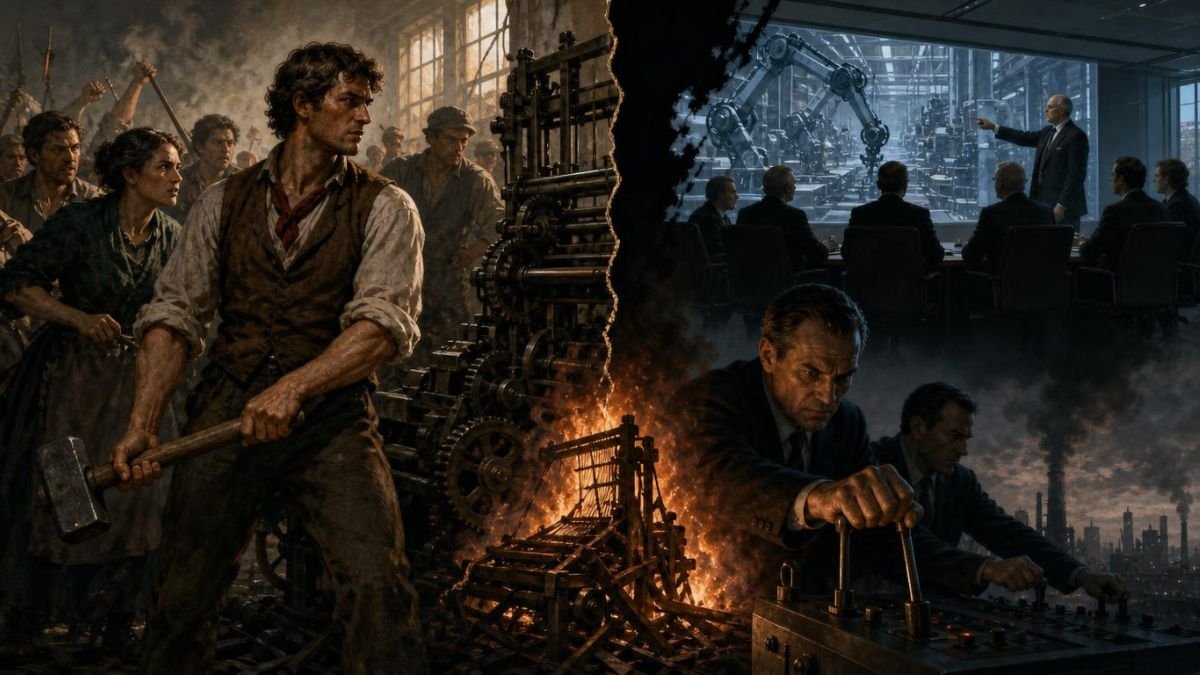
Somewhere in an office right now, a meeting is going badly.
Someone has just raised a hand and said something reasonable — that the new system might not work the way the demo suggested, that the rollout timeline seems optimistic, that nobody has asked the people who'll actually use it. And someone else, senior enough to end conversations, has leaned back in a chair and said the magic words.
"Don't be such a Luddite."
And that's it. Meeting over. Not because the objection was answered, but because it was reclassified. The question changed from is this a good idea to what's wrong with you. Two hundred years of history compressed into a single word that does the work of an entire argument without having to make one.
It's a magnificent piece of language, honestly. Efficient. Devastating. Almost impossible to recover from, because any further objection just proves the point.
It's also based on a version of events no working historian would recognize.
The Punchline and Its Owners
Let's establish what the word means now, because we all know, and pretending otherwise would be tedious.
A Luddite is someone who fears the future. Someone who can't program the microwave and wears it as a personality. The word carries a specific flavor of contempt: not malice, but pity. We don't call people Luddites because we think they're dangerous. We call them Luddites because we think they're being left behind and haven't noticed yet. It arrives pre-loaded with a whole theory of history — progress moves one direction, some people are on the train, some are standing on the tracks waving their arms, and the train is not stopping.
Here's the first strange thing. Every insult drawn from history gets its meaning from somewhere, and usually you can trace it. Quisling comes from a man who actually collaborated. Machiavellian comes from a book that actually recommends the tactics. But when you go looking for the Luddites who hated technology — the ones who wanted to smash the future and go back to spinning wool by hand in a field — they're not in the archive.
What's in the archive is much more interesting, and much less flattering to everyone who's ever used the word as a weapon.
What Actually Happened, 1811 to 1816
Start with who they were, because this is where most of the myth falls apart immediately.
The Luddites were not desperate unskilled laborers with nothing to lose. They were the aristocracy of the textile trades. Croppers in Yorkshire, who finished woolen cloth with shears weighing forty pounds and did it with an accuracy that took years to develop. Framework knitters in Nottinghamshire, working stocking frames under a trade structure with apprenticeships and something resembling professional identity. Weavers in Lancashire. Skilled, comparatively well paid, and — this matters enormously — people who had worked with machines their entire lives.
They weren't machine-haters. They were machine operators. Some of them owned their frames.
So what were they objecting to?
Read the letters they left behind and the answer is remarkably consistent. They objected to machinery used, in the phrasing that recurs in their own documents, in a fraudulent and deceitful manner. Not machinery. Machinery used a specific way, to a specific end.
In hosiery, manufacturers were using wide frames to produce cheap "cut-up" goods — knitting a broad sheet of fabric, cutting stocking shapes out of it, stitching them together. Faster and cheaper, absolutely. Also worse: the stockings came apart. A trade reputation built over generations was being spent down for short-term margin, and the workers who'd built it were being paid less to help destroy it. In the woolen trade, gig mills and shearing frames replaced croppers with unapprenticed labor at a fraction of the wage.
And here's the detail that should end the "anti-technology" reading permanently: they smashed selectively. Raiding parties would enter a workshop, destroy the wide frames or the shearing frames, and leave the other machinery in the same room completely untouched. Sometimes they left a note explaining which machines they'd targeted and why. That is not the behavior of people who hate machines. That is the behavior of people conducting a labor dispute with an unusually precise sense of what they're disputing.
Because that's what it was. A labor dispute. Conducted with hammers because every other instrument had been taken away.
The Doors That Were Closed First
This is the part that almost never survives into the popular version, and it's the part that changes everything.
The Luddites did not start with hammers. They started with paperwork.
England in 1811 still had, on the books, a whole architecture of trade regulation inherited from the Tudors. The Statute of Artificers of 1563 set apprenticeship requirements. A statute from 1551 banned gig mills outright. There were mechanisms — petitions, appeals to magistrates, applications to Parliament — through which a trade could argue a practice was destroying it. Not exotic legal theories: the ordinary way English trades had handled exactly this conflict for two and a half centuries.
The workers used them. They petitioned. They organized legal appeals. They asked Parliament, repeatedly and in writing, to enforce laws that already existed.
Parliament's response was to repeal the laws.
The gig mill ban went in 1809. The apprenticeship clauses of the Statute of Artificers went in 1814. Meanwhile the Combination Acts of 1799 and 1800 had already made it a criminal offense for workers to organize collectively to bargain over wages or conditions — a prohibition that would stand until 1824.
Look at the sequence, because the order matters. Petition legally: denied. Rely on existing protective law: law repealed. Organize a union: illegal. Strike: illegal.
Every legitimate channel was systematically closed, one after another, over roughly a decade — and then, when people who had been stripped of every peaceful option took up hammers, we named an insult after them and used it for two hundred years to describe people who are bad at using computers.
There is a version of this story where the Luddites are irrational. It requires you to skip the first ten years.
The Hanging Offense
The state's answer to frame-breaking tells you how the state understood the stakes.
In 1812, Parliament passed the Frame Breaking Act, which made the destruction of stocking frames a capital felony. Not a fine. Not transportation. Death.
Under this law, damaging a knitting machine and murdering a person carried the same penalty. Property and life were formally equated, in statute, by a legislature that had spent three years dismantling the legal protections of the people it now proposed to hang.
Troops flooded the north of England — the numbers are debated, but historians have long noted that the force deployed against machine-breakers in the Midlands and Yorkshire was comparable to, and by some counts larger than, the army Wellington then had fighting Napoleon in Spain. An empire at war with France stationed a substantial share of its available force against its own textile workers.
There was violence on both sides, and honesty requires saying so. Luddites attacked mills. At Rawfolds Mill in April 1812, defenders shot two attackers dead. That same month a mill owner named William Horsfall was assassinated on the road near Huddersfield. These weren't symbolic actions, and people died.
At the York special commission in January 1813, seventeen men were executed. Others were transported to Australia. The trials were fast.
And in February 1812, in the House of Lords, a twenty-four-year-old poet stood up to give his maiden speech and told his fellow peers, in front of everyone, that they were about to hang men for the crime of being made redundant.
Byron's speech against the Frame Work Bill is worth reading in full sometime. His argument was not sentimental. It was structural: these men had been useful, their usefulness had been rendered unprofitable by a change they did not choose, they had been offered nothing in its place, and Parliament's entire response was to build more gallows. He asked, pointedly, whether there was not one policy available between doing nothing and killing people.
It didn't work. The bill passed. But the fact that it was said, at the time, by a member of the class doing the hanging, matters — because it means the humane reading of the Luddites is not a modern invention we've projected backward. It was available in the room. It was simply not chosen.
The Awkward Fact That They Were Right
Here's where the economics stops being comfortable for anyone.
The standard defense of the Industrial Revolution is that yes, the transition was painful, but look at the result — wealth, medicine, literacy, longer lives. It's not a bad argument. Nobody sensible wants to go back.
But the Luddites weren't making a claim about 1950. They were making a claim about their own lives and their children's, and on that narrower question the data has been quietly vindicating them for a while now.
Economic historians have a name for the period: Engels' pause. Between roughly the 1790s and the 1840s, British output per worker rose dramatically while real wages for ordinary workers stayed close to flat. The gains from the most spectacular productivity surge in human history to that point went overwhelmingly to profits and capital accumulation, not to the people operating the machines. Wages didn't begin to move meaningfully until the 1840s and after — which is to say, roughly a generation after the Luddites were hanged.
So when a cropper in Yorkshire in 1812 said this new arrangement is going to make my family poorer and I don't believe the promise that it'll work out, he was not being superstitious. He was making an empirical forecast about the distribution of gains over the following decades, and he got it substantially right. The people who told him he was wrong got it wrong.
He was, admittedly, wrong about the long run. But he was not going to live in the long run. Neither, generally, are we.
Now Let's Talk About Who Actually Stops Technology
So that's the smear. Skilled workers, closed out of every legal process, making a precise and largely accurate economic argument, get remembered as superstitious peasants afraid of the loom.
Now here's the part I find genuinely difficult to shake once you've seen it.
The Luddites did not stop the power loom. They didn't even slow it down much. Within a generation the technology they'd resisted was universal. As saboteurs of progress they were spectacularly ineffective — which is one reason the insult is so cruel. It mocks them for failing at something they never accomplished.
Meanwhile the actual, documented, court-recorded suppression of useful technology — cases where something genuinely good was kept from the public for years or decades, deliberately, by people who understood exactly what they were doing — mostly happened in offices. By people in good suits. With lawyers.
And not one of them has ever been called a Luddite.
Every case below is documented in court records, patent filings, corporate archives, or industry documents produced under legal discovery. No suppressed miracle cures. No engines that run on water. Just ordinary commercial self-interest doing what it does, at scale, with consequences.
The Cartel That Fined Its Members for Making Good Lightbulbs
Start with the one that sounds fake and isn't.
In 1924, representatives of the world's largest lightbulb manufacturers — including Osram, Philips, General Electric and their affiliates — met in Geneva and formed a cartel. It was called Phoebus, which is a wonderfully theatrical name for a group whose principal achievement was making lightbulbs worse.
Incandescent bulbs at the time commonly lasted well past 1,500 hours, and some considerably longer. Engineers were actively working on extending life further, because that's what engineers do.
Phoebus standardized bulb life at 1,000 hours.
Not as a recommendation. As an enforced ceiling. Member companies submitted samples for testing, and those whose bulbs lasted too long were fined, on a sliding scale, according to how far the excess ran. The cartel kept a testing laboratory in Switzerland for the purpose. Engineering effort was redirected — not toward making bulbs last longer, but toward making them reliably fail on schedule.
This is documented in the cartel's own surviving records and in subsequent antitrust litigation. It isn't a theory. It's an administrative system, with paperwork, for the deliberate degradation of a product hundreds of millions of people used every day. The cartel fell apart with the Second World War. The 1,000-hour standard outlived it by decades.
Now: how many people in the world today could name Phoebus? And how many could tell you, roughly, that some weavers once smashed some looms because they were scared of the future?
The Safer Fuel That Already Existed
This one is worse, and I'd argue it's the single most consequential entry on the list.
In the early 1920s, engineers at General Motors were working on engine knock — the destructive premature combustion that limited how efficient a gasoline engine could be. They found solutions. Plural. Ethanol worked. Ethanol blends worked well, were known to work, and were discussed openly in the technical literature.
Ethanol had one commercial defect: you cannot patent it. Anyone can make it from crops. There's no royalty stream in a molecule that farmers can distill.
Tetraethyl lead could be patented. So tetraethyl lead is what went into the gasoline, marketed under a brand name that carefully omitted the word "lead" entirely.
The consequences arrived almost immediately. In 1924, workers at a refinery producing the additive in New Jersey began suffering severe neurological symptoms; five died. The episode was public and alarming enough to prompt a Surgeon General's conference in 1925. The committee convened afterward permitted production to continue, with no requirement for long-term health study.
What followed was a decades-long exercise in the management of scientific consensus. Industry funded a laboratory whose director became the dominant authority on lead toxicity in the United States, and who established a research standard that has since been named after him: the presumption that a substance is safe until harm is affirmatively demonstrated, with the burden of demonstration falling on critics who had almost no funding. When the geochemist Clair Patterson produced, in the 1960s, rigorous evidence that atmospheric lead levels had risen enormously above natural background because of gasoline, he found his research funding drying up and was left off relevant expert panels.
Leaded gasoline began to be phased out in the United States in the 1970s and wasn't fully eliminated from on-road fuel until 1996. Globally, the last country stopped selling it in 2021. Epidemiologists have spent the last two decades trying to quantify the cost in lost cognitive development across multiple generations of children worldwide, and the estimates are large enough that people generally stop reading before the end of the sentence.
A safer alternative existed at the beginning. It was known. It was rejected because it couldn't be owned.
Nobody involved has ever been described as an enemy of progress.
The Man Who Invented FM Radio
Edwin Armstrong was one of the most gifted engineers of the twentieth century, and his story is the one that makes me angriest, so I'll try to keep it flat.
Armstrong invented frequency modulation and patented it in 1933. FM was not an incremental improvement over AM radio. It was a different order of thing — static-free, high-fidelity, dramatically better in every way listeners could actually hear. He demonstrated it. It worked.
RCA, then the dominant force in American broadcasting, had enormous sunk investment in AM and was betting its future on television. FM was, from RCA's position, a problem: a superior technology it didn't control, arriving at an inconvenient moment.
What followed was not sabotage in any dramatic sense. It was regulatory and legal attrition, which is far more effective. In 1945 the FCC moved the FM band from its established frequencies to a different part of the spectrum. There were technical arguments offered for the move — arguments contested vigorously at the time — but the effect was unambiguous: roughly four hundred thousand existing FM receivers became useless overnight, along with the transmitting infrastructure Armstrong had built. FM's momentum was broken, and it would take decades to recover.
Then came the patent litigation, which ran for years and drained Armstrong of money and health. He died in 1954, by his own hand, still fighting. His widow continued the cases and won them, one after another, over the following thirteen years.
Every time you hear music on the radio without static, you're hearing a technology that reached you roughly a generation later than it should have, because it inconvenienced an incumbent.
The Telephone Company and the Plastic Cup
If the Armstrong story is tragic, this one is farce, and I include it because the absurdity makes the principle unusually visible.
For most of the twentieth century, AT&T operated under a rule prohibiting "foreign attachments" — any device not manufactured by AT&T could not be connected to an AT&T telephone. The stated rationale was network integrity.
In 1948 this rule was applied to the Hush-A-Phone, which was a plastic cup. You put it over the mouthpiece so people nearby couldn't overhear you. It had no electrical connection to anything. It was, functionally, a hand — a hand you could buy.
AT&T argued that this cup threatened the telephone network. The FCC agreed in 1951. It took until 1956, and a federal appeals court, to establish the radical principle that a customer may cup their hand around a telephone using a manufactured object. That ruling, and the Carterfone decision in 1968, cracked the door that eventually let answering machines, fax machines and modems exist — which is to say, eventually, the consumer internet.
But the cup isn't the significant part.
Bell Labs developed working magnetic recording in the 1930s. AT&T declined to deploy it, reasoning that if people knew calls could be recorded they might use the telephone less. The technology sat. And when Paul Baran developed the theory of distributed packet-switched networks at RAND in the early 1960s — the foundational architecture of the internet — he brought it to AT&T and was told, in substance, that it wouldn't work and that they weren't in the business of competing with themselves.
An institution with both the capital and the expertise to build the internet in the 1960s decided that would be commercially inconvenient. So it happened later, elsewhere, differently.
Patents as Roadblocks: Two Cases
Two quick ones, because they complicate the story in a way I think is necessary.
In 1895, a lawyer named George Selden was granted a patent covering, in extremely broad terms, the self-propelled road vehicle. He had filed in 1879 and kept the application pending for sixteen years through procedural amendments — waiting, essentially, for an industry to appear so his patent could greet it. A licensing association formed around it and spent years deciding who was permitted to manufacture automobiles in the United States. Henry Ford refused to pay, was sued, and won on appeal in 1911. Without that fight, the early American car industry would have been a gated community.
And then the Wright brothers, who invented powered flight and then spent years in aggressive patent litigation against Glenn Curtiss and essentially everyone else building aircraft in America — litigation historians widely credit with hobbling American aviation so badly that when the country entered the First World War, it had to buy European planes to fight in. The deadlock broke only in 1917, when the federal government forced the manufacturers into a patent pool because the alternative was having no air force.
I include the Wrights deliberately, because they break the tidy version of this essay. They weren't a cartel or an incumbent defending an obsolete position. They were the inventors — the very people the progress narrative celebrates — and they slowed their own field down for years because they believed, not without justification, that they were owed.
The lesson isn't "corporations bad." It's narrower and harder: the power to obstruct technology accumulates wherever ownership accumulates, it gets used, and the story we tell afterward almost never mentions it.
The Electric Car, Told Honestly
Which brings me to a story I want to tell carefully, because the popular version and the documented version are not the same — and the difference is itself the point.
The popular version says oil companies killed the electric car in the early twentieth century. It's a satisfying story. Electric cars were genuinely competitive around 1900; a substantial share of American automobiles were electric; then they vanished, and gasoline won, and gasoline had powerful friends.
The evidence doesn't support the murder. It supports something less dramatic and, I'd argue, more instructive.
Electric cars lost around 1912 for reasons that are mostly boring and structural. The electric starter, introduced that year, eliminated the hand crank — the gasoline car's most miserable feature and the electric's biggest selling point. Ford's assembly line made gasoline cars cheap in a way electrics could not match. Battery energy density was genuinely poor and improved slowly. Rural America wasn't electrified, so a farmer physically could not charge a car. And enormous oil discoveries had made gasoline cheap.
No conspiracy needed. Capital, infrastructure and physics chose a winner, and the winner then received a century of compounding public investment in roads and refineries and supply chains that made the alternative progressively harder to revive. That's not sabotage. It's lock-in — and lock-in doesn't require anyone to do anything wrong, which is exactly what makes it so durable.
But there is a documented electric car killing. It's just eighty years later.
In 1990, California adopted a Zero Emission Vehicle mandate requiring automakers to sell a rising percentage of zero-emission vehicles in the state. General Motors built the EV1 in response — a purpose-built electric car, not a converted gasoline model, and by the accounts of nearly everyone who drove one, genuinely good. Around eleven hundred were produced. They were leased only, never sold.
What followed is a matter of public record. Automakers and oil industry groups mounted a sustained campaign against the mandate — lobbying, public messaging, and litigation, joined at one point by the federal government. The mandate was weakened in 1996, then again in 2001, then again in 2003. And GM recalled the EV1s, refused offers from lessees to buy them outright, and had most of them crushed.
There is a photograph of them stacked in a desert lot. It is one of the strangest images in the history of American manufacturing: a company destroying a working product that its own customers were begging to pay for.
There's a related thread about large-format nickel-metal-hydride battery patents, which passed from GM to an oil company through acquisition around 2000-2001 and were afterward not licensed for electric vehicle use. Documented, but contested in its significance — reasonable people read the commercial motives differently, and I don't want to overclaim.
Here's what I want to draw out, though, and it's why I told the early-1900s story straight rather than the way it's usually told. The mythologized version — oil barons strangling the electric car in 1905 — is the kind of story that makes us feel informed while making us slightly stupider. And the moment we accept a satisfying story without checking it, we've done exactly what everyone who repeats the Luddite myth has done. Myths are not harmless just because they point in a direction we like.
The Cigarette That Was Too Safe to Sell
One more, from the industry documents made public through litigation.
In the 1970s, Liggett — a major American tobacco company — ran a research project, internally called XA, developing a cigarette using palladium as a catalyst to substantially reduce carcinogens in the smoke. Testing in animals reportedly showed significant reduction in tumor formation.
It was never marketed.
The reasoning, according to testimony and documents produced later in litigation, was legal rather than scientific. Selling a safer cigarette would constitute an admission that the existing product was unsafe — and that admission would be catastrophic in the liability suits the industry was fighting. Better, from a defense standpoint, to have no safer product at all.
Read that again, because it's a genuinely remarkable inversion. The existence of the improvement was the danger. Not its failure. Its success.
I don't have a joke for this section. Some things aren't funny, and I'd rather say so than reach for wit that isn't there. People died in the interval, and they died in numbers, and the calculation that produced that interval was made by people in a conference room who understood what they were choosing. There is no version of this that is about fear of progress or discomfort with change. It is a decision, made competently, by informed adults, in favor of a defensible legal position over a smaller number of tumors. Whatever contempt we've been spending on hosiery workers for two hundred years might be better allocated here.
The Asymmetry
In every case we talked about, someone with resources chose to prevent, delay or degrade a technology that would have benefited people, because it threatened a position they held. In every case it worked, for years or decades. In every case real harm followed: cognitive damage, cancers, dirtier air, worse products, a later internet.
And in no case did the perpetrators acquire a reputation as enemies of progress.
Instead we have a vocabulary. What the Luddites did is called vandalism, hysteria, technophobia. What the boardroom does is called strategy, competitive positioning, protecting shareholder value, managing the transition, being realistic about timelines. Same verb — stopping a technology — completely different noun depending on who's performing it and how well-dressed they are.
The insult tracks power, not behavior. It always has. "Luddite" was popularized as a smear by people who wanted specific labor grievances reclassified as a psychological defect, because a grievance requires an answer and a defect only requires management. It worked so well that two centuries later we deploy it reflexively, at colleagues, with no idea we're using a tool manufactured for exactly this purpose.
Where I'm Implicated
I should be honest about my own position here, because writing a piece like this from a posture of clean-handed outrage would be its own kind of dishonesty.
I've used the word. Not in a meeting to shut someone down — or at least I don't think so, though I'm aware that's precisely what someone who'd done it would say. But casually, affectionately, about relatives who can't manage a smartphone, about myself when I couldn't get a printer to work. It's a fun word. It has a nice shape in the mouth. I never once wondered where it came from, and I write for a living, and being curious about where words come from is meant to be part of the job.
That's minor. Here's the part that isn't.
I have been, repeatedly, on the winning side of transitions that hurt other people, and I accepted the winner's explanation every time without much examination. When digital publishing gutted print, I was on the digital side, and I found it easy to believe that the people complaining were nostalgic rather than correct about their own economic prospects. They were correct about their own economic prospects. Many of them still are. I just wasn't the one holding the bill.
And I'm aware — acutely, given what I do — that I'm now standing in roughly the position those people occupied, watching a technology arrive that does a version of my work, and finding that all the arguments I once found unpersuasive have become extremely persuasive to me personally, on a schedule that exactly matches my own exposure. That's not a coincidence. It's not insight either. It's just what it feels like when the machinery finally reaches your street.
The Luddites' real offense, I've come to think, was not that they were wrong. It was that they were early, and poor, and lost. History mocks the losers of technological transitions, and then history's winners write down the lesson: don't be like them. Not don't be outmaneuvered. Not organize earlier. Just: don't be the kind of person who objects.
What They Actually Asked For
The Luddites' demands, when you read them, are almost boring in their reasonableness.
They wanted machinery introduced gradually rather than overnight. They wanted minimum standards for quality so the trade's reputation wasn't destroyed. They wanted apprenticeship rules maintained so skill retained value. They wanted, in a few documented cases, a small tax on machine-produced goods to fund support for displaced workers. They wanted, in the modern vocabulary, a managed transition with retraining and a share of the productivity gains.
That's it. That's the terrifying anti-progress agenda. It reads like a moderate policy paper. You could put it in front of a European labor ministry today and the only objection would be that it's insufficiently ambitious.
And you can hear the same argument now, in places nobody thinks to call Luddite. Farmers who want to repair their own tractors and found for years that they legally couldn't, because the software was locked and only authorized dealers held the keys — some resorting to firmware cracked overseas to fix machines they owned outright. Doctors asking whether a diagnostic algorithm was validated on populations resembling their patients. Teachers asking what happens to assessment when the assignment can be generated in four seconds. Writers and musicians asking whether the material used to build a system that competes with them might have been theirs.
None of these are objections to technology. All of them are objections to terms. And every one of them, reliably, gets met with some version of the word.
The Small Thing
I don't have a grand resolution. The forces in this piece are large and I'm not going to pretend a piece of writing such as mine dents them.
But there's a small thing, and I think it's real.
The next time you're in a room where someone raises a concern about a new system, and someone else reaches for the word — or for its many polite cousins, change-resistant, not a fit for where we're going, stuck in the old way — just notice which move is being made. Not to win the argument. Just to see it.
Because two entirely different things can happen next. Either the concern gets addressed, or the person gets reclassified. If it's the second one, the concern is still sitting there, unexamined, and it will still be sitting there when the thing goes wrong.
That's the whole practice. Notice who is permitted to slow something down, and who gets mocked for trying.
The word "Luddite" has been doing free labor for two hundred years, moving suspicion away from the people with the capacity to stop things and onto the people with nothing but their hands. It's a good word. It's earned its keep. It's just been working for the wrong side the entire time.
The croppers of Yorkshire lost. They were always going to lose; they were outgunned by an actual army. But they weren't confused, they weren't superstitious, and they weren't afraid of machines. They were skilled workers who read the terms of a contract nobody let them negotiate, correctly predicted what it would cost them, and were hanged for saying so.
The least we can do is stop using their name as a joke.
Questions Worth Arguing About
When you've heard "Luddite" used in a professional setting, what was the actual objection being raised? Was it ever answered?
The Luddites were right about their own lifetimes and wrong about the long run. When we evaluate a technological transition, whose timeline should count — the generation absorbing the cost, or the generation collecting the benefit? Is there an honest way to weigh them against each other?
Every case in this piece involves someone with a legally protected position — a patent, a license, a regulatory relationship — using it to block something better. Is that a flaw in how we structure ownership, or is it the predictable cost of a system that has to incentivize invention somehow?
The Wright brothers slowed American aviation for years through patent litigation. Does it change your reaction that they were the inventors rather than incumbents? Should it?
Where are you currently benefiting from a transition that's costing someone else, and how convinced are you by your own explanation of why that's fine?
If the historical Luddites showed up at a meeting today with their actual demands — gradual introduction, quality standards, retraining, a share of the gains — how would your organization respond? Be honest.
What You Can Actually Do
Retire the word, or at least catch yourself using it. Not out of piety. Out of accuracy. If someone is objecting to how a technology is being deployed, say that. It's a more precise sentence and it's much harder to dismiss.
Read the primary material. The Luddites left letters, and they're startling — literate, funny, furious, and utterly clear about what they were objecting to. Kevin Binfield's collected edition is the accessible starting point. E. P. Thompson's chapter remains the landmark treatment. Byron's speech takes ten minutes.
Ask the terms question. When something new arrives in your workplace, industry or country, the useful question is almost never should this exist. It's who chose the terms, who captures the gains, and who absorbs the cost. That question is available to anyone and it's remarkably unpopular, which is a good sign.
Support the right to repair where you live. It is the most direct modern descendant of the Luddite argument — the claim that a tool you own should remain a tool you can open. It's winning slowly in some places and it's winning because ordinary people made noise.
And in the next meeting where somebody gets called change-resistant, ask the follow-up. Just the one. "What's the actual concern, though?" It costs you almost nothing and it puts the question back on the table where it belongs.








0 Comments