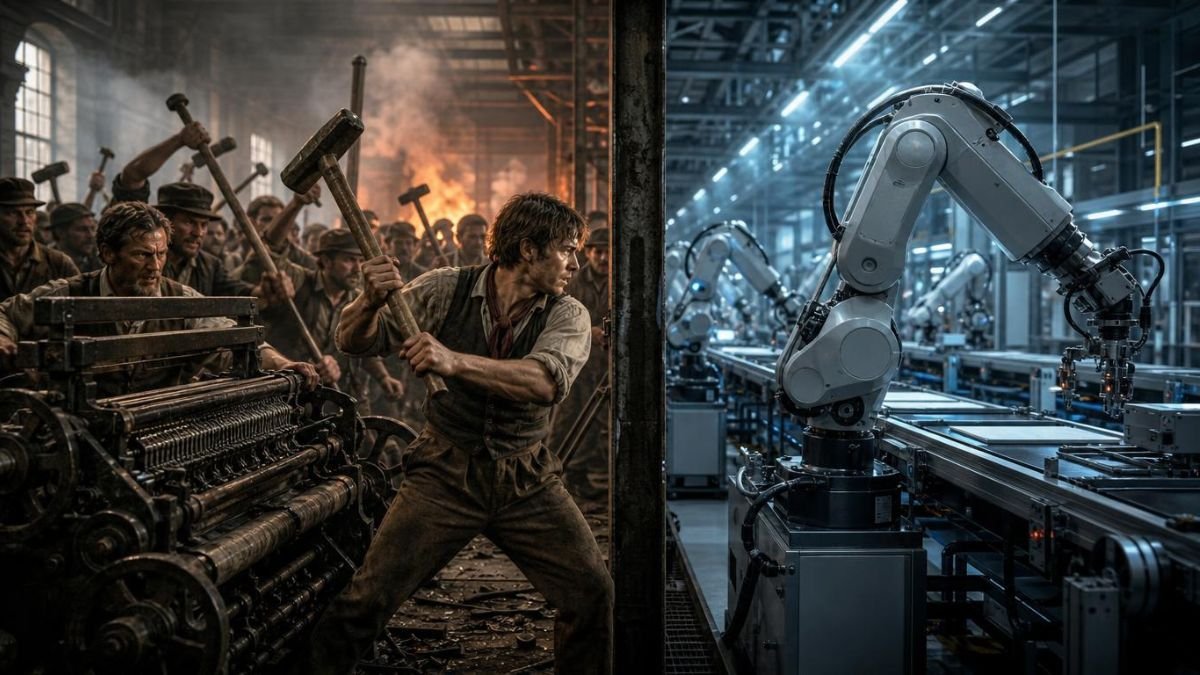
- Who the Luddites Actually Were
- What They Were Actually Fighting About
- The Empire Strikes Back
- How a Labor Movement Became an Insult
- The Mirror: Why This Is Suddenly Everyone's Problem
- What the Luddites Actually Teach Us
- Let's Get Critical
- Fantastic Guest: Lord Byron
- The Story: The Quiet Take
- Author's Commentary
- Let's Discuss
- What Now?
- Language Focus | Vocabulary and Speaking
- Language Focus | Grammar And Writing
- Glossary
- The Quiz
Let me ask you to do something uncomfortable. Picture the last time you heard the word "Luddite." Maybe someone said it about an uncle who refuses to use a smartphone, or about a coworker who still prints her emails, or about an entire movement of people worried that artificial intelligence might hollow out their careers. Whatever the context, the word did a very specific job. It ended the argument. It said: this person is afraid of the future, and you don't have to take them seriously, because you can't argue with progress.
Here's what should bother you. That tidy little insult is built on a lie. Not a small one, either. One of the most thorough and successful pieces of myth-making in the history of the English language. The real Luddites were not technophobes. They were not cavemen swinging hammers at the dawn of a brighter tomorrow. They were among the most skilled, literate, and economically sophisticated workers of their entire era, and when they broke machines, they did it for reasons so rational, so specific, and so eerily familiar that once you understand them, you will never be able to use the word "Luddite" as a lazy insult again.
And the reason this matters right now, in your life, today, is that we are living through the exact argument the Luddites were having. Swap the word "stocking frame" for "language model" and the questions are identical. Who benefits when a machine can do what a person used to do? Who decides how that machine gets used? And when the productivity gains arrive, where exactly does the money go? The Luddites had answers. They paid for those answers with their lives. The least we can do is actually listen to what they were saying instead of the cartoon we made of them.
Who the Luddites Actually Were
Let's get the picture right, because the details are everything here. The Luddite rebellion erupted across the English Midlands and North between 1811 and 1816, in three main trades. In Nottinghamshire, the framework knitters, called stockingers, made hosiery on intricate hand-operated frames. In Yorkshire, the croppers, also called shearmen, finished woolen cloth, raising and shearing the nap with shears that could weigh forty pounds, in a job that took years to master and produced the smooth, finished surface that made English cloth valuable. In Lancashire, the cotton weavers worked the looms that clothed half the world.
These were not unskilled laborers. The cropper in particular was a kind of aristocrat of the workshop, a man whose tacit knowledge, the feel in his hands, took an apprenticeship to build and could not be written down. His trade had customs, protections, and a sense of dignity that went back generations. This is the first thing the myth erases. When you imagine a Luddite, you probably imagine someone with nothing to lose. The truth is closer to the opposite. These were people with a great deal to lose: a craft, a status, a way of life that had a name and a history and a place in the community.
The Man Who Never Existed
The movement took its name from Ned Ludd, who, as far as anyone can tell, never existed. The story went that a young apprentice named Ludd, somewhere in Leicestershire in the 1770s, smashed a couple of knitting frames in a fit of temper, and ever after, when a frame turned up broken, people would say Ned Ludd must have done it. By 1811 this shadowy figure had been promoted. He was now General Ludd, or King Ludd, and the threatening letters that mill owners received were signed in his name, often addressed as coming from Sherwood Forest, which tells you exactly which folk hero the Luddites wanted you thinking about. Robin Hood, robbing the rich, hiding in the trees, beloved by the people. This was not the branding of men who didn't understand what they were doing. This was a movement with a sense of theater, a mythology, and a public-relations instinct that any modern campaign would envy.
So already the cartoon is falling apart. Skilled, organized, literate, strategic, with a borrowed legend and a flair for the dramatic. Now let's talk about what actually made them pick up the hammers, because this is where the story stops being history and starts being a mirror.
What They Were Actually Fighting About
Here is the sentence that should reframe everything: the Luddites did not oppose machines. They opposed a specific way of using specific machines. Read that twice, because the entire myth depends on you never hearing it.
Many Luddites had worked with machinery their whole lives. The frame, the loom, the shears were their tools. What changed in the early 1800s was not the existence of machines but the arrival of a new generation of them, deployed by a new kind of owner, under new economic pressure from the Napoleonic Wars and a brutal slump. The gig mills and shearing frames that threatened the croppers could do the finishing work faster and with far less skill. And crucially, the cloth they produced was often worse. Cheaper, shoddier, what the trade contemptuously called "cut-ups." The machine wasn't necessarily better at the job. It was better at the only thing the owner cared about, which was being cheaper.
And that cheapness had a destination. The savings didn't flow to the worker, or to the customer in the form of honest goods, or to the community. They flowed up, to the owner, who could now employ a handful of unskilled hands, often children, at a fraction of the wage, bypass the apprenticeship system that had protected the trade for centuries, and pocket the difference. The mechanization of the work was not, in itself, the crime. The crime was that the gains from that mechanization were being captured entirely by the people who already held the capital, while the people who had spent their lives building the skill were thrown into displacement, poverty, and what the period bluntly called immiseration, the grinding of a once-proud worker down into a pauper.
Machinery Hurtful to Commonality
The Luddites had a phrase for the machines they targeted. They called them machinery "hurtful to commonality," meaning harmful to the common good. And notice the precision in that. Not all machinery. Hurtful machinery. They distinguished, carefully, between automation that lifted everyone and automation that enriched a few by ruining many. They would break the shearing frames in one workshop and leave the other equipment untouched. They sent warnings before they acted. They were, in the words of the great historian Eric Hobsbawm, engaged in something he called collective bargaining by riot, a tactic of the powerless in an age when they had no unions, no vote, no legal way to negotiate, and no political representation whatsoever. Breaking the machine was not a tantrum. It was the only language management had left them.
This is the part I most want you to sit with, because it dismantles the lazy version completely. The Luddites were not asking history to stop. They were asking a question that has never stopped being relevant: when a new technology arrives, who gets to decide the terms? They appealed to old laws, to royal charters protecting their trades, to a whole tradition that the historian called the moral economy, the idea that markets should serve the community and not the other way around. They wanted the gains shared. They wanted the transition managed so it didn't destroy them. They wanted, in the most basic sense, a seat at the table where their future was being decided. And the answer they got was the answer the powerful so often give. They got soldiers.
The Empire Strikes Back
The government's response tells you how dangerous the authorities found these supposedly backward, irrelevant cavemen. In 1812, Parliament passed the Frame Breaking Act, which made the destruction of machinery a capital offense. Let that sink in. Breaking a stocking frame could now get you hanged. The state was willing to kill you for damaging property, in a country that did not extend the same urgency to the workers being starved by that same property.
At the height of the unrest, the Crown deployed around twelve thousand troops to the Luddite districts, a force, as people loved to point out at the time, larger than the army the Duke of Wellington had taken to fight Napoleon in the Peninsula. Think about the math of that fear. An empire at war with the most dangerous man in Europe sent more soldiers to suppress its own weavers and croppers than to fight the French. You do not do that to people you genuinely believe are irrelevant relics. You do that to people whose argument you find threatening precisely because, somewhere, you suspect it might be right.
The repression worked the way repression usually works. There were betrayals, spies, show trials. At the York Special Commission in January 1813, men were tried in batches. Seventeen were executed, including George Mellor, a young cropper hanged for the assassination of a mill owner named William Horsfall, who had reportedly boasted that he would ride up to his saddle in Luddite blood. Others were transported to the far side of the world, shipped to Australia, which was its own kind of death, the death of never seeing your home again. The movement was crushed, the frames kept turning, the cloth got cheaper and worse, and the men who had asked to share in the future were buried, exiled, or broken.
And then came the cleverest part, the part that affects you directly even now. The winners wrote the story.
How a Labor Movement Became an Insult
This is where psychology, my own home territory, gets interesting, because what happened to the word "Luddite" over the next two centuries is a textbook case of how the powerful control a narrative. The genuine grievance, about wages and dignity and who controls the gains from technology, was quietly deleted. In its place we got a simple, flattering, and extraordinarily useful story: the Luddites were people who were afraid of progress and tried to stop it, and they failed, because you can't stop progress, and only a fool would try.
See how much work that little story does. It turns a political argument about distribution into a personality flaw about fear. It makes the worker the problem instead of the system. And most usefully of all, it makes any future objection to any future technology automatically ridiculous. Worried about how automation is being deployed? You're a Luddite. Concerned that the gains from AI might flow entirely to a handful of companies while millions face displacement? Luddite. The word becomes a scapegoat-making machine, a way to take a serious question about power and reframe it as the whining of people too dim to embrace the future. It is one of the most efficient pieces of rhetorical jujitsu ever invented, and you have almost certainly used it yourself without knowing what you were doing.
I want to be fair here, and this is where the nuance matters, because the Luddites are not simply heroes either. Some of their tactics were violent. People died, on both sides. Romanticizing them into spotless martyrs would be its own kind of myth, just a more flattering one, and we'll push hard on that later. But the choice we're usually offered, between the cartoon villain and the spotless saint, is a false one. The truth is more interesting and more useful than either. The Luddites were ordinary, skilled, desperate people making a rational argument through the only means available to them, and losing, and then being slandered by the winners for two hundred years. That's not a fairy tale. That's just history, and it happens to be happening again.
The Mirror: Why This Is Suddenly Everyone's Problem
Now we arrive at the reason you clicked. Replace the stocking frame with the algorithm and watch how perfectly the argument rhymes.
A new generation of technology has arrived, and it can do things that used to require years of human skill. The illustrator who spent a decade learning to draw, the translator who carries two languages and two cultures in her head, the paralegal, the copywriter, the customer-service agent, the coder, the radiologist. These are not unskilled people with nothing to lose. They are, like the croppers, the aristocrats of their workshops, people whose tacit knowledge took years to build. And like the croppers, they are watching a machine arrive that produces output that is often, let's be honest, worse, but cheaper. The AI-generated article with the soul sanded off. The translation that's technically passable and quietly wrong. The "good enough" that's good enough for the only person whose opinion the budget reflects.
And here is the question that should be keeping us all up at night, the Luddite question, the one we spent two hundred years training ourselves not to ask. When the productivity gains from this technology arrive, where do they go? Because the gains will be enormous. The whole pitch of automation is that it produces more value with less human labor. That value is real. The only question, the only question that has ever actually mattered, is who captures it. If it flows, as it did in 1812, entirely to those who already own the capital, while the people whose skills are displaced are told to retrain, adapt, or get out of the way of progress, then we are not living through something new. We are living through a rerun, and we already know how the powerful prefer it to end.
The Three Questions That Never Go Away
Strip away two centuries and the Luddites leave us with three questions, and I'd argue they are the only three that matter whenever a powerful new technology shows up. First, who benefits? Not in theory, not eventually, not in the aggregate, but actually, in the next five years, in real bank accounts. Second, who decides? Who sits at the table where the technology's deployment gets planned, and who gets told about it afterward? And third, what's the alternative? Because "stop all technology" is a strawman almost nobody actually holds, then and now, but "deploy this technology in a way that shares the gains and cushions the displacement" is a real, reasonable, achievable position that the myth exists specifically to make sound impossible.
Notice that none of these are questions about the machine. They are questions about power, distribution, and choice. The technology is never really the issue. The terms are the issue. The Luddites understood this with a clarity we have largely lost, and we lost it on purpose, because a population that believes technological pain is as inevitable as the weather is a population that will never think to ask who arranged the storm.
The Trap of "Learn to Code"
You've heard the modern version of the advice the croppers got. For a decade, the standard answer to anyone displaced by automation was "learn to code." Retrain. Move up the value chain. Make yourself useful to the future instead of clinging to the past. And then, with a timing so perfect it would be funny if it weren't so cruel, the new AI tools turned out to be unusually good at writing code, and the people who had dutifully retrained discovered that the rising water had simply followed them up the hill.
This is the precarity at the heart of the modern economy, the sense that no skill is safe, that the ladder you're told to climb keeps having its rungs sawed off beneath you. And the Luddites would recognize it instantly, because they were told the same thing in different words. Adapt. Move on. The advice always sounds reasonable when you're the one giving it from a comfortable distance. It sounds rather different when you're the one whose forty years of mastery just became, overnight, a quaint historical curiosity, a victim of an obsolescence that someone else chose, scheduled, and profited from.
What the Luddites Actually Teach Us
So let me be clear about what I'm not saying, because the myth is so strong it'll try to pull this whole argument back into its gravity. I am not saying stop AI. I am not saying smash your laptop. I am not even saying the Luddites were right to break machines, exactly. What I'm saying is that they were right about the thing that actually mattered, the thing we've been trained not to see: that technology is never neutral in its effects, that the question of who controls it and who profits from it is a political question and not a technical one, and that the people who tell you a painful transition is simply inevitable are very often the same people who arranged for the pain to land on you and the profit to land on them.
The Luddites lost. But they lost a fight worth having, and they were right to have it. The croppers vanished, the trade died, the cloth got worse, and the only people who remember the croppers now are historians and, for the next few minutes, you. But the question they raised never died, because it can't. It comes back with every new machine, dressed in new language, aimed at new workers, and every single time, the powerful reach for the same old word to make the question disappear. Luddite. Technophobe. Enemy of progress. Don't let them. The next time you hear it used as an insult, you'll know what it's really doing. It's not describing a fear of the future. It's smuggling away a question about the present. And that question, who benefits, who decides, what's the alternative, is yours to ask, loudly, while it still might matter.
The hammers are long gone. The argument is not. And this time, you get to be in the room.
Take This Package With You
Read this study package free below, or get the clean, ad-free PDF and EPUB, plus extra worksheets and audio, on Patreon.
Let's Get Critical
I just spent quite some time rehabilitating the Luddites, and a clean rescue story should make you suspicious, including mine. So let me turn around and kick the legs out from under my own argument, because the whole point of thinking well is to keep going after you've reached a conclusion you're pleased with.
Start with the biggest one, the thing I conveniently underplayed. The Industrial Revolution that the Luddites resisted went on to lift a staggering portion of humanity out of grinding, lifelong poverty. The cheap cloth I sneered at as "shoddy cut-ups" clothed millions of people who had previously owned, quite literally, one set of clothes. The croppers suffered terribly, and that suffering was real and unjust. But their great-grandchildren lived longer, ate better, and died less often in childhood than any croppers in history, and a meaningful part of that was built on exactly the mechanization the Luddites tried to break. If you zoom out far enough, the machine breakers were standing in front of one of the greatest reductions in human misery ever recorded, swinging a hammer at it. That doesn't make them villains. But it should complicate the halo I was busy polishing.
Now let me question my favorite move, the "the cloth was worse" argument. I used it to suggest the machines weren't even better, just cheaper. But notice whose standard I borrowed to call the cloth "worse." The croppers' standard. The skilled trade defending its monopoly. There is a much less flattering reading of the whole affair, and intellectual honesty demands I put it on the table. Skilled guilds throughout history have used "quality" and "tradition" as cover for what was really price-fixing, a way to keep their craft scarce, their wages high, and their goods expensive, at the direct expense of the poor consumer who would have been delighted with a cheaper coat that lasted a few years less. From that angle, the Luddites start to look less like noble labor pioneers and more like a privileged trade protecting its turf, and the "cut-ups" they despised look like the first affordable clothing a poor family ever got to own. I don't think that's the whole truth. But I'd be lying if I said it was none of it.
Here's another crack in my own foundation, and it's the one economists would jump on fastest. My entire AI mirror leans on the assumption that displaced work simply vanishes, that the croppers' jobs were destroyed and nothing replaced them. But the broader historical record keeps embarrassing that assumption. Every wave of automation since has triggered the same confident prediction of permanent mass unemployment, and every time, against all intuition, new kinds of work emerged that nobody had imagined. The economists have a name for the mistake I may be making. They call it the lump-of-labor fallacy, the belief that there's a fixed amount of work in the world, so that every job a machine takes is a job gone forever. If that belief were true, the automation of the last two centuries should have left us with permanent armies of the unemployed, and instead employment kept finding new forms. Maybe AI is genuinely different this time. People always say "this time is different," and they are almost always wrong, and one day they will be right, and the hard part is that you can't tell which time you're in until afterward. I leaned hard on "this time is the same as 1812." I should at least admit I can't prove it.
Then there's the violence, which I waltzed past with a quick, tasteful mention. Let me stop waltzing. The Luddites didn't only break frames. Some of them shot a man off his horse and killed him. Mill owners were threatened, terrorized, in a couple of cases murdered. I framed this as "collective bargaining by riot," which is a wonderfully sympathetic phrase, but you could swap in a much uglier one and it would fit the same facts. When does the desperate violence of the powerless become simply violence? I genuinely don't know where that line sits, and I notice I drew it generously because I'd already decided to like these people. That's exactly the kind of motivated reasoning I'm supposed to be warning you against.
And let me turn the harshest light on the move at the very center of this whole piece. I accused the powerful of replacing the real Luddites with a flattering myth. Fair enough. But am I not doing precisely the same thing in the opposite direction? I took a messy, violent, internally divided movement of specific tradesmen with specific and sometimes self-interested grievances, and I smoothed them into clear-eyed prophets of labor rights who were "right about what mattered." That's a myth too. A nicer one, a more useful one for my argument, but a myth all the same. The honest version of the Luddites is grainier than either cartoon. They were neither the fools the winners painted nor the seers I just painted. They were people, which is to say they were partly right, partly self-interested, partly noble, partly brutal, and entirely unable to see the long future that would prove them both more and less correct than they knew.
Finally, the practical hole. My three sacred questions, who benefits, who decides, what's the alternative, sound magnificent until you ask the obvious follow-up: decided how, and by whom, exactly? "Give workers a seat at the table" is a lovely phrase that conceals a thousand impossible problems. Which workers? Deciding what? With what power to enforce it? The Luddites had a clear, concrete demand, the old protections of their trade, and even that couldn't survive contact with economic reality. My modern version is vaguer and therefore safer to say and harder to actually do. I raised the right questions. I should be honest that I didn't really answer them, and that answering them is the part where everything actually gets hard.
I still believe the core of what I wrote. The myth is real, the question of who captures the gains is the question that matters, and the casual use of "Luddite" as an insult really does smuggle a serious argument out of the room. But the honest version of my case is quieter and grainier than the rousing one I'd enjoy shouting from a rooftop. The Luddites weren't a verdict. They were a question that history never finished asking, and pretending I've answered it would make me exactly the kind of confident myth-maker I spent this whole article complaining about.
Fantastic Guest: Lord Byron
A note before we begin. When you write about the Luddites, the obvious guest is a Luddite, or a historian, or an economist. I wanted none of them. I wanted the one man who stood up in the House of Lords in February of 1812, in his very first speech as a peer of the realm, and defended the frame breakers to their faces, with a wit so savage that the chamber didn't quite know whether to applaud or arrest him. George Gordon, Lord Byron. Poet, aristocrat, scandal, exile, and the most famous celebrity of his age before the word existed. He defended the workers, then fled the country that made him, and died of fever in a Greek swamp at thirty-six, fighting for someone else's revolution. If anyone can tell us what it's like to romanticize a rebellion and to see through romance at the same time, it's him. He is, as ever, beautiful, limping, and entirely too pleased with himself.
Danny: Lord Byron, thank you for coming. You've been dead two hundred years, so let me begin with the obvious. You stood in Parliament and defended men the entire establishment wanted hanged. Why on earth did a baron do that?
Byron: Because the spectacle offended my taste, and offending my taste was the gravest crime available in my world. Picture it. The cream of England, gathered in their ermine, gravely debating whether to add the breaking of a stocking frame to the list of crimes for which a man might be hanged. We already hanged men for poaching a hare. Now we proposed to hang them for damaging a machine, in a county where the living men, the makers of the machines' rivals, were dropping dead of hunger in the lanes. I asked my fellow lords a simple question. Whether there was not already blood enough upon their penal code, that more must be poured to glut it. They did not care for the question. They cared even less for the manner. I have always found that the truth is forgivable; it is the elegance of the delivery that they never pardon.
Danny: So you're telling me your great act of solidarity with the working class was, at least partly, an aesthetic objection.
Byron: My dear fellow, do not say "at least partly" as though you have caught me. Say it plainly. I found the hanging of weavers ugly, and I have devoted my whole life to the proposition that ugliness is the only sin. You moderns want your heroes to act from pure compassion, scrubbed of vanity, as if a clean motive were the only thing that counts. I acted from a tangle of pity and pride and theater and genuine rage, all at once, the way every human being who has ever done anything has acted. The weaver still kept his neck. Tell me the cleanliness of my motive mattered to him at the end of a rope.
Danny: That's a fair hit, and I walked into it. But let me press on the pride, because it's the part everyone notices about you. You defended the poor from the floor of the Lords and then, a few years later, you left England entirely and spent your remaining years on the shores of Italian lakes and Greek battlefields, living rather better than any cropper ever did. Doesn't the champagne radical have a credibility problem?
Byron: He has nothing but a credibility problem. I have never denied it and I will not start for you. Yes, I pitied the starving from a very great height, and the height was upholstered. I am the man who wrote songs for the Luddites and then dined on the proceeds of an estate I could barely keep solvent, surrounded by servants, pursued by creditors, and adored by women who should have known better. The hypocrisy is total. But here is the thing your age never grasps, in its endless hunt for the unblemished spokesman. The hypocrite who says the true thing has still said the true thing. The argument does not check the speaker's bank account before it becomes correct. You may despise me freely and agree with me anyway. Most of my friends managed it. So did most of my enemies.
Danny: I'll take the deal. Let's talk about romance, then, because you are the romance, you are practically the dictionary illustration. The argument I made in the article is that we've buried the real Luddites under a myth, the myth of the technophobe, and I tried to dig them out. But a colleague of mine, who happens to be my own conscience, pointed out that I may have just buried them under a nicer myth, the noble labor prophet. You, of all people, the great myth-maker, what do you say to that?
Byron: I say your conscience is the only honest man in this conversation, and you should pay him more. Listen to me, because this is the one subject on which I am the world's leading authority, having ruined my own life with it. I built a myth. I made myself into a figure, the brooding wanderer, the beautiful sinner, mad and bad and dangerous to know, and I did it so well that I vanished inside it, and by the end I could no longer find the ordinary, limping, frightened man underneath. That is what a myth does. It is not a lie, exactly. It is a flattering simplification that eats the truth from within. And you have done it to your weavers. You have made them clean. You have made them prophets. You have taken men who broke machines for a hundred reasons, some noble, some petty, some drunk, some merely following the man next door, and you have given them a single shining purpose they never possessed. It is beautifully done. It is also exactly the crime you accuse the other side of committing. The myth that flatters your argument is still a myth. I should know. I am one.
Danny: That is uncomfortably well aimed for a man who's been a skeleton since 1824.
Byron: Death sharpens the aim. It removes the desire to be liked, which is the great softener of all honest speech. When you no longer need anyone's good opinion, you can finally afford the truth, which is, I admit, a luxury that comes slightly too late to be of use.
Danny: Let me give you the modern half of this, because here's where it gets strange. The machines I'm writing about aren't stocking frames anymore. We've built machines that can write. They can compose music, paint pictures, draft poems. The thing you did, Byron, the thing you thought no machine could ever touch, the making of verse, there are now devices that produce it by the yard, on command, in seconds. What does the great poet say to that?
Byron: You have saved your cruelest blow for last, and I respect the craftsmanship. So the machine has climbed all the way up the hill, has it. First it took the cropper's shears, then the clerk's pen, and now it reaches for the poet's lyre. Good. I am almost glad. I spent my life insisting that poetry was a divine fire, a thing struck off the soul in agony, and I suspect I was at least half a fraud, because a great deal of verse, mine included, is mere assembly. Rhyme, meter, a stock of images, a knack. If a machine can do the assembly, then it has only proved that the assembly was never the sacred part. The question your clever device cannot answer is the one that made me bleed onto the page in the first place. Not how to arrange the words, but why a particular man, on a particular ruined night, needed to. The machine can counterfeit the poem. It cannot counterfeit the wound that demanded it. And if your age forgets the difference, you will be drowning in flawless verse and starving for a single true line, and you will not even know what you are hungry for.
Danny: That might be the best thing anyone's said to me about AI, and it came from a man who never saw a lightbulb.
Byron: We saw plenty by candlelight that you have gone blind to under all your electricity. But do not let me become wise and gentle, it does not suit me. Let me return your earlier blow, since we are roasting one another and you have been landing rather more than your share. You sit there, lamenting the machine that displaces the craftsman, and you composed your lament how, precisely? On a machine. You researched it through a machine. You will publish it on a machine, to be read by people staring into machines, and somewhere in the writing of it I would wager you reached for one of these new thinking-engines to check a date or smooth a phrase. You are the cropper and the mill owner in one skin, weeping over the loom while your foot works the treadle. At least my hypocrisy had the decency to wear good tailoring. Yours wears a glow on its face at two in the morning.
Danny: Guilty. Comprehensively, embarrassingly guilty, and I notice you enjoyed that far too much.
Byron: I have so few pleasures left. Permit me my schadenfreude; it is the warmest thing about the afterlife.
Danny: Let me ask about the violence, because in the article I rather skated over it, and my conscience caught me there too. Your weavers didn't only break frames. Some of them killed. A mill owner named Horsfall was shot dead. You loved liberty, you eventually died for it in Greece. But you were also a lord, and lords have a particular terror of the mob. Where did you actually stand when the breaking turned to blood?
Byron: On both feet, uncomfortably, which is the only honest place to stand on that ground. I will tell you a thing the romantics who quote me never want to hear. I feared the mob. I, the supposed friend of the people, felt the old aristocratic dread when I imagined the crowd with its torches, because a crowd has no face and no mercy and no second thoughts, and I had read enough of the French business to know where the torches lead. And yet. And yet I also knew who had left these men no door but the torch. You cannot strip a man of his vote, his union, his wage, his bread, and his last legal recourse, and then act astonished when he picks up a hammer, and feign that his violence arrived from nowhere, a savagery native to his class. The violence of the desperate is always answered for in the ledger of those who made them desperate. That does not make the killing of Horsfall just. It makes it owed. Those are different words, and your age, which loves to forgive or condemn and hates to do both at once, will struggle with the distinction. I lived in the distinction. It is the only place a thinking man can live.
Danny: You keep doing this thing where you refuse the clean answer. Most of my guests at least pretend to land somewhere.
Byron: Then most of your guests are flattering you. The clean answer is the myth again, do you see? It is always the myth. "The Luddites were right." "The Luddites were criminals." "Progress is good." "Progress is theft." Each of these is a frame, and you may break it as gleefully as any weaver, for they are all hurtful to commonality. The truth has corners. It catches on things. It will not slide neatly into your headline or your hashtag. I spent my life being quoted in fragments by people who wanted a clean Byron, a rebel they could wear like a brooch, and I have watched them do the same to your weavers, and they will do it to your machines, and to you. Distrust the smooth story. Especially when it is your own, and especially when it flatters you. That is my whole philosophy. I charge nothing for it, which is fortunate, as I died bankrupt.
Danny: Since you mention the smooth story flattering us, let me put one more uncomfortable mirror up. There's a version of my own argument that's just nostalgia in a nice coat. A longing for the dignified craftsman of the past that conveniently forgets how brutal, poor, and short his life actually was. Am I selling the audience a fantasy of a golden age of work that never existed?
Byron: Almost certainly, and you should examine the impulse, because it is older than you and more dangerous than it looks. Every generation believes the real, the solid, the meaningful work lived just behind it, in the time of its grandfathers, and that it alone has been cursed to live amid hollow imitations. It is a trick of the eye. The cropper did not feel like a dignified artisan in a golden age. He felt cold, and afraid, and behind on his rent. We gild the past precisely because it is safely dead and cannot contradict us, the same reason you can make a prophet of a weaver and a saint of a scoundrel like me. But I will grant you the kernel that is not nostalgia. It is not the hardness of the old work you should mourn. It is the connection between the hand and the thing, the knowing that lived in the fingers, the small daily proof that what you did could not have been done by just anyone. That was real, and it is genuinely going, and a man who has it does not always know what he has until the machine has it instead. Mourn that. Do not mourn the cold and the rent. Aim your grief precisely, or it curdles into mere complaint.
Danny: Let me ask you about a word, then, since you're a man who knows what words can do. Over the two centuries since you died, "Luddite" stopped meaning a member of a labor movement and started meaning a fool afraid of progress. You watched your own name turn into a brand while you were still alive. How does a word get weaponized like that?
Byron: Ah, now you have asked me about my one true area of expertise, which is the corruption of reputations, having had mine corrupted by experts and then improved upon the technique myself. Here is how it is done, and watch closely, because it is being done to someone this very minute, somewhere, probably to you. You take a word that contains an argument, "Luddite," which once held a whole case about wages and dignity and power, and you quietly hollow out the case and leave only the costume. Then you fill the empty costume with a single, simple, useless meaning, "one who fears the future," and you hand it around as an insult. After that, no one need ever engage the original argument again, because the word that used to carry it now carries only mockery. The genius of it is that it requires no lie. You need not say a false thing about the weavers. You need only make their name unsayable without a sneer. I have seen empires defended this way, and reputations destroyed, and I confess I deployed the trick myself on more than one rival whose only crime was boring me. Words are the cheapest weapons and the deadliest. They cost nothing and they kill for centuries.
Danny: That's bleak. Is there a defense against it?
Byron: One, and it is the dreary one. You must do the slow, unglamorous work of putting the argument back inside the word. Every time some comfortable fellow says "Luddite" and means "idiot," you must stop him and say, no, here is who they actually were, here is what they actually wanted, and watch his face fall, because you have made his easy weapon heavy again. It is tedious. It wins no crowds. It is the precise opposite of how I lived, which is why I respect it. The myth travels in an instant and the truth must walk, limping, behind it, arriving late to every party. But it arrives. Sometimes, with a stubborn enough friend carrying it, it arrives.
Danny: I want to give you a chance to surprise me, because you've been relentlessly grim about the machines. Is there any version of this where the machine is liberty's friend and not its enemy?
Byron: Of course there is, and it wounds my brand to admit it. I am supposed to brood, not to hope. But consider. I railed against the loom because of who held the whip behind it. The loom itself was innocent; it was a thing of iron, with no opinions. Had the gains from that loom been shared, had the cropper been made a partner in the cloth instead of a casualty of it, he might have worked half the hours for twice the bread and spent the rest of his days fishing, or drinking, or writing dreadful poetry to annoy men like me. The machine that ruins one man under one master could free that same man under a juster arrangement. It was never the iron. It was always the arrangement. So yes, your thinking-engines could be the greatest liberation in your history, an unburdening of all the dull and grinding labor that wastes a human life. They could also be the greatest theft. The machine does not decide which. You do, collectively, by who you permit to hold the whip. That is the most hopeful thing I will say, and I have already said too much of it; my reputation for despair is the only inheritance I have left, and you nearly talked me out of it.
Danny: Last question, and I want the poet, not the politician. If you could send one line forward, to the illustrator or the translator or the coder sitting there right now watching a machine learn to do the thing they spent a life mastering, what would you tell them?
Byron: I would tell them this, and it is the only counsel I have ever found that did not turn to ash. The machine can take the task. It cannot take the having-done-it. Whatever they have built in themselves, the discipline, the eye, the ear, the years of attention, that is theirs in a way no engine can reach, because it was never finally about the output at all. I wrote my poems and the poems left me and went into the world and became other people's, quoted wrong, carved on the brooches of strangers. The poems were never the point. The man the writing made me was the point, and no one, no king, no censor, no thinking machine, was ever able to unmake him. Tell them to build the self the work builds, and to hold that, and to let the machine have the rest. The rest was always going to be taken anyway, by death if not by the device. What you become while you do the work is the only thing you were ever permitted to keep.
Danny: Lord Byron, you walked into here a hypocrite and you're walking out having said three things truer than most living people manage in a lifetime. Thank you. Genuinely.
Byron: It is the hypocrites who say the truest things, my friend. We have stood at the necessary distance from our own ideals to see their exact shape. The consistent man is too close to his virtue to describe it. Now let me limp off before you make me sentimental, which is the one thing I have never been able to forgive in a poet, and which, naturally, I was guilty of constantly. Good night. Distrust the smooth story. And do answer your conscience's letters; he is the only correspondent in this whole affair worth the postage.
The Story: The Quiet Take
The celery had to be cold. Vera had learned that from Olin, forty years ago, in this same room, when she was younger than Diego was now and twice as sure of everything. A warm stalk went soft and the break sounded like a sigh. A cold one, snapped clean an inch from your ear, was a femur giving way under a car, was a man's whole afternoon ending, was the single worst sound in the world for exactly three frames. She kept a head of it in the little refrigerator beside the gravel trays, next to the leather gloves and the bag of cornstarch that had been, in its time, every snowfall in nineteen films.
"You don't have to come in for this part," Diego said. He was setting up the second microphone, the new one, the one that fed the box. "Marsh just needs the walk. We could do the walk without—"
"I'm here now," Vera said.
The room had not changed in the years she had owned it, which was the thing she was proudest of and the thing Marsh had circled in red. The pit ran the length of the floor: a panel of marble, a panel of old oak salvaged from a school gymnasium, a tray of pea gravel, a tray of sand, a square of frozen-sounding metal grating, and at the far end the patch of dead leaves she replenished every October from the same tree in the same park, because no two trees sounded alike and the audience would never know why one autumn felt wrong. Along the back wall hung the props, two thousand of them, the coconut shells and the rusted hinges and the cracked leather wallet and Olin's shoes, a pair of brown brogues worn to the exact shape of a dead man's feet, which Vera had never once put on and never once thrown away.
Marsh came in with two coffees and handed her one, which was how she knew the news was going to be the bad kind. He was not unkind. That was the part nobody warned you about. He was perfectly pleasant, a man her son's age in a soft gray sweater, and he believed, sincerely, that he was rescuing her.
"So the model's trained on about ninety hours now," he said. "Footsteps, cloth, impacts, the whole library. It's genuinely good, Vera. I'd love you to hear it before you decide anything."
"Decide anything," she repeated, tasting it.
"The consulting role. It's real money for a lot fewer hours. You'd review the output, flag what's off, the system learns from your notes. Honestly it's the best of both worlds." He smiled. "Your ear, none of the, you know. The physical toll."
"The toll," Vera said. Her knees were sixty-one years old and she did her best walking on them eight hours a day on six different surfaces, and she would have done it for sixty-one more if the building had let her.
Diego said, too quickly, "Should we just do the reel?"
They did the reel. Marsh queued the scene they had all been living with for a week. A man, gray, ordinary, walks out of a house he has lived in for thirty years. He has lost it, or sold it, or buried someone in it; the film never quite said, which was the whole art of the film. He comes down the front hall, stops, comes back for nothing, stands, and goes. Ninety seconds. No music. The director had been very clear there would be no music. It would all be in the feet.
Marsh played the model's version first. The footsteps were there. They were, Vera had to admit, technically immaculate: the weight distributed correctly, the hall's reverb convincing, the shift from runner to bare wood exactly where the picture changed. A machine had watched the man walk and had produced the sound a man like that would make, and it was right, every footfall was right, and it was the deadest thing she had ever heard in her life.
"It's clean," she said.
"It's clean," Marsh agreed, pleased, missing it entirely.
She didn't know how to tell him what was wrong, because the wrongness was the absence of something the machine had no reason to include. The man in the film comes back for nothing. He takes three steps toward the kitchen and stops and turns around, and the script said only "he hesitates," and the machine had rendered the hesitation as three steps and a pause, which is what hesitation is, dimensionally. But it is not what hesitation is. Vera had walked that hall a dozen times in her head and she knew that the third step had to land just slightly wrong, slightly long, because a man who has decided to leave and then doubts it does not walk like a man who is walking. He walks like a man arguing with his own legs. The machine had given the legs no argument. It had given them only the average of ten thousand other legs, and the average of a thing is precisely the place where the truth has been worn smooth.
"Let me hear what you'd do," Marsh said. "For the comparison. That's all I'm asking today. One pass, your way, so the system has the, the gold standard." He caught himself. "So we can calibrate."
So that was the day's work, then. To do the thing one last time so that the thing she did could be taken from her hands and put in the box. The croppers, she thought, though she did not know she was thinking of croppers, had at least been spared the indignity of being asked to teach the shears.
She put down the coffee. She took off her shoes.
This part she never explained, because it could not survive explaining. She stood at the head of the pit in her socks and she watched the man come down the hall on the screen and she did not think about footsteps. She thought about the last time she had left a house for good, a small house in a town she didn't go back to, and the way she had come back into the empty front room for a book she had already packed, for nothing, just to stand in it, and how her own feet had sounded to her then, too loud in the bare room, the sound of a person who no longer lived somewhere making noise in it anyway.
The picture rolled. Vera walked.
Marble to oak. The weight came down through her heel the way grief comes down, all at once and from the top. At the hall runner she shortened her stride without deciding to, because the man was slowing, because he didn't want to reach the door, and at the third step she let her foot land long and wrong, the argument in the legs, and she felt rather than heard Diego go still at the board. She stopped where the man stopped. She did not move for the length of his not-moving, and the room held a silence that had a shape, a silence that was clearly a man standing in a hall he was about to lose, and then she turned, two steps back toward a kitchen that wasn't there, toward a life that wasn't there, and stopped again, and then she walked out, and her last footfall on the oak was soft, almost nothing, the step of a man who has finally agreed to go.
When it ended nobody said clean.
Diego was looking at the meters so he wouldn't have to look at her. Marsh had set his coffee down somewhere in the middle of it and not picked it back up.
"Okay," Marsh said, and his voice had gone careful. "Okay. That's—yeah. Can we get a second take? Just a, a neutral one? Same walk, less—" He moved his hand in the air, hunting. "Less interpretation. For the baseline. The model needs the clean version to learn the, the mechanics, and then we layer the—" He stopped. He had heard himself.
"You want the one without the man in it," Vera said.
"I want the data," Marsh said, gently, and she understood that he was not a cruel person, he was only a person who had never once in his life been asked to leave a house, and so could not hear the difference between a footstep and a goodbye, and would build a machine on that deafness, and the machine would be deaf in exactly the shape of him, and the films would all be a little deafer after that, and no one would know why, the way no one knew about the leaves.
She did the neutral take. She walked the man down the hall like a metronome, even, correct, soulless, the gold standard for a thing with no gold in it, and Marsh brightened and said that's great, that's perfect, that's exactly what we need, and Diego labeled the file and did not meet her eyes.
After Marsh left, the studio was very quiet. Diego made himself busy coiling a cable that did not need coiling.
"He's not wrong that it's good money," Diego said finally. "The consulting thing. You'd be set."
"I know."
"And the model really is—I mean you heard it. Ninety percent of the time you couldn't tell."
"I know that too," Vera said. "Ninety percent is the whole problem. Nobody fights about the ninety. It's the ten you can't put in the box. It's the ten that was the entire job." She was unhooking the leather gloves from the wall, the cornstarch, the cold celery, the small ridiculous holy junk of her life, and putting them in a canvas bag, not all of it, just what fit, just what was hers.
Diego watched her. "You're not coming back."
"I'm seventy if I'm a day," she said, which wasn't true, but it ended the sentence. She lifted Olin's brogues off their nail. She had never worn them. She held them a moment and then she set them, carefully, on the board in front of Diego, toes pointing at him, the way you'd hand someone a key.
"He used to say the feet know things the head argues with," she said. "I never knew what he meant for about ten years. You've got maybe a year before they sell the leases and put a box in this room. Learn what you can off me before then. The box can have the ninety. Somebody should still know the ten. Even if nobody's paying for it. Especially then."
Diego looked at the shoes. "I don't even know what to do with these."
"Nothing," Vera said. "That's the point of them. You keep the thing the machine can't use, so you remember there was one." She picked up the canvas bag, and it was lighter than forty years should weigh, and she walked toward the door across the oak panel she had walked ten thousand times.
And here is the thing Diego would think about for the rest of his career, long after the room held a box and the box held a version of her that was right ninety percent of the time. He had spent five years recording her feet. He knew her walk the way you know a voice on the phone. And as she crossed the oak that last time, in her own shoes, carrying her own things, not performing anything, not a man in a film, just a woman going home, her footsteps on the wood were the truest sound he had ever heard come off that floor, and there was not a microphone in the world pointed at them, and there never would be again.
The door closed. The room kept the silence the way the leaves kept October. Diego sat for a long time with a dead man's shoes in his hands, listening to a quiet that no model would ever be trained on, learning, too late and just in time, the difference between a sound and the reason for it.
Author's Commentary
Let me pull up a chair and tell you what I was actually doing in there, because a story keeps its secrets better than an essay and I'd like you to have a few of mine.
The first decision, and the one everything hung on, was to pick a craft you'd probably never thought about. I could have written about a translator, a coder, an illustrator, the usual suspects in any conversation about AI and work. But the moment you name one of those, the reader's brain files the story under "ah, this is the AI-takes-jobs story," and starts nodding along to a thesis instead of living inside a person. Foley artistry, the art of making a film's everyday sounds with physical props, is invisible enough that most people don't know it's a job at all. That invisibility was the whole point. I wanted you to fall in love with a craft a little before you realized you were being shown its funeral. The croppers were invisible to us too, until this article. I wanted to give you the experience of that, not the explanation of it.
The cold celery is real, by the way. Foley artists really do snap chilled celery and romaine for the sound of breaking bones, and a warm stalk really does go soft and useless. I led with that detail because it does a quiet job: it tells you, before any argument, that this work contains knowledge you cannot get from a manual, knowledge that lives in the hands and the years. That is the thing the whole Luddite story turns on, the tacit skill of the artisan, and I never wanted to say the word "tacit" in the story. I wanted you to feel it in a refrigerated vegetable.
I thought hardest about Marsh, the man bringing in the machine. The lazy version of this story makes him a villain, a suit rubbing his hands. I made him kind. I made him her son's age, in a soft sweater, sincerely convinced he's rescuing her from "the physical toll." That was deliberate, and it's the most important choice in the piece. The myth we inherited about the Luddites needs a villain twirling a mustache, and real history almost never provides one. The mill owners mostly believed in progress. Marsh believes in progress. The damage doesn't require a bad man; it only requires a man who cannot hear a particular frequency, who genuinely cannot tell a footstep from a goodbye, and who is nonetheless the one holding the budget. When he reaches for the word "sentimental," and later when the narrator imagines him calling things "nostalgic," that's the modern version of the sneer the whole article is about. Nobody in the room ever says "Luddite." They don't have to. The word does its work now in softer disguises.
The hinge of the story is the moment Marsh asks for a "neutral" take, a version of the walk with "less interpretation," so the machine can learn the mechanics. I thought about that beat for a long time because it's where the Luddite mirror clicks fully into place without ever announcing itself. The croppers were never asked to train the shearing frames; they were simply replaced. Vera's indignity is more modern and more intimate. She is asked to perform her art one last time precisely so that her art can be extracted from her body and installed in a box. That's the part of our moment the nineteenth century didn't have a name for: the worker invited, politely, to be the raw material of her own obsolescence. I wanted that to land as a feeling in your stomach, not a point on a slide.
And the thing she does about it is the thing I'm proudest of, because it isn't resistance in any heroic sense. She doesn't smash the machine. There's your Luddite expectation, quietly refused. She does the neutral take. She complies. And then she takes one object off the wall, Olin's shoes, the pair she never wore and never threw away, and she hands them to the young man not as a tool but explicitly as a useless thing, "you keep the thing the machine can't use, so you remember there was one." That's my actual argument about this entire historical moment, smuggled into a gesture. The resistance that's available to most of us isn't breaking the future. It's refusing to let the meaning be forgotten. It's keeping the ten percent alive even when nobody will pay for it. Especially then.
The "ninety and the ten" runs through the story as its real spine. Ninety percent of the time, Vera admits, you can't tell the machine from the human, and she says that's the whole problem, because nobody fights about the ninety, and the ten you can't put in the box was the entire job. I believe that's true far beyond foley. The danger of "good enough" automation isn't that it's bad. It's that it's good enough to make the missing ten percent invisible, and the missing ten percent is usually where the meaning was. I didn't want to argue that. I wanted you to hear a dead, immaculate footstep and then a living, wrong one, and feel the difference yourself.
The title, "The Quiet Take," points two ways, which is the only kind of title I trust. There's the literal quiet take she records, and there's the quiet way she leaves, and underneath both there's the question of what a "take" even is, a thing taken, a thing performed, a thing extracted. And the last image, her own real footsteps crossing the floor with no microphone pointed at them, the truest sound in the building, witnessed by one person and recorded by nothing, is the emotional argument of the whole package in a single picture. Some things are real precisely because they can't be captured. The machine gets the output. What it never gets is the reason. Byron said almost the same thing to me in the interview, that the engine can counterfeit the poem but not the wound that demanded it, and I'll confess I wrote the story and the interview in conversation with each other, each trying to say the unsayable thing the other couldn't quite reach. Whether either of them got there is, fittingly, the ten percent I can't put in a box.
Let's Discuss
Here's the thing nobody tells you about learning: you don't really own an idea until you've argued about it out loud with another human being who pushes back. Reading is input. Discussion is where it becomes yours, where your English stops being a thing you study and starts being a thing you think in. So take these five questions into the comments, to a friend, to a colleague who disagrees with you, and use them. The goal isn't to be right. The goal is to be changed a little, and to change someone else.
Question One
We use "Luddite" as an insult meaning "afraid of technology." Now that you know the real history, is it fair to keep using the word that way, or does every casual use quietly bury a serious argument? Try this: before you answer, listen for the word in the wild this week, on the news, from a friend, and notice exactly what job it's doing in the sentence. Bring back a real example. Discussing concrete cases beats trading abstractions every time.
Question Two
The article insists "it's not the tool, it's the terms," that the real question is always who controls a technology and who profits from it. But push on that. Are there technologies where the tool itself is the problem, regardless of who owns it? Where's the line? Use a specific example to test the article's claim rather than accepting it. If you can find one case the article's neat formula doesn't fit, you've understood it better than if you just agreed.
Question Three
The critical section raised an uncomfortable possibility: that the croppers' complaint about "shoddy" machine cloth was partly a skilled guild protecting its monopoly and its high prices against poor consumers who finally got affordable goods. So who do you side with, the displaced artisan or the family that could finally afford a coat? Notice that this is the AI question too. When you defend the illustrator against the image generator, are you also, quietly, defending higher prices against people who could never afford an illustrator anyway? Allow yourself to contemplate that discomfort before you resolve it.
Question Four
Byron argued that the machine can take the task but never the having-done-it, that what the work builds inside you is the only thing no machine can reach. That's beautiful. Is it true, or is it a comforting thing successful people tell themselves while their income disappears? Test it against a real person's situation, maybe your own. Does "you still have what the work made you" pay rent? Where is it genuinely consoling, and where is it just a nicer way of saying "tough luck"?
Question Five
If you accept that some displacement from AI is coming, what would a fair transition actually look like, concretely? The article kept demanding workers get "a seat at the table" and then admitted it never said which table, which workers, or with what power. So you say it. Propose one specific, real mechanism, a policy, a practice, a rule, and then let someone else attack it. Vague agreement is easy and useless. The conversation only gets valuable at the level of "okay, but how, exactly," which is precisely where the article chickened out and you don't have to.
What Now?
We've taken the Luddites apart and put them back together, argued with ourselves, and let a dead poet roast everyone. Now let's turn all of it into something you can actually use, because an idea you don't act on evaporates by Thursday.
A Balanced Framework: The Three Questions and the Two Habits
Here's a framework that doesn't ask you to either worship technology or smash it, both of which are myths anyway. When any powerful new tool lands in your life or your work, run it through three questions and two habits.
The three questions are the Luddites' own, dragged into the present. Who benefits, actually and soon, not in some glowing aggregate but in real terms over the next few years, from this tool being deployed the way it's being deployed? Who decides how it gets used, and are the people affected anywhere near that decision or just informed of it afterward? And what's the alternative, not the fantasy of stopping everything, but the realistic option of deploying it on terms that share the gains and cushion the harm? If you can answer those three honestly about any technology touching your life, you're already thinking more clearly than most of the people selling it.
The two habits keep you honest. First, find the ten percent. For any task being automated around you, ask what the irreplaceable ten percent is, the interpretation, the judgment, the meaning that the machine renders as a smooth average. Then make that ten percent your specialty, because that's where durable human value is hiding. Second, distrust the smooth story, Byron's parting gift. When someone hands you a clean narrative, "this is just progress," "you can't fight the future," "they're only afraid of change," assume a real argument has been quietly removed from the room, and go looking for it. Balance isn't sitting on the fence. It's refusing both cartoons and doing the harder work of seeing the grainy truth.
The Seven-Day Action Plan
This works whether you're a student, a professional, a parent, or someone between chapters. Small daily moves, building toward clarity.
Day one, audit your own ten percent. Write down the thing you do, study or work or care for, and name the part of it a machine could plausibly do "good enough" and the part it couldn't. Be brutally specific. That second list is your real asset. Most people have never written it down once.
Day two, catch the word in the wild. Spend the day listening for "Luddite," "progress," "disruption," "inevitable," or "just sentimental." When you hear one used to end an argument, pause and silently reconstruct the argument it ended. You're training an ear, the way Vera trained hers.
Day three, talk to someone older about a vanished job. A relative, a neighbor, a stranger if you're brave. Ask what work used to exist that doesn't now, and what was lost and gained when it went. You'll get the Luddite story in miniature, in a real human voice, and it will stick better than any article.
Day four, use the new tool on purpose, with your eyes open. Pick up the AI tool in your field, the one you've been avoiding or leaning on, and use it deliberately for one task. Notice exactly where it's genuinely useful and exactly where the ten percent goes missing. Informed is stronger than for or against.
Day five, find out where the gains go. In your own workplace or industry, ask the uncomfortable question: when this tool saves money, where does the saving actually land? Wages? Prices? Profits? You may not get a clean answer. Asking is the point.
Day six, build one thing the machine can't extract. Make something, write, cook, repair, play, teach, that produces no data and no product anyone could sell, purely for the having-done-it. Reconnect with the part of work that was never about the output. This is your antidote to precarity, and it's free.
Day seven, write your seat-at-the-table proposal. One paragraph. If you could set one concrete term for how AI gets used in your field, fairly, what would it be? Specific enough that someone could argue with it. Then find that someone. You've now done the thing the article admitted it didn't: you've moved from "who decides" to "here's how." That's where everything that matters actually happens.
Language Focus | Vocabulary and Speaking
Word Power
Let's slow down and pocket some of the language that did the heavy lifting in this piece, because these are not decorative words. They're the kind of vocabulary that makes you sound like you actually think for a living, and most of them will serve you far beyond this one topic. We'll take ten of them, and I'll show you not just what they mean but how they behave in the wild, which is the part dictionaries always leave out.
Start with obsolescence, a word that sounds expensive and is. It means the state of being out of date, no longer used or useful, replaced by something newer. In the article, the cropper's forty years of mastery became "a quaint historical curiosity, a victim of an obsolescence that someone else chose." Notice that nuance, because it's the whole game: obsolescence sounds like a natural process, like rust, but it is very often a decision somebody made and profited from. You'll meet it most in the phrase "planned obsolescence," the practice of designing products to die so you'll buy another. Use it whenever you want to point out that something has been made out of date, not simply gone out of date. In French this is obsolescence, in Spanish obsolescencia, in Italian obsolescenza, and in Arabic it's تقادم (taqādum).
Next, automation, the big one, the word the whole anxiety orbits. It means the use of machines or systems to do work that people used to do, with little or no human involvement. The article warns that "the whole pitch of automation is that it produces more value with less human labor." Here's the usage tip most people miss: automation is morally neutral as a word, but it almost never arrives in a neutral sentence. Listen for what verb sits next to it. Automation "frees" us, or automation "threatens" us, and the verb tells you the speaker's politics before they do. In French, automatisation; in Spanish, automatización; in Italian, automazione; and in Arabic, أتمتة (atmatah).
Then there's artisan, a lovely warm word that has been quietly upgraded in your lifetime. Traditionally it means a skilled worker who makes things by hand, the cropper, the weaver, the potter. But marketing has gotten hold of it, so now your supermarket sells "artisan bread," borrowing the word's glow of handcraft and care to sell you something a machine probably made. Use the real meaning when you want to honor skill, and use the marketing meaning, with a raised eyebrow, when you want to mock how that honor gets sold. French: artisan. Spanish: artesano. Italian: artigiano. Arabic: حِرَفِيّ (ḥirafī).
Now displacement, which is the polite, clinical word for a brutal thing. It means being moved or pushed out of your place, and in the economic sense, being pushed out of your job by something else, a machine, a cheaper worker, a new method. The article speaks of workers "thrown into displacement, poverty." The reason to love this word is precisely that it's clinical: it lets you name the phenomenon coolly while everyone notices how cold the coolness is. In French, déplacement; in Spanish, desplazamiento; in Italian, spostamento; in Arabic, إزاحة (izāḥa).
Here's a fun one with a contested history: sabotage. It means the deliberate destruction or obstruction of something, especially as a form of protest or to gain an advantage. There's a charming folk story that it comes from French workers throwing their wooden shoes, sabots, into machinery, and I used the word in the article precisely because that origin story is probably a myth, which makes it the perfect word for a piece about myths. The real lesson is to enjoy a good etymology but to verify it, because the most delicious word histories are often invented. French: sabotage. Spanish: sabotaje. Italian: sabotaggio. Arabic: تخريب (takhrīb).
Now a showpiece word, immiseration, which you will almost never hear in casual speech and which will make people sit up when you deploy it correctly. It means the process of making someone progressively poorer and more wretched. The article describes "the grinding of a once-proud worker down into a pauper." That grinding-down is immiseration. It's a heavy, deliberate word, so save it for when you mean it, when you want to insist that poverty was done to people, not simply suffered by them. French: paupérisation. Spanish: empobrecimiento, or the sharper pauperización. Italian: immiserimento. Arabic: إفقار (ifqār).
You already know scapegoat, but let's sharpen it, because it's one of the most useful words in any language. A scapegoat is a person or group unfairly blamed for a problem in order to spare the real cause. I argued that the word "Luddite" became "a scapegoat-making machine," turning the worker into the problem instead of the system. The trick to using it well is to point not at the blame but at the function of the blame, what the scapegoating achieves, who it protects. French: bouc émissaire. Spanish: chivo expiatorio. Italian: capro espiatorio. Arabic: كبش فداء (kabsh fidāʾ).
Then mechanization, the slightly older cousin of automation. It means replacing human or animal labor with machines. The article distinguishes carefully: "the mechanization of the work was not, in itself, the crime." Use mechanization when you're talking about the older, physical, industrial wave of machines, and automation when you mean the newer, often digital wave. Keeping them distinct makes you sound precise. French: mécanisation. Spanish: mecanización. Italian: meccanizzazione. Arabic: مَكْنَنة (maknanah).
Now the word that names our whole era, precarity. It means the condition of being insecure, unstable, without reliable work or income, of living perpetually on the edge. The article calls it "the sense that no skill is safe, that the ladder you're told to climb keeps having its rungs sawed off beneath you." It's the noun behind the adjective "precarious," and it has become a defining word for modern work. Use it when you want to name not a single hardship but a permanent state of insecurity. French: précarité. Spanish: precariedad. Italian: precarietà. Arabic: هَشَاشَة (hashāsha).
And finally, the quiet hero of the entire package, nuance. It means a subtle difference or distinction, a fine shade of meaning that a blunt view misses. I begged you to notice "where the nuance matters," and Byron built his whole philosophy on it: "the truth has corners. It catches on things." To have nuance, or to bring nuance, is to refuse the cartoon, to hold two true things at once. It is, honestly, the single most valuable intellectual habit there is, and the word for it should live on the tip of your tongue. French: nuance. Spanish: matiz. Italian: sfumatura. Arabic: فَارِق دَقِيق (fāriq daqīq).
Guided Vocabulary Builder
Now let's make these yours, because recognizing a word on a page and reaching for it in a real sentence are two completely different skills, and only the second one counts. We're going to walk through some situations. Each time, I'll set a scene, point you toward one of our words, and then I want you to actually stop and build the sentence before you read on. Don't skip the stopping. The stopping is the entire exercise.
Picture this. Your phone is two years old, it's slowing down, and the company has just released an update that mysteriously makes it slower. You're complaining to a friend, and you want to name what's happening, the suspicion that this slowdown was designed. Which of our words captures that the phone has been deliberately made out of date? Stop and say the sentence out loud. …
You reached for obsolescence, and ideally for "planned obsolescence," something like, "This is just planned obsolescence, they want me to buy the new model." Good. Now flip it to something positive: use the word about a skill, not a gadget. How would you say that learning a language protects you against your skills becoming obsolete? Stop and try. ... Maybe, "Learning languages is one skill that never falls into obsolescence." Feel how the word stretches.
Here's another. You're in a meeting, and your manager announces that a new system will "handle" half of the team's routine tasks starting next month. You want to describe what's happening to the team without sounding hysterical, naming the cool fact and letting its coldness speak. Which word? Stop and build it. …
You wanted displacement, something like, "So we're looking at the displacement of about half our roles." Notice how much more serious that sounds than "people losing jobs," and how much harder it is to wave away. Now use the related idea about yourself in a sentence about job insecurity in general. What word names the feeling that nothing is stable? Stop. ... Precarity. "There's a real sense of precarity in this whole industry right now." You've just upgraded "everything feels unstable" into something an economist would nod at.
Let's do a trickier one. You're discussing a political scandal where a junior employee got fired and blamed for a decision that clearly came from the top. You want to name the maneuver precisely. Which word, and how would you frame it to point at the function of the blame? Stop and say it. …
Scapegoat, ideally as a verb: "They scapegoated the intern to protect the executives who actually made the call." That little phrase "to protect" is the sophisticated part, because it shows you understand what the scapegoating was for. Try one more with it, about history, about the Luddites themselves. Stop. ... Perhaps, "The word itself was used to scapegoat workers for the failures of the system."
Now a gentler scene. You're praising a small bakery, a real one, where a person actually shapes the loaves by hand at five in the morning. You want a word that honors that skill and gently contrasts it with the mass-produced stuff. Stop and build. …
Artisan. "You can taste that it's made by an actual artisan, not a factory." And here's your challenge, the one I want you to sit with: use the same word sarcastically, the marketing way. Stop. ... Something like, "Oh, it's artisan all right, artisan-made in a factory in three states." Same word, opposite tone. That control is real fluency.
One last build, and I want the hardest word for it, because if you can wield this one you can wield anything. You're in a heated argument where everyone is picking a side, the technology is all good or all bad, and you want to insist that the truth is more complicated, that both sides hold a piece of it. Which word names what the conversation is missing? Stop and say the whole sentence. …
Nuance. "I think we're losing all the nuance here, it's not all good or all bad, it's about who controls it." If you can drop that into a real argument and mean it, you don't just know the word. You've absorbed the entire point of this article into a single sentence, which is exactly where vocabulary is supposed to end up.
Speaking Challenge
Here's your mission, and I want you to actually do it, not just nod at it. Find one person this week and have a real, out-loud conversation about whether AI is more like a threat or a tool, and make yourself use at least five of our ten words: obsolescence, automation, artisan, displacement, sabotage, immiseration, scapegoat, mechanization, precarity, nuance. Not all crammed into one sentence like a hostage situation. Woven in naturally, where they fit.
A few tips to make it land. First, signpost your nuance out loud, literally say "there's a nuance here," because it buys you time and signals that you're about to say something more careful than a slogan. Second, when you reach for a heavy word like immiseration or precarity, slow down slightly around it; native speakers naturally give big words a little runway, and rushing them is what makes them sound bolted-on. Third, use the question structure from the article as your spine: "who benefits, who decides, what's the alternative." Those three questions can carry an entire conversation, and they make you sound like you're thinking rather than reciting.
If you freeze, that's not failure, that's the exact moment learning happens, the place where you reach for a word and have to build it under pressure. The croppers had tacit knowledge in their hands; you're building tacit knowledge in your mouth, and the only way to build it is to use it before you feel ready. So don't wait to feel ready. Pick your person, pick your five words, and go be slightly too sophisticated at dinner. Worst case, you teach someone what "immiseration" means. There are worse things to be known for.
Language Focus | Grammar And Writing
Here's your challenge. Write an argumentative essay of roughly five hundred to seven hundred words answering this question: Is comparing today's AI anxiety to the Luddite rebellion illuminating or misleading? Don't just pick a side and cheer for it. Build a real case that takes the strongest version of the opposing view seriously and then explains why you still land where you land. In other words, do the thing this whole package has been modeling: argue with nuance, concede what's true on the other side, and earn your conclusion instead of declaring it.
That kind of essay lives or dies on a few specific grammar structures, so let's turn the challenge into a lesson and arm you properly.
The first and most important tool is the language of concession and contrast, because a nuanced argument is essentially a controlled series of "yes, but" moves. You concede a point to your opponent, then pivot. The words that do the conceding are although, while, granted, admittedly, it's true that, and even though. The words that do the pivoting are however, yet, nonetheless, still, and that said. Watch how they pair: "Although the Luddites did sometimes turn to violence, their underlying argument was economic, not technophobic." Or, "Granted, every past automation panic proved overblown; nonetheless, the speed of this transition may be genuinely different." Master that yes-but rhythm and your writing instantly sounds fairer and smarter, because it shows you've actually looked at the other side instead of pretending it doesn't exist. A tip: don't start more than one sentence in a row with the same concession word, or the rhythm turns into a tic. Rotate them.
The second tool is hedging, the careful, qualified language that separates a thoughtful writer from a shouting one. English gives you a whole toolkit of softeners: may, might, could, tends to, often, in many cases, arguably, it seems, this suggests. Compare "AI will destroy these jobs" with "AI may displace a significant share of these roles." The second isn't weaker; it's more credible, because it claims only what you can actually defend. This matters enormously in this particular topic, where the honest position includes real uncertainty about whether "this time is different." Hedge your predictions and assert your principles, and you'll never overreach. One caution: don't hedge everything, or you'll sound like you believe nothing. Hedge the predictions, commit to the values.
The third tool is the conditional, and specifically the counterfactual conditional, which is the secret weapon of historical argument. When you want to imagine how things might have gone differently, you reach for the third conditional and its mixed forms: "If the gains had been shared, the croppers might not have rebelled." "Had the transition been managed, fewer lives would have been ruined." Notice that elegant inversion, "Had the transition been managed," which drops the "if" and sounds wonderfully formal and confident. Counterfactuals let you argue about causes and alternatives, which is exactly what an essay about "what should have happened" requires. Use them to show that outcomes weren't inevitable, that choices existed, because that's the beating heart of the Luddite argument and yours.
The fourth tool is the comparison structure, since your whole essay is built on an analogy and you'll need to handle analogies with precision. Learn these frames: "Just as the Luddites faced X, today's workers face Y." "In the same way that..., so too..." "The parallel breaks down, however, when we consider..." That last one is gold, because a sophisticated analogy essay doesn't just assert that two things are alike; it specifies exactly where the comparison holds and exactly where it snaps. Showing where your own analogy fails is the single most persuasive move available to you, because it proves you're not in love with your own cleverness.
The fifth tool is subtler: nominalization, the trick of turning verbs and adjectives into abstract nouns. "Workers were displaced" becomes "the displacement of workers." "Machines were introduced" becomes "mechanization." "People grew poorer" becomes "immiseration." Academic and analytical English leans heavily on these noun forms because they let you treat a whole process as a single thing you can then discuss. Our vocabulary list is full of them on purpose. A word of caution, though, the kind good writing teachers always give: nominalization in heavy doses makes prose cold and lifeless, a fog of abstract nouns with no human being doing anything. The best analytical writing alternates, a clear human sentence, then an abstract one, so the reader feels both the person and the pattern. Use nominalization to sound precise, then break it with a plain, concrete sentence to sound alive.
Now assemble it. Open with a clear position, your thesis, ideally one that admits the question is genuinely hard. Build body paragraphs that each make one point, concede the counterpoint with your yes-but structures, and pivot. Use hedging when you predict and conditionals when you imagine alternatives. Deploy your comparison frames to show where the Luddite analogy illuminates and where it misleads, because the strongest answer to "illuminating or misleading" is probably "both, and here's exactly which parts are which." Close not with a triumphant slogan but with an earned, slightly uncertain conclusion, because by now you know that the smooth story is the one to distrust, including your own. Write the corners in. Let the truth catch on things. That's not just good grammar. That's the whole point.
Glossary
Thirty words and ideas worth carrying out of here. I'll tell you what each means, where it lives in our story, and how to put it to work in your own sentences.
Luddite: Originally a member of the 1811-1816 movement of skilled workers who broke machines in protest; now a lazy insult meaning someone who fears technology. The whole article is an argument about how the first meaning got buried under the second. Use it carefully now that you know the difference, and feel free to correct people who use it as a slur.
Obsolescence: The state of being out of date and no longer useful. The cropper's skill fell into an "obsolescence that someone else chose." Use it, especially as "planned obsolescence," whenever something has been made outdated rather than simply growing old.
Automation: The use of machines or systems to do work people used to do. It sits at the center of the modern anxiety. Watch the verb beside it, "frees" or "threatens," to hear the speaker's stance, and use it the same way to signal yours.
Artisan: A skilled worker who makes things by hand. The Luddites were artisans, the aristocrats of their workshops. Use it sincerely to honor craft, or with a knowing smile to mock how "artisan" now sells factory bread.
Displacement: Being pushed out of your place or your job by something else. The clinical coolness of the word is exactly why it lands; it lets you name a brutal thing calmly. Use it when "losing jobs" feels too small for what's happening.
Sabotage: Deliberate destruction or obstruction, often as protest. Its wooden-shoe origin story is probably a myth, which made it the perfect word for a piece about myths. Use it for intentional damage, and enjoy its colorful, dubious history responsibly.
Immiseration: The process of making someone progressively poorer and more wretched. It insists that poverty was done to people, not merely suffered by them. A heavy, deliberate word; save it for when you mean exactly that.
Scapegoat: A person or group unfairly blamed to spare the real cause. The word "Luddite" became a scapegoat-making machine. Use it, ideally as a verb with "to protect," to point at what the blame is actually shielding.
Mechanization: Replacing human or animal labor with machines, especially in the older industrial sense. The article notes mechanization itself "was not the crime." Use it for the physical machine age and "automation" for the digital one to sound precise.
Precarity: The condition of permanent insecurity, unstable work, unreliable income, life on the edge. It names not one hardship but a whole state of being. Use it when you mean more than "stress," when you mean structural instability.
Nuance: A subtle distinction or fine shade of meaning. Byron's "the truth has corners" is a hymn to it. To bring nuance is to hold two true things at once; it may be the most valuable intellectual habit there is, so keep the word handy.
Cropper: A skilled finisher of woolen cloth in the Luddite era, who sheared the nap with forty-pound shears. Their trade was destroyed by the shearing frame. Use it as a vivid, specific example of a vanished skilled craft when you want history rather than abstraction.
Redundancy: Being let go because your role is no longer considered necessary; more broadly, being surplus to requirements. It's the bureaucratic cousin of displacement. Use it, as in "made redundant," for the polite official language of job loss, and notice how that politeness softens a hard blow.
Sedition: Speech or action that incites rebellion against authority. The state treated Luddite organizing as close to this. Use it for the crime of stirring revolt, and notice how often it's used to criminalize ordinary dissent.
Insurrection: A violent uprising against an established authority. The government feared the Luddites were edging toward one, which is why it sent twelve thousand troops. Use it for an organized revolt, a notch above a riot and below a full revolution.
Petition: A formal written request to those in power, often signed by many. Before they broke frames, many workers petitioned, lawfully, and were ignored. Use it for the peaceful, official ask that precedes, and sometimes fails to prevent, less peaceful measures.
Transportation: In this historical context, the punishment of shipping convicts overseas, often to Australia, frequently for life. Many Luddites were transported. Use it knowing it meant exile and the permanent loss of home, a quieter death than the gallows.
Deskilling: Stripping the skill out of a job by breaking it into simple tasks a machine or untrained hand can do. It's the precise mechanism behind the cropper's fall and behind much automation anxiety today. Use it to explain how a proud craft becomes a cheap, replaceable task.
Augmentation: Enhancing human ability with a tool rather than replacing the human. The hopeful version of AI, "it augments rather than replaces." Use it when you want to describe technology as a partner to human skill instead of its executioner.
Disruption: A radical shake-up that overturns an existing industry or way of doing things; also a worn-out business buzzword. It's the cheerful word the powerful use for what feels, to the displaced, like catastrophe. Use it, but notice whose side the word is standing on.
Proletariat: The working class, those who live by selling their labor rather than owning capital. The Luddites are often seen as an early stirring of proletarian consciousness. Use it for the broad class of workers, especially when contrasting labor with the owners of capital.
Subsistence: The minimum food, shelter, and income needed merely to survive. The Luddites' wages were being driven below it. Use "subsistence wages" or "subsistence living" to describe bare survival with no margin, no comfort, no security.
Guild: An association of skilled craftsmen that regulated a trade, its standards, its prices, and who could enter it. The critical section notes guilds could protect quality and protect their own monopoly. Use it for any group that controls entry to a profession, ancient or modern.
Apprenticeship: A system of learning a craft over years under a master, the traditional gateway to skilled trades. The new machines let owners bypass it, which was part of the grievance. Use it for any structured, hands-on, long-term learning of a craft, the opposite of a quick online course.
Repression: The use of force or control by authority to suppress dissent. The state's answer to the Luddites was repression: troops, spies, show trials, the gallows. Use it for the deliberate crushing of opposition, especially by those with power over those without.
Technophobia: Fear or strong dislike of technology. It's the thing the myth falsely accuses the Luddites of, and the thing the word now wrongly implies. Use it accurately, for genuine fear of tech, and resist letting it stand in for any reasonable objection to how tech is used.
Livelihood: The means by which you secure the necessities of life, your job, your income, your way of making a living. The Luddites were fighting for their livelihoods, not against machines. Use it when you want to stress that a job is not just income but the foundation of a life.
Productivity: The amount of output produced per unit of labor or input. Automation's whole promise is more productivity, and the article's whole question is who captures the resulting gains. Use it precisely, and always follow it with the real question: productive for whom, and to whose benefit.
Romanticize: To make something seem more beautiful, noble, or appealing than it really was. Both Byron and the critical section warn against romanticizing the Luddites into spotless heroes. Use it to flag when nostalgia or admiration is quietly editing out the messy truth, including your own.
Algorithm: A set of rules or steps a computer follows to solve a problem or make a decision; now shorthand for the automated systems shaping modern life. "Replace the stocking frame with the algorithm" is the article's pivot. Use it for any coded decision-procedure, and remember that an algorithm always encodes somebody's choices.
The Quiz
Thirty questions: fifteen on comprehension, fifteen on vocabulary. This is an MCQ quiz, but I want more from you than a circled letter. After each question, write one line justifying your choice. That tiny act of explaining is where the learning locks in. The full answer key, with feedback on every single option, comes after the quiz, so resist the urge to peek.
Part One — Comprehension Questions
Question 1:
According to the article, the central thing the Luddites were actually fighting about was:
A) A religious objection to all forms of progress
B) The noise and smoke the new factories produced
C) Who controlled the new machines and who profited from them
D) Their simple fear that machines were evil
Your Reasoning: ____________________
Question 2:
The figure of "Ned Ludd" or "General Ludd" was:
A) The wealthy industrialist who invented the stocking frame
B) The army general sent to crush the rebellion
C) A largely mythical figurehead in whose name the Luddites acted
D) A real labor union president of the period
Your Reasoning: ____________________
Question 3:
The croppers, highlighted in the article, were:
A) Highly skilled cloth finishers whose trade took years to master
B) Farmers who harvested wheat for the growing cities
C) Unskilled child laborers in the new factories
D) Government inspectors who licensed machines
Your Reasoning: ____________________
Question 4:
When the Luddites targeted machinery "hurtful to commonality," they meant machines that were:
A) Too expensive for owners to buy
B) Constantly breaking down
C) All machines, without any exception
D) Harmful to the common good, as opposed to those that helped everyone
Your Reasoning: ____________________
Question 5:
The Frame Breaking Act of 1812 made breaking a machine:
A) A capital offense, punishable by death
B) A minor fine
C) Entirely legal
D) Grounds for a government pension
Your Reasoning: ____________________
Question 6:
The article points out that the troops the Crown sent to the Luddite districts numbered:
A) A token force of a few hundred
B) Larger than the army Wellington had in the Peninsular War
C) Exactly equal to the number of Luddites
D) Fewer than a single regiment
Your Reasoning: ____________________
Question 7:
At the York Special Commission of 1813, George Mellor was:
A) Acquitted and later elected to Parliament
B) The presiding judge who freed the accused
C) A spy who betrayed the movement
D) Executed, in part for the murder of mill owner William Horsfall
Your Reasoning: ____________________
Question 8:
According to the article, "Luddite" became an insult mainly because:
A) The Luddites chose it themselves as a joke
B) The winners rewrote the story, deleting the real grievance and leaving only "fear of progress"
C) A dictionary error was never corrected
D) It began as a French swear word
Your Reasoning: ____________________
Question 9:
The article's "three questions that never go away" are:
A) Who benefits, who decides, and what's the alternative
B) When, where, and how
C) Cost, speed, and quality
D) Who, what, and why
Your Reasoning: ____________________
Question 10:
The "learn to code" trap refers to:
A) Coding being too hard for displaced workers to learn
B) A free government coding program
C) Workers being told to retrain, then finding AI could do the new skill too
D) Coding being banned in several countries
Your Reasoning: ____________________
Question 11:
In the Let's Get Critical section, the "lump-of-labor fallacy" is the mistaken belief that:
A) Unions are always correct
B) Machines can never replace humans
C) Workers are naturally lazy
D) There is a fixed amount of work, so every job a machine takes is gone forever
Your Reasoning: ____________________
Question 12:
One uncomfortable point the critical section raises about the "the cloth was worse" argument is that:
A) It may have been guild protectionism defending high prices against poor consumers
B) The cloth was in fact identical
C) The croppers never actually said it
D) Machine cloth was superior in every possible way
Your Reasoning: ____________________
Question 13:
In the Fantastic Guest interview, Byron says a thinking machine can counterfeit the poem but never:
A) The rhyme and the meter
B) The wound that demanded it
C) The poet's handwriting
D) The publisher's address
Your Reasoning: ____________________
Question 14:
Byron's surprising, hopeful admission about machines is captured in his line:
A) "Poetry is dead and the machine killed it"
B) "The mob is always right"
C) "It was never the iron. It was always the arrangement."
D) "Smash every last one of them"
Your Reasoning: ____________________
Question 15:
In the story "The Quiet Take," Marsh asks Vera for a "neutral" take mainly so that:
A) The director secretly prefers boring sound
B) The AI model can be trained on her performance, effectively to replace her
C) She can rest her aging knees
D) The microphone had broken earlier
Your Reasoning: ____________________
Part Two — Vocabulary Questions
Question 16:
"Planned ______ is when a product is designed to fail so you'll buy the next model." The best word is:
A) apprenticeship
B) obsolescence
C) petition
D) nuance
Your Reasoning: ____________________
Question 17:
Which sentence uses "displacement" correctly?
A) "The displacement of the dessert was delicious."
B) "She felt great displacement after winning the award."
C) "The displacement turned green in the sunlight."
D) "We're facing the displacement of thousands of workers by the new system."
Your Reasoning: ____________________
Question 18:
"Immiseration" most nearly means:
A) The process of being ground down into poverty
B) A sudden windfall of wealth
C) A minor irritation
D) A joyful public celebration
Your Reasoning: ____________________
Question 19:
If you "scapegoat" someone, you:
A) reward them generously for their work
B) teach them a valuable new trade
C) unfairly blame them to shield the real cause
D) promote them into management
Your Reasoning: ____________________
Question 20:
"Precarity" describes:
A) a stable, permanent, well-paid job
B) a state of permanent insecurity and instability
C) a kind of ancient industrial machine
D) a feeling of total confidence
Your Reasoning: ____________________
Question 21:
Choose the best word: "The debate lost all its ______ the moment everyone split into two angry camps."
A) nuance
B) automation
C) gallows
D) productivity
Your Reasoning: ____________________
Question 22:
Someone called an "artisan" is:
A) a person who fears all technology
B) a factory floor manager
C) an unemployed laborer
D) a skilled maker who works by hand and long training
Your Reasoning: ____________________
Question 23:
"Sabotage" involves:
A) carefully servicing a machine
B) deliberately damaging or obstructing something
C) purchasing newer equipment
D) writing a polite formal request
Your Reasoning: ____________________
Question 24:
The best definition of "mechanization" is:
A) the writing and publishing of poetry
B) the raising of workers' wages
C) the replacing of human labor with machines
D) the closing of an unprofitable factory
Your Reasoning: ____________________
Question 25:
"Redundancy," in the workplace sense, means:
A) losing your job because the role is judged no longer needed
B) receiving a surprise promotion
C) taking an extended paid holiday
D) earning a large annual bonus
Your Reasoning: ____________________
Question 26:
To "romanticize" the past is to:
A) describe it with cold, perfect accuracy
B) make it seem more noble or appealing than it really was
C) forget that it ever happened
D) despise absolutely everything about it
Your Reasoning: ____________________
Question 27:
An "algorithm" is best described as:
A) a coded set of steps a computer follows to decide or produce something
B) a rare type of musical instrument
C) an old French wooden shoe
D) a member of the House of Lords
Your Reasoning: ____________________
Question 28:
"Deskilling" a job means:
A) making it require far more training
B) giving the worker a generous raise
C) relocating the job overseas
D) stripping the skill out of it so simpler hands or machines can do it
Your Reasoning: ____________________
Question 29:
Which sentence uses "augmentation" in the hopeful sense from the article?
A) "He was charged with augmentation and jailed for a year."
B) "The software is pure augmentation; it boosts what a skilled human can do."
C) "The augmentation wiped out every job in the building overnight."
D) "Augmentation simply means the fear of new machines."
Your Reasoning: ____________________
Question 30:
"Subsistence" wages are wages that:
A) make you comfortably wealthy
B) are always paid in gold coin
C) barely cover the minimum needed to survive
D) come with a guaranteed yearly bonus
Your Reasoning: ____________________
Part One — Comprehension
Question 1. Correct answer: C. The whole spine of the article is that the Luddites weren't fighting the machines themselves but the terms of their use, who owned them and who pocketed the gains, so C is exactly right. A is the cartoon the article dismantles; they had no blanket religious objection to progress. B sounds plausible but the article never frames their grievance as environmental discomfort; it was economic. D is the myth in its purest form, the "afraid of machines" story the piece exists to demolish.
Question 2. Correct answer: C. Ned Ludd was a borrowed legend, a name the movement signed its letters with, sometimes "from Sherwood Forest" to summon Robin Hood. A is wrong because no single inventor named Ludd built the frame. B inverts the truth, confusing the rebels' mascot with the army that hunted them. D is an anachronism; organized unions like that didn't exist yet, which was part of the whole problem.
Question 3. Correct answer: A. Croppers were the aristocrats of the workshop, finishing woolen cloth with forty-pound shears, a skill that took years, which is the article's key point about how much they had to lose. B confuses them with agricultural workers. C is the opposite of the truth; they were the highly skilled, not the unskilled. D invents a bureaucratic role that didn't exist.
Question 4. Correct answer: D. "Hurtful to commonality" meant harmful to the common good, and the article stresses the precision of that phrase, they distinguished harmful machines from helpful ones. A and B misread it as a complaint about cost or reliability. C is the trap, the false idea that they opposed all machines, when the entire phrase exists precisely to make a distinction.
Question 5. Correct answer: A. The 1812 Act really did make machine-breaking a hanging offense, which the article uses to show how seriously, even savagely, the state took the threat. B wildly undersells it. C is the reverse of the truth. D is there for a grim laugh; the state offered the gallows, not a pension.
Question 6. Correct answer: B. The often-cited factoid is that more troops went to the Luddite counties than Wellington had in the Peninsula, and the article uses it to show how threatened the authorities felt. A and D both shrink the force to make the point disappear. C is a tidy-sounding invention with no basis.
Question 7. Correct answer: D. George Mellor was hanged at York, in part for the assassination of mill owner William Horsfall, one of the article's hardest facts and a centerpiece of the later debate about violence. A and B rewrite him into a winner or an authority figure. C confuses him with the informers who actually betrayed the movement.
Question 8. Correct answer: B. The article's psychological core is that the powerful rewrote the story, hollowing out the real economic grievance and leaving only "fear of progress." A gets the agency backward. C and D are inventions; no single dictionary slip or foreign curse did this. It was a long, useful, deliberate reframing.
Question 9. Correct answer: A. Who benefits, who decides, what's the alternative, the three questions the article calls the only ones that ever really matter. B, C, and D are generic question sets that sound reasonable but aren't what the article actually names, so watch for plausible-but-not-stated distractors.
Question 10. Correct answer: C. The trap is the cruel timing, workers told to retrain into coding, only for AI to get good at coding too, so the water followed them up the hill. A misses the irony entirely. B and D invent programs and bans the article never mentions.
Question 11. Correct answer: D. The lump-of-labor fallacy is the belief in a fixed quantity of work, which the critical section raises as a genuine challenge to the article's own argument. A, B, and C are unrelated claims dressed up to look like economics. The honesty of that section is admitting this fallacy might apply to the article itself.
Question 12. Correct answer: A. The bracing self-critique is that "the cloth was worse" might be a skilled guild protecting its monopoly and high prices at the expense of poor consumers who finally got affordable goods. B and C deny the complaint was ever made. D overcorrects into the opposite myth; the point isn't that machine cloth was perfect, it's that "worse" was a loaded, interested judgment.
Question 13. Correct answer: B. Byron's most quoted line in the interview: the machine can counterfeit the poem but not the wound that demanded it, his way of locating what's truly human in creation. A names exactly what he concedes a machine can copy. C and D are trivial misreadings that miss the metaphor entirely.
Question 14. Correct answer: C. "It was never the iron. It was always the arrangement" is Byron's surprising, hopeful pivot, the machine could free us under a juster arrangement. A and D paint him as a pure pessimist or vandal, which the interview specifically subverts. B is a line he explicitly resists; he confesses he actually feared the mob.
Question 15. Correct answer: B. The gut-punch hinge of the story is that Vera is asked to perform one last time so the model can learn to replace her, the worker made into the raw material of her own obsolescence. A misreads the director's "no music" note. C and D take Marsh's gentle excuses at face value, which is exactly the deafness the story is exposing.
Part Two — Vocabulary
Question 16. Correct answer: B. Obsolescence is being made out of date, and "planned obsolescence" is the textbook phrase for designing things to die. A is a training system, unrelated. C is a formal request. D is a subtle distinction. Only B fits both the blank and the famous collocation.
Question 17. Correct answer: D. Displacement is being pushed out of your job or place, so the workers-and-system sentence is the natural fit. A confuses it with a physics term about volume. B treats it as an emotion, which it isn't. C uses it as if it were a physical object that changes color. Context is everything here.
Question 18. Correct answer: A. Immiseration is the grinding-down into poverty, so A nails it. B is its exact opposite. C trivializes a heavy word. D is cheerfully wrong. Remember, this word insists the poverty was done to someone.
Question 19. Correct answer: C. To scapegoat is to unfairly blame someone to shield the real cause, so C is spot on. A, B, and D are all kindnesses, the opposite of what scapegoating does. The tell is "unfairly" plus "to shield."
Question 20. Correct answer: B. Precarity is permanent insecurity and instability, so B is right. A describes its opposite, security. C invents a machine. D names a feeling precarity tends to destroy. If a job is precarious, B is your word.
Question 21. Correct answer: A. Nuance is the fine shade of meaning that vanishes when people pick angry sides, so it fills the blank perfectly. B, C, and D don't fit the sense of "lost subtlety" at all. The clue is "split into two angry camps," the death of nuance.
Question 22. Correct answer: D. An artisan is a skilled hand-maker, so D is correct. A describes a technophobe. B and C name people defined by management or unemployment, not craft. The word honors skill and training, which only D captures.
Question 23. Correct answer: B. Sabotage is deliberate damage or obstruction, so B is right. A is its opposite, repair. C is purchasing. D is a peaceful letter. The key word is "deliberately."
Question 24. Correct answer: C. Mechanization is replacing human labor with machines, so C is the definition. A, B, and D describe unrelated events, poetry, raises, closures. Pair it in your mind with the industrial machine age.
Question 25. Correct answer: A. Redundancy, in the workplace sense, is losing your job because the role is deemed unnecessary, so A is right. B, C, and D are all pleasant outcomes, the opposite of being made redundant. The bureaucratic politeness of the word hides a hard blow.
Question 26. Correct answer: B. To romanticize is to make something seem nobler or lovelier than it really was, so B fits. A describes accuracy, the opposite. C is forgetting. D is contempt. Both Byron and the critical section warn against doing exactly this to the Luddites.
Question 27. Correct answer: A. An algorithm is a coded set of steps a computer follows, so A is correct. B, C, and D are deliberately absurd, an instrument, a shoe, a peer. Remember the article's pivot, "replace the stocking frame with the algorithm."
Question 28. Correct answer: D. Deskilling strips the skill out of a job so cheaper hands or machines can do it, so D is right. A is its opposite. B and C are unrelated outcomes. The mechanism is "break it into simple tasks."
Question 29. Correct answer: B. Augmentation is technology boosting human ability rather than replacing it, the hopeful sense, so B is correct. A treats it as a crime. C makes it the destroyer, the opposite of augmentation. D confuses it with technophobia. The clue is "boosts what a skilled human can do."
Question 30. Correct answer: C. Subsistence is the bare minimum needed to survive, so subsistence wages barely cover survival. A, B, and D all imply comfort or wealth, the opposite. The weavers' wages being driven below subsistence is what made the whole situation desperate.
Take This Package With You
If this package helped you, you can take it with you. Become a Companion on Patreon for $5 a month to get the clean, ad-free PDF and EPUB, along with extra worksheets, workbooks, and audio. Everything here stays free either way.






0 Comments