INTRODUCTION
You are making dinner. You are in a perfectly good mood. The kitchen smells like olive oil and garlic, the evening is peaceful, and life is, for the moment, going quite well. And then you pick up the onion.
Within thirty seconds of the first cut, your eyes are burning, your vision is a blur, and you are weeping over a vegetable in a way that feels disproportionate to the vegetable's emotional significance. The onion, for its part, is unmoved. It has no feelings about the situation. It has caused your distress not out of malice but through a biochemical defense mechanism that evolved over millions of years to deter exactly this kind of thing — being eaten.
The chemistry that explains why onion fumes make you cry is more elegant and more interesting than the experience of suffering through it suggests. It involves enzymes, sulfur compounds, volatile gases, and your eyes' defense system doing exactly what it was designed to do — reacting to a perceived chemical threat with a flood of protective moisture. The onion did not design this mechanism to be cruel. It designed it, in the evolutionary sense, to survive. That it produces one of the kitchen's most universal experiences of involuntary, undignified weeping is a side effect that the onion was not consulted about.
Today we follow the chemistry from the first cut to the last tear. This is a Why It Happens episode, which means our job is to explain a familiar phenomenon clearly and completely without losing the wonder in the mechanics. We are also doing close reading, because the language of chemical explanation — with its precision, its chains of cause and effect, its analogies and its vocabulary — is particularly rich material for building analytical English. Let's get into it, and let's try not to cry.
The Article
Why does cutting an onion make you cry when cutting a carrot does not? Both are vegetables. Both you cut with the same knife on the same board. But only one of them brings you to immediate, involuntary tears while leaving you standing in your kitchen blinking and sniffling and wondering why you chose to make French onion soup. The answer to why onion fumes make us cry is a story about evolutionary chemistry, enzymatic reactions, and your eyes doing something genuinely admirable under circumstances they were not originally designed for.
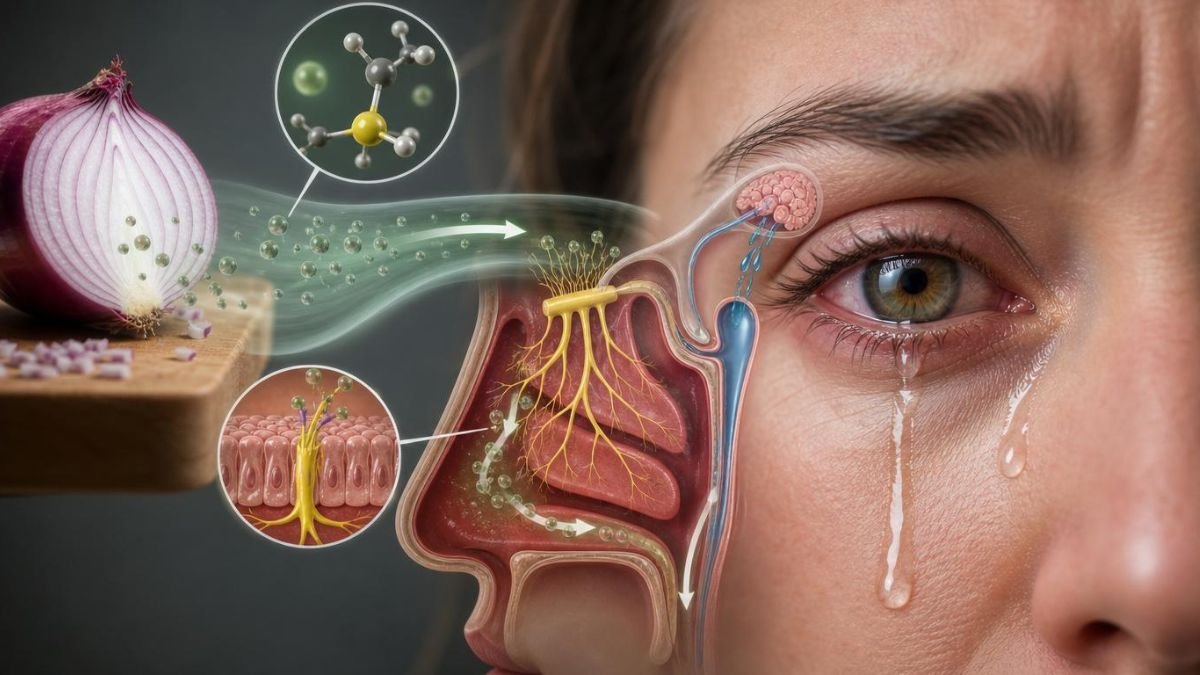
The onion's tear-inducing chemistry begins not when you buy it, store it, or peel it, but the moment you cut it — because cutting is what triggers the chemistry. An intact onion is, chemically speaking, a collection of separated components: in its cells are sulfur-containing amino acid compounds called S-alk(en)yl-L-cysteine sulfoxides, and in other compartments are enzymes called alliinases. As long as the onion is intact and the cellular compartments are intact, these two components are kept apart, like two chemicals in separate chambers of a reaction vessel. When you cut the onion — when the knife ruptures the cells — the alliinases and the sulfur compounds come into contact with each other for the first time. A rapid enzymatic reaction begins.
The alliinase enzymes catalyze the breakdown of the sulfur compounds into a variety of reactive molecules. One of these molecules is a particularly unstable and volatile compound called syn-propanethial-S-oxide — abbreviated as SPSO, and occasionally, informally, called the lachrymatory factor, from the Latin "lacrima" meaning tear. SPSO is a gas at room temperature; it evaporates from the cut surface of the onion and diffuses into the air. It is also, as you have doubtless experienced, quite enthusiastic about reaching your eyes as quickly as possible. When SPSO contacts the aqueous surface of your eye — the thin film of tear fluid that covers the cornea — it reacts with that fluid to form sulfenic acid. Sulfenic acid is an irritant. Your eyes' trigeminal nerve endings detect it, classify it as a chemical threat, and signal immediately to your lacrimal glands — the tear-producing glands above each eye — to produce more fluid to dilute and wash away the irritant. Your eyes are not overreacting. They are doing exactly what they are supposed to do when they detect a chemical irritant. The problem is that the chemical is a gas, and washing it away with tears introduces more fluid that reacts with more SPSO and produces more sulfenic acid, which triggers more tears, which require more washing — a cycle that continues until the SPSO dissipates.
This is also why cold onions produce somewhat less irritation than room-temperature ones. Temperature affects the rate of enzymatic reactions and the volatility of gases: at lower temperatures, the alliinase-catalyzed reactions proceed more slowly, and SPSO evaporates more slowly from the cut surface, giving it less time to reach your eyes before you move away or the onion is submerged in oil or liquid. The advice to refrigerate your onions before cutting is chemically valid — not dramatically effective, but genuinely based on real chemistry. The advice to cut onions under running water is also valid: running water near the cutting surface captures the SPSO before it can reach your eyes. The advice to wear goggles is the most effective solution and the most undignified one, which is probably why most home cooks choose the squinting-and-stoicism method instead.
Different onion varieties produce different amounts of SPSO — sweet onions, which have lower sulfur content, are notably less lachrymatory than yellow or brown onions. This is also why shallots and chives, which belong to the same Allium family and have the same basic chemistry, produce different intensities of the same reaction: the concentration of the sulfur precursor compounds varies across the family, producing the different intensities of eye-watering you experience with different Allium species.
The deeper question — why does the onion produce this chemistry at all? — has an evolutionary answer. The sulfur compounds in onions serve multiple purposes: they contribute to the characteristic flavor and aroma that, somewhat counterintuitively, makes the onion attractive to cooks; they have antimicrobial properties that protect the onion from certain bacterial and fungal pathogens; and, most relevantly here, they deter herbivores. A deer, a rabbit, or an insect that starts eating an onion encounters the SPSO reaction and receives an irritating, aversive chemical signal that discourages continued feeding. The lachrymatory factor is, in evolutionary terms, the onion's chemical alarm system. Humans, with our extraordinary tolerance for aversive flavors that come with culinary rewards, have simply decided to power through it — armed with sharp knives and the knowledge that the soup will be worth it.
The fact that we can explain the chemistry completely does not stop it from being annoying. But understanding what is happening — knowing that the burning in your eyes is SPSO reacting with your tear film to produce sulfenic acid, and that your tears are a sensible protective response to a real chemical irritant — does change the quality of the experience slightly. It transforms an apparently irrational assault by a vegetable into an entirely rational chemical interaction in which both you and the onion are behaving exactly as biology and chemistry require. The onion is not your enemy. It is just doing what millions of years of evolution designed it to do. You happen to be in the way.
Does knowing why onions make you cry change how you feel about the experience — or does your nervous system simply not care about the explanation and start watering your eyes anyway? And is there something almost respectful, in hindsight, about a vegetable that has been fighting back against being eaten for millions of years with such effective chemical ingenuity?
Close Reading Analysis
Paragraph 1: "Why does cutting an onion make you cry when cutting a carrot does not?"
Question: the article opens by comparing the onion to a carrot — both vegetables, both cut the same way, only one causing tears. What is the analytical function of this comparison, and why is this specific comparison better than simply asking "why do onions make you cry?"
The comparison with a carrot is a controlled contrast: it isolates the variable responsible for the phenomenon by holding all other conditions constant. Both are vegetables, both are cut with the same knife, both are handled in the same way — but only one causes crying. This immediately focuses the investigative question: it is not about cutting vegetables in general, not about knives, not about the act of preparing food — it is specifically about something in the onion that is not in the carrot. The comparison also makes the oddness of the phenomenon more vivid: you are not crying about the carrot, which is right there, equally cut, equally unfeeling. The onion is specifically different. The comparison sharpens the question by eliminating potential irrelevant factors before the explanation even begins.
Paragraph 2: the separated components:
Question: the paragraph describes the intact onion as "a collection of separated components" and uses the analogy of "two chemicals in separate chambers of a reaction vessel." What kind of figurative language is the reaction vessel analogy, and how does it serve the explanation?
The reaction vessel analogy is a technological simile — it compares a biological structure (the cellular compartments of an onion) to a piece of chemistry lab equipment (a reaction vessel with separate chambers). The analogy serves explanation in two ways: it makes the biological principle (enzymes and substrates kept separate until activation) immediately comprehensible using familiar laboratory concepts, and it implies mechanism — the onion is not just storing chemicals, it is holding them in controlled separation until the cell disruption that activates the reaction. The analogy is also accurate without oversimplifying: the cellular compartments of the onion really do function as separate chambers that keep reactive components apart. When the knife ruptures those compartments, the "separate chambers" analogy predicts exactly what happens: the contents combine and react.
Paragraph 3: syn-propanethial-S-oxide:
Question: the paragraph introduces the technical name "syn-propanethial-S-oxide" and then provides its abbreviation (SPSO) and its informal name ("lachrymatory factor"). What does providing three different names for the same compound accomplish for different types of readers?
The three-name strategy serves different audiences simultaneously. The full chemical name (syn-propanethial-S-oxide) provides scientific accuracy for readers who want or can use it, and signals that the explanation is based on real chemistry rather than popular simplification. The abbreviation (SPSO) provides a working handle for subsequent references — it is easier to track the argument when the compound has a short consistent label than when it is named fully every time. The informal name ("lachrymatory factor") provides the etymological key (from Latin "lacrima," tear) that makes the name meaningful rather than arbitrary. Together, the three names serve precision, usability, and comprehension — the full name is used once (for accuracy), the abbreviation throughout (for tracking), and the informal name explained once (for meaning). This is a model of how to introduce technical vocabulary in accessible writing.
Paragraph 4: cold onions and practical advice:
Question: the paragraph validates the advice to refrigerate onions before cutting as "chemically valid — not dramatically effective, but genuinely based on real chemistry." What is the function of "not dramatically effective" here, and what would be lost if the writer had omitted this qualification?
"Not dramatically effective" is the honest qualifier that prevents overclaiming. The advice to refrigerate onions is chemically sound (temperature slows enzymatic reactions and gas volatility), but anyone who has tried it knows it does not eliminate eye irritation. Without the qualifier, the paragraph would imply that cold onions don't cause crying, which is false. With the qualifier, the paragraph is accurate: cold onions cause somewhat less irritation, and this is explainable by the chemistry, but "somewhat less" is the honest assessment of the effect size. The qualifier also implicitly answers the reader's follow-up question ("why doesn't refrigerating them help more?") before it is asked, which is good explanatory writing practice: anticipate the next logical question and answer it within the same paragraph.
Paragraph 5: why does the onion produce this chemistry?
Question: the paragraph explains the evolutionary purpose of SPSO — deterring herbivores — but also notes that the compounds "contribute to the characteristic flavor and aroma that, somewhat counterintuitively, makes the onion attractive to cooks." What does "somewhat counterintuitively" accomplish here, and what does the tension between deterrence and culinary attractiveness reveal about the complexity of evolutionary adaptations?
"Somewhat counterintuitively" flags a genuine paradox: the same chemistry that deters animals from eating the onion makes it attractive to human cooks. This is not a contradiction — it is a feature of evolutionary adaptations that they often have multiple effects, some intended (in the loose teleological sense) and some coincidental. The sulfur compounds evolved primarily as defensive chemistry; their culinary utility is a coincidental secondary property that humans, uniquely, have turned to their advantage. The observation that humans "power through" the aversive chemical signal because of the culinary reward is also significant: it illustrates that the evolutionary arms race between plant defenses and herbivore persistence does not always favor the plant when the herbivore is intelligent enough to find workarounds — cooking, in this case.
Closing question:
"Is there something almost respectful, in hindsight, about a vegetable that has been fighting back against being eaten for millions of years with such effective chemical ingenuity?"
The question proposes "respect" for the onion — an obviously comic idea that is also, on reflection, genuinely interesting. The onion's chemical defense is remarkably effective: it irritates the eyes of virtually every mammal that encounters it, it has been doing so for millions of years, and it still does it every time in modern kitchens equipped with sharp knives and running water. Calling this "chemical ingenuity" — attributing a form of cleverness to an entirely non-conscious organism — is anthropomorphism, but it is productive anthropomorphism: it invites the reader to look at the onion not as a passive ingredient but as a player in the same evolutionary game that every organism, including humans, is playing. The question does not require agreement — it is an invitation to reconsider the relationship between the cook and the vegetable with a fresh perspective.
Speaking & Writing Challenges
Writing Challenge
Choose any plant or animal defense mechanism — the bombardier beetle's chemical spray, the pufferfish's toxins, the skunk's spray, the stinging nettle's microscopic needles — and write a 400–500 word explanatory paragraph that: (1) introduces the mechanism using a controlled contrast (comparing the organism to a related one without the defense), (2) explains the chemistry or biology of the mechanism step by step, using at least one laboratory analogy and at least one technical term with etymology, (3) explains the evolutionary purpose, and (4) notes any "counterintuitive" secondary effect — something the defense produces that is unexpected or useful in a different context from the one it evolved for.
Speaking Challenge
Prepare a two-minute spoken explanation of onion chemistry for someone who has just been crying while cutting onions and is genuinely annoyed about it. Your challenge: (1) open by validating their experience empathetically, (2) explain the SPSO mechanism in plain spoken English (no jargon without immediate plain-language definition), (3) tell them which piece of practical advice actually works and why, (4) end by telling them something about the onion's evolutionary purpose that makes the whole experience feel less like a personal assault and more like a fascinating biological encounter. The goal is register management: moving between empathy, explanation, practical advice, and genuine wonder within two minutes.









0 Comments