Two weeks ago I saw a post that was so obviously machine-made it practically had a serial number stamped on it. You know the type. The confident opening line that means nothing. The three bullet points that are the same point in different costumes. The little rhetorical flourish at the end, the one shaped like wisdom but weighing nothing, the verbal equivalent of a helium balloon. And a picture of a woman with an extra thumb.
I screenshotted it. I wrote something withering. I hovered over the post button, feeling the specific warm glow of a person about to be right in public.
And then, because I have the misfortune of a slow internet connection that gives you time to think, I sat there for eleven seconds watching the little upload wheel spin, and a thought arrived that I did not invite and did not enjoy.
Who showed me that post?
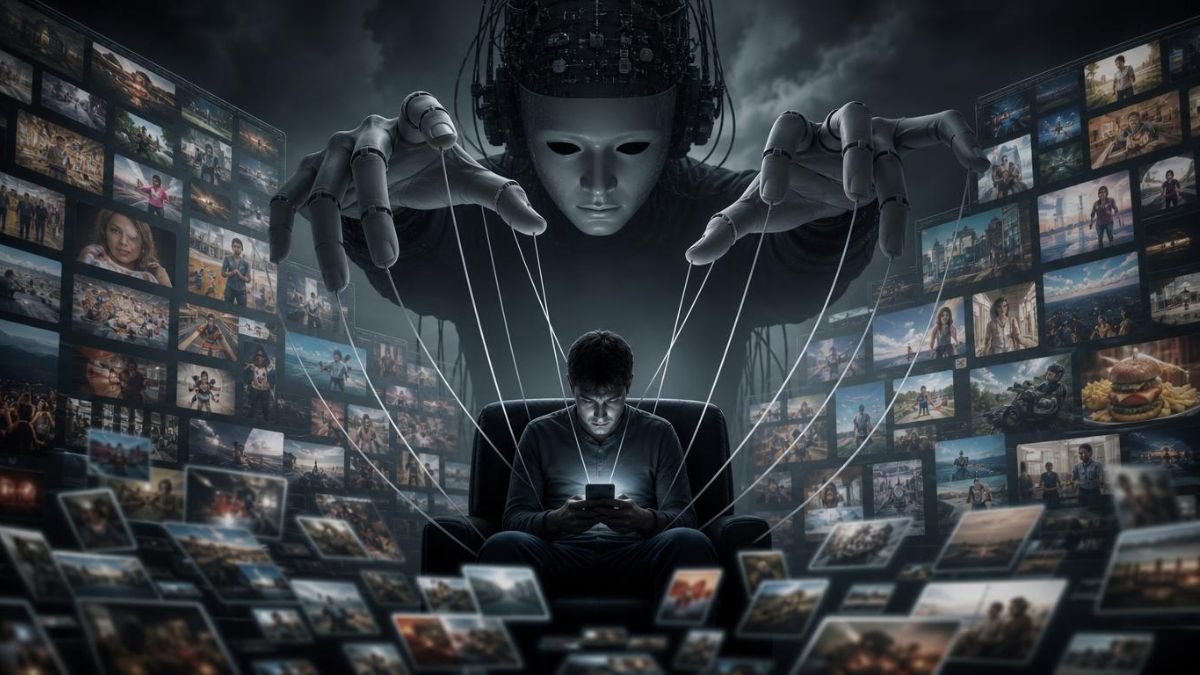
Not a friend. Not an editor. Not a person at all. A recommendation system, running somewhere in a building I will never see, calculated that this particular piece of garbage would produce a reaction in me. It was right. It was so right that my reaction was going to become a post, which would produce reactions in other people, which would teach the system that garbage of that shape performs beautifully, which would result in more of it, forever.
The slop was machine-made. Fine. Everybody agrees that's bad.
But the delivery was machine-made too. The sequencing, the timing, the decision about what my Tuesday evening would consist of. And I had never once, not for a single second in fifteen years, been disgusted by that.
So here's the thing I want to walk into with you, and I want to say up front that I don't come out the other side with a tidy answer, because there isn't one and anyone selling you one is selling you something. We have developed an enormous, theatrical, deeply satisfying disgust at machine-made content, while having quietly accepted machine-made choice without a whimper of protest. And I think the gap between those two reactions is where something honest is hiding.
Let's go get it.
First, let me say the obvious thing so nobody thinks I've lost my mind
The slop is real.
I'm not going to do the annoying contrarian move where I pretend the flood isn't happening because it makes my argument more fun. The internet is currently filling up with generated text and generated images at a rate that no human editorial capacity can keep pace with, and a great deal of it is worthless in a very specific way: it is content that exists to occupy a space where content is expected, rather than content that exists because someone had something to say.
Recipe sites with no kitchen behind them. News articles about events that were themselves summaries of other summaries. Books that are hollow inside. Product reviews for products the reviewer never touched, in a voice that never existed, recommending things to people who will be mildly let down and never know why. Images of food that no cook made and no camera saw, of buildings that don't stand anywhere, of grandmothers who never lived.
That's real, it's getting worse, and if you feel a physical recoil from it, your instincts are functioning correctly. I'm not here to talk you out of the recoil.
I'm here to ask why the recoil is so selective. Because I've watched people who would post a furious thread about a generated article sit through a forty-minute video that said one thing in the first ninety seconds and then said nothing for thirty-eight and a half minutes, and feel nothing. No disgust. No recoil. Just a Tuesday.
Both of those wasted the same finite, non-refundable resource. Only one of them triggered a moral emotion.
That asymmetry is the whole thing.
The word "slop" is doing a job we haven't inspected
I love the word, for the record. It's a great word. It's got that wet consonant cluster, that farmyard grimness, the sound of something being poured into a trough. Language nerds should take a moment to appreciate it: it does its work in one syllable and no explanation is needed. Whoever popularized it deserves a small statue.
But watch what it does.
"Slop" is a disgust word. Not a bad word, not a false word, not an exploitative word. A disgust word. It puts the whole problem in the category of contamination. Something has entered the food supply that shouldn't be there.
And disgust is a remarkable emotion for exactly one purpose: making you not eat the thing. It's fast, involuntary, requires no evidence, and is basically impossible to argue with. If you've ever tried to talk someone into eating a food they find revolting, you know reason has no purchase there. That's not a bug — disgust evolved to be un-arguable, because taking time to weigh the evidence about the meat was how you died.
Which makes it the single worst tool for thinking that we own.
It doesn't distinguish. It doesn't do proportions. It can't tell you that this generated article about tax deadlines is actually accurate and useful while that generated memoir about surviving a war is a moral obscenity. It just says: away from me. And once we've put something in the disgust category, we stop reasoning about it entirely and start doing something else instead.
We start performing.
What we're actually doing when we do the face
Here's the uncomfortable social observation, and I include myself in it completely.
Public disgust at AI content has become an identity signal, and a very efficient one. It costs nothing. It requires no expertise. It carries no risk of being unfashionable. And it announces, in a single gesture, several flattering things about you at once: that you have taste, that you can tell, that you're not fooled, that you're on the human side of a line that a lot of people are anxious about.
It's the cheapest available way to seem discerning.
I want to be careful here, because I'm not saying the feeling is fake. I think the feeling is completely sincere. What I'm saying is that a sincere feeling can also be a convenient feeling, and when a feeling is both sincere and convenient, it grows much faster than it would on sincerity alone. That's how most public moral emotions work. That's how they've always worked. This isn't a new human failing invented by the internet, it's just the internet giving an old failing a distribution deal.
And there's the tell: notice how much of the disgust attaches to surface features rather than to harm.
The em dash discourse. I have to say something about this because it's personally aggrieving. I have used em dashes my entire writing life, with enthusiasm, sometimes irresponsibly, and I now find myself being audited by strangers for a punctuation habit I formed before some of the auditors were born. The word "delve" has been effectively executed in public. Certain sentence rhythms are now suspect. A tricolon is grounds for investigation.
None of these are harms. Nobody is hurt by a colon. What's happening is that we're building an aesthetic purity test and calling it an ethical position, and the two things feel identical from the inside, which is exactly why we should be suspicious.
And the purity test has an obvious failure mode: careful non-native English writers, who were trained in formal register and write with the slightly elevated precision that formal training produces, are getting accused constantly. So are autistic writers, whose prose is sometimes more structured than the neurotypical norm. So are students who learned to write from textbooks rather than from group chats. The vibes-based detector has a bias, and the bias runs in a direction that should make us all feel a bit ill.
Meanwhile the actual harms — the uncredited training, the collapsing freelance rates, the confident falsehoods that a tired reader will believe — those get about a tenth of the airtime that punctuation does.
We are policing accent while ignoring the robbery.
The part nobody wants to hear: the machine was already choosing
Now the hypocrisy proper.
Here's a question worth contemplating. When was the last time you consumed something substantial that was not selected for you by an automated system?
Not made by. Selected by.
Your feed. Your recommended videos. Your discovery playlist. Your news app's front page, which is not a front page in any editorial sense, it's a personalized guess. The books the store suggests. The search results, which are ranked by a system optimizing for something that is related to but not identical to your interests. The podcast that auto-played after the one you chose. The article at the bottom of the article.
We handed over curation completely, and we did it without a single significant public argument. There was no backlash. There was no discourse. There were no screenshots with disgusted faces. There was a slow, comfortable slide, over about a decade, from "I choose what I read" to "I choose from what I'm shown," and those are not the same sentence and we never discussed the difference.
And curation is not a small thing. Curation is arguably the larger power. An editor who selects which ten of a hundred pieces to publish shapes a publication more than any single writer does. A radio programmer shapes a generation's taste more than most of the musicians they play. Choosing is authorship at scale. Ask any DJ. Ask any librarian. Ask anyone who has ever made someone a playlist and understood, halfway through, that they were writing a letter.
So when someone says "I refuse to consume AI-generated content," what they usually mean, whether they know it or not, is: "I refuse machine authorship while continuing to accept machine editorship without conditions."
That's not indefensible. You could construct an argument for it. But almost nobody constructs it, because almost nobody has noticed that they need to.
And here's the sharper version, the one that made me put my pen down for a bit. A great deal of the human-made content you consume was shaped by the machine before any language model existed. The video that's exactly ten minutes long because that's where the ad break threshold sat. The recipe with fourteen hundred words of childhood memoir before the ingredient list, because dwell time was the metric and search rewarded it. The article split across five pages. The title that's a question because questions get clicked. The thumbnail with the face doing the expression. The intro that says "before we get into it" because retention drops at the eight-second mark.
Every one of those was made by a human being, and every one of those was made to a machine's specification.
We've been eating machine-designed food this whole time. We just liked that a person was working in the kitchen.
Some AI content is better, and pretending otherwise makes us liars
Now the part where I'm going to lose a few people, and I'd ask you to stay a minute longer than is comfortable.
There is generated content that is better than human-made alternatives. Not stylistically. Style is where the machines are weakest and where they will remain weakest longest, because style is the residue of a specific life and machines don't have one. I mean content-wise. Substantively. In terms of what a person actually walks away knowing.
Consider a genuinely common situation. You need to understand how something works. A visa process, a medical term your doctor said too fast, a clause in a contract, a concept in statistics that everyone assumes you already know.
Option one: a video by a person, in which the first two minutes are an introduction, the next two are a sponsorship read, the next three are a personal anecdote establishing credibility, and the actual information arrives at minute nine, incomplete, because the creator is not an expert and read the same three sources you would have found.
Option two: a machine-generated explanation that is organized, appropriately hedged, gets to the point immediately, and is correct.
If you tell me you'd choose option one on principle, I think one of us is not being honest, and I'm fairly sure it isn't me. And note something we rarely credit about the second option: it doesn't waste your time on purpose. It has no incentive to. That absence of manipulation is an actual virtue, and it's slightly humiliating that we've built machines less manipulative than our media economy.
Let me push it further, because I've been on both sides of this.
Between 2015 and 2019 I wrote content for money that I would now describe, without much argument, as slop. Listicles. Search-engine filler. "Ten Tips for Better Sleep," in which I, a man who has not slept properly since roughly 2011, confidently advised strangers on sleep hygiene. Product descriptions for objects I'd never held. Blog posts padded to a word count because the client's agency had a word count, assembled from the top four search results, reworded enough to be legally mine and not enough to be actually mine.
I produced slop. At scale. For money. Before any machine could.
The only thing that made it human was that a human was tired while making it.
So when I feel disgust at a generated article, some honest fraction of that disgust is a man recognizing his own old work in a mirror and not enjoying the resemblance. And I think — carefully, without wanting to insult anyone — that this is true for more of us than will say it. A lot of the loudest anger is coming from people whose work was already being produced at a volume and a shallowness that made it substitutable, and the machine didn't cause that. The machine just made it visible.
That's a horrible thing to thing about. I've had a while and I still don't enjoy it.
Where I stop being clever
I want to drop the wit here entirely, because the next part doesn't deserve it.
Everything I've said so far is an argument about consumption, and consumption is genuinely the softer half of this. The harder half is production, and on that side there are people being hurt right now in ways that no amount of clever framing improves.
The training data was taken. Not licensed in most cases, not negotiated, not paid for. The books of living writers, the illustrations of working artists, the photographs, the code, the translations, the archives, the forum posts where someone answered a stranger's question in 2009 for free out of ordinary human decency. That was gathered and used to build commercial systems, and the people who made it were not asked and were not paid, and the legal systems that might have prevented this are moving at the speed of legal systems while the technology moves at the speed of capital. Whatever your position on how this resolves, "they were not asked" is not in dispute.
And the market effects are not hypothetical. I've watched them arrive. I know illustrators whose steady commercial work — the unglamorous, reliable, rent-paying work, spot illustrations and icon sets and background art — evaporated inside eighteen months. Not their best work. Their bread work. The work that made the good work financially possible. Nobody outside the profession understands that the bread work is load-bearing. It always is. Every artist you admire was subsidized by boring jobs you never saw.
Here, in Lebanon, where a substantial number of educated people have spent the last several years surviving on remote freelance income paid in dollars because the local currency became a rumor, this is not an abstraction about the future of creative labor. It's whether a specific household covers a specific generator subscription this month. I have sat across a table from a translator with twenty years of experience who was being offered post-editing work at a fraction of her rate: read the machine's output, fix it, take a third of what you used to earn, and by the way, faster. She took it. She has children. The word for that is not "disruption."
If your critique of AI content stops at aesthetics — at the phrasing, the extra thumb, the em dashes — you have found the least important objection available and stopped there because it's the one that requires nothing of you. The important objections require you to think about consent, about compensation, about power, and about who ends up holding the bill. Those objections cannot be discharged with a screenshot.
I have used these tools. I'm not going to perform purity I don't have. I've used them to check my own logic, to find the word I was circling, to build a first outline I then dismantled, to translate something roughly so I could tell whether it was worth translating properly. I don't use them to write the sentences you're reading, because the sentences are the only thing I actually have. But I'm implicated. Everyone reading this is implicated. There is no clean seat in this room, and I'd rather we admit that than compete over who is standing furthest from the mess.
The grey zone has a shape, and it isn't "human or machine"
Right. So if disgust is the wrong instrument and origin is the wrong test, what's the better question?
I think there are four, and I think they're better because they're answerable. You can audit them. You can write them into an editorial policy or a course syllabus or a personal rule. "Does this feel like AI?" cannot be audited, and depends on a detection ability that, if we're honest, most of us do not have to the degree we claim.
Question one: Who is accountable if this is wrong?
This is the big one and it's the one that actually matters. Not "who typed it" but "who answers for it." A named person, an institution with a correction policy, a masthead, a reputation that can be damaged, someone who can be argued with, corrected, sued, or embarrassed. Content with an accountable party behind it is a fundamentally different object from content with nobody behind it, and this distinction does not track the human/machine line at all. An anonymous human-written health blog with no accountability is worse than a generated explainer published by an institution that will issue a correction and take the hit. Accountability is the load-bearing wall. Everything else is decoration.
Question two: Who was paid, and who wasn't?
Was anyone compensated for making this? Was anyone's work used to make it without compensation? Does consuming it move money toward or away from people who make things? You will not always be able to answer this and you will not always be able to act on it, but it's the question that connects your consumption to somebody's rent, and it's the one that most media criticism politely omits.
Question three: What was disclosed?
Not "was AI used," but "was I told the truth about how this was made?" I don't need a label on every machine-assisted sentence; that way lies madness, and would require labeling roughly everything, including spellcheckers and the auto-complete in your email. What I need is for nobody to actively lie to me about the nature of what I'm receiving. Non-disclosure is a specific harm, separate from the tool. A ghostwritten memoir has always been a disclosure question, and we've had that argument for a century without resolving it.
Question four, and this is the one with teeth: Does it claim an experience it did not have?
Here is where I stop being relaxed about any of this.
A generated summary of a tax regulation claims nothing. It says: here is information. Fine. Useful, even.
A generated essay that says "when my mother was dying, I learned that—" is a different category of object entirely. That is not slop. That is a lie, and it's a lie about the one thing that content can uniquely carry: that a person was somewhere, and felt something, and came back to tell you.
Testimony is the sacred category. Not art in general — I'm honestly unsure where I land on generated art in general, and I distrust anyone who's certain — but testimony specifically. When someone tells you what it was like, the entire value is that they were there. Simulated testimony isn't low-quality content. It's counterfeit currency, and it devalues every real note in circulation, including the ones held by people who have very little else.
That's my line. It's not "no machines." It's "don't fake having been there."
Sort by function, and the fog clears a little
Building on that, here's a rough sorting system that I've found genuinely useful, and I offer it as a tool rather than a doctrine.
Content does about four different jobs, and origin matters wildly differently for each.
Testimony. Someone tells you what happened to them. Origin is everything. There is no such thing as valuable machine testimony; the category is defined by the presence of a person who lived it. Zero tolerance, no interesting edge cases.
Reporting. Someone tells you what happened in the world. Origin matters enormously, because somebody had to be there, ask the question, look at the document, take the risk. A machine can restructure a report. It cannot make one. When generated "news" summarizes other outlets' reporting and takes the traffic, it's parasitism, and the host dies.
Explanation. Someone tells you how something works. Origin matters much less than accuracy, clarity, and accountability. This is the largest category by volume and the one where the disgust reflex is most misapplied. If it's correct, clear, and someone stands behind it, I don't need to know whether the first draft came from a person or a process. I need it to be right.
Making. Art, music, fiction, the things whose value isn't reducible to information. Here it's genuinely contested and I won't pretend otherwise. It depends on whether you're consuming the object or the relationship. Some art we love as an artifact. Some we love because a specific person made it, and the knowledge of that person is inside the experience — which is why a beautiful forgery is still a disappointment when you learn what it is. Both of these are legitimate ways to love a thing. They just have different answers to the machine question, and pretending there's a single answer is why this argument never ends.
Run any piece of content through that and you'll notice the disgust reflex is calibrated almost entirely for testimony and reporting, while being applied mostly to explanation, where it does the least good and the most damage.
A media diet without purity, because purity diets always fail
I'm allergic to advice that assumes you have infinite willpower and no job. So this is small, and it's what I actually do, unevenly, with regular failures.
Choose the first thing yourself. Not everything. Just the first thing. Open a session by deliberately picking something you decided on before you arrived. This sounds trivial. It changes the whole session, because it establishes that you're the one steering, and everything after is a departure from your route rather than the route itself.
Budget by hours, not by origin. Your scarce resource is attention, and the human-made thing that wasted ninety minutes cost you exactly as much as the machine-made thing that wasted ninety minutes. Grade content on what it gave you back, not on the species of its maker. This one hurts, because some things you feel virtuous about consuming don't survive the audit.
Keep a short list of accountable sources. Five to ten names — people or institutions that will publish a correction and lose something if they're wrong. This is your foundation. Everything else is weather. Highest-leverage item on this list, and it takes an afternoon.
Pay for something. One thing. Anything. A subscription, a book, a musician's page, a translator's fee. Not for moral hygiene — one payment doesn't fix an economy — but because it keeps a live connection in your head between the thing you enjoy and the person who has to eat.
Stop performing the detection. If a piece is bad, say it's bad and say why. "This is inaccurate," "this wastes your time," "this is unsourced," "this is faked experience." Those are claims you can defend. "This is AI" is a claim you probably can't, and when you're wrong you've publicly accused a person of fraud over their punctuation.
And notice the reaction economy. If your disgust becomes a share, you're distributing the thing you hate, for free, with a bonus of engagement. The most devastating thing you can do to slop is genuinely nothing. Scroll past. No screenshot, no quote, no witty caption. It's not satisfying. That's the price.
What's actually underneath this
I've been circling something for quite some time now and I should finally land on it.
I don't think this is really about content quality. I think the disgust is standing in front of a fear, the way disgust often does, and the fear is this:
We're afraid we can't tell.
Not afraid the machines are good. Afraid that our ability to detect the difference — which we've been treating as a kind of moral organ, proof of taste, proof of humanity, proof that we're the sort of person who notices — turns out to be much weaker than we've been claiming in public. Every time someone confidently identifies an AI text and is wrong, and there are a lot of those, a small private panic happens. If I can't tell, what exactly was my taste? What was I actually detecting all those years? Was I ever the connoisseur, or was I just a person with opinions and good luck?
And underneath that one, there's a smaller and lonelier fear, and this is the one I actually recognize, because it's mine.
If a machine can produce something indistinguishable from what I make, then what I make might not have needed me.
Not "wasn't good." Wasn't necessary. Could have come from anywhere. Was never the irreplaceable output of one specific life, but a predictable arrangement of the era's available materials, which happened to pass through me on its way to existing.
That's the wound. And I want to be careful not to bandage it too quickly with something warm, because the warm answer — "but you're unique, your voice is yours, no machine has lived your life" — is true but it isn't reassuring, and treating it as reassurance is how it turns into a poster.
Here's the honest version. The fear is legitimate for a lot of the work most of us do. My listicles were not necessary. They could have come from anywhere. That's not machines taking something from me; that's machines revealing something about work I was already doing, which is that I was producing a commodity and calling it writing because the word felt better.
But some of what I've made could only have come from here. Not because I'm special — I want to be precise about this — but because it's located. It comes from a specific kitchen in a specific city where the power cuts at odd hours, from a specific set of arguments with specific people, from a language I code-switch in badly, from a particular kind of exhaustion that belongs to this place and this decade. That work isn't threatened by a machine, because a machine can imitate its surface and cannot occupy its position. Nothing can. Position isn't a style. It's an address.
So the useful question isn't "can a machine do what I do." The useful question is "how much of what I do is located, and how much of it was always going to be replaceable, and am I brave enough to look at the ratio?"
Most of us won't like the ratio. I don't like mine. But knowing it is the difference between working and producing, and I'd rather know.
So where does that leave us
Not with a rule. With a posture.
The disgust isn't wrong. It's imprecise, and imprecise disgust is worse than useless, because it feels like moral action while accomplishing nothing — which is the most dangerous thing a feeling can do.
The hypocrisy is real, but it isn't a gotcha and I'm not enjoying it. It's just information. We accepted machine curation without argument and are now refusing machine authorship with enormous noise, and until we notice that, the actual harms — the taken work, the collapsed rates, the faked testimony, the flood that drowns the good along with the bad — proceed without much interference.
And the grey zone isn't a failure of our thinking to be resolved. It's the shape of the thing. Some machine-made content is more useful than some human-made content. Some human-made content is more manipulative than anything a machine has produced. You have to hold both at once, and holding two things at once is uncomfortable, which is why so many people would rather hold one and shout.
Sit in the grey. It's the only place where anything gets thought.
The small thing
Last night I did the exercise I described earlier, the one about choosing the first thing yourself. I opened my laptop and, before anything could suggest anything, I typed in the name of an essay I'd been meaning to read for two years. It's by a woman who was alive when she wrote it and is not alive now. It took eleven minutes to read.
Nothing dramatic happened. I didn't have a revelation. I wasn't transformed.
But there was a moment, about halfway down, where she wrote something slightly wrong — a little overstated, a bit too pleased with itself — and I felt a small snag of resistance, the way you do when a real person overreaches in front of you. And I noticed that I liked the snag. That the small wrongness was the thing that made it feel like company. A machine wouldn't have overreached there. It would have hedged, correctly, and I'd have felt nothing at all.
That's not an argument. I can't build a policy on it and I won't pretend it settles anything.
But it's what I've got, and it's mine, and no system recommended it to me.
Questions Worth Thinking about
When was the last time you consumed something substantial that no algorithm put in front of you? Not "made by a human" — chosen by you. If you can't remember, what does that mean about where your actual media policy lives?
Think of the last human-made thing that genuinely wasted your time. Did you feel disgust? If not, why does the machine-made waste trigger a moral emotion and the human-made waste trigger only mild irritation?
Be honest about your detection ability. If someone showed you twenty pieces of writing and asked you to sort them, how confident are you really? And if you're less confident than you've been implying in public, what has your taste actually been doing all this time?
Where's your own line? Mine is faked testimony. Is yours in a different place, and can you say why in a sentence that doesn't rely on "it just feels wrong"?
Of the work you make — professional, creative, whatever it is — how much is located, in the sense of coming from a position nothing else occupies, and how much could have come from anywhere? What would change if you moved the ratio by ten percent?
If a piece of content is accurate, clear, accountable, and useful, does it matter to you how it was made? Answer for real, not for the audience.
Who is currently being hurt by all this in ways that a screenshot doesn't address, and what would it cost you to do something about that instead?
What To Do With This
Do one audit this week. Look at your last ten hours of consumption. Mark each item: did I choose this, or was it served? Was it testimony, reporting, explanation, or making? Would I choose it again? Don't change anything yet. Just look. Most people find the results genuinely surprising, and you can't fix a diet you've never actually seen.
Build your accountable list. Five to ten sources — people or institutions that will publish a correction, that have something to lose. Write them down somewhere you'll find them. This is the foundation everything else sits on and it takes one afternoon.
Pay one person this month. A subscription, a book, a musician, a translator, an illustrator. One. Not as absolution. As a live wire between what you enjoy and someone's rent.
Retire one lazy accusation. The next time you're about to say "this is AI" based on a dash or a word choice, say the specific thing instead: it's wrong, it's unsourced, it wastes your time, it's faking experience. Defend a claim you can actually defend.
And come argue with me. I've told you my line — faked testimony, everything else negotiable — and I've told you where I'm implicated. If you think I've been too soft on the machines, or too hard, or if I've missed the objection that actually matters, write it. Tag it, send it, reply to the episode, argue in the comments. This is a question we're going to be living inside for the rest of our working lives, and it will not be settled by the person with the strongest feeling.
It'll be settled, if it ever is, by people willing to stand in the grey and keep the lights on.


0 Comments