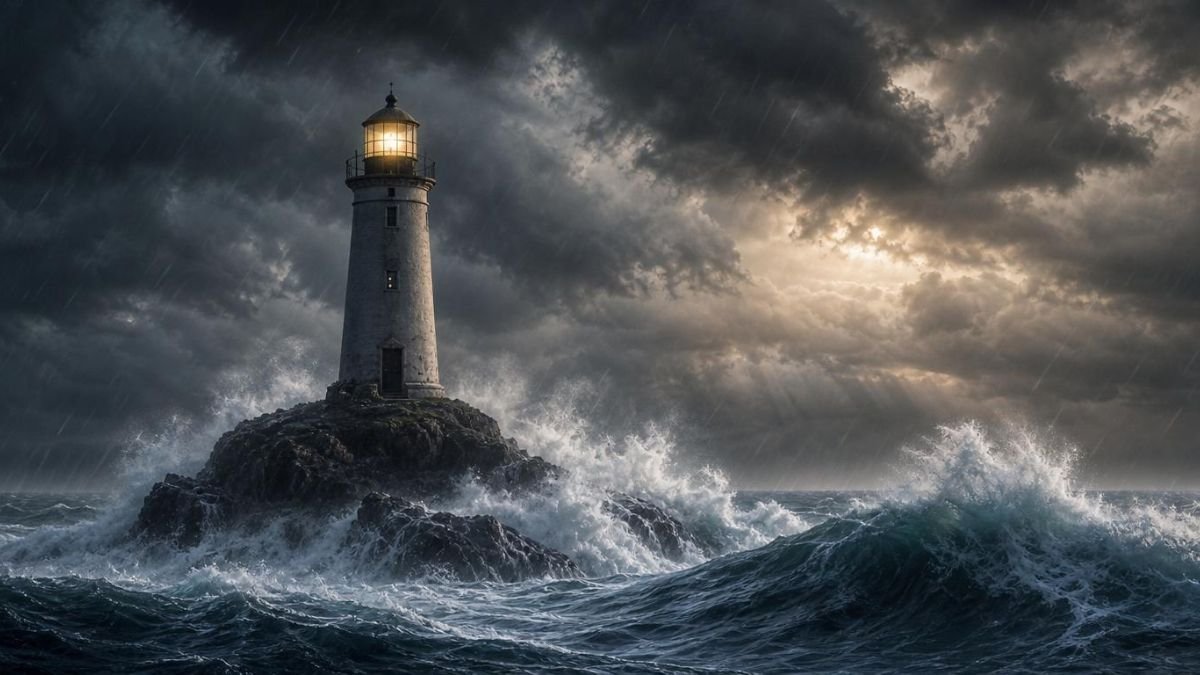
What if surviving something was never about winning against it — but about simply still being there when it's over?
Think about this for a second. Because we talk about hard times like they're battles. We fight our illnesses. We beat the odds. We conquer our fear. And there's a courage in that language, I won't take it from you. But then, quietly, in the middle of someone's worst season, we reach for a different phrase. A softer one. We say, you just have to weather the storm.
And I want to stop there with you, on that word. Weather.
Because listen to what it's doing. Weather is the noun for the thing happening to you — the rain, the wind, the sky that turned on you without warning. The weather is the storm itself. But somewhere along the way, we took that same word and made it a verb. To weather. And the verb doesn't mean to cause a storm, or to stop one, or to escape it. To weather something means to come through it and still be standing on the other side.
The same word is both the wound and the healing. The storm and the surviving. Isn't that something? We didn't invent a new word for endurance. We just took the name of the thing that was hurting us, and quietly turned it into the name of what we did about it.
Now here's the part I really want you to feel. Think about a ship in a storm. A good captain, an old captain, does not fight the sea. You cannot punch the ocean. You cannot out-muscle a wave. What the captain does is turn the bow into the swell, ease off, hold steady, and ride. To weather the storm at sea is an act of staying afloat, not winning a fight. The victory, if you can even call it that, is unglamorous. The victory is: we're still here. The sails are torn, the deck is soaked, everyone is exhausted — and we're still here.
That's the secret hiding inside this phrase. It lowers the bar for you, and it lowers it on purpose, out of mercy. It's not asking you to be triumphant. It's not asking you to feel okay. On the days you cannot imagine winning anything, weathering is still available to you. You can be flattened and afraid and still be weathering the storm perfectly, because weathering was never about how you felt. It was only ever about whether you were still there when the sky cleared.
But there's one more layer, and this is the one I love most.
Weather has a third meaning. When we say a cliff is weathered, or a face is weathered, or an old wooden door is weathered, we mean it has been worn down by time and rain and sun. Weathering, in this sense, is erosion. It takes something away from you. The weathered stone is smaller than it was. The weathered face has lines the young face didn't have.
So here is the strange, beautiful truth that this one word is trying to tell you. To weather the storm and to be weathered by it are the same word, because they are the same event. You do not come through the storm unchanged. You come through it worn. Something is taken. There is a cost, and the language is honest enough not to hide it from you.
And yet.
Have you ever really looked at weathered wood? At an old table that has been in a family for a hundred years, at driftwood shaped by the sea, at the face of someone who has lived through a great deal and kept their kindness anyway? There is a beauty in weathered things that no new, unmarked, untested thing can have. The grain shows. The story shows. Weathered things are more themselves, not less. The storm didn't just take from them. It revealed them.
I think about this a lot, living where I live, in a country that has weathered more storms than I could name. And what I've come to believe is this: the people I admire most are not the ones who were never touched by hard weather. They're the ones who were touched, deeply, and who wear it. You can see it in them. Not as damage. As depth.
So maybe the phrase isn't a small comfort after all. Maybe it's a whole philosophy, folded up so tightly we forgot to unfold it.
Because when someone says to you, weather the storm, they are telling you four things at once. They're saying: you cannot control this sky. They're saying: you don't have to defeat it, you only have to stay. They're saying: yes, it will cost you something, that's real, that's honest. And they're saying: the version of you that comes out the other side — worn, changed, weathered — will be more beautiful, not less. Will be more you.
We spend so much of our lives afraid of being changed by our hardest seasons. Afraid the grief will mark us, the loss will leave a line, the storm will take something we don't get back. And some of that fear is fair. Something is taken. But I want to offer you the other half, the half the word has been quietly holding for you this whole time. You will be weathered. And weathered things are the ones we keep. Weathered things are the ones we treasure. Weathered things are the ones that finally look like they've been alive.
So the next time you're in it — and you will be, we all will be — I don't want you to think about being strong. Strength is exhausting, and some storms are longer than our strength. I want you to think about this word instead. Just weather it. Turn your bow into the wave. Hold steady. Let it take what it's going to take. And trust that staying, simply staying, simply being here when the sky finally goes quiet, is not a small thing.
It might be the truest brave thing there is.
So here's what I'll leave you with tonight. Think of the storms you've already weathered — the ones you were sure you wouldn't survive, and did. Look at what they wore into you. And then ask yourself, gently, honestly: is that a scar you carry? Or is it, maybe, the most beautiful part of your grain?






0 Comments