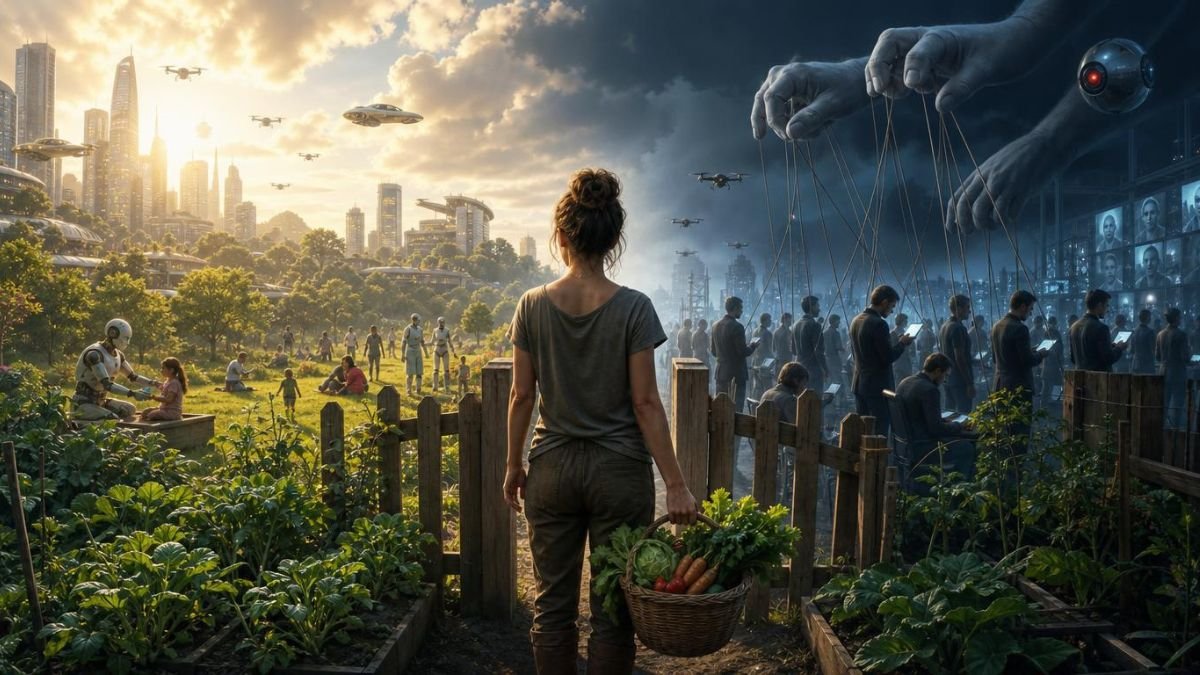
There is a version of the future in which you wake up whenever you want, in an apartment you did not pay for, and consider — genuinely consider, as a lifestyle choice — growing vegetables.
Not because you need vegetables. Vegetables are handled. Vegetables are abundant, cheap, delivered by something with wheels and no opinions. You would be growing them the way a person plays tennis. For the friction. For the little hit of meaning you get from doing something inefficiently on purpose.
This is not my invention. This is roughly the picture Elon Musk painted at the U.S.–Saudi Investment Forum in Washington, where he predicted that within ten to twenty years, work will be optional. His comparison was exactly that: you can buy vegetables at the store, or you can grow them in your backyard, which is much harder, and some people do it anyway because they like growing vegetables. Work, in this future, is gardening. Work is a hobby with better branding.
And I want to say something up front, because I think it matters for everything that follows.
I don't think he's lying.
I think he means it. I think it's sincere. I think there is a real chance he genuinely believes he is describing the most generous economic arrangement in human history and cannot understand why anyone would receive this news with anything but gratitude. That's what makes it worth taking seriously. Cynicism is easy to argue with. Sincerity is the hard case.
So let's do the hard case.
Let's Get the Prophecy Right Before We Argue With It
I want to be precise here, because there is a genre of commentary that consists of getting a rich man's position slightly wrong and then defeating it heroically. Not interested. If we're going to take a swing, we take it at the actual thing.
Here is the actual thing, assembled from several years of him saying it in slightly different rooms.
At the UK's AI Safety Summit in late 2023, sitting next to Rishi Sunak, he said there would come a point where no job is needed. You could have one for personal satisfaction, but AI would be able to do everything. He called this future "protopian." He also said, and I want you to hold onto this phrasing, that we won't have universal basic income — we'll have universal high income. He did not, at the time, explain the difference.
At VivaTech in Paris in 2024, asked whether he was worried about AI taking his job, he said that in the benign scenario probably none of us will have a job, there will be universal high income, and there'll be no shortage of goods or services. He put the odds of that benign scenario at around eighty percent. He also said something that I think is the most interesting thing he has said on the subject, and we'll come back to it: that the question won't be one of goods and services, it'll be one of meaning. If the computer and the robots do everything better than you, does your life have meaning?
In April, on X, he got specific about the mechanism: universal high income via checks issued by the federal government is, in his words, the best way to deal with unemployment caused by AI. When someone pushed back and asked how everyone could possibly afford, say, a penthouse, he doubled down. Everyone can have a penthouse if they want. The output of goods and services will be several orders of magnitude higher than today's economy.
At Davos in January he said that AI and robotics are the path to abundance for all, and that they're the only way to solve global poverty.
And in December, when Ray Dalio was praising the new savings accounts being seeded for American newborns, Musk called it a nice gesture but said there will be no poverty in the future and so no need to save money. There will be universal high income. He has said elsewhere that saving for retirement could be irrelevant in twenty years, and that money itself will stop being relevant — he cites Iain M. Banks's Culture novels, in which a post-scarcity civilization simply has no currency.
So: ten to twenty years. Work optional. Money possibly obsolete. Poverty eliminated. Government checks in the interim. Penthouses available.
That's the position. I've stated it as strongly as I can, which I think is the minimum courtesy you owe an idea before you take it apart.
Not everyone in the billionaire chorus is singing the same note, by the way. Jeff Bezos has argued the opposite — that AI is more likely to create a labor shortage than mass unemployment, freeing people to invent things that don't exist yet. Michael Burry, the man who shorted the housing market and has since disclosed a short position on Tesla, replied to the "work will be optional" post with a single word: "False." Then: "There will be revolution first."
I want to note that both of those are also predictions from very rich men. Nobody in this conversation is poor. Keep that in mind. Including about me, in a way I'll get to.
The Beautiful Passive Voice
Read that prophecy again and notice something about the grammar.
Work will be optional. Money will stop being relevant. There will be universal high income. Poverty will be eliminated. Checks will be issued.
Do you see it? Every verb in the utopia is in the passive voice. Nobody does anything. Things simply become. It's the grammar of weather. It's the grammar of a sunrise. It has the same relationship to human agency as "it will rain on Thursday."
This is not a gotcha about writing style. This is the entire argument hiding in plain sight, because the moment you put those sentences into the active voice, you have to name a subject, and the subject is where all the trouble lives. Somebody will make work optional. Somebody will issue the checks. Somebody will decide how much is on them, who qualifies, on what conditions, in which countries, and — this is the part that keeps me awake — when to stop.
Passive voice is the native language of every plan that would sound alarming with a subject in it. "Mistakes were made." "The population was relocated." "Work will be optional."
I'm not accusing anyone of hiding the ball. I think it's more interesting than that. I think when you are genuinely at the top of a system, the system stops looking like a set of decisions made by people and starts looking like a landscape. Like weather. Like something that simply is, and that you are describing rather than shaping. That's not villainy. That's altitude. And altitude has a very specific optical effect: from far enough up, everything below you looks like terrain.
The Difference Between Money You Earn and Money You Receive
There's an objection coming and I'd like to head it off: "So you'd rather people worked in factories? You'd rather have back pain and commuting? You're romanticizing toil." No. God, no. Work is not sacred. I've done work that made me feel like a spreadsheet with a pulse. Anybody who tells you the dignity of labor is universal has never done twelve hours of a job whose entire purpose is to make a number in another city slightly larger.
I'm not defending work. I'm defending something work incidentally provides, which nobody has proposed replacing.
Here it is: a wage is a claim. A transfer is a gift.
That's the whole thing. That's the load-bearing sentence of this episode and everything else is elaboration.
When you earn money, the money is downstream of something you control. You control your labor. You can offer it, withhold it, sell it to a competitor, sell it in a different country, organize with others to raise its price, or stop offering it entirely at a moment maximally inconvenient to the person who needs it. That last one has a name. It's called a strike, and it is, historically, the single most powerful instrument ordinary people have ever held. Not the vote — the vote is periodic and diluted and can be structurally neutralized in a hundred ways. The strike is immediate, undilutable, and terrifying to power, because power runs on other people's hands.
Every meaningful improvement in the material conditions of working people over the last two centuries was extracted with that instrument or the credible threat of it. The weekend. The eight-hour day. Child labor laws. Workplace safety. Not granted from above out of moral improvement. Extracted, from below, by people who could stop.
Now automate everything.
Not most things. Everything. Take the premise at full strength, exactly as offered. The robots do it all. Human labor is economically unnecessary.
You have just abolished the strike. Not by banning it. By making it meaningless. You cannot withhold what nobody wants. A general strike in a fully automated economy is a group of people agreeing not to do something that wasn't happening anyway. It's a hunger strike in a world where nobody was going to feed you regardless. The most powerful lever in the history of ordinary human political leverage doesn't get taken away from you — it gets rendered into a piece of ceremonial equipment, like a ceremonial sword. Beautiful. Historic. Attached to nothing.
And in exchange, you get a check.
Some Free Advice for Anyone Who Wants to Rule Forever
Put yourself in the shoes of a government — any government, pick your least favorite, it works for all of them — that would like to remain in power indefinitely and would prefer not to be inconvenienced by its own citizens.
Historically this has been difficult. Repression is expensive and unreliable. Propaganda works until it doesn't. Rigging elections is embarrassing when caught. The really persistent problem is that your population produces the wealth, which means your population can, in principle, stop producing it, which means you need them at least a little bit more than they need you.
Now imagine someone walks into your office and offers you a system in which the wealth is produced by machines you regulate, and every single citizen receives their entire livelihood as a monthly transfer from your treasury.
You would sign that with a pen made of gold. You would sign it twice in case one copy got lost. This is the single most effective instrument of political control ever designed, and the beautiful thing — the genuinely elegant thing — is that you don't have to be a tyrant to use it. You just have to be a normal, self-interested institution with a budget and a preference for stability.
You don't need to arrest the protest organizer. You need to review her eligibility. You don't need to censor the newspaper. You need to introduce a modest conditionality requirement, phrased in the language of fairness, about civic participation. You don't need secret police. You need an appeals process that takes eleven months.
And you would never, ever call it any of that. It would all be administrative. It would come in a beige envelope. The most consequential political mechanism in human history would be experienced by the people inside it as paperwork.
I want to be careful here, because I'm not describing a conspiracy. Nobody has to plan this. This is just what institutions do with the levers they're handed, on a long enough timeline, without anyone in the room ever thinking of themselves as the villain. Every single person implementing it is doing their job.
The Question Nobody Wants to Ask Out Loud
Here is the version of this that I find hardest to be funny about, so I'll be funny about it quickly and then stop.
Your country decides to go to war.
Maybe you agree. Great, no problem, this section doesn't apply, enjoy the war. But maybe you don't. Maybe it's one of those wars — the ones that are extremely popular for about nine weeks and then spend forty years being taught in schools as a mistake. Maybe you look at the maps and the speeches and the very confident men on television and you think: no. Not with my hands. Not with my body. Not with my name on it.
In the world we currently live in, refusing is expensive and frightening and sometimes illegal, but it is possible, and the reason it's possible is that your livelihood and your government are two different things. You have an employer. You have savings. You have a skill somebody else will pay for. You have, in the worst case, a border and a suitcase and the ability to be useful somewhere else. Your ability to eat is not administered by the institution you are refusing.
Now remove that. Now your income is a monthly transfer from the state, universal, high, generous, and entirely at the state's discretion.
What exactly is conscientious objection in that world? What is a draft resister who has no other source of food? What is a war protest, when every single protester's entire material existence flows through the treasury of the thing being protested?
I want to be honest about the strength of the counterargument, because there is one. You could constitutionalize it. Make the payment a right, unconditional, non-suspendable, judicially enforceable, immune to political interference. Fine. Excellent. Do that. I'm serious — that would help enormously.
But look at what you've just done. You've made the survival of every human being in the country contingent on the durability of a legal guarantee. Not on their capacity to feed themselves. On a guarantee. And I would like you to name for me the constitutional guarantee that has never in the history of any nation been suspended during an emergency, reinterpreted by a sympathetic court, quietly amended in a bill about something else, or simply not funded.
I'll wait.
There's a phrase from the American revolution that everyone knows: no taxation without representation. It's a good slogan. But political scientists have spent decades on its shadow, and the shadow is scarier. It shows up in the literature on rentier states — Hazem Beblawi and Giacomo Luciani in the eighties, Michael Ross later — and the finding, roughly, is this: when a government's revenue comes from something other than its citizens, the government's need for its citizens declines, and so does its accountability to them. Representation turns out to be, historically, something people bought with taxes. It was a transaction. We fund you, therefore you answer to us.
Universal high income inverts that transaction completely. Now the government funds you. Follow the logic to its end and ask yourself what that means for who answers to whom.
That's not a prediction. It's a question. But it's the question, and I notice that the people describing this future in the passive voice have not gotten around to it.
Not Communism. Something Newer and Worse.
You'll hear this called communism. It isn't, and the ways it isn't are the interesting part.
Communism — the actual doctrine, on paper, in theory, before the tanks — proposed a ladder. In the socialist stage, from each according to his ability, to each according to his contribution. Effort was supposed to be legible. You did more, you got more. There was a mechanism, however corrupted in practice, by which your own exertion changed your position. And in practice, of course, it was corrupted spectacularly: the nomenklatura had access to goods and apartments and foreign travel that ordinary citizens could not obtain at any price, effort included. I'm not defending it. I'm noting what it claimed, because the claim is what we're comparing.
Universal high income proposes a floor. A high floor. A genuinely comfortable floor, possibly with a penthouse on it. And then nothing. No ladder. Not a broken ladder, not a rigged ladder, not a ladder with a queue — the absence of the architectural category of ladder.
Because think about what a ladder actually requires. It requires that effort convert into position. That's it. That's the whole mechanism. You do something valuable, someone pays you more than they paid you before, and you move. Every rags-to-riches story, every immigrant family's second generation, every unbearable motivational poster in every unbearable office, runs on that single conversion.
If human labor produces nothing of economic value, the conversion rate is zero. Not low. Not unfair. Zero. There is no amount of effort you can apply, no skill you can acquire, no hours you can work, no cleverness you can deploy, that changes your position, because your position is not a function of anything you do. It's a function of what you're issued.
Meanwhile — and this is the part where I stop being able to keep the smile on — the people who owned the machines on the day the machines became sufficient will own them the day after. And the day after that. Forever. Because the only mechanism that ever redistributed ownership downward was people selling their labor and buying things with the proceeds, and we just switched that off.
So what you get is not a classless society. You get a two-caste society with a very comfortable lower caste, permanent membership, no exams, no transfers, no appeals. One caste receives. One caste owns. The line between them is not merit, or effort, or intelligence, or even luck going forward. It's a timestamp. Which side of a particular decade you happened to have capital on.
Aristocracy had at least the decency to be honest about being hereditary. This would be hereditary while insisting it's abundance.
And history has a name for the arrangement where a population receives its subsistence from the center and produces nothing the center needs. Rome ran it for centuries: the grain dole, free bread for the citizens of the city, and then, because a fed population with nothing to do is a political problem, an extremely aggressive entertainment budget. Bread and circuses. We remember it as a joke about decadence. It was a governance strategy, it worked, it lasted a very long time, and the people receiving the bread were citizens of the most powerful state on earth with almost no capacity to influence it.
We have much better circuses now. Ours are personalized.
And Then There's Everybody Else
Here's where the plan stops being merely dangerous and becomes something closer to a joke told at a funeral.
Read the mechanism again: "Universal HIGH INCOME via checks issued by the federal government."
The federal government.
There is one country in that sentence. There are one hundred and ninety-odd others, and roughly seven billion people, for whom this sentence is not a plan, not a promise, not even a rumor. It's a weather report from somewhere else.
Who issues the check in Bangladesh? Who issues it in Kenya, in Egypt, in Honduras, in the Philippines, in Nigeria, in Pakistan, in Lebanon — where I'm sitting, in a country whose government has spent the last several years demonstrating in real time exactly how much it can be relied upon to transfer wealth to its citizens? What is the fiscal capacity of a state whose entire tax base was people working, in a world where nobody works? Where does the money come from, when the productive assets are corporate, foreign-owned, and physically located on another continent?
Nobody has answered this. Not because they're evil. Because it wasn't in the frame. The frame was a domestic labor market problem in a wealthy country, and the solution scales exactly as far as that country's treasury and not one meter further.
And it is so much worse than just being left out, because the same technology that generates the abundance over there actively demolishes the development ladder over here.
The World Bank's Development Report this year found that jobs in high-income countries are more than three times as exposed to automation by generative AI as jobs in low- and middle-income ones — about fourteen percent versus four and a half. Sounds like good news for the poor world. It isn't. It's a measurement of how few of the good jobs there were in the first place. The exposed jobs in poorer countries are precisely the ones that constituted a path: the clerical work, the administrative work, the outsourcing, the back office. Kenya has something like two million digital workers. Ghana's business process outsourcing sector runs into the hundreds of millions of dollars. That entire sector exists for one reason — labor cost arbitrage — and AI's whole proposition is that labor cost stops determining competitiveness.
And the freelance economy, the one that let a talented twenty-three-year-old in Cairo or Manila or Tripoli sell translation and design and writing directly into a wealthy market — studies found earnings in the exposed categories dropped by more than twenty percent after ChatGPT's release. That's not a forecast. That already happened. To people I know.
Then there's the manufacturing ladder, which is the only ladder that has ever reliably worked. Get cheap, get factories, get slightly less cheap, move up. Britain and Sweden and Italy climbed it. Korea climbed it. China climbed it. And it's closing: manufacturing employment in the early industrializers didn't start declining until they hit around thirty-five thousand dollars per capita. India and much of sub-Saharan Africa are hitting the same turning point at around eighteen hundred. Bangladesh tripled its garment exports between 2010 and 2024 and employment in the sector stayed flat. The ladder is still visible. The rungs have been removed.
Add remittances. In dozens of countries, the single largest source of household income isn't domestic wages — it's money sent home by someone working abroad. Which means those economies are exposed to automation in other people's countries, through a channel nobody is modeling, with no vote and no representation in the decision.
So the honest description of what's on offer is this: one country, or maybe a handful, may achieve an automated post-work abundance for its citizens, funded by a treasury with global reach, while simultaneously dismantling the development pathway for everyone else and offering them, in compensation, nothing. Not a smaller check. Not a delayed check. Nothing, because there is no institution on earth with the authority or the money to write it.
And then — I want to say this plainly — those countries will be blamed for their own instability.
This Is the Part Where I Stop Making Jokes
I've been doing a bit. Let me stop.
I want to talk about the thing that is actually taken away, which is not income.
There's a family. Put them wherever you like — this works in Dhaka, it works in Kinshasa, it works twenty minutes from where I'm sitting. The father drives, or hauls, or fixes engines, or stands behind a counter for eleven hours. The mother cleans other people's houses, or teaches forty children in a room built for twenty-five. Their combined income does not permit dignity by any definition either of them would have chosen. The apartment is too small. The power is unreliable. The medicine is rationed by arithmetic.
And they get up anyway. Every day. For decades.
Ask them why and they will not say anything about self-actualization. They'll point at a child. The whole structure — the eleven hours, the second job, the not-buying-things, the specific and total absence of anything you would call a life for the two adults involved — is a bet. The bet is that effort compounds. That the daughter goes to a better school than they did, and her daughter to a better one than that, and somewhere in there the family crosses a line and stays crossed.
That bet is often wrong. It's wrong all the time. It's wrong more often than it's right, and the people making it usually know that, and they make it anyway, because the alternative is not making it.
That bet is the load-bearing wall of most of the human species. Not democracy, not religion, not ideology — the belief, held by billions of people simultaneously, that effort applied over time changes outcomes for someone you love. Every functioning society on earth is standing on it. It is the reason people tolerate conditions that are otherwise intolerable. It is the reason your city has not burned down.
Now tell that family, correctly and with evidence, that effort no longer converts. That there is no amount of work, no school, no skill, no sacrifice, no eleven-hour day that changes their daughter's position, because human capability is no longer economically relevant, and their position from now on is whatever their government can afford to transfer, if it can, if it does, if it continues to.
You have not made them poorer. In some scenarios you may have made them richer.
You have taken away the reason.
And I want to be extremely clear about what happens next, because it isn't sad. Sad is a mood. What happens next is structural. A person with no path and no leverage and no reason does not become peaceful. Nobody in the history of the world has ever responded to the removal of their future with tranquility. They move — and they'll be met with walls, because the countries with the checks will have every incentive to defend the perimeter of the check. They radicalize — because when the mainstream explanation of your life offers you nothing, the extreme explanation is the only one that at least treats your situation as a scandal rather than a statistic. Or they fight — and there will be no shortage of people willing to organize that, and the weapons will also be automated, and the calculus of a state that no longer requires its population as workers or soldiers is a calculus I would prefer not to think about at night.
Michael Burry said "there will be revolution first" and everybody treated it as a market call. It wasn't a market call. It was the most accurate sentence anyone has contributed to this conversation, and it's four words long.
The devastating part isn't that most of the world will be left out of the abundance. That's just unfair, and the world is extremely well practiced at unfair.
The devastating part is that for the first time in recorded history, being left out would be permanent by design — not because of a policy that could be changed, or a prejudice that could be overcome, or a border that could be crossed, but because the mechanism by which anyone has ever climbed out of anything would no longer exist. Every previous injustice, however brutal, left the ladder standing somewhere. Slavery left it. Colonialism left it. Every catastrophe of the twentieth century left it. People climbed out. It took generations and it cost oceans, but the physics permitted it.
This wouldn't. And a permanently sealed floor is not poverty. Poverty is a condition. This would be a category.
My Own Hands Are Not Clean and I'd Rather Say So Myself
I've been talking here for some time being clear-eyed about other people's incentives, so let's do mine.
I make things out of language. Editorials, essays, episodes, lessons. Chamath Palihapitiya — whose essay Musk was replying to when he said work would be optional — titled it "The Great Descent," and the argument was that the cost of expertise is falling to zero. My entire professional existence is a small business selling expertise. I am not analyzing this trend. I am in it, and it is not going my way, and everything I've said in this episode should be read by you with that firmly in mind, because a man describing the danger of a future in which his own skills are worthless is not a neutral observer. He's a witness with an interest.
Worse: I use these tools. Not occasionally. Constantly. I have handed over pieces of my own craft to software, in exchange for speed, and I did it voluntarily, and I would do it again tomorrow, and I know exactly what that makes me — a person who has accepted the individual benefit of a process whose collective consequences he is now warning you about. That's not hypocrisy I've discovered and repented of. That's the arrangement I'm currently in, and I don't have a clean way out of it.
And here's the ugliest part, the one I almost cut.
I live in a country that has already run a small, unglamorous version of this experiment. Not the abundance part — the other part. The part where the relationship between work and livelihood snaps. My compatriots did everything correctly. They worked, they saved, they put the money in a bank, and one morning the money was a number on a screen that somebody else controlled, and no amount of effort — none, zero, not a single hour of additional labor — could retrieve it. And what replaced the wage economy was exactly what I've been warning you about: a patchwork of transfers. Remittances from a son abroad. A parcel from an NGO. A subsidized generator on your street operated by a man who is, coincidentally, extremely interested in how your neighborhood votes. Nobody in Lebanon needs to be taught what happens to a person's political voice when their electricity comes from a patron. We've been taking that course, with practicals, for a long time.
So when I hear "the government will simply pay everyone," I don't hear a policy proposal. I hear the sound of a system I already live inside, being described in an American accent, as a utopia.
And I'll tell you the last true thing, which is that some part of me wants it to work. I'm tired. The idea that the whole exhausting machinery of earning could just stop, that I could write only what I actually want to write, that nobody's rent would depend on their usefulness — I want that. It's beautiful. I'm not immune to it. That's precisely why I don't trust my own reception of it, and why I've spent this long trying to think past the part of me that would sign the offer without reading it.
What Would Actually Have to Be True
I'm not interested in ending on despair. Despair is just cynicism with better lighting, and it lets everyone off the hook.
So let's assume the machines really do arrive. Assume the abundance is real, the deflation argument holds, output goes up by orders of magnitude, the vegetables are handled. What would have to be true for that to be liberation instead of the most elegant cage ever constructed?
Not more money. The amount was never the issue. A million a year on the same terms is the same cage with a nicer view.
The issue is the instrument. And there is a difference, an old one, between a check and a claim.
A check is discretionary. Someone decides to send it. That someone can decide otherwise, can attach conditions, can means-test it, can index it to behavior, can delay it during an emergency, can define you out of eligibility. You are its recipient. You are, structurally, a supplicant, no matter how large the number is or how politely it arrives.
A claim is ownership. It doesn't require anyone's goodwill. It generates income because a thing you own produced value, and taking it from you requires an act of expropriation that has to be argued for in public, in front of a court, with a name attached.
If the machines are going to do the work, then the question that actually matters — the only one — is not how much do people get. It's do people own any of it.
This isn't science fiction. Alaska has paid its residents an annual dividend since the early eighties, and it is not welfare: it's a distribution from a permanent fund that owns assets. Norway's sovereign wealth fund holds a piece of the global economy on behalf of its citizens. These are small, imperfect, oil-shaped precedents, and they don't scale automatically to a planet. But they establish the principle, which is that a population can hold productive assets rather than receive charity derived from them, and that the political relationship those two arrangements produce is not remotely the same relationship.
So the questions worth asking, every time someone describes this future to you:
Ownership or income? A stake, or a stipend?
Portable or territorial? Does it follow the person or the passport — and if it's the passport, say clearly that the plan is for one country and stop calling it universal.
Revocable or not? What exactly is the procedure for taking it away, who executes it, and what does an ordinary person do about it on a Tuesday?
And who, precisely, is the subject of the verb? Not "checks will be issued." Issued by whom, funded from what, at whose discretion.
None of these are technical questions. All of them are political, all of them are being deferred, and the deferral is not neutral — every year they go unanswered is a year the ownership question gets settled quietly by default, in favor of whoever already owns the machines. The technology is being built at a rate of hundreds of billions of dollars a year. The politics of it are being built at a rate of approximately one tweet a quarter.
Closing
I don't have a march for you to join. I have something much smaller, and I think smaller is the honest size.
The next time somebody sketches your future in the passive voice — work will be optional, money will be irrelevant, poverty will be eliminated, you will be provided for — do one thing. Just one. Put the verb back in the active voice and find out who's holding it.
Who makes work optional? Who provides? Who decides you've been provided enough? Say the sentence out loud with a name in it and listen to how different it sounds. "You will be provided for" is a lullaby. "They will provide for you" is a description of a relationship, and you'll know immediately whether you like your position in it.
And then, separately, quietly, without turning it into a philosophy: own something. Anything. A skill they haven't gotten to. A tool. A patch of land. A list of people who read what you write and would follow you elsewhere. A share of something that produces. Not because it will save you — it very well might not, and I don't want to sell you a hedge against the future in the last thirty seconds of an episode about people selling hedges against the future.
Own something because there is a real, hard, and I think permanent difference between a person who has and a person who receives. And in every version of the next twenty years — the good one, the bad one, the boring one in the middle where the robots turn out to be six years late as usual — that difference is going to matter more, not less.
They're going to tell you the vegetables are handled.
Ask who owns the garden.
Discussion Questions
If a government payment became your entire livelihood, what would you stop being willing to say in public? Be specific — the honest answer is usually more interesting than the brave one.
Is there a version of universal income that could survive a genuinely hostile government? What would it need to look like, legally, to be un-revocable?
The development ladder — cheap labor, factories, gradual ascent — has lifted more people out of poverty than any deliberate program in history. If automation removes it, what replaces it for a twenty-year-old in a country that hasn't climbed yet?
Musk asked whether a person's life has meaning if machines do everything better. Set aside whether it's a good question and ask a sharper one: why is that the question a billionaire lands on, and not the question about power?
If you were designing the distribution of an automated economy from scratch, would you choose a check or a share — and which one do you think you'd actually be offered?
Call to Action
If this argument has a hole in it, I want to hear about the hole. Send it. Not the applause — the hole. Especially if you work in economics, in development, in policy, or if you're one of the people whose freelance income has already dropped by twenty percent and you have a view about all this that's grounded in something other than reading.
And if there's someone in your life who reflexively cheers this future, or reflexively fears it, send them this. The point isn't to move anyone from one camp to the other. It's to get everyone asking the ownership question early enough that the answer isn't already fixed.




0 Comments