The Story
There is a mountain in the country of Selvareth that no map agrees on. Shepherds say it moves with the seasons. Astronomers say it does not exist at all. But the old women who keep the salt road know better, and on the night Talwen Marrowsey lost his daughter to a fever no physician could name, an old woman knelt beside him and whispered the way.
He climbed for three days. He carried nothing but the last word his daughter had spoken, which was nothing. Silence, he discovered, weighs more than iron.
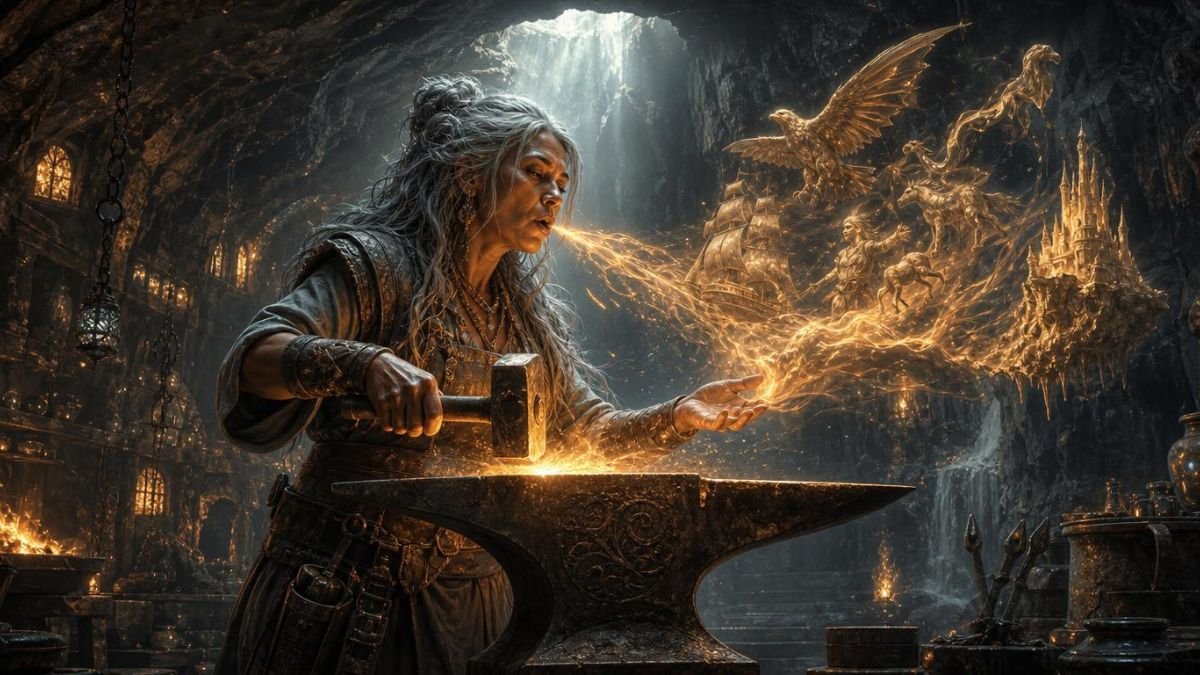
At the summit there was a door in the rock, and behind the door a forge, and at the forge stood the smith.
She was older than language. Her arms were bare and scarred with the faint shapes of things that had not been invented yet. Her hair was the color of cooling steel. She did not look up when Talwen entered. She only said, "Mind the sparks. They bite."
"I was told you could hammer words into being," Talwen said. His voice came out small and crooked, the voice of a man who had been crying for a week and did not yet know it.
"I can hammer truths," the smith answered. "Words are only the shape we squeeze them into. What did you bring me?"
Talwen opened his mouth and the silence fell out, heavy as a stone, and clanged against the anvil.
The smith studied it. She turned it over with her tongs. "Ah," she said softly. "A child's last quiet. These are the hardest. They want to be other things."
She set the silence on the anvil and lifted her hammer.
"Wait," Talwen said. "I came to ask you to forge her name. Liora. I want her back. I want—"
"You want a daughter," said the smith. "But you brought me a silence. The forge can only shape what you bring it. Tell me her name with your whole mouth, with your whole life. Speak her like you spoke her on the morning she was born."
Talwen could not. He had spent so many weeks not saying the name that the name had grown thorns. He opened his lips and what came out was a sob the size of a country.
The smith caught it in her tongs and laid it on the anvil. She struck once. The sob became a sound. She struck twice. The sound became a syllable. She struck a third time, and Talwen heard, distant as a memory, the laugh his daughter used to make when he chased her around the well.
"Again," said the smith. "Speak."
"Liora," Talwen breathed. "Liora, who was afraid of moths. Liora, who pretended to read before she could. Liora, who asked me why the moon followed only the people it loved."
Each word he gave her, the smith struck into the iron. The forge sang. Sparks rose like small bright birds. And Talwen understood, slowly, what was being made.
It was not his daughter. He had known, perhaps, since the first step of the climb.
It was a story.
The smith lifted it from the anvil, glowing. It was the shape of a small bright girl made entirely of spoken light. She turned to look at Talwen with eyes the color of every memory he had ever refused to bury.
"She will live as long as you speak her," the smith said. "Tell her to your neighbors. Tell her to strangers. Tell her on the days you would rather forget. Each telling will feed the forge. Each silence will starve it."
"That is not the same," Talwen said, and his voice broke.
"No," said the smith. "But it is not nothing. The world is built of these. Look around you."
And Talwen looked, and saw, for the first time, that the walls of the forge were lined with such small bright shapes: lost mothers, lost villages, lost languages, lost gods. Each one a story someone had refused to stop telling. Each one alive in the strange, stubborn way that stories are.
He took the shape of his daughter in his hands. She was warm.
He walked down the mountain slowly, and on the salt road he met a stranger, and before he could stop himself, he said, "Let me tell you about Liora. She was afraid of moths."
The stranger sat down to listen.
Behind him, the mountain moved one careful inch closer to the sea.
Author's Commentary
I wrote this story for everyone who has ever lost someone and discovered, with a strange kind of horror, that grief is mostly silence. We expect mourning to be loud. It is usually the opposite. We stop saying the name because the name has become a wound, and then one day we realize the silence has become the wound instead.
The Story Forge is my answer, or at least my offering. We cannot bring people back. But we can refuse to let them disappear. Every time we say the name of someone we have lost, every time we tell a strange child the story of a grandmother they will never meet, we are doing what Talwen does at the bottom of the mountain. We are feeding the forge.
I also wanted to suggest something about storytelling itself, which has been my work for most of my adult life. A story is not a substitute for a life. But it is not a small thing either. Civilizations are made of them. Religions. Families. The fact that you, reading this, can briefly feel the warmth of a fictional child you have never met is, I think, evidence of something quietly miraculous about being human.
Discussion Questions
Who in your life has gone unspoken too long, and what would it cost you to say their name aloud today? Do you think stories preserve people, or do they slowly replace them with something more bearable? If the smith asked you to bring her your heaviest silence, what would you carry up the mountain?
A Small Call to Action
Tell someone, this week, a story about a person they have never met. A grandparent. A neighbor. A friend you lost. Speak the name out loud, even if your voice shakes. The forge is hungrier than you think, and it has been waiting.




0 Comments