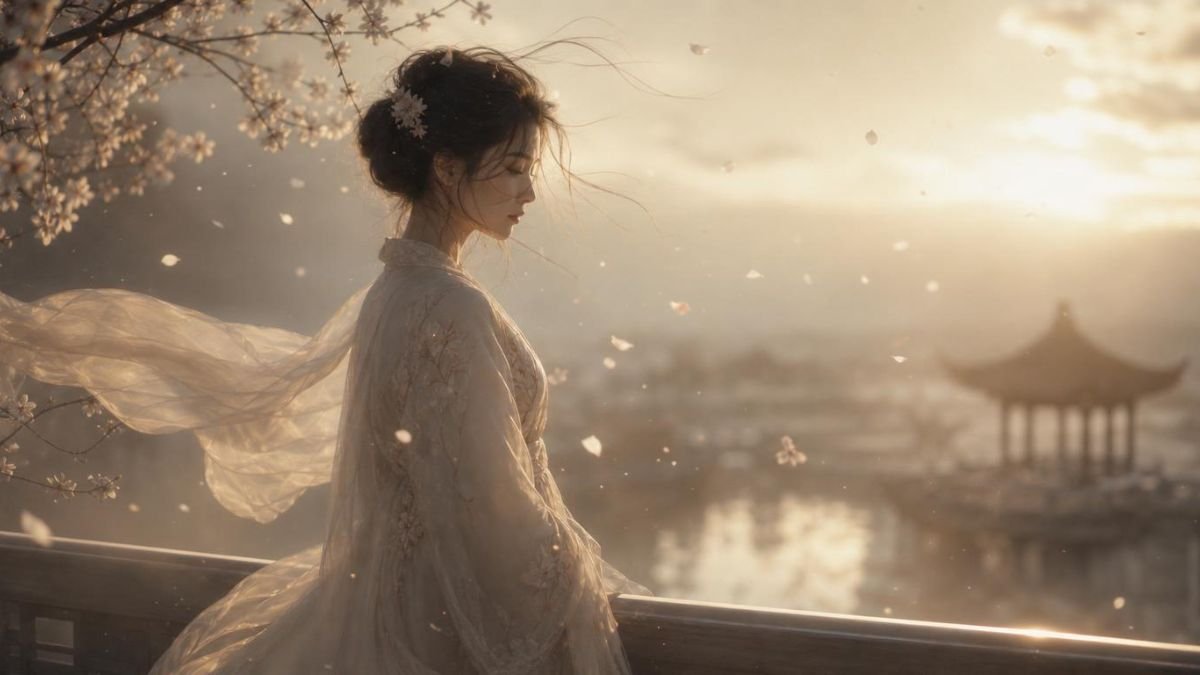
Would you love anything at all, if it were guaranteed to last forever?
Be honest with yourself before you answer. Because I think we tell ourselves we want permanence — we want the moment to freeze, the summer to stretch out, the people we love to stay exactly as they are. But I wonder if we'd actually want that, if we could have it. I wonder if the thing that makes a moment precious is precisely the thing we keep wishing we could remove: the fact that it's leaving.
Fleeting. Even the word won't hold still. Say it slowly — fleeting — and notice how it barely touches the ground before it's gone. It comes from an old word meaning to float, to drift, to flow away. It's related to fleet, as in a fleet of ships sailing over the horizon, and fleet as in fleet-footed, fast, already halfway gone. It's a word built entirely out of motion. You can't say fleeting about something that stays. The word itself is a kind of goodbye.
And we're surrounded by fleeting things. The whole world is, if you look. A sunset holds its most impossible color for maybe ninety seconds before it fades. Snow that catches the light and is water by the time it lands in your hand. A song you loved at seventeen that will never sound exactly that way again, because you'll never be seventeen again to hear it. Your child's voice at four years old — you know, even as you hear it, that it's already dissolving, that in a year it'll be gone and you won't have noticed the last time it happened.
That's the ache of fleeting things. We almost never get to know when the last time is the last time. The last time you're carried. The last time your whole family sleeps under one roof. The last ordinary Tuesday with someone before everything changes. It slips past dressed as an ordinary moment, and only later, looking back, do you realize you were standing inside something that would never come again.
There's a phrase for this in Japanese — mono no aware — and it doesn't quite translate, but it points at something like the gentle sadness of things, the tender ache you feel because you know they won't last. The cherry blossom is the great symbol of it. It blooms in an explosion of pink, and within a week or two, it's gone, drifting down like snow. And the culture that loves it doesn't love it despite that. It loves it because of that. If the blossoms stayed all year, people wouldn't gather under them and weep a little. It's the leaving that makes them holy.
And here's the quiet turn I want to offer you. We spend so much energy fighting the fleeting — trying to preserve, to capture, to save, to make things stay. We photograph the sunset instead of watching it. We narrate the moment instead of living inside it. And in trying to keep the fleeting thing, we sometimes miss it entirely. Because a fleeting thing can only be met one way: by being fully there while it's here. There's no other option. You can't save it for later. Later is exactly what it doesn't have.
This is why our instinct to capture everything is such a quiet tragedy. We stand in front of the sunset and reach for a camera, because some part of us panics at the leaving and wants proof, wants to keep it, wants to smuggle the moment out of time and into something permanent. And I understand that instinct completely. But watch what it does. In the seconds you spend framing the shot, adjusting it, checking whether it came out — the actual sunset, the real one, the one that was only ever going to happen once, has moved on without you. You traded the fleeting thing for a picture of the fleeting thing. And the picture, later, will never once give you back what you felt. It'll only remind you that you were there, half-looking, when the sky did something impossible.
That's what fleeting things teach, if we let them. They teach presence — not as a wellness slogan, but as a hard, unavoidable fact. The reason to be here now isn't that being present is virtuous. It's that now is the only place the fleeting thing exists. Miss now, and you've missed it. There's no rerun. The blossom won't wait for you to look up.
And maybe that's the strange gift buried inside the word. If everything lasted forever, nothing would ask for your attention. You could always come back tomorrow. Nothing would be urgent, and so nothing would be precious. It's mortality — the fact that things end, that you end, that this end — that hands each moment its weight. The fleeting nature of things isn't the flaw in the design. It might be the whole point of it. It's what turns time from a flat, endless line into something that glows.
So no — I don't think you'd love anything at all if it lasted forever. I think forever would drain the color out of everything. I think the leaving is the loving. I think we are able to hold things dear precisely because we cannot hold them long.
There's a freedom in accepting that, too. Once you stop demanding that beautiful things stay, you can finally enjoy them while they're here. You stop bracing against the ending and start living inside the middle. The blossom is falling? Yes. It was always going to. So look at it now, while it's still in the air.
Here's what I'll leave you with, and I mean it as a real question, not a rhetorical one. If the things you love are fleeting — all of them, every single one — then what are you doing right now, in this fleeting moment, that you'll wish you had noticed while it was still here?


0 Comments