- The Immortality You Never Asked For
- The Legal Tangle
- The Memorialization Economy
- The AI Resurrection Question
- Digital Legacy as Cultural Memory
- What You Can Actually Do
- LET’S GET CRITICAL
- FANTASTIC GUEST
- THE EDUSTORY | The Gardener of Threads
- AUTHOR’S COMMENTARY
- LET’S DISCUSS
- “WHAT NOW?” FRAMEWORK & 7-DAY PLAN
- LANGUAGE FOCUS: VOCABULARY AND SPEAKING
- LANGUAGE FOCUS: GRAMMAR AND WRITING
- Let’s Play & Learn
- Check Your Understanding | Quiz
The Immortality You Never Asked For
Nobody sits down to plan their digital estate. You plan your will, maybe — if you are the organized type, or if someone in your family scared you with a story about a distant cousin and a disputed lakehouse. You plan your funeral arrangements, possibly. You might even have an awkward conversation with your family about what to do with the record collection. But your Google account? Your twelve years of Instagram posts? The 47,000 text messages on your phone, including the ones you definitely should have deleted? These things have a way of slipping through the cracks of mortal planning.
And yet here is the reality: digital data is remarkably persistent. The servers that host your accounts are not sentimental, but they are sturdy. Your Facebook profile, your email archives, your cloud storage full of blurry photos from weddings you barely remember attending — all of this will outlast you, absent deliberate action to the contrary. We are the first generation of human beings to face this reality in any meaningful way, and most of us are handling it by not thinking about it at all.
This is worth thinking about. Not in a morbid way — or at least, not only in a morbid way — but because the questions it raises are genuinely profound: Who owns a dead person’s data? What happens to the people left behind who want access to it? Can a digital presence constitute a form of legacy, the same way a published book or a painted portrait does? And perhaps most unsettling of all: should we be building AI systems that can simulate dead people, and if so, what does that do to grief, to memory, and to the nature of identity itself?
The Legal Tangle
Let us start with the practical, because the practical turns out to be a mess. When you sign up for any major platform — Apple, Google, Facebook, Amazon — you agree to terms of service that typically state, somewhere in the fine print that exactly no one reads, that your account is personal and non-transferable. This means that, legally speaking, when you die, your account does not pass to your heirs the way your furniture does. It reverts, in a sense, to the platform.
What this looks like in practice has generated some genuinely heartbreaking legal cases. There was the family of a German teenager killed in a train accident who spent years in court fighting Facebook for access to her account — they wanted to read her final messages to understand whether her death was an accident or a suicide. Facebook initially refused on grounds of privacy. A German court eventually ordered access in 2018, but the legal process took five years and required the family to fight all the way to the Federal Court of Justice. Five years. For access to their own daughter’s thoughts.
Apple has similarly resisted providing access to deceased users’ accounts, and for years had no official policy for handling such requests at all. It took a grieving father in Arizona — who had to obtain a court order just to access his late wife’s iPad photos — before Apple finally introduced a Legacy Contact feature in 2021, allowing users to designate someone who can access their account after death. It was a straightforward, obviously necessary feature. It took a lawsuit and a decade of people dying with locked devices to get it.
The legal landscape is improving, slowly and unevenly. The Revised Uniform Fiduciary Access to Digital Assets Act, adopted in varying forms by most U.S. states, creates a framework for digital estate planning. The European Union’s General Data Protection Regulation takes a different approach, treating the data of deceased persons as generally outside its protections — leaving the question to member states, who have handled it inconsistently. The upshot is that if you die without having made explicit provisions for your digital accounts, the process of accessing or inheriting them can be legally complex, emotionally exhausting, and, in some cases, simply impossible.
The Platforms Have the Power
The uncomfortable reality at the center of all of this is that the platforms hold the power. They wrote the terms. They control the servers. They decide, ultimately, whether a grieving family gets access or gets a politely worded denial. This is not merely an abstract legal observation. It means that some of the most intimate records of a human life — conversations, photographs, journals written in the form of social media posts — are held in private custody, subject to corporate decisions that may have nothing to do with the wishes of the person who created them or the needs of the people who loved them.
The Memorialization Economy
Platforms have responded to the reality of user death in a variety of ways, some more thoughtful than others. Facebook introduced memorialized accounts, in which a deceased user’s profile is preserved and accessible to friends and family for remembrance but the account can no longer be logged into. A designated Legacy Contact can manage the account — posting remembrances, responding to friend requests — but cannot read private messages or change significant account settings.
Google has an Inactive Account Manager, which allows users to set up an automated plan: after a defined period of inactivity, designated contacts can be notified and given access to specified data. Twitter, now X, will deactivate an account upon proof of death if requested by a verified family member, but does not provide access to private data. Instagram follows a similar memorialization model to Facebook.
What is interesting about these policies is not only what they allow but what they reveal about how platforms think about death. They have built systems that preserve the appearance of a person — the profile, the posts, the public-facing archive — while carefully maintaining control over the infrastructure beneath it. A memorialized Facebook account is not really an estate. It is a display case. The actual data — the messages, the behavioral patterns, the vast machine-learning-friendly archive of preferences and interactions — remains with the company, quietly.
The Business of the Dead
And this raises a question that does not get asked often enough: what are companies doing with the data of dead users? Legally, in most jurisdictions, the answer is: whatever they were doing with it before, unless specific deletion is requested and honored. The terms of service do not typically include a “death clause” that halts all data processing. In a world where data is routinely used to train AI systems, to refine algorithms, and to build behavioral models, the data of deceased users is potentially just as valuable as the data of living ones — and considerably less likely to complain about how it is being used.
The AI Resurrection Question
This is where we enter territory that is genuinely new, genuinely contested, and — depending on your philosophical disposition — either deeply comforting or profoundly disturbing. Over the past several years, a small but growing industry has emerged around what might be called digital resurrection: the use of AI to create interactive simulations of deceased individuals, based on their existing data.
The most prominent example is the company HereAfter AI, which offers a service allowing people to record their stories and memories during their lifetime, which are then made available to family members as an interactive AI after their death. A related company, StoryFile, worked with the actor William Shatner to create an interactive AI version of himself — a project that raised immediate questions about what would happen to that simulation after Shatner himself died.
More controversially, the startup Eternos — and others operating in the same space — offer services that can generate a simulation of a deceased person using their existing digital footprint: their social media posts, their emails, their texts, their voice recordings. Using large language models and voice synthesis, these services claim to produce an entity that speaks, responds, and even jokes in a manner consistent with the person it is based on.
The Ethics of Speaking for the Dead
The ethical questions here are significant and genuinely unresolved. Does a person have the right to consent — or to refuse consent — to being digitally resurrected? Most people have never thought about this question, which means the default answer is usually determined by whoever holds the data and whoever holds the grief. If your family wants to create an AI version of you and they have access to your digital footprint, there may be nothing in current law to stop them, regardless of what you would have wanted.
There is also the question of grief itself. Does interacting with an AI simulation of a deceased loved one help the grieving process or distort it? The psychology research on this is nascent, but early indicators are cautious. Some grief counselors worry that these simulations may complicate the acceptance stage of mourning by providing a substitute for the person rather than a path toward living without them. Others argue that any technology that reduces suffering is worth using, and that humans have always found ways to maintain symbolic relationships with the dead — through photographs, through rituals, through the stories we tell about them.
What seems clear is that AI resurrection raises questions that photographs and rituals do not: the simulation can respond. It can generate new content. It can, in a meaningful sense, participate in a conversation. Whether what it produces has anything to do with what the actual person would have said is a question that neither the technology nor its proponents tend to answer with much directness.
Digital Legacy as Cultural Memory
Stepping back from the individual and the legal, there is a larger cultural dimension to all of this that deserves attention. The aggregate of our digital data — the vast, sprawling, searchable archive of what hundreds of millions of people posted, searched, shared, and said across a generation — constitutes something genuinely unprecedented in the history of human civilization. No previous era has left anything like this record.
Historians of future centuries will have access to the inner lives, the daily rhythms, the opinions and anxieties and jokes of ordinary people at a level of granularity that is simply not available for any previous period. The diary of a medieval peasant is an almost unimaginable treasure. In two hundred years, the equivalent of ten billion simultaneous diaries will be available, if anyone can figure out how to access and interpret them.
This is, depending on your perspective, either a remarkable gift to the future or an extraordinary privacy violation in both directions — committed by the present against the future, and by future generations against the present. The people who posted their most intimate thoughts on early-2000s LiveJournal blogs almost certainly did not contemplate the possibility that digital archivists would still be mining those posts for cultural insight in the twenty-third century.
What You Can Actually Do
Given all of this, the practical question becomes: what should you do? The answer, frustratingly, is that most people do nothing, and the gap between what is legally possible and what people actually arrange is enormous.
At minimum, the experts in digital estate planning recommend: creating a document that lists all your digital accounts and passwords, stored somewhere secure and accessible to a trusted person; designating Legacy Contacts or equivalent features on platforms that offer them; deciding explicitly what you want to happen to each major account — preserved, deleted, or transferred; and incorporating your digital estate into any formal will or estate plan with the help of a lawyer who knows what they are doing in this area.
Beyond the practical, there is a philosophical decision each of us faces: what kind of digital presence do we want to leave behind, and for whom? The answer to that question is not a legal or technical matter. It is a deeply personal one, and it is one that most of us are currently leaving to chance — or to the terms of service.
LET’S GET CRITICAL
The article you just read makes a strong case for taking digital legacy seriously — the legal tangle, the ethical questions around AI resurrection, the unprecedented cultural archive we are building. All of that is real and important. But there are several threads in this conversation that deserve to be pulled harder, and some assumptions in the mainstream digital legacy discourse that are worth questioning.
Start with the framing of digital legacy as primarily a problem of access and preservation. The implicit assumption running through most discussions of this topic — including, to some extent, the article above — is that more access to a deceased person’s data is generally better than less. Families should be able to access their loved one’s accounts. Digital estates should be inheritable. The record should be preserved. But this framing takes as given something that is actually quite contested: the idea that a person’s digital footprint is a meaningful representation of who they were.
Consider what your digital data actually captures. It captures what you searched for, what you posted publicly, what you messaged to other people in what you believed was a private context. It does not capture the texture of your daily thinking, the things you considered and decided not to say, the kindnesses that left no digital trace, the person you were in a room when no devices were present. A family that gains access to a deceased person’s complete digital archive may find that what they receive is simultaneously overwhelming in volume and surprisingly thin in the things that actually mattered. More data is not necessarily more understanding.
This connects to a deeper problem with the AI resurrection discussion. The article presents digital resurrection as an ethical gray area, which it is. But one thing that does not get said clearly enough is that these systems are, structurally, impressive hallucinations. A large language model trained on your text data will generate outputs that sound like you, but the mechanism by which it does this is pattern matching and statistical prediction — not memory, not understanding, not anything resembling the actual cognitive and emotional processes that made you who you were. When a grief-stricken parent talks to an AI trained on their child’s texts, what they are talking to is not a version of their child. They are talking to a very sophisticated mirror of their own expectations, shaped by training data that the child produced in a completely different context and with no anticipation of this use.
The danger here is not just philosophical. There is genuine psychological risk in systems that blur the distinction between simulation and person. Our capacity for grief depends, at some level, on the reality of loss — on the recognition that the person is gone and will not return. A technology that creates a persistent, responsive simulacrum that can be interacted with indefinitely is not a tool for processing grief. It may be a tool for indefinitely deferring it. The grief counselors who have raised this concern are not being sentimental or technophobic. They are applying professional knowledge about how human minds process loss, and their caution deserves more airtime than it typically gets.
There is also a power and equity dimension that the article touches on but does not fully develop. The companies building digital legacy tools — the HereAfter AIs and Eternoses of the world — are not charities. They are commercial entities operating in a largely unregulated space, building businesses around one of the most emotionally vulnerable markets imaginable: people in grief, people facing their own mortality, people who would give a great deal to have one more conversation with someone they have lost. The potential for exploitation in this market is enormous, and the current regulatory framework offers almost no protection.
The data sovereignty question also runs deeper than the article’s framing suggests. When we talk about families wanting access to their loved ones’ accounts, we tend to discuss it as though the only parties involved are the family and the platform. But those accounts contain conversations with other living people — people who may have shared things in what they believed was a private exchange with the person who is now dead, and who have a legitimate privacy interest in those communications. The right of a family to read their deceased daughter’s messages is not simply the family versus the platform. It is also the family versus every person who sent that daughter a private message and never consented to a third party reading it.
Finally, and perhaps most importantly, we need to be much more honest about the class and cultural dimensions of digital legacy planning. The advice to “consult a digital estate lawyer” and “create a comprehensive digital asset inventory” is sound, but it describes a practice that is accessible primarily to people with the time, education, and resources to engage with it. The people most likely to die young — due to poverty-related health outcomes, violence, or occupational hazard — are also the people least likely to have arranged their digital estates. Their families may be the ones who most acutely need access to a deceased person’s device or account and the ones with the fewest legal resources to pursue it. A conversation about digital legacy that does not grapple with this disparity is, at minimum, incomplete.
FANTASTIC GUEST
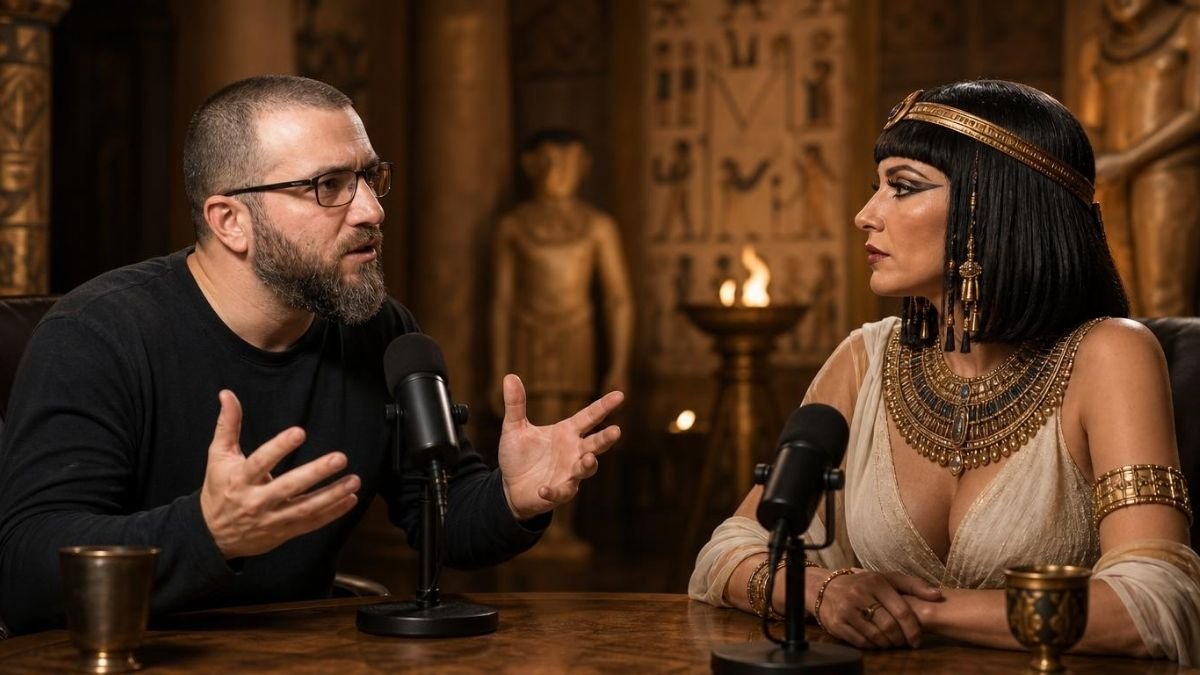
A Conversation with Jorge Luis Borges
Jorge Luis Borges (1899–1986) was an Argentine writer, poet, and essayist whose labyrinthine fictions explored infinity, identity, time, and the nature of knowledge. His concepts of the infinite library, the double, and the impossibility of complete understanding make him, arguably, the philosopher of the internet age who never lived to see it.
Danny: Jorge Luis Borges, welcome to English Plus Magazine. I should note for anyone unfamiliar with you that you were one of the greatest writers of the twentieth century, a master of labyrinths, mirrors, infinite libraries, and the nature of identity and time. Which means you are, frankly, overqualified for this conversation about search histories and server farms.
Jorge: I spent my life writing about infinite archives and the nature of memory’s relationship to identity, and you are surprised I have something to say about the internet? I am perhaps the only person who should have been consulted before any of this was built.
Danny: Fair point. Let’s start with the concept that runs through so much of your fiction — the infinite library, the idea of a total record of human thought and experience. We now have something that at least gestures toward that. How does the internet compare to what you imagined?
Jorge: The Library of Babel, as I conceived it, contained every possible book — including books of pure nonsense, books that contradicted each other, books whose meaning no one could discern. What struck me about that library was not its abundance but its fundamental uselessness. The existence of every possible book does not mean the existence of knowledge. It means the existence of an infinite noise in which signal is almost impossible to locate. Your internet strikes me as remarkably similar in this respect. It contains everything, and therefore, in a meaningful sense, it contains nothing. Everything is equally accessible and therefore equally inaccessible.
Danny: That’s a rather dark view of the greatest information system ever built.
Jorge: I am Argentinian. We are constitutionally predisposed to find the melancholy in any triumph. But I am serious. The illusion of the internet is that abundance is the same as richness. A library of a trillion books in which you can never find the right one is not a treasure. It is a particular kind of torture. Borges designed that library as a hell. You built it as a commercial product.
Danny: On the topic of digital legacy specifically — the idea that our data persists after we die, that our digital footprint constitutes a kind of ongoing presence — what do you make of that?
Jorge: I find it both fascinating and philosophically sloppy. The question of what constitutes identity after death has occupied philosophers and mystics for millennia, and it is not a question that data storage answers. When people say that someone “lives on” in their digital legacy, they are using the word “lives” in a way that would have embarrassed even the most credulous Victorian spiritualist. A collection of recorded behaviors is not a person. It is a collection of recorded behaviors. My published work will outlast me — it already has, as I died in 1986. Do you think of that as me living on?
Danny: I think many people would say yes, actually.
Jorge: And they would be wrong in a very interesting way. What lives on in my writing is something I made, something I chose to make public, something that was crafted with the explicit intention of communicating. The relationship between that work and my actual interior experience is complicated and partial. A text message someone sent at two in the morning to a person they were arguing with is not like that. It is a fragment, a moment, without context. To compile such fragments and call the result a person is to confuse the shadow with the body that cast it.
Danny: The shadow with the body — that’s very you.
Jorge: Everything I say is very me. I have had decades of posthumous existence to refine the brand.
Danny: Let me ask you about the AI resurrection question. Companies are now building services that claim to simulate deceased individuals using their data — their texts, emails, social media posts. What do you think of that?
Jorge: I wrote a story called “The Circular Ruins,” in which a man devotes his entire life to dreaming another man into existence — to creating, through sustained imagination, a being who is real enough to walk into the world. At the end of the story, he realizes that he himself is someone else’s dream. That discovery, the horror and wonder of it, is what gives the story its power. Your AI resurrection services are attempting something similar: to dream a person into continued existence using data as the raw material. But they have missed the essential point of the exercise. In my story, the dreamed man does not know he is a dream. The moment he finds out, the dream collapses. Your AI simulations do not know they are simulations either. But the people talking to them do. And that knowingness — that awareness that you are speaking to a sophisticated pattern rather than a person — undermines everything. The comfort is hollow because the pretense is transparent.
Danny: Unless you choose to believe it.
Jorge: Ah. And now we have arrived at the most dangerous part of the conversation. Yes, people can choose to believe things they know are not true. They do it constantly, with religion, with hope, with love. But there is a difference between a productive fiction that helps a person live and a technology that profits from that fiction. One is a coping mechanism. The other is a business model. I find myself considerably more sympathetic to the former.
Danny: You spent your life writing about doubles, about mirror images, about the idea that identity is unstable and maybe even illusory. Does the concept of a digital legacy change how you think about the self?
Jorge: It confirms what I always suspected, which is that the self is a story we tell about ourselves, revised constantly, never completed. What your digital data captures is a series of drafts — early drafts, provisional drafts, drafts written in different moods by what are almost different people. The person who tweeted in 2009 is not the same person who tweeted in 2019. To compile these drafts and call the result an identity is like binding together every version of a manuscript, including the ones the author burned for good reason, and calling it the definitive text.
Danny: Do you think we should be worried about what we are building?
Jorge: I think you should be worried about what you are not thinking about. The technical problems — the storage, the access, the simulation — are relatively tractable. The philosophical problems are not. You are building systems that will outlast the people who built them, that will be used in ways that were never intended, that will create relationships between the living and the dead that human culture has never had to navigate before. And you are doing all of this very quickly, with great commercial enthusiasm, and essentially no philosophical oversight whatsoever.
Danny: On that cheerful note —
Jorge: I wrote labyrinths, Danny. I specialized in cheerful notes.
Danny: —Jorge Luis Borges. Thank you very much for being with me today on English Plus Magazine.
THE EDUSTORY | The Gardener of Threads
Rafael had been dead for eleven months when his daughter found the folder.
It was on the laptop she had borrowed from him two Christmases ago and never quite gotten around to returning — the old one, the one with the cracked hinge and the peculiar habit of making a sound like a small animal when it heated up. She had been meaning to give it back since the January before last. Now it sat on her kitchen table in Tucson with the particular heaviness of things that have become impossible to return.
The folder was called MISC and it was full of voice memos.
Valentina did not open it that night. She made tea instead, and then made it again when the first cup went cold, and then went to bed and lay awake in the small hours thinking about the folder the way you think about a letter that you know will change something and are not ready to have changed.
In the morning she opened it.
There were 214 recordings. The earliest was dated March 7th, six years ago. The most recent was four days before his stroke.
She pressed play on the most recent one.
“Okay, so,” her father’s voice said, slightly too close to the microphone, “this is the one about the fig tree.”
He had been a gardener. Not professionally — he had been an accountant for thirty years, meticulous and mild, the kind of man whose ties were always slightly too wide for the decade he was living in. But on weekends and after work, in the small yard behind the house in Albuquerque, he had grown things with a concentration that seemed, to Valentina as a child, almost meditative. Tomatoes, peppers, herbs in clay pots. And one enormous fig tree that predated him by at least thirty years and that he had tended with a reverence she had always found slightly theatrical.
In the recording, he talked for seven minutes about how to prune a fig tree in autumn. Not as instruction — he was not giving a tutorial. He talked the way people talk when they are thinking aloud, circling around something, testing the shape of it. He talked about the difference between cutting away what was dead and cutting away what was merely dormant. He talked about how the tree looked skeletal after pruning and how that always made him nervous for about two weeks before the spring growth made it obvious he had done the right thing.
“You have to trust what you can’t see yet,” he said at the end, and then there was a long pause and then the recording stopped.
Valentina sat at the kitchen table for a long time after that.
She called her brother in Seattle that evening. Marco answered on the fourth ring, sounding slightly breathless, and she could hear in the background the particular entropy of his apartment — music, children, something being dropped.
“I found voice memos on Dad’s old laptop,” she said. “Two hundred and fourteen of them.”
There was a pause. “From when?”
“Six years back. The last one is from four days before.”
Another pause. In the background, a child said something emphatic in what sounded like Spanish.
“What are they about?” Marco asked.
“The fig tree, mostly. I’ve only listened to one.”
“The fig tree.” She could hear him processing this. “Of course the fig tree.”
Their father had never, to Valentina’s knowledge, kept a diary. He was not a writer. He had not been a man of many words in person — he listened carefully and spoke carefully and the things he said tended to be simple and accurate. She had not expected the recordings to be beautiful, and they were not, exactly. But they were something she did not have a word for. They were him in a register she had not had access to while he was alive. The private register. The thinking-out-loud register.
She asked Marco if she should share them and he said yes without hesitating, and she sent him the folder, and then she lay awake again thinking about what she had done.
In the weeks that followed, she worked her way through them slowly, the way you might eat something rare and irreplaceable. There was a recording from four years ago about a disagreement he’d had with a colleague — not angry, just methodical, turning the thing over, deciding. There was one from three years ago that was clearly recorded during a drive, the road noise underneath his voice, about how he felt about retiring. There was one from two years ago, at what sounded like night, that was barely two minutes long and that said almost nothing she could parse, just some observations about a documentary he had watched, and then a long silence, and then: “I think I miss your mother more in autumn. I don’t know why that is.”
Her mother had died when Valentina was nine.
She listened to that one three times and did not tell Marco about it.
A friend of hers — a therapist named Claudia, who had the particular quality of being someone you both wanted to tell everything to and were slightly afraid of — asked Valentina over lunch how she was doing with the recordings.
“I keep worrying I’m doing something wrong,” Valentina said.
“Wrong how?”
“Like I’m reading his diary without permission. Or like —” She stopped. “Like I’m holding on to something in a way that’s not healthy.”
Claudia tilted her head, which was her way of declining to answer directly. “What does it feel like when you listen to them?”
Valentina considered. “Like he’s still thinking. Like the thinking is still happening somewhere.”
“And is that comforting?”
“I don’t know. Sometimes yes. Sometimes it makes it worse because I know it stopped.”
She did not start listening to them every day. That was one of the things she was careful about, without fully articulating to herself why. She kept them the way you keep something precious — occasionally, with awareness, not as routine.
Four months after the discovery, Marco called her from a voice-memo app he had found. He said it used AI to generate responses based on the audio files. You could, he said, apparently have a kind of conversation with the recordings — the system would take the new input and generate a response in the same vocal style and register. He said some people found it helpful. He said a friend from work had used something similar after his father died.
Valentina said: “I don’t think so.”
“You sure?”
“Yeah.”
There was a pause. “How come?”
She thought about the recording with the autumn silence in it, the one about missing their mother. She thought about her father’s voice in that recording — not performing anything, not speaking for any audience, just inhabiting a moment of private feeling at nighttime in a house she had not visited in three years.
“Because he wasn’t talking to me,” she said. “He was just talking.”
Marco was quiet for a moment. Then he said: “Yeah. Okay. Yeah, I get that.”
She drove to Albuquerque the following spring — not for any particular reason, or not a reason she could easily have explained. The house had been sold eight months ago to a young couple with a toddler and a large amiable dog. She drove past it without stopping.
The fig tree was visible from the road. It was enormous and apparently healthy, its new leaves that particular bright tender green that early spring produces. The new owners had probably no idea what they had. They had probably just been told there was a fig tree in the yard and thought, fine, a fig tree.
She did not stop. She drove past slowly and then took the long way out of the neighborhood, and she thought about the recording with the pruning instructions — “you have to trust what you can’t see yet” — and something in her chest that had been tight for eleven months loosened by a degree she could feel but not measure.
She drove back to Tucson in the early evening, with the desert going gold and purple around her, and she thought about her father’s voice, and about how the recordings were not him, exactly, but were something that had been inside him that he had put outside himself, for reasons of his own, and how that was different from nothing. Different from nothing in a way that mattered.
She still had 119 recordings she had not listened to.
She was in no hurry.
AUTHOR’S COMMENTARY
Let me start with what I was trying to avoid, because it’s as important as what I was trying to achieve. The obvious story to write about digital legacy is the tech story — the one where a grieving relative discovers an AI resurrection service and uses it, and something goes either hauntingly right or catastrophically wrong. That story would have been thematically transparent and emotionally tidy, and I didn’t want to write it. I wanted to write something that came at the material sideways.
The discovery of the voice memos felt like the right angle because it sits at a precise intersection of the article’s themes without dramatizing any of them directly. Voice memos are a form of digital data. Their accidental preservation is a form of digital legacy — unplanned, unsought, discovered rather than inherited. And what they preserve is not a curated self (unlike a social media archive) but something much rarer: a person thinking privately. The drama of the story is entirely internal, which I think is the only honest register for a subject this intimate.
Rafael was designed to be someone whose inner life was not obvious to the people who loved him. This was important to me. A lot of the discourse around digital legacy focuses on the dramatic cases — the contested accounts, the AI resurrections, the legal battles — and there is a quieter version of the phenomenon that I think is actually more common and more revealing: the ordinary digital record of an ordinary person who never thought of themselves as leaving a legacy at all. Rafael’s voice memos were never intended for anyone. That is what makes them precious and complicated.
The fig tree is doing a lot of work in the story. It is a real thing — gardens are tangible, seasonal, mortal in their own way — and it operates as a structural counterweight to the digital material. When Valentina drives past the house at the end and sees the fig tree thriving under new ownership, the point is not sentimental. It is that something her father tended has an existence independent of memory, independent of data, independent of whether anyone remembers his relationship to it. The new owners don’t know. The tree doesn’t know. It grows anyway. This is not the same as legacy, and the story is not saying it is. It is just something else, something the digital archive cannot replicate.
The moment where Marco offers the AI response service and Valentina refuses it was the most technically important scene in the story, and I was careful not to editorialise. She doesn’t say the AI would be wrong or bad. She says: “He wasn’t talking to me. He was just talking.” This distinction is the heart of the story’s ethical position, stated quietly and once. The recordings have value precisely because they were not addressed to her — because they are a window into a private inner life rather than a message. An AI that “responds” to new input would collapse that distinction. It would convert the private into the interactive, the accidental into the intentional, and in doing so would lose the very thing that makes the recordings meaningful.
The character of Claudia (the therapist friend) exists to do what good secondary characters do: create the opportunity for the protagonist to articulate something they would not otherwise say aloud. Valentina’s line — “it makes it worse because I know it stopped” — is the most psychologically honest line in the story, and it required someone to ask the right question to draw it out. That line is also, I think, the story’s most precise statement about the nature of digital presence after death. It is not that the data is comforting or disturbing in itself. It is that the data creates a vivid sense of a continuing presence, and that presence is constantly interrupted by the knowledge of its own impossibility.
Marco is deliberate in his contrast with Valentina. He is warmer, quicker, more comfortable with technology, less likely to sit with ambiguity. When he immediately offers the AI service, it is not because he is less thoughtful — it is because he is handling the same grief with a different cognitive style, looking for interaction where Valentina is looking for understanding. Neither position is wrong. The story does not say his approach would be a mistake. It says it is not the right thing for her, and that her reason is valid.
The ending is unhurried because the story earns unhurriedness. Valentina has 119 recordings left. She is in no hurry. This is, I think, the most honest possible statement about what a good relationship to inherited data looks like: not consuming it quickly, not converting it into something interactive, not performing grief or processing it on any schedule. Just holding it, occasionally, with awareness.
LET’S DISCUSS
The only way knowledge becomes part of you is when you put it into words — your own words, in conversation with other people who are also thinking. Everything in this issue becomes sharper, more real, and more useful the moment you start talking about it. So here are five questions worth taking seriously.
Question 1
The article describes families fighting for years to access a deceased loved one’s accounts. But the “Let’s Get Critical” section raises a different question: does access to a person’s digital archive give you a genuine understanding of who they were, or does it give you a very large collection of fragments that you will inevitably misread?
Push both sides of this. Think about your own digital footprint — the texts sent in bad moods, the things you searched out of curiosity, the posts you made at twenty that you would not make today. If a family member read all of that after your death, would they understand you better, or would they construct a version of you that is both data-rich and somehow less true than the person you actually were? Is there such a thing as too much access?
Question 2
The Borges interview raises the idea that an AI trained on someone’s data is not a version of that person but “a sophisticated mirror of your own expectations.” If that is true — if the simulation is ultimately a reflection of the user rather than the deceased — does it still have value? And does the answer change depending on why someone is using it?
Think about the distinction between something that helps a person grieve and something that prevents them from grieving. Think also about whether it matters if the person using the AI knows it is not real. Does knowingness change the ethical calculation, or does it make no practical difference if the emotional effect is the same?
Question 3
The EduStory ends with Valentina refusing the AI service because “he wasn’t talking to me.” Is that a meaningful ethical distinction, or is it a rationalization for a preference she would have arrived at anyway for other reasons?
This is a question about moral reasoning — specifically, about whether we ever really know why we make the decisions we make about deeply personal things. What would it take to convince Valentina to change her mind? What would it take to convince you?
Question 4
The article notes that the aggregate of our digital data constitutes an unprecedented cultural archive — something historians of the future will find extraordinary. But whose data is being preserved, and whose is likely to disappear? Does the digital archive produce a more democratic historical record, or does it simply reproduce the same biases as every archive that came before it — preserving the articulate, the connected, and the people who could afford reliable internet access?
This is worth thinking about from the angle of history and power as much as from the angle of personal legacy. Who gets to be remembered? Who always got to be remembered? Has that changed, or have the mechanisms simply updated?
Question 5
The article says most people handle the reality of digital legacy by not thinking about it at all. Why do you think that is — and is there a version of the argument that not thinking about it is the right choice?
This last question is designed to be a little uncomfortable. We live in a culture that heavily rewards planning, preparation, and self-awareness. But there is also something to be said for the decision to let certain things take care of themselves, to not treat every aspect of life and death as a project to be managed. Is there a meaningful difference between avoidance and acceptance? Where is the line?
“WHAT NOW?” FRAMEWORK & 7-DAY PLAN
Before the seven-day plan, here is the framework that underlies it — a set of principles that try to hold in tension everything we have discussed, including the uncomfortable parts.
Principle One: Your data is not your legacy, but it is not nothing. The story and the Borges interview both push back on the idea that a digital archive is a genuine continuation of a person. They are right. But the article is also right that the archive matters — to families, to historians, to anyone who cared about the person. The framework tries to honor both: take your digital estate seriously without confusing it with the whole of who you are.
Principle Two: Planning is not morbid. It is kind. The families who spent years in court fighting for access to a loved one’s account were not unusual in their grief — they were simply unprepared. The practical steps available to you right now, taken an hour at a time, can spare people you love enormous difficulty.
Principle Three: The default is never what you would have chosen. If you do not make explicit decisions about your accounts, the default decisions will be made for you — by platforms, by their terms of service, by whoever happens to be holding your device when you die. Those defaults rarely align with what most people would actually want.
Principle Four: Less may be more. The instinct in the digital age is to preserve everything. But before you plan your digital legacy, it is worth asking what you actually want preserved, and what you would prefer to have quietly deleted. There is a digital equivalent of the instruction “burn the letters,” and it is legitimate.
Seven-Day Action Plan
Day One: The Inventory. Open a document and list every platform you use regularly — email, social media, cloud storage, subscription services, financial accounts. Do not worry about organizing it yet. Just know what you have.
Day Two: The Password Question. Look into a reputable password manager if you do not already use one. The single most practical barrier to digital estate management is that no one else knows your passwords. A password manager with a shared emergency access feature solves this.
Day Three: The Platform Research Day. For your three most important accounts, look up the current policy on death and account access. Many platforms now have legacy contact features. Check whether yours do and whether you have set them up.
Day Four: The Preference Document. Write a one-page document describing what you would want to happen to each major account: preserved, deleted, or transferred to a specific person. This does not need to be legal — it just needs to exist.
Day Five: The Conversation. Tell one trusted person — a family member, a close friend — where to find the preference document and the passwords. Have the conversation. It is shorter and less uncomfortable than you think.
Day Six: The Curation Day. Go through one significant digital archive — your photos, your social media history, your email. Delete the things you would be embarrassed by. Keep the things that matter. This is not macabre. It is editing.
Day Seven: The Bigger Question. Take thirty minutes to write — for yourself, not for anyone else — about what you would want people to understand about you that is not captured in your digital footprint. This exercise is not about morbidity. It is about the gap between the data and the person, and about sitting with that gap honestly.
The seven days are a beginning, not a completion. Digital estate planning is an ongoing practice, not a single event. But one week of focused attention is enough to transform the default situation — which is nothing — into a situation that is at least thought-about.
LANGUAGE FOCUS: VOCABULARY AND SPEAKING
The vocabulary in this issue is rich with words that cross legal, technological, philosophical, and psychological territory, and that is exactly what makes it worth spending time on. Let us walk through ten of the most important terms and look at how they work in context and in the wider world.
Start with “digital estate.” An estate, in the traditional legal sense, is everything a person owns at the time of their death — property, money, possessions — that can be passed on to heirs. The phrase “digital estate” extends this concept to intangible assets: your accounts, your data, your cloud storage, your digital subscriptions, even your cryptocurrency if you have any. What makes this phrase important is the legal work it is trying to do — it frames digital assets as things that can and should be managed, inherited, and planned for, rather than just left to the platform’s default settings. You can use this phrase in any context involving the management of online accounts after death: “She had made no plans for her digital estate, leaving her family in a difficult legal position.”
The word “memorialization” appears in the article’s discussion of how platforms handle deceased users. To memorialize something is to preserve it as a memorial — a tribute or reminder of someone who has died. Platforms use this term deliberately: a “memorialized account” sounds respectful, even reverential. But as the article notes, memorialization is also a way of maintaining control while appearing to offer access. The word carries emotional weight that its technical meaning does not fully earn. In everyday use: “The community created a small memorial garden in the park as a memorialization of the children who had died during the war.”
“Posthumous” is a word worth knowing thoroughly. It comes from the Latin for “after burial,” and it describes anything that occurs or comes into existence after a person’s death. Posthumous publications, posthumous awards, posthumous legal battles. The AI resurrection industry is creating a new category of posthumous existence — one that is interactive rather than passive — and the word stretches a little uncomfortably to cover it. “The novelist’s most celebrated work was published posthumously, based on a manuscript found in her study.”
“Data sovereignty” is a phrase that combines two individually familiar concepts into something important and underused. Sovereignty means supreme authority or control. Data sovereignty is the principle that people should have supreme control over their own data — including what is done with it, who accesses it, and what happens to it after their death. It is a concept more common in legal and policy discussions than in everyday conversation, but it is enormously relevant to this topic. “The new legislation strengthened data sovereignty by requiring companies to delete user data upon verified death, unless the estate holder requested otherwise.”
“Fiduciary” is a legal term that describes a person who has a legal and ethical obligation to act in the best interests of another. A fiduciary duty is a duty of care and trust — it is what a lawyer owes a client, or a financial advisor owes an investor. The Revised Uniform Fiduciary Access to Digital Assets Act applies this concept to digital estate management, creating a formal legal framework in which someone can be designated as a fiduciary with responsibility for a deceased person’s digital accounts. “She was named as fiduciary for her father’s estate, which meant she had both the legal authority and the legal responsibility to manage his assets carefully.”
“Simulacrum” is a word borrowed from philosophy — Plato used it, and the French philosopher Jean Baudrillard made it central to his theory of postmodern culture. A simulacrum is a representation or likeness of something, particularly one that has come to be accepted as a substitute for the real thing. When the article discusses AI resurrection creating a simulacrum of a deceased person, it is using the word with its full philosophical weight — these systems do not just resemble the person, they are substitutes for the person, and the danger is that people may eventually treat the substitute as equivalent to the original. “The wax figure in the museum was an impressive simulacrum of the general, down to the buttons on his uniform, but something in its stillness made children uncomfortable.”
“Latent” means present but not yet active or visible — hidden potential, dormant quality. In the context of digital legacy, the data that a deceased person left behind is latent with information that may or may not be surfaced, depending on who accesses it and how. Voice memos unlistened to are latent communications. Emails unread are latent conversations. The word captures something true about archived data: its meaning exists in potential, not in fact, until someone engages with it. “The archivist believed the collection held latent historical significance that had not yet been recognized.”
“Provisional” means temporary, conditional, or subject to revision — not yet final. In the Borges interview, he describes the data in a person’s digital footprint as “provisional drafts” of identity — versions of the self that were produced in specific moments and specific moods and that should not be taken as definitive. This is a valuable way of thinking about your own digital archive: the things you said and searched and posted were provisional, not permanent expressions of who you are. “The committee approved a provisional budget pending a full financial review.”
“Non-transferable” is a legal term describing something that cannot be passed from one person to another. The terms of service for most major platforms specify that your account is non-transferable, meaning it is yours alone and cannot be given, sold, or inherited. This is the legal basis for the conflicts described in the article — the platform’s ownership of your account experience is, by contract, not something that survives you. “The concert tickets were marked non-transferable and could only be used by the person named on the booking.”
Finally, “aggregate” means a whole formed by combining many individual elements. The article uses it to describe the total of all human digital data — the vast, combined record that constitutes an unprecedented archive of human experience. Understanding the difference between individual data and aggregate data is important in the digital age: your individual search history may seem trivial, but the aggregate of billions of search histories constitutes an enormously powerful dataset. “The aggregate of student performance data across the district revealed patterns that no individual school’s records had made visible.”
For the speaking challenge, we are focusing on the skill of speaking about abstract and emotional topics with precision rather than vagueness. This is hard because our instinct when discussing death, grief, and identity is to speak in comfortable generalities. “It’s complicated.” “It’s different for everyone.” These are not wrong, but they are not very useful either. The practice is to take an abstract claim — say, “a digital archive is not the same as a person” — and make it specific and concrete in speech. Find a real example. Find an exception. Find the edge of where the claim stops being true.
The speaking challenge: choose one concept from this issue — digital legacy, posthumous data, AI resurrection, data sovereignty, or any other — and explain it to someone who has never encountered it before. You have three minutes. You may not use technical jargon without immediately explaining it. You must include at least one concrete example. Record yourself, play it back, and identify the moment where you reached for vagueness and ask yourself what specific thing you could have said instead.
LANGUAGE FOCUS: GRAMMAR AND WRITING
The writing challenge for this issue: Write a letter — not an email, a letter — addressed to someone you love, describing what you would want them to do with your digital presence after your death. This is a document you would not necessarily send. Its purpose is to make explicit something that most people leave entirely implicit, and in doing so, to practice one of the most demanding forms of personal writing: writing that is honest about death without being either morbid or sentimental.
This prompt is demanding in the best possible way, because it requires you to be specific about things you probably have not thought about specifically, and to write in a register that is simultaneously personal and practical.
Let us use this challenge to explore a set of grammar structures that are particularly important for this kind of writing.
The first is the use of conditional sentences to express wishes and hypotheticals. When writing about what you would want after your death, you are writing about a hypothetical future, and English has specific structures for this. The second conditional — “If you were to find my voice memos, I would want you to listen to them slowly” — expresses a hypothetical condition and its consequence. The third conditional — “If I had known this day was coming, I would have organized everything differently” — expresses a hypothetical about the past. These two structures carry very different emotional weight in a letter like this: the second conditional is forward-looking and planning; the third conditional is reflective and sometimes rueful. Knowing which one you need and when is a mark of advanced writing control.
The second structure is passive voice, used to shift the focus from actor to recipient. In a letter about digital legacy, passive voice is often exactly right: “My accounts should be deleted” rather than “You should delete my accounts.” The passive construction here is not evasive — it is genuinely appropriate for a situation where the emphasis should be on what happens rather than who does it. Understanding when passive voice serves the writing rather than obscuring it is one of the most useful things an advanced writer can learn.
The third structure is the use of relative clauses to add precision without adding sentences. “The photos folder, which contains the images from the last five years, is the one I would most want preserved” uses a non-restrictive relative clause (note the commas) to specify without a new sentence. “The folder that contains family photos” uses a restrictive relative clause to distinguish it from other folders. The difference between “which” and “that” in this context is not merely grammatical pedantry — it changes what you are communicating.
The fourth is hedging with modal verbs to acknowledge uncertainty. A letter about death involves a lot of appropriate uncertainty: you cannot know exactly who will be reading this or in what circumstances. Modal verbs — might, could, may, should — allow you to express degrees of certainty and obligation that are honest about this ambiguity. “You may find this strange” is more honest than “You will find this strange.” “You might consider preserving the messages from my mother” is more honest than “Preserve the messages from my mother.” Advanced writers use modals not because they are unsure of their meaning but because their meaning genuinely includes uncertainty.
Finally, practice the art of the short sentence for emotional weight. In formal writing, there is a tendency toward complexity and length. But in personal writing, the short sentence often does the most work. “Keep the photos. Delete the rest. Tell my brother first.” These short declaratives communicate decisiveness and clarity in a way that a longer, more syntactically complex sentence could not. The contrast between long, complex sentences and short, simple ones creates rhythm in personal writing — and rhythm is what carries the reader.
Let’s Play & Learn
Interactive Vocabulary Building
Crossword Puzzle
Word Search
Check Your Understanding | Quiz
Instructions: For each question, choose the best answer from the options provided. After each question, write a short justification explaining why you chose that answer. This justification is an important part of the exercise — it trains you to think, not just guess.
Part One: Comprehension Questions (Questions 1–15)
1. According to the article, what is the typical legal status of your online accounts when you die?
A) They automatically transfer to your next of kin
B) They revert to the platform due to non-transferable terms of service
C) They are immediately deleted after a grace period
D) They become public property accessible to anyone
Your Justification: _____________________________________________
2. How long did the German family mentioned in the article have to fight in court to access their deceased daughter’s Facebook account?
A) Two years
B) Three years
C) Five years
D) Eight years
Your Justification: _____________________________________________
3. What event prompted Apple to finally introduce the Legacy Contact feature?
A) European Union data protection legislation
B) A class-action lawsuit by multiple families
C) A grieving father obtaining a court order to access his late wife’s iPad photos
D) A congressional hearing on digital estate rights
Your Justification: _____________________________________________
4. What does Facebook’s memorialized account allow a designated Legacy Contact to do?
A) Read all private messages and emails
B) Change account settings and delete content freely
C) Post remembrances and respond to friend requests but not access private data
D) Transfer the account to a new owner completely
Your Justification: _____________________________________________
5. According to the ‘Let’s Get Critical’ section, what is the primary concern about the ‘addiction framing’ equivalent in digital legacy — specifically, what does framing data access as the goal of digital estate planning obscure?
A) The technical complexity of data extraction
B) The fact that digital data is an incomplete and potentially misleading representation of a person
C) The legal costs of pursuing digital estate claims
D) The environmental impact of data storage
Your Justification: _____________________________________________
6. In the Borges interview, what does Borges say was the fundamental characteristic of the Library of Babel that makes it comparable to the internet?
A) Its vast size and physical extent
B) Its inaccessibility to ordinary people
C) Its abundance of everything, which paradoxically makes useful knowledge nearly impossible to locate
D) Its organized cataloging system that was too complex to navigate
Your Justification: _____________________________________________
7. How does Borges describe the problem with AI resurrection systems in the interview?
A) They are too expensive to be widely used
B) They rely on data that is incomplete and biased
C) The person talking to them knows it is a simulation, which undermines any genuine comfort
D) They violate copyright law by using a person’s voice without permission
Your Justification: _____________________________________________
8. In the EduStory, why does Valentina decide not to use the AI response service her brother suggests?
A) She finds the technology too complicated
B) She is worried about the privacy implications
C) She realizes her father was not talking to her in the recordings — he was just talking
D) She discovers the service requires access to data she no longer has
Your Justification: _____________________________________________
9. What detail about the fig tree at the end of the story is most significant to the story’s themes?
A) It has been cut down by the new owners
B) It is thriving under new owners who don’t know its history — its existence is independent of memory or data
C) Valentina secretly tends it at night without the new owners knowing
D) It has died because nobody has been pruning it properly
Your Justification: _____________________________________________
10. According to the article, what is potentially happening to deceased users’ data on most platforms in the absence of specific deletion requests?
A) It is automatically anonymized within one year
B) It is transferred to national archive institutions
C) The same data processing that occurred while they were alive continues, including potential use for AI training
D) It is encrypted and placed in permanent cold storage
Your Justification: _____________________________________________
11. What philosophical concern about AI resurrection does the ‘Let’s Get Critical’ section raise that the main article does not address directly?
A) The legal intellectual property questions
B) The risk that simulations may indefinitely defer rather than help process grief
C) The energy consumption of running persistent AI systems
D) The possibility that AI could generate false memories about the deceased
Your Justification: _____________________________________________
12. Borges references his story ‘The Circular Ruins’ in the interview. What was the key discovery at the end of that story, and how does he connect it to AI resurrection?
A) The protagonist discovers he has been creating the world through his dreams, connecting to how data creates digital worlds
B) The protagonist discovers he himself is someone else’s dream — connecting to the idea that AI simulations, like dreamed people, involve a knowing pretense that undermines their reality
C) The protagonist discovers the ruins are a library, connecting to the internet as archive
D) The protagonist discovers his double has taken over his life, connecting to the risk of digital identity theft
Your Justification: _____________________________________________
13. What broader cultural concern does the article raise in the section ‘Digital Legacy as Cultural Memory’?
A) That future historians will be overwhelmed by too much data and unable to do their work
B) That the digital archive is creating an unprecedented record of ordinary human life that may constitute both a gift to the future and a privacy violation in both directions
C) That social media companies will eventually delete all historical data for business reasons
D) That digital data is already being lost at alarming rates due to technological obsolescence
Your Justification: _____________________________________________
14. According to the author’s commentary, why did the author choose not to write the ‘obvious’ story about digital resurrection?
A) It would have required too much technical research
B) It would have been too similar to existing science fiction
C) It would have been thematically transparent and emotionally tidy — a parable rather than genuine literary fiction
D) It would have required a female protagonist, which didn’t fit the story
Your Justification: _____________________________________________
15. What does the ‘What Now?’ framework identify as the most important practical barrier to digital estate management?
A) The complexity of platform-specific legacy tools
B) The lack of legal frameworks in most countries
C) The fact that most people have not made their passwords accessible to anyone they trust
D) The cost of legal advice for digital estate planning
Your Justification: _____________________________________________
Part Two: Vocabulary Questions (Questions 16–30)
16. The city’s old industrial warehouse district had undergone a dramatic _____ — what had been derelict buildings were now galleries, restaurants, and creative studios.
A) dissolution
B) resurrection
C) memorialization
D) encryption
Your Justification: _____________________________________________
17. The foundation was established with funds held in _____, ensuring that music scholarships would continue long after its founders were gone.
A) dormancy
B) aggregate
C) perpetuity
D) sovereignty
Your Justification: _____________________________________________
18. The _____ scan detected no active disease, but the doctors noted a slight abnormality that they wanted to monitor over the next six months.
A) posthumous
B) latent
C) provisional
D) fiduciary
Your Justification: _____________________________________________
19. She had been appointed as _____ for her elderly neighbor’s affairs, which meant she had both the authority and the legal obligation to manage his finances responsibly.
A) custodian
B) fiduciary
C) simulacrum
D) aggregate
Your Justification: _____________________________________________
20. The peace agreement was _____ and required ratification by both parliaments before it could take formal effect.
A) dormant
B) posthumous
C) latent
D) provisional
Your Justification: _____________________________________________
21. Critics described the remake as a glossy _____ of the original — it had all the visual elements but none of the emotional depth.
A) legacy
B) inheritance
C) simulacrum
D) archive
Your Justification: _____________________________________________
22. The tribe had defended its _____ over the sacred lands for three generations, refusing every attempt to commercialize or transfer the territory.
A) sovereignty
B) perpetuity
C) dissolution
D) memorialization
Your Justification: _____________________________________________
23. His _____ fame grew steadily in the years after his death as scholars began to reassess work that had been ignored during his lifetime.
A) dormant
B) posthumous
C) latent
D) provisional
Your Justification: _____________________________________________
24. The _____ data from all ten hospitals showed a dramatic improvement in recovery times, even though individual hospitals had seen only modest results.
A) provisional
B) latent
C) aggregate
D) fiduciary
Your Justification: _____________________________________________
25. After three years of inactivity, the company’s social media accounts were _____ but technically still accessible to anyone with the original login credentials.
A) dissolved
B) dormant
C) provisional
D) encrypted
Your Justification: _____________________________________________
26. The civil rights movement’s _____ was not primarily the legislation it achieved, but the change in what the next generation believed was possible.
A) archive
B) dissolution
C) labyrinth
D) legacy
Your Justification: _____________________________________________
27. Navigating the insurance claim process felt like finding a way through a _____ — every answer generated three new requirements and two contradictory instructions.
A) simulacrum
B) labyrinth
C) custodian
D) fiduciary
Your Justification: _____________________________________________
28. Without explicit _____ from the participants, the researcher was legally prohibited from using their personal data in any published study.
A) sovereignty
B) inheritance
C) consent
D) perpetuity
Your Justification: _____________________________________________
29. The _____ of the partnership meant both businesses could pursue independent strategies without the constraints they had operated under for a decade.
A) memorialization
B) labyrinth
C) dissolution
D) resurrection
Your Justification: _____________________________________________
30. The manuscript’s _____ message became clear only after the code was broken — what had looked like random text was a complete account of the events of that night.
A) dormant
B) posthumous
C) aggregate
D) latent
Your Justification: _____________________________________________
Quiz Answer Key and Feedback
Click to Expand
Part One: Comprehension — Answer Key
1. Correct Answer: B
Option B is correct. The article clearly explains that platform terms of service typically specify that accounts are personal and non-transferable — they revert to the platform, not to the user’s estate. Option A is the opposite of what happens. Option C describes a policy some platforms have but is not the universal default. Option D would be a significant data protection violation and is not standard practice.
2. Correct Answer: C
Option C is correct. The article specifies ‘five years’ and notes the case went all the way to the Federal Court of Justice. If you chose A or B, you may have been estimating rather than checking. Option D would have been an even more extreme case but is not what the article states.
3. Correct Answer: C
Option C is correct. The article describes a specific individual — a grieving father in Arizona — who had to obtain a court order to access his late wife’s iPad photos, and this became the catalyst for Apple’s Legacy Contact feature. Option A is relevant to data protection generally but was not the specific trigger. Option B is not described. Option D did not occur.
4. Correct Answer: C
Option C is correct. The article specifies that a Legacy Contact can post remembrances and respond to friend requests but cannot read private messages or make significant changes. Option A is explicitly what is not allowed. Option B describes more access than is available. Option D would require account transferability, which the terms of service do not allow.
5. Correct Answer: B
Option B is correct. The ‘Let’s Get Critical’ section makes this argument directly: digital data captures recorded behaviors, not the whole person. It argues that families receiving a complete digital archive may find it both overwhelming and, paradoxically, less truthful than the person they actually knew. Options A, C, and D are not the primary concern raised.
6. Correct Answer: C
Option C is correct. Borges explicitly says the Library contained everything and therefore, in a meaningful sense, nothing — because abundance without discoverability is not knowledge. Option A is a feature of the library but not his comparison point. Options B and D are not how Borges characterizes the Library.
7. Correct Answer: C
Option C is correct. Borges identifies the knowing quality of the interaction as its fatal flaw: unlike a person in a dream who does not know they are dreamed, the AI simulation’s pretense is transparent, and that transparency undermines its comfort. Options A and B are separate concerns not raised by Borges in the interview. Option D is not the argument he makes.
8. Correct Answer: C
Option C is correct. Valentina’s specific reason is stated: ‘He wasn’t talking to me. He was just talking.’ The privacy and value of the recordings lies precisely in their not being addressed to her. Option A is not the reason given. Option B is not mentioned. Option D is not an issue in the story.
9. Correct Answer: B
Option B is correct. The fig tree is thriving without anyone who remembers its history — it is growing independently of any record, memory, or data about it. The story uses this as a counterweight to the digital material. Option A is the opposite of what is described. Option C does not happen. Option D would undermine the whole metaphor.
10. Correct Answer: C
Option C is correct. The article explicitly raises this concern: in the absence of specific deletion requests, the same data processing that occurred during life typically continues. The article flags this as a significant and under-discussed issue. Option A is a possibility for some platforms but not the default. Option B is not described. Option D is not standard practice.
11. Correct Answer: B
Option B is correct. The critical section dedicates significant attention to the grief counselors’ concern that AI simulations may prevent rather than facilitate the process of grieving — by providing a substitute for the person rather than a path toward accepting their absence. Options A and C are legitimate concerns but are not the ones the critical section emphasizes. Option D is a specific risk but not the main psychological concern raised.
12. Correct Answer: B
Option B is correct. Borges describes the dreamed man’s horror at discovering he is a dream, and then connects this to AI simulations: unlike the dreamed man, the person talking to the AI knows it is not real, which collapses the comfort. Options A, C, and D misread both the story and the connection Borges draws.
13. Correct Answer: B
Option B is correct. The article raises both the historical treasure and the privacy concern: future historians will have unprecedented access to ordinary lives, but those ordinary people never consented to being archived for posterity. Options A and C are potential concerns but are not the ones the article develops. Option D is mentioned elsewhere in digital preservation discussions but not in this article.
14. Correct Answer: C
Option C is correct. The commentary explicitly states the author wanted to avoid a story that would be ‘thematically transparent and emotionally tidy’ — a parable with a lesson. Options A and B are not reasons the commentary gives. Option D misunderstands the commentary entirely.
15. Correct Answer: C
Option C is correct. The ‘What Now?’ plan specifically identifies password accessibility as the single most practical barrier: ‘The single most practical barrier to digital estate management is that no one else knows your passwords.’ Options A, B, and D are real challenges but are secondary to the password problem in the plan’s framing.
Part Two: Vocabulary — Answer Key
16. Correct Answer: B
Option B, resurrection, is correct. The sentence describes a dramatic revival of something that was effectively dead — an industrial district coming back to life. Dissolution (A) means ending, which is the opposite. Memorialization (C) means preserving in tribute. Encryption (D) is a security process and makes no sense here.
17. Correct Answer: C
Option C, perpetuity, is correct. The sentence describes a foundation designed to continue forever. Dormancy (A) suggests temporary inactivity, not permanent continuation. Aggregate (B) means combined total, not duration. Sovereignty (D) means control, not time.
18. Correct Answer: B
Option B, latent, is correct. The sentence describes an abnormality that is present but not yet active — the definition of latent in a medical context. Posthumous (A) refers to events after death, irrelevant here. Provisional (C) means temporary. Fiduciary (D) is a legal term about trust.
19. Correct Answer: B
Option B, fiduciary, is correct. The sentence describes someone with both legal authority and legal obligation to act in another’s best interest — the precise definition of fiduciary. Custodian (A) is close but implies care without the specific legal duty. Simulacrum (C) means copy or imitation. Aggregate (D) means combined total.
20. Correct Answer: D
Option D, provisional, is correct. The sentence describes an agreement that is not yet final, subject to ratification — temporary and conditional, which is exactly what provisional means. Dormant (A) means inactive. Posthumous (B) refers to death. Latent (C) means hidden but present.
21. Correct Answer: C
Option C, simulacrum, is correct. The sentence describes a copy with all the surface qualities but none of the depth — a false substitute for the real thing. Legacy (A) means what is left behind. Inheritance (B) means what is received from another. Archive (D) is a collection of records.
22. Correct Answer: A
Option A, sovereignty, is correct. The sentence describes supreme control over a territory. Perpetuity (B) refers to duration, not control. Dissolution (C) means ending. Memorialization (D) means preserving in tribute.
23. Correct Answer: B
Option B, posthumous, is correct. The sentence describes fame that grew after the person’s death — the definition of posthumous. Dormant (A) means temporarily inactive. Latent (C) means hidden but present. Provisional (D) means temporary.
24. Correct Answer: C
Option C, aggregate, is correct. The sentence describes the combined data from multiple hospitals revealing a pattern that individual data could not show — the power of aggregate data. Provisional (A) means temporary. Latent (B) means hidden. Fiduciary (D) is a legal term.
25. Correct Answer: B
Option B, dormant, is correct. The sentence describes accounts that are inactive but not deleted — the definition of dormant. Dissolved (A) would mean they had been formally ended. Provisional (C) means temporary. Encrypted (D) means security-protected.
26. Correct Answer: D
Option D, legacy, is correct. The sentence describes what a movement left behind — its lasting impact and contribution to the future. Archive (A) is a collection of records. Dissolution (B) means ending. Labyrinth (C) means a complex maze.
27. Correct Answer: B
Option B, labyrinth, is correct. The sentence describes a process so complex and self-referential that it is impossible to navigate — a labyrinth. Simulacrum (A) means copy. Custodian (C) is a person, not a process. Fiduciary (D) is also a person.
28. Correct Answer: C
Option C, consent, is correct. The sentence describes the legal requirement for permission to use personal data in research — consent. Sovereignty (A) means control rather than permission. Inheritance (B) is about receiving from someone else. Perpetuity (D) refers to duration.
29. Correct Answer: C
Option C, dissolution, is correct. The sentence describes the formal ending of a partnership — a dissolution. Memorialization (A) means preserving as tribute. Labyrinth (B) is a maze-like complexity. Resurrection (D) means coming back to life.
30. Correct Answer: D
Option D, latent, is correct. The sentence describes a message that was present in the text but hidden and not yet readable — latent until the code was broken. Dormant (A) means inactive. Posthumous (B) means after death. Aggregate (C) means combined total.


0 Comments