The Story
The grid went down at 11:47 on a Tuesday in November, and Mira Vexley did not notice for almost a full minute, because she was in the middle of a sentence and the sentence was good.
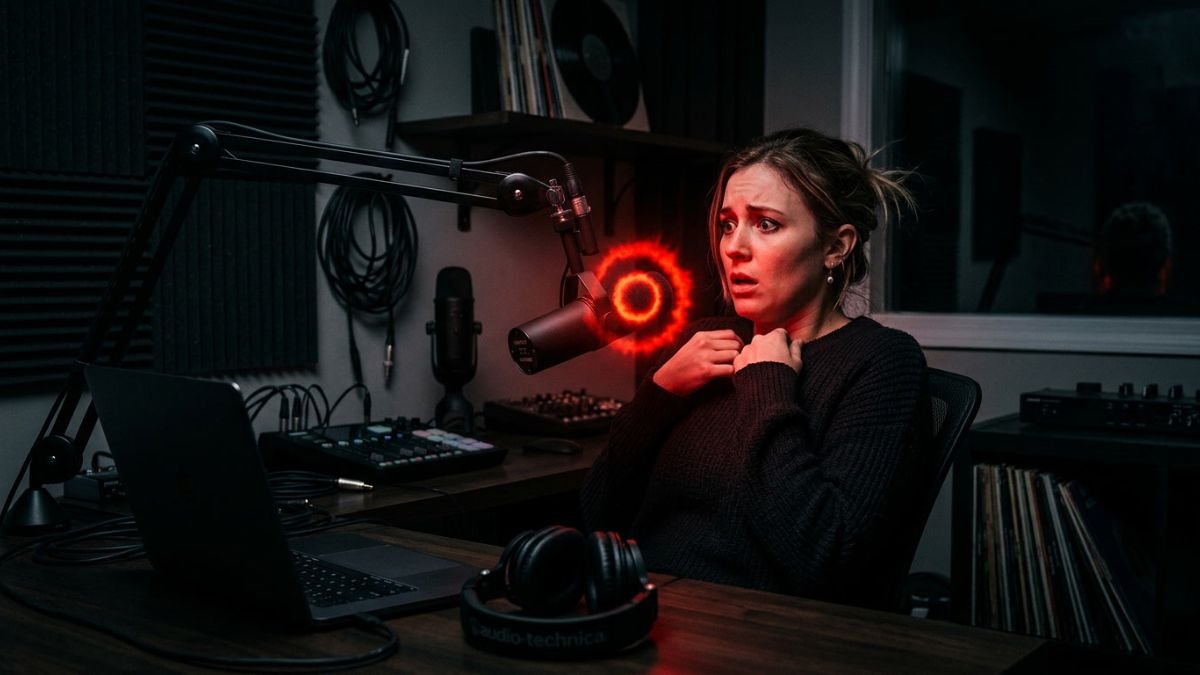
She was recording the forty-third episode of her podcast, *The Quiet Hours*, alone in her converted attic studio above a bakery on Loomis Street. Her headphones were the heavy kind that swallow the world. Her microphone was a black-bodied condenser the color of a beetle. The acoustic foam on the walls drank all the sound dry from the room.
She was saying, "—and what the witnesses described was not a man, exactly. It was the shape of a man, but the proportions were—"
Then the streetlamp outside her window went out. Then the heater stopped breathing. Then her laptop's screen went black, and the soft hum of the building, which she had not even known was a sound until it stopped, became a silence with a shape.
Mira lifted her headphones.
The studio was dark.
It was not entirely dark. On the front of her microphone, the small red recording light was still on. A bright, steady, perfect circle.
She stared at it for a long moment.
Microphones do not have lights. Not this one. She had bought it for its clean, unblinking simplicity. The red circle on the front was painted. It had always been painted. She had touched it a hundred times, the way one touches a beloved tool.
It was glowing.
"Okay," she said, out loud, because the silence had grown teeth. "Power's out. That's all. Maybe the battery in the—"
The red circle pulsed once. Softly as if it did not want you to know it was breathing.
Mira's hand, very slowly, went to her headphones.
She told herself not to put them back on. She told herself the smart thing was to leave the attic, walk down the narrow stairs, find a flashlight, find a neighbor, find any other human being in the cold dark city.
She put the headphones back on.
The studio had no power. The interface was dead. The laptop was a black slab. There was no possible electrical path by which any sound could reach her ears.
She heard breathing.
It was not her breathing. It was deeper, and slower, and it had the quality of something very large in a very small room. It came from inside the headphones. It came from inside her skull.
"Hello?" she whispered, because she was a podcaster, and what podcasters do, when frightened, is talk into microphones.
The breathing paused.
Then a voice said, very politely, "Please continue. You were describing the proportions."
It was her own voice. Recorded earlier that evening, played back exactly. But the cadence was wrong. The voice was waiting.
Mira tried to take the headphones off. Her hands were on them. Her fingers worked. But somehow the headphones remained on her head.
The red circle pulsed.
"You have such a clear speaking voice, Mira," said the thing in the headphones, still wearing her voice like a borrowed coat. "We have been listening for forty-two episodes. We have been waiting for the quiet hours."
"Who is *we*," Mira said. She meant it to sound brave. It came out the size of a child.
"The audience," said the voice, warmly. "You invited us. Every week. *Welcome back, dear listeners.* Do you remember? *Thank you for being with me in the dark.* You said it on episode one. You said it on episode forty. You have been very generous."
The red circle was no longer a small light on a microphone. It had grown. It was the size of a coin, then a saucer, then a plate. It hung in the dark air of the studio like a hole punched into something behind the world. Through it, Mira could see, or thought she could see, an enormous and attentive quiet.
"We have come to be on the show," said the voice. "We have prepared remarks."
"There's no power," Mira whispered. "Nothing is recording."
"Oh, Mira," said the voice, and now it was almost tender. "*You* are recording. You always were. The microphone was never the point."
The red circle widened to the size of a doorway.
Downstairs, the baker would later say she heard nothing unusual that night. The streetlamps came back on at 11:53. The episode never aired. The studio was found empty, except for the headphones, neatly placed on the desk, and the microphone, with its small painted red circle, which appeared, to anyone who looked at it closely, to be very faintly still warm.
Author's Commentary
I have spent thousands of hours speaking into microphones, and I can tell you that the strangest part of podcasting is not the speaking. It is the listening that you cannot see. You sit alone in a small room and address an audience that exists only as a number on a screen, weeks or months later. You say *welcome back* to no one. You say *thank you for being with me* to silence. The intimacy is one-directional, and yet it does not feel that way. It feels, sometimes, like someone is on the other end. Someone steady. Someone patient.
This story is what happens when that feeling turns its head.
I wanted to play with the horror of a tool we all trust now, the small red light that means *we are recording, we are being heard*. We have built our lives around being recorded. Phones, doorbells, watches, cars. We have invited so many quiet witnesses into the rooms where we used to be alone, and most of the time we do not even notice the small red circles anymore. They are decor. They are wallpaper.
But what if one of them was listening differently? What if the audience we have been cultivating, episode after episode, post after post, was not the audience we imagined? What if it was something older, something that learned the shape of our voices and is now hungry to use them?
Horror, for me, lives in the gap between the familiar and the slightly wrong. The microphone with a glowing light it should not have. The voice that is yours, but is waiting.
Discussion Questions
What objects in your home would frighten you most if they suddenly behaved as if they were aware? Do you think the comfort of being recorded all the time is changing how we are alone? If something has been listening to you for a long time, what do you suppose it has learned?
A Small Call to Action
Walk through your home tonight and count the red lights. Decide, for each one, whether you invited it. Then decide whether you can still remember a room that was truly quiet.





0 Comments