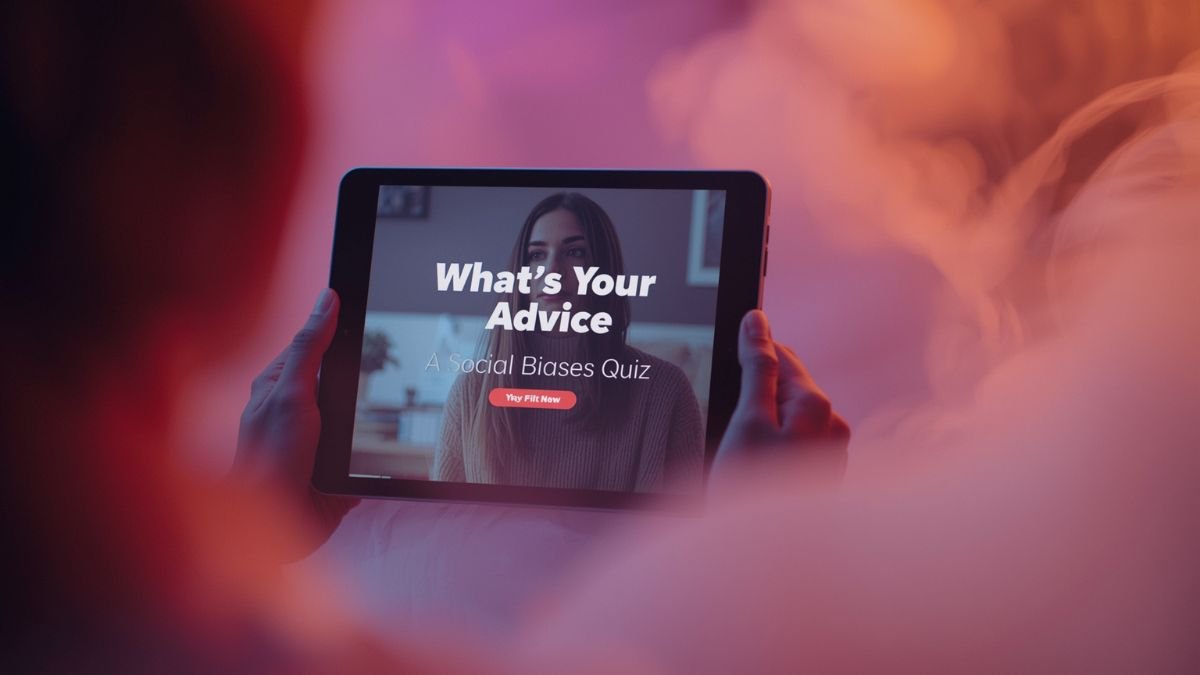
What's Your Advice? Navigating the World of Social Biases 👥
Have you ever been in a meeting where everyone seems to agree on a bad idea? Or seen someone who needs help and wondered why nobody was doing anything? These are common situations where invisible forces—social biases—are pulling the strings. We are all wired with mental shortcuts that help us navigate a complex social world, but sometimes, these shortcuts lead us down the wrong path.
This quiz is your practical guide to fighting back. Instead of just defining biases, you'll be dropped into realistic scenarios and asked to choose the best course of action. Think of it as a flight simulator for social situations. By learning to spot these biases and applying the right strategies, you'll be better equipped to foster teamwork, make fairer judgments, improve your relationships, and become a more effective and respected voice in any group. Ready to upgrade your social intelligence? Let's begin!
Learning Quiz
This is a learning quiz from English Plus Podcast, in which, you will be able to learn from your mistakes as much as you will learn from the answers you get right because we have added feedback for every single option in the quiz, and to help you choose the right answer if you're not sure, there are also hints for every single option for every question. So, there's learning all around this quiz, you can hardly call it quiz anymore! It's a learning quiz from English Plus Podcast.
Quiz Takeaways | The Social Navigator's Playbook: How to Outsmart Your Own Mind
Great work on completing the quiz! You've just tackled some of the trickiest situations we face in our social and professional lives. These scenarios demonstrate a crucial truth: the biggest obstacles to effective teamwork and fair judgment are often the invisible biases operating inside our own heads and in the dynamics of a group. Think of this knowledge not as a critique of your brain, but as a practical user manual for it. Let's review the playbook you've started to build.
A major theme we explored is the challenge of thinking clearly within a group. Groups can make us smarter, but they can also amplify our worst tendencies. You saw how Groupthink can lead a team to a disastrous consensus simply because no one wants to cause conflict. The key takeaway is that you can dissent constructively by asking curious, critical questions rather than being aggressive. Similarly, Pluralistic Ignorance is the strange group paralysis where everyone is confused but pretends to understand, because they think they're the only one. We learned that the bravest and most helpful action is to be the one person who admits confusion, breaking the spell for everyone. And in the Bystander Effect, a crowd can dilute responsibility until no one acts. The solution is to reverse this: single someone out and give them a specific job. In all these cases, one person with the right strategy can change the entire group dynamic.
Next, we looked at the errors we make when we judge other people. The Fundamental Attribution Error is perhaps the most common social sin: we see a coworker show up late and think "lazy," not "stuck in traffic." The cure is to consciously force ourselves to consider the situation before judging someone's character. We also saw how the Halo Effect (one good trait makes someone seem perfect) and its evil twin, the Horns Effect, can lead us to make biased judgments based on superficial qualities like charm or a heavy accent. The antidote here is structure—using standardized questions in an interview, or consciously redirecting a conversation to ensure all voices are heard and ideas are judged on their merit, not their packaging. This category also includes the Just-World Hypothesis, the victim-blaming belief that people get what they deserve. The counter-move is to build empathy by highlighting situational factors over supposed character flaws.
Another critical area is the "us vs. them" mentality that so often divides us. In-Group Favoritism is the natural, but problematic, tendency to prefer and trust people who are "like us." We saw how this can lead to scrutinizing an "outsider" on a team. The most powerful solution is to break down the barriers between "us" and "them" through collaboration on a shared goal, turning strangers into individuals and colleagues. We also have to be vigilant against Stereotyping, which is the lazy habit of applying a generalization to an individual. The playbook here is to always redirect the focus from the general category (like age or background) back to objective, individual criteria (like skills and experience).
Finally, and perhaps most challengingly, we looked at the biases that live within our own egos. The Self-Serving Bias makes us take credit for all our successes and blame others for all our failures. The only cure is conscious, honest reflection and a willingness to acknowledge the role of luck and others in our wins. But this is hard because of the Bias Blind Spot—our infuriating ability to see these biases in everyone but ourselves. This is why the most courageous move is to actively ask for feedback from a trusted source, creating an external mirror for our own blind spots. We must also fight the False Consensus Effect, our assumption that everyone thinks like we do. The solution is simple but revolutionary: stop assuming and start asking.
By understanding these patterns—Groupthink, the Bystander Effect, the Fundamental Attribution Error, In-Group Bias, and our own Bias Blind Spot—you're not just learning psychology trivia. You are learning a set of practical, actionable skills. You are learning to pause before you judge, to speak up when it matters, to listen more carefully, and to lead more effectively. You are learning how to be a better teammate, a fairer manager, and a more self-aware human being. That is the real goal of becoming a social navigator.





0 Comments