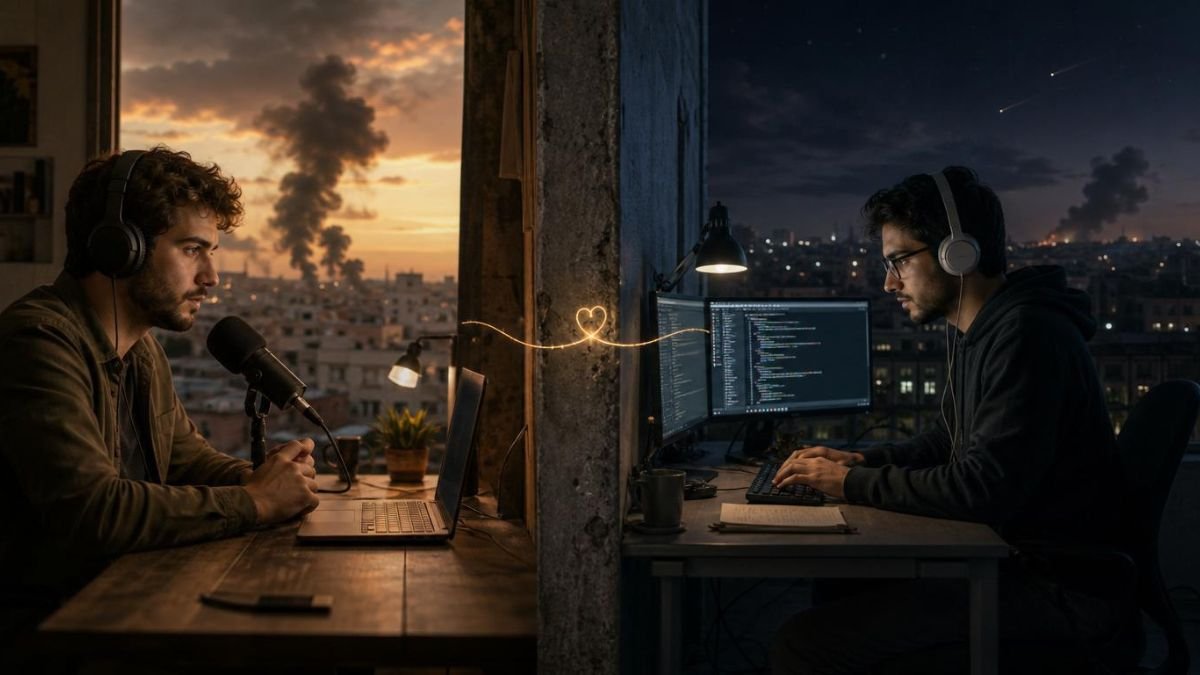
Have you ever tried to soundproof a room against a sonic boom?
It is, I can assure you, a spectacularly futile endeavor. You can buy the thickest, most geometrically pleasing acoustic foam panels on the market. You can arrange them on your walls so they look like a cool, modern art installation. You can seal the cracks in the window frame, put a heavy rug on the floor, and invest in a dynamic microphone that promises to isolate your voice from background noise.
And then, just as you hit the little red record button and lean in to deliver your opening thought, the sky literally tears itself open, shaking the fillings in your teeth and turning your expensive foam panels into glorified wall decorations.
This is the very specific, highly irritating reality of a man named Danny.
Danny is a veteran instructional designer. For years, he lived in the corporate world, building training modules, designing learning paths, and trying to impose structure and logic onto the beautiful chaos of human learning. But eventually, the corporate world lost its luster. He wanted to make a difference. And, let's be entirely honest with each other here, he also wanted to make a successful business of his own. He wanted his time back. He wanted his voice back.
So, he started podcasting. He lives in Lebanon, and years ago, what began as a humble, "let's see if I can do 100 episodes" project turned into a magnificent obsession. He is now over 1,300 episodes deep. He sits in his meticulously (yet tragically inadequately) soundproofed room, dreaming of making a difference in the world, and perhaps, making a difference in his own life.
Just a few miles south, across a line drawn in the dirt, heavily fortified with concrete, razor wire, and the heavy weight of history, sits Avi.
Avi doesn't know about acoustic foam, but he knows a lot about ergonomic chairs and dual-monitor setups. Avi is a software engineer. Like Danny, he looked at the corporate ladder he was climbing—the stock options, the endless Jira tickets, the mandatory fun of tech company offsites—and decided to jump off. He quit his comfortable job in Israel because he is dreaming of building a big company, launching a massive startup, and making a difference.
Danny and Avi do not know each other. They have never met. They have never shared a coffee, never debated the merits of leaving the corporate world, never commiserated over the terrifying freedom of solopreneurship.
But they do know one thing about each other. They know that they hate each other.
Most of the time, if you stop them on a random Tuesday while they're waiting for water to boil, they couldn't exactly articulate the visceral, granular details of why. It’s just a heavy, ambient truth, like gravity.
But, what am I talking about here? Of course, they know why.
Avi’s country has invaded Danny’s country multiple times over the decades. Danny has vivid, sensory memories of the sky falling, of infrastructure crumbling, of the sheer, terrifying helplessness of watching a modern military machine operate in his backyard.
On the other side of the equation, Danny’s people—or at least, the people who claim to speak for the land Danny stands on—swear a solemn, continuous oath to remove Avi’s country from the map entirely. Avi has grown up with the existential dread of rockets, of sirens interrupting dinner, of knowing that just miles away, there are men who consider his very existence an affront to the universe.
It is a heavy inheritance. It’s like inheriting a massive, incredibly ugly piece of furniture from your ancestors that takes up your entire living room. You can't move it, you can't throw it out, and you keep stubbing your toe on it in the dark.
Now, on a day-to-day basis, neither Danny nor Avi really care about all of that. They have podcasts to edit and code to compile. But they also do care. Intensely. They love their countries. They are deeply rooted in their cultures, their food, the smell of the air, the specific cadence of their hometowns.
Yet, recently, if you catch them in a quiet moment—perhaps right after the power grid fails for the third time in Danny’s city, or when Avi reads the news about yet another political crisis tearing his society apart internally—they both share a secret, quiet feeling.
They feel that their countries do not love them back.
Let’s talk about how a conflict actually feels on the ground, because it’s rarely how it looks on a cable news panel.
When a conflict flares up—when the rhetoric reaches a fever pitch, when the news anchors put on their serious faces, and the first strikes happen—there is a momentary surge of adrenaline and ideology. The grand historical narratives are dusted off. The maps are brought out. The pundits argue about 1948, or 1982, or 2006. The "why" is everywhere. It is loud, proud, and completely deafening.
But here is the great, absurd truth about war that no one likes to admit: the "why" has an incredibly short shelf life.
Within days, sometimes hours, the grand ideological justifications evaporate, replaced entirely by the maddening, all-consuming daily realities of the situation.
Danny isn't sitting at his microphone thinking about the geopolitical chess board of the Middle East. He is thinking, “If the electricity cuts out before this audio file finishes rendering, I am going to lose my mind.” He is trying to calculate whether it’s safe to drive to the grocery store, and if they will even have the good coffee beans left.
Avi isn't staring at his dual monitors pondering the historical context of borders. He is trying to trace a bug in his code while a siren wails in the distance, forcing him to decide whether he has ninety seconds to save his work and run to the stairwell, or if he should just risk it and push the commit to GitHub.
They are both instructional designers and software engineers thrust into a survival game they did not sign up for.
Danny’s entire profession is built on logic. Instructional design is about creating a path from ignorance to understanding. It is about flow, structure, and measurable outcomes. War is the exact opposite of instructional design. War is a syllabus written by a madman, where the rules change every ten minutes, and the ultimate test is simply whether you wake up the next morning.
Avi’s profession is about finding bugs and fixing them. He builds elegant architectures designed to run smoothly. He looks at the world as a system that can be optimized. But the geopolitical reality he lives in is legacy spaghetti code. It’s a system built on top of a system, patched together with temporary ceasefires and broken treaties, full of fatal errors, and nobody—nobody in the entire world—has the administrator privileges required to fix it.
People on both sides love their land and despise what the other side is doing. Danny hates the drones buzzing over his house, the constant, low-frequency hum of a threat that never goes away. Avi hates the rockets that force him to treat his apartment building like a bunker. This hatred is real. It is visceral. It leads them, in their darker moments, to buy into the vows of annihilation.
But soon—remarkably soon—they stop thinking about annihilation. Because annihilation is an abstract concept.
Living is a practical one.
They start thinking about their own fundamental, unalienable will to simply live in their own lifetime. They realize that they only get one spin on this little blue rock. Danny only gets so many years to build his podcast network. Avi only gets so many years to launch his startup. And they are spending the prime of their lives watching their respective governments squander their potential on a never-ending, cyclical game of incredibly violent ping-pong.
This brings us to a harsh, deeply philosophical reality of the situation: the realization of unrequited patriotism.
Imagine loving someone with all your heart. You defend them, you make excuses for their bad behavior, you give them your money, your time, and your loyalty. And in return, they occasionally set your house on fire and tell you it’s for your own good.
That is what it feels like to be a citizen in a perpetual war zone.
Danny looks at his country—a place of unparalleled beauty, of resilience, of a culture so rich it hurts—and he sees a state that cannot provide him with 24 hours of uninterrupted electricity. He sees a system that allows his fate to be decided by people who do not know his name, who play dangerous games with his airspace while he’s just trying to upload an interview about personal development.
Avi looks at his country—a place built on the promise of sanctuary, a powerhouse of innovation and technology—and he sees a state constantly fractured, a society trapped in a militaristic loop that demands his taxes, his reserve duty, and his quiet compliance, while the cost of living skyrockets and the promised peace remains a political mirage.
They love their countries, but they feel that the state—the bureaucratic, political entity that governs the country—has abandoned them. The state is too busy fighting the enemy to care about the citizens.
This is the ultimate absurdity of being enemies.
Danny and Avi are told to direct all their anger, all their fear, and all their frustration southward and northward, respectively. "Look at the enemy," the politicians say. "They are the reason your life is hard. They are the reason you cannot have peace."
But late at night, when the screens are dark and the skies are temporarily quiet, the irony settles in. Danny's life isn't just hard because of Avi's country; it's hard because his own systems are failing him. Avi's life isn't just stressful because of Danny's side of the border; it's stressful because his own leadership seems perfectly comfortable maintaining a status quo of perpetual anxiety.
They are two men standing on opposite sides of a mirror, throwing rocks at their own reflections, encouraged by leaders who safely stand out of the blast radius.
Let us indulge, for a moment, in a little hypothetical storytelling. Let’s play a game of "What If."
Imagine an alternate timeline. The border doesn't exist, or at least, it’s just a line on a map that you drive across without stopping, like driving from France to Germany today.
Let's put Danny and Avi in a coffee shop. Let's say they meet at a co-working space in Cyprus, or a cafe in Berlin, or hell, a nice little spot in Beirut or Tel Aviv.
Danny sits down with his laptop, sporting a t-shirt with his podcast logo. Avi is sitting at the next table, wearing a hoodie from a tech conference, staring intently at a screen full of dark mode code.
Danny groans out loud because his audio editing software just crashed. Avi looks up, recognizes the specific sound of software-induced despair, and says, "Premiere Pro or Audition?"
"Audition," Danny sighs. "Episode 1304, down the drain."
Avi smiles. "I'm a developer. The amount of code I've lost to a bad commit... I feel your pain. I'm Avi, by the way."
"Danny."
Within twenty minutes, they are drinking coffee together. Within an hour, they realize they are kindred spirits.
Danny talks about the terrifying leap of leaving the corporate world. The imposter syndrome. The days when you wonder why you gave up a steady paycheck for the wild west of independent creation.
Avi nods furiously. He talks about the exact same things. The pressure of building something from nothing. The isolation of being a solopreneur. The constant hustle to get people to care about the thing you are pouring your soul into.
Danny tells a joke about corporate HR departments. Avi laughs so hard he spills his espresso. Avi explains a complex piece of code using a metaphor about traffic jams, and Danny, the instructional designer, lights up, praising how perfectly Avi structured the analogy.
They are the same guy.
They are ambitious, creative, slightly anxious, fiercely independent men trying to carve out a tiny slice of meaning in a chaotic universe. They share the same entrepreneurial spirit, the same distaste for bureaucracy, the same underlying desire to leave the world a little bit better than they found it.
If you stripped away the passports, the history books, and the politicians, Danny and Avi wouldn't just tolerate each other. They would be great friends. They would be collaborators. Avi would build the custom app for Danny’s podcast network. Danny would consult on the user onboarding experience for Avi’s startup. They would grab a beer on Friday nights and complain about the algorithms.
This is the deepest, most agonizing tragedy of the whole situation.
War doesn't just destroy buildings. It doesn't just take lives. It assassinates potential. It murders the future. It actively prevents the beautiful, serendipitous collisions of human beings who were perfectly designed to understand each other.
The border that separates them is not just a physical barrier; it is a conceptual prison. It forces them to view a potential best friend as a mortal threat. It takes the infinite, gorgeous complexity of a human life and reduces it to a single data point: Enemy.
So, what do Danny and Avi do?
They rebel. Not with guns, not with protests, but with the quiet, stubborn persistence of living.
When Danny sits down in his superficially soundproofed room, adjusts his microphone, and starts recording his 1,304th episode despite the roar of jets above him, he is committing an act of defiance. He is saying, "You can control the airspace, but you cannot control my voice. I am going to teach, I am going to speak, and I am going to build my business."
When Avi puts on his noise-canceling headphones to drown out the sirens, takes a deep breath, and continues writing the code for his startup, he is also committing an act of defiance. He is saying, "You can threaten my physical existence, but you cannot stop my mind from building the future."
Their ambition is their armor. Their desire to create is their shield against a world that seems intent on destruction.
We often look at places consumed by conflict and we pity the people there. We think of them purely as victims. But that robs them of their agency. Danny and Avi are not just victims; they are active participants in a daily, heroic struggle for normalcy.
They are pointing out the absurdities of their situation just by refusing to let it consume them entirely.
But the tragedy remains. They are doing this alone, isolated from one another by a manufactured hatred.
The never-ending conflict is a masterclass in wasted human capital. Think of the brainpower, the creativity, the sheer amount of time and resources spent on defense, on attack, on political maneuvering, on historical grievances. Now imagine all of that energy redirected towards building. Towards art, towards technology, towards medicine, towards podcasts and startups.
The Middle East is full of Dannys and Avis. It is packed to the brim with brilliant, funny, tired people who just want to make a living and make a difference.
And until the grand narratives collapse under the weight of their own absurdity, until the people realize that the state does not love them the way they love the land, Danny and Avi will remain in their separate rooms, separated by miles of barbed wire and decades of grief.
They will keep looking up at the exact same sky, annoyed by the exact same noises, dreaming the exact same dreams, completely unaware that their best friend is sitting just across the border, waiting for the WiFi to come back on.
So, let's step out of the story for a moment and look in the mirror.
We've talked a lot about the absurdity of Danny and Avi's situation, but this isn't just a story about the Middle East. It’s a story about the lines we draw, the narratives we inherit, and the way we allow abstract concepts to dictate our human connections.
I want you to think about the "borders" in your own life.
- Who is your Avi? Who is your Danny? Who is the person or group of people you have been subtly (or not so subtly) taught to view with suspicion or disdain? If you stripped away the labels, the politics, and the history, what common ground would you find?
- When does the "Why" evaporate for you? In your own conflicts—whether they are family feuds, workplace dramas, or political arguments—how often do you lose sight of the original disagreement because you are so consumed by the daily friction of the fight?
- Are you waiting for permission to live? Danny and Avi refuse to put their dreams on hold despite living in a warzone. What external circumstances are you using as an excuse to delay your own ambitions?
Here is my challenge to you this week: Catch yourself in a moment of inherited bias. The next time you feel a surge of frustration or anger toward a group of people based on a news headline or a political narrative, pause. Force yourself to imagine a single, specific individual in that group. Imagine them sitting at a desk, frustrated that their computer crashed, sipping a coffee, just trying to make it through a Tuesday.
Rehumanize the abstract. It is the only way we dismantle the absurdities that keep us apart.
If this story resonated with you, don't just keep it to yourself. Share it with someone who might need a reminder of our shared humanity. Leave a comment, write a review, or just send a message to a friend you haven't spoken to in a while.
Let's start building the coffee shops where Danny and Avi can finally meet.
Danny Ballan
Editor-in-Chief
English Plus Magazine




0 Comments