Introduction
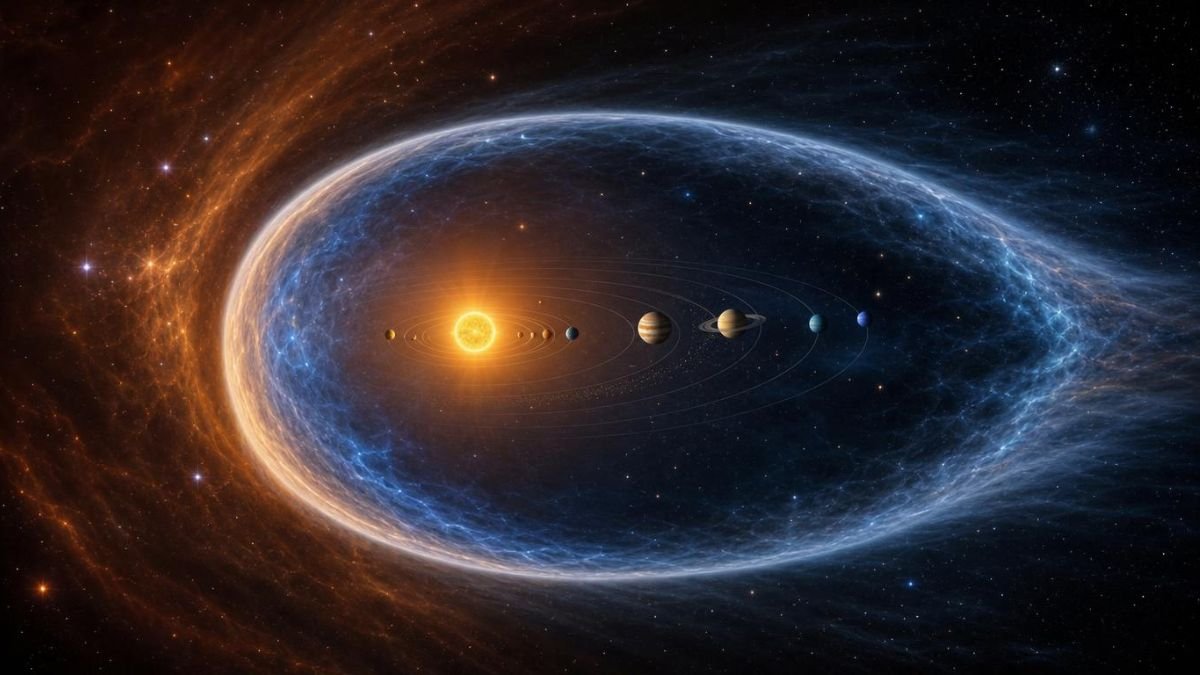
You have spent your entire life inside a bubble. So has everyone you know, everyone who has ever lived, every dinosaur, every trilobite, and every bacterium that has ever divided. The bubble is enormous, invisible, and being continuously inflated by the Sun at roughly a million miles an hour. It has a front and a back, it has weather, it wobbles, and about a dozen years ago a small spacecraft launched in the 1970s finally flew out of it and told us what the other side is like.
That is not a metaphor, by the way. The heliosphere is a real physical structure, and it is arguably the largest single thing in the solar system that could reasonably be called an object. It's the region carved out of interstellar space by the outward pressure of the Sun's own atmosphere, which doesn't stop at the Sun's surface but keeps going, thinning as it travels, pushing back the gas and dust between the stars until, somewhere past Neptune, the pushing and the pushing back reach a stalemate. That stalemate is the wall. Inside it is our neighborhood. Outside it is everything else.
Here's the part that ought to keep you up at night, in a good way. That wall is not decorative. It absorbs and deflects a substantial fraction of the high-energy cosmic radiation streaming in from exploded stars across the galaxy. Life on Earth developed under two layers of protection, our planet's magnetic field and the Sun's much larger one, and we did not know about the outer layer until about seventy years ago. We have been sheltering under something for four billion years without noticing there was a roof.
This article follows that story: how a Victorian astronomer noticed comet tails pointing the wrong way, how a young physicist in the 1950s was told his solar wind paper was so obviously wrong it shouldn't be published, what the Voyagers actually found at the edge, why the two of them found different things, and why scientists still cannot agree on whether the heliosphere is shaped like a comet or a croissant.
Now, about how you're going to read it. Close reading means slowing down deliberately and paying attention to how a text works rather than only what it reports. Most language learners stall somewhere in the upper-intermediate range, and the reason usually isn't vocabulary. You've read a great deal. You understand almost everything. But you understand it at one depth, evenly, the way you'd read a bus schedule, so you never notice the argument hiding in an adjective, the metaphor that's doing analytical work, or the sentence that withholds its verb because delay creates tension.
Depth is what breaks the plateau. Asking why the writer chose "stalemate" instead of "balance." Noticing that a paragraph is structured to make you feel small before it makes you feel lucky. Asking what a scientific claim would look like if it were wrong. That kind of attention transfers straight into your own speaking and writing, because you cannot use a technique you have never consciously seen someone use. The questions after each paragraph are the real lesson. Try them before you read the analysis. Getting one wrong on your own is worth more than getting it right by reading ahead.
The Heliosphere
Start with a fact that sounds like a mistake. The Sun's atmosphere is hotter than its surface, and not slightly hotter. The visible surface, the photosphere, runs at about 5,500 degrees Celsius, which is respectable. The corona above it, the pearly halo you see during a total eclipse, reaches a million degrees and sometimes more. This is roughly as sensible as walking away from a campfire and getting warmer. Physicists have been arguing about the coronal heating problem for eighty years, and while the leading suspects involve magnetic waves and countless small explosions called nanoflares, nobody has fully closed the case. What matters for our purposes is the consequence. At a million degrees, the Sun's gravity cannot hold onto its own outer atmosphere. The corona doesn't sit there. It leaks, continuously, in every direction, forever.
Close reading questions:
- How does the campfire comparison work, and why is an ordinary domestic image more effective here than a technical explanation?
- What does the writer gain by admitting that scientists haven't solved the coronal heating problem?
- Why does the paragraph end on "it leaks" rather than on the mystery, and what does that ordering tell you about where the article is heading?
That leak is the solar wind, and the story of how we found out about it is a small masterpiece of scientific stubbornness. In the 1950s, a German astrophysicist named Ludwig Biermann was puzzling over comet tails. Everyone knew comets grew tails pointing away from the Sun, and everyone assumed sunlight was pushing the dust. But comets have a second tail, a bluish ion tail, and it pointed away from the Sun too accurately and reacted too quickly for light pressure alone to explain. Biermann proposed that something material was streaming out of the Sun and blowing the tail back like a windsock. Then in 1958, a young University of Chicago physicist named Eugene Parker worked out the mathematics and published a paper describing a supersonic wind of charged particles filling the solar system. Two reviewers rejected it. The editor, Subrahmanyan Chandrasekhar, who would later win a Nobel Prize, could find no actual error in the math and published it anyway. Four years later, Mariner 2 flew to Venus and measured the wind directly. Parker was right, and lived long enough to watch a spacecraft named after him fly into the corona itself.
Close reading questions:
- Why does the writer include the detail that the reviewers found no error but rejected the paper anyway, and what does that reveal about how science actually operates?
- What is the function of the phrase "like a windsock," and what does it do that "was blown backward" would not?
- How does the last sentence work as an ending, and what emotion is it engineering?
So picture what that wind does. Charged particles, mostly protons and electrons, pour off the Sun in all directions at speeds between three hundred and eight hundred kilometers per second, carrying the Sun's magnetic field with them like a sheet dragged along behind a sprinter. Because the Sun rotates roughly every twenty-seven days, that magnetic field doesn't stream out straight. It winds into an enormous spiral, the same shape water makes leaving a spinning garden sprinkler, and it's called the Parker spiral after the man whose paper nobody wanted. This wind is a plasma, which is the fourth state of matter and, awkwardly for our sense of importance, the most common one in the visible universe. Solids, liquids, and gases are the local specialty. The universe is mostly plasma, and we happen to live on a rare damp rock where it isn't.
Close reading questions:
- What is the rhetorical purpose of calling solids, liquids, and gases "the local specialty"?
- How do the two similes in this paragraph, the sprinter's sheet and the garden sprinkler, differ in what they're asked to explain?
- Why might a writer describe the universe's composition in terms of what humans find unusual, rather than describing it neutrally?
Now, that wind has to stop somewhere, because it isn't blowing into a vacuum. Interstellar space is thin but not empty, containing hydrogen atoms, helium, dust, magnetic fields, and the accumulated debris of dead stars, all of it possessing its own pressure. The solar wind pushes outward and thins as it spreads, obeying the inverse square law, so its pressure drops steadily with distance. Eventually, roughly eleven billion miles out, it drops to where it can no longer bulldoze the interstellar gas aside, and the wind slows abruptly from supersonic to subsonic. That abrupt slowdown is the termination shock. Past it lies a turbulent region called the heliosheath, where solar wind piles up, heats, and swirls like water in the pool below a waterfall. And past that is the heliopause, the actual boundary, where the Sun's influence finally yields to the galaxy's.
Close reading questions:
- Why does the writer use the verb "bulldoze" for a process involving nearly nothing per cubic centimeter, and is that word choice honest?
- Trace the paragraph's structure: how does it use a sequence of three named boundaries to build a sense of approach?
- What does the waterfall comparison capture about the heliosheath, and what does it distort?
Two objects have been out there and made the crossing, and their story is the reason we know any of this firsthand. Voyager 1 and Voyager 2 launched in 1977, weeks apart, designed for a four-year mission to Jupiter and Saturn. They carry about as much computing power as a modern key fob and communicate on a transmitter roughly as powerful as a refrigerator light bulb, and their signals now take more than twenty hours to reach us. In August 2012, Voyager 1 crossed the heliopause. Six years later, in November 2018, Voyager 2 followed, and here is the detail that makes the whole thing scientific rather than merely impressive: they crossed at different distances. Voyager 1 exited at about 121 astronomical units, Voyager 2 at about 119. The boundary was not in the same place. It breathes.
Close reading questions:
- Why does the writer specify the key fob and the refrigerator bulb rather than giving technical specifications, and what does that choice assume about the audience?
- What is the significance of the two crossings occurring at different distances, and why does the writer call it the detail that makes the story "scientific rather than merely impressive"?
- What does the two-word sentence "It breathes" accomplish that a fuller explanation would not?
Knowing when they crossed is stranger than it sounds, because you cannot see a heliopause. There's no line, no visible membrane, nothing on a camera. What the Voyagers detected was a switch in the flavor of their surroundings. Inside, the plasma is hot and thin, with relatively few particles moving fast. Outside, it's cold and dense, with more particles moving slowly. Cosmic rays from the wider galaxy suddenly climbed, and particles from the Sun suddenly dropped off. Voyager 1's plasma instrument had failed decades earlier, so its crossing had to be confirmed indirectly through a stroke of luck: a solar eruption reached the spacecraft and made the surrounding plasma ring like a struck bell, and the pitch of that ringing revealed the density. Voyager 2 still had a working plasma detector and measured the change directly. Between them, they turned an inference into a confirmation.
Close reading questions:
- Why is "the flavor of their surroundings" used instead of a precise scientific term, and does the informality cost the sentence anything?
- What is the epistemological difference between Voyager 1's indirect confirmation and Voyager 2's direct measurement, and why do scientists care about that difference?
- What does the bell metaphor explain about how we can measure something we cannot touch?
Here's what the bubble is doing for you personally. The galaxy is full of cosmic rays, atomic nuclei accelerated to nearly the speed of light by supernovae and other violent events, and they arrive from every direction constantly. The heliosphere's tangled magnetic fields deflect and scatter a large share of them before they ever reach the planets. We can watch this happening in real time, because when solar activity peaks and the wind blows harder, the bubble inflates and cosmic ray levels at Earth measurably drop. When the Sun goes quiet, they rise again. The shielding is imperfect, and Earth's own magnetic field and atmosphere handle the rest, but there is a genuine sense in which the Sun does not merely warm us. It also stands between us and the rest of the galaxy.
Close reading questions:
- How does the phrase "for you personally" change the reader's relationship to the information that follows?
- Why does the writer include the anti-correlation between solar activity and cosmic ray levels, and what role does that evidence play in the argument?
- The paragraph ends with a two-part structure, "does not merely warm us" followed by a stronger claim. Why is that ordering effective?
There's a question underneath all this that scientists are still fighting about, and it's a good one: what shape is the heliosphere? For decades the textbook answer was a comet. The Sun is moving through the galaxy at around 25 kilometers per second, so the bubble should be compressed at the front and drawn into a long tail behind, like a jellyfish or a windsock. But in 2020, a team using data from several missions proposed something else entirely: a shape more like a croissant, or a deflated crescent, with two jets rather than a single tail. Others argue the tail exists but is shredded and unstable. The disagreement is not embarrassing. It's the natural result of trying to map a structure from the inside, using a handful of probes and a great deal of inference, which is roughly like determining the shape of a house while standing in one room with the lights off.
Close reading questions:
- Why does the writer insist that the disagreement "is not embarrassing," and who is that sentence aimed at?
- Evaluate the dark house analogy: what does it capture accurately about the problem, and where does it fail?
- If two teams look at overlapping data and produce a comet and a croissant, what does that tell you about the relationship between data and models?
That mapping problem got a lot easier thanks to a genuinely clever trick. A NASA mission called IBEX, launched in 2008, makes images of the boundary without going anywhere near it. It detects energetic neutral atoms, which form when a fast charged particle out at the edge steals an electron from a slow neutral one, instantly becoming electrically neutral and therefore no longer trapped by magnetic fields. Freed, it flies in a straight line, and some of those lines end at a detector in Earth orbit. IBEX is essentially building a picture of the heliosphere's edge out of particles that escaped from it, which is the astronomical equivalent of mapping a stadium by catching the peanuts thrown out of it. Its first results revealed something nobody predicted: a bright, narrow ribbon of emission stretching across the sky, still not fully explained.
Close reading questions:
- How does the peanut analogy make an unfamiliar detection method intuitive, and what is deliberately simplified away?
- Why does the writer save the unexplained ribbon for the final sentence rather than opening with it?
- What does it suggest about scientific instruments that IBEX's most notable discovery was something it was not designed to look for?
Step back far enough and the heliosphere stops being an isolated curiosity. Every star with a wind blows one. They're called astrospheres, and we've imaged them around other stars, some of them beautiful, some of them enormous. Which means the galaxy is not a smooth sea of gas but a foam, full of bubbles pressed against each other, each one carved by a different star, each one a slightly different environment. Our own bubble drifts through a wispy cloud of interstellar material and will eventually leave it, entering a region with different density and pressure, which will change the bubble's size and possibly the radiation reaching Earth. Our address is not fixed. We are inside a bubble, inside a cloud, inside an arm of a galaxy, and every one of those layers is moving.
Close reading questions:
- What is the effect of the word "foam" as a description of the galaxy, and how does it revise the picture most readers arrive with?
- Why does the paragraph end with three nested locations and the observation that all of them move?
- What does the phrase "our address is not fixed" gain from the mundane word "address"?
The thing that stays with me about all of this is how recent it is. Every human being who lived before about 1959 lived inside the heliosphere without knowing there was one. They looked up at the same sky, and the roof was already there, doing its work, entirely unnoticed. Which raises a question worth carrying around with you: what else is like that right now? What structure are we sitting inside at this moment, shaping our lives completely, that nobody has thought to name yet because it hasn't occurred to anyone that it could be there? Somebody in the future is going to find it, and be astonished that we managed to miss something so large.
The Deep Dive Analysis
How does the campfire comparison work, and why is an ordinary domestic image more effective here than a technical explanation?
The comparison works by translating an abstract thermal anomaly into a bodily experience the reader has actually had. Everyone knows what it feels like to step back from a fire and feel the heat drop, and reversing that expectation produces an immediate sense of wrongness, which is exactly the reaction physicists have to the coronal heating problem. A technical explanation would need to introduce magnetohydrodynamics before the reader had any reason to care that there was a puzzle at all. The domestic image establishes the puzzle first and postpones the physics, which is generally the right order in expository writing: make the reader want the explanation before you supply it. Notice also the phrasing, "roughly as sensible as," which is a comic understatement construction. It signals that the writer knows this sounds absurd, and that shared acknowledgment builds trust. When you write about anything technical in English, look for the everyday experience that has the same structure as the phenomenon, not the same subject matter.
What does the writer gain by admitting that scientists haven't solved the coronal heating problem?
Three things. Credibility, first: a writer willing to say "nobody has fully closed the case" is signaling that the rest of the article's confident claims are confident for a reason, since they clearly haven't been asserted indiscriminately. Second, it models the article's central attitude, which is that open questions are exciting rather than embarrassing, an idea the article returns to explicitly when discussing the heliosphere's shape. Third, it's honest, and the honesty is load-bearing, because a reader who later discovers that the problem is unsolved would retroactively distrust everything else. There's a further point about how science writing often goes wrong. Popular accounts tend to present science as a finished body of facts, which makes the field seem both more authoritative and less interesting than it is. Admitting uncertainty at the right moments is how you convey that science is an activity rather than an inventory.
Why does the paragraph end on "it leaks" rather than on the mystery, and what does that ordering tell you?
End position is emphasis position in English prose, so whatever a paragraph closes on is what the reader carries into the next one. Closing on the mystery would have made the coronal heating problem the subject of the article, which it isn't. Closing on the leak hands off directly to the solar wind, which is the actual thread. The choice of the plain verb "leaks" also matters: after a paragraph containing "million degrees" and "nanoflares," a small domestic word lands hard, and the deflation is deliberate. The rhythm reinforces it, since the sentence "It leaks, continuously, in every direction, forever" uses commas to slow the pace and let each element register, with "forever" isolated at the end where it does the most damage. Paragraph endings in well-built prose are almost never neutral. They are handoffs, and tracking what each one sets up is one of the most reliable ways to see a text's architecture.
Why include the detail that reviewers found no error but rejected the paper anyway?
Because it exposes the human machinery of science, which is the paragraph's real subject. Peer review is often presented as an impersonal filter that separates good work from bad, and the Parker story shows it operating as something messier: a group of experts confronting a result that violated their intuitions, unable to locate a flaw, and rejecting it on the strength of the violation alone. That is a genuinely important thing for a reader to understand, because it explains both why science is reliable in the long run and why it can be obstructive in the short run. Chandrasekhar's decision matters here too, since the correction came not from a better argument but from an editor applying a principle: if you cannot find the error, you cannot claim there is one. The detail also produces narrative satisfaction, setting up the vindication four years later. Watch how the paragraph uses a documented institutional failure to make a point about institutional strength.
What is the function of "like a windsock," and what does it do that "was blown backward" would not?
A windsock is not merely something blown backward. It's an instrument, a device whose entire purpose is to reveal an invisible current by its own shape, which is precisely what a comet's ion tail turned out to be. The simile therefore encodes Biermann's actual reasoning, which was that the tail's behavior was evidence of an unseen flow. "Was blown backward" would report the motion and lose the epistemology. The comparison also carries a note of ordinariness, placing an airport windsock beside a comet, which keeps the paragraph's register conversational. This is the mark of a well-chosen simile: it should do analytical work, not decorate a claim already complete. When you're evaluating figurative language in your reading, ask what the comparison knows that the literal statement doesn't, and if the answer is nothing, you're looking at ornament.
How does the last sentence of that paragraph work as an ending, and what emotion is it engineering?
It closes a loop across sixty years in a single clause. Parker was rejected in 1958; the Parker Solar Probe launched in 2018 and flew into the corona while he was alive to see it. The sentence never states the moral, and that restraint is what makes it land, since a reader who assembles the meaning themselves feels it more strongly than one who is told. The emotion being engineered is a mix of vindication and something gentler, the pleasure of a long story finishing properly. Note the grammatical compression: "and lived long enough to watch" packs a whole biography into a subordinate clause. Note also that the paragraph withholds Parker's full significance until the last possible moment, having introduced him earlier as merely "a young University of Chicago physicist." Delayed revelation is a structural technique available in nonfiction just as much as in narrative, and it costs nothing but a decision about ordering.
What is the rhetorical purpose of calling solids, liquids, and gases "the local specialty"?
It performs a reversal of perspective, which is the article's recurring move. The phrase borrows from restaurant language, where the local specialty is the regional dish you won't find elsewhere, and applying it to the three states of matter that constitute everything in human experience reclassifies our entire world as provincial. This is a compact way of making an argument that would take several sentences to state directly: that our sense of what is normal in the universe is an artifact of where we happen to live. The humor also softens what could feel like a lecture. "Awkwardly for our sense of importance" in the preceding clause does related work, naming the reader's likely discomfort before they feel it. A reading habit worth developing is to notice when a writer borrows vocabulary from a completely unrelated domain, because the borrowed frame usually carries an argument that no explicit claim in the paragraph makes.
How do the two similes in that paragraph differ in what they're asked to explain?
The sprinter's sheet explains a relationship, namely that the magnetic field is carried along by the wind rather than sitting still while the wind passes through it, which is the frozen-in flux concept in plasma physics rendered without jargon. The garden sprinkler explains a geometry, showing why a radial outflow from a rotating source produces a spiral rather than straight lines. So one is about causation and one is about shape, and neither could substitute for the other. It's worth noting that both similes involve motion the reader has physically observed, which is not accidental, since abstract explanations of the Parker spiral typically require a diagram and the sprinkler eliminates it. There is also a slight difference in fidelity: the sheet is loose and imprecise, doing gestural work, while the sprinkler is close to exact, since the mathematics really is the same. Good expository writing mixes registers of precision like this deliberately, using rough analogies where a rough picture is enough and tight ones where accuracy matters.
Why describe the universe's composition in terms of what humans find unusual, rather than neutrally?
Because the article's purpose is to shift the reader's default perspective, and neutral description doesn't do that. Saying "plasma constitutes most of the visible universe" is a fact that passes through the mind without resistance. Saying that solids, liquids, and gases are the local specialty forces a reorientation, because the reader has to notice that they were treating their own environment as the standard. There's a broader technique here worth naming: the most effective science writing rarely adds information to the reader's existing picture; it rearranges the picture so that existing information sits differently. The risk is anthropocentrism dressed as its own cure, since framing everything relative to human intuitions can reinforce the centrality it's trying to undermine. The article accepts that risk knowingly, which you can tell from the self-aware phrase "our sense of importance."
Why use "bulldoze" for a process involving nearly nothing per cubic centimeter, and is that honest?
It's honest in one important sense and misleading in another, and the tension is worth sitting with rather than resolving. The interstellar medium is astonishingly thin, roughly one atom or less per cubic centimeter, so "bulldoze" evokes a physicality the situation doesn't have. But pressure is what actually governs the boundary, and over eleven billion miles, even minuscule densities produce a real and decisive balance of forces. The word conveys the outcome accurately while exaggerating the mechanism, which is a common and defensible trade in science writing, though a reader should always register when it's being made. The most useful habit here is asking, whenever you meet a vigorous verb applied to something invisible or diffuse, whether the vigor belongs to the phenomenon or to the writer's need to make it feel like something. Often the answer is both, and knowing that is different from being fooled.
Trace the paragraph's structure: how does the sequence of three named boundaries build a sense of approach?
The paragraph is constructed as a journey, and the ordering mimics travel outward. It begins with a general condition, the wind thinning, then supplies a mechanism, the inverse square law, then delivers three named features in the order you would encounter them: termination shock, heliosheath, heliopause. Each is introduced with a slightly different structure, one as an event, one as a region, one as a boundary, which prevents the list from feeling mechanical. The naming itself is doing work, since giving a reader three technical terms in sequence would normally be a burden, but embedding them in a spatial progression makes them feel like landmarks rather than vocabulary. The final clause, where the Sun's influence "yields to the galaxy's," anthropomorphizes just enough to give the sequence an emotional endpoint. When you need to teach unfamiliar terms in your own writing, look for a natural sequence, spatial or temporal, that gives the reader somewhere to hang them.
What does the waterfall comparison capture about the heliosheath, and what does it distort?
It captures turbulence and the piling-up of material that has been abruptly slowed, which is genuinely what happens when supersonic wind decelerates at the termination shock. It also captures a sense of local chaos within a larger directional flow, which is accurate. The distortions are significant, though. Water in a plunge pool is dense, cohesive, and bounded by gravity, whereas the heliosheath is a diffuse magnetized plasma governed by electromagnetic forces, and its "turbulence" operates on scales of billions of miles rather than meters. The comparison also implies a downward direction that has no counterpart in space. This is the standard situation with analogies in science writing: they transfer a structural relationship at the cost of importing irrelevant properties, and the reader's job is to identify which properties came along accidentally. Practicing that separation explicitly is one of the fastest ways to sharpen critical reading.
Why specify the key fob and the refrigerator bulb rather than technical specifications?
Because the point is not the numbers but the disproportion, and disproportion is felt rather than calculated. Telling a reader that Voyager's transmitter operates at around 20 watts means almost nothing to most people, whereas "roughly as powerful as a refrigerator light bulb" produces an immediate and slightly alarming picture of a faint glow twenty hours away. The choice assumes an audience that is curious but not technical, and more importantly one whose sense of wonder is more accessible through domestic objects than through units. The key fob comparison does something additional: it makes the achievement feel improbable rather than merely impressive, since we associate advanced results with advanced equipment. There's a rhetorical caution worth noting too, because such comparisons can be slippery, and a careful writer chooses them to be roughly fair rather than merely startling.
What is the significance of the two crossings occurring at different distances?
It converts a single observation into a measurement of a dynamic system. If both spacecraft had crossed at the same distance, we would know one number and could not tell whether it was fixed. Two crossings at different distances and different times, in different directions from the Sun, establish that the boundary moves, which immediately raises testable questions about what moves it. The leading answer involves the eleven-year solar cycle, since stronger solar wind inflates the bubble and weaker wind lets it contract, and the two crossings occurred at different phases of that cycle. This is why the writer calls it the detail that makes the story scientific: a single heroic crossing is an achievement, but two crossings that disagree constitute data. There's a general principle here about replication. A result you cannot compare to anything is barely a result, and the value of a second measurement often exceeds the value of the first.
What does the two-word sentence "It breathes" accomplish?
It compresses the entire preceding explanation into an image and stops. The brevity after a long sentence loaded with numbers creates a physical pause, and the personification transforms the heliopause from a static structure into something alive, which is exactly the conceptual shift the paragraph wants. "Breathes" is also more precise than it looks, since breathing is cyclical, driven from within, and involves expansion and contraction, all of which are true of the solar cycle's effect on the bubble. A longer sentence, "the boundary expands and contracts in step with the eleven-year solar cycle," would be more informative and far less memorable, and the article can afford to be memorable here because it has already supplied the information. Very short sentences are expensive in English prose, in the sense that overusing them destroys their effect. They work when they arrive after complexity, and their placement is worth studying wherever you find them.
Why is "the flavor of their surroundings" used instead of a precise term, and does the informality cost anything?
The precise phrasing would involve plasma density, temperature, and magnetic field orientation, and the paragraph goes on to supply all three in accessible terms. The informal phrase functions as a preview, telling the reader what kind of change to expect before naming the specifics, which reduces cognitive load. "Flavor" also implies something perceived directly and holistically rather than measured, which is a slight misdirection, since the Voyagers measured very specific quantities. That is the informality's cost: it faintly suggests the spacecraft sensed an ambience when in fact they registered numbers. The cost is small and the paragraph corrects it immediately, but noticing that a colloquial phrase has smuggled in a slightly wrong picture is exactly the kind of attention this exercise trains. Informality in expository writing is a tool with a price, and skilled writers pay it consciously.
What is the epistemological difference between Voyager 1's indirect confirmation and Voyager 2's direct measurement, and why does it matter?
Voyager 1's plasma instrument was dead, so the crossing had to be established through inference: a solar eruption caused the surrounding plasma to oscillate, the frequency of that oscillation depends on electron density, and the measured frequency implied a density consistent with interstellar space. Every step in that chain relies on theory being correct. Voyager 2's plasma instrument measured the density itself, requiring far fewer theoretical assumptions. The difference matters because indirect evidence is always vulnerable to the failure of an intermediate assumption, and a result that depends on a long inferential chain is more fragile than one that doesn't. This is why the second crossing was scientifically valuable even though it confirmed what was already believed, since it validated the inference method as well as the conclusion. Note the useful vocabulary distinction available in English here between "inference" and "measurement," and the related pair "indirect" and "direct." Precision about how you know something, not just what you know, is a hallmark of advanced expression.
What does the bell metaphor explain about measuring something we cannot touch?
It explains resonance as a diagnostic tool. When you strike a bell, its pitch is determined by its physical properties, so hearing the pitch tells you about the object without examining it. Plasma behaves comparably: disturb it and it oscillates at a frequency set by its electron density, so measuring the frequency yields the density. The metaphor is unusually faithful, since both cases involve a characteristic frequency determined by the medium's properties, and it makes an abstract technique immediately graspable. It also connects to a much wider family of scientific methods, including how we determine the composition of stars from spectra and the interior structure of the Sun and Earth from wave propagation. A great deal of science consists of listening to how things respond to being disturbed, and the bell is one of the best available images for that entire approach.
How does "for you personally" change the reader's relationship to what follows?
It converts spectatorship into stake. Everything before this point in the article has been a story about the Sun, a wind, and two spacecraft, all of which the reader observes from outside. The phrase closes that distance and asserts that the subject has been about the reader's own body all along. This is a common and effective structural move in science writing: deliver the mechanism first, then reveal the personal consequence, since the reversed order tends to feel like a sales pitch. The pronoun shift is also worth noticing grammatically, since the article uses "you" throughout, but here it's intensified by "personally," which is technically redundant and therefore emphatic. Redundancy used deliberately for emphasis is a legitimate device, and distinguishing it from redundancy caused by carelessness is a skill both for reading and for editing your own writing.
Why include the anti-correlation between solar activity and cosmic ray levels?
Because it is the paragraph's actual evidence, and without it the shielding claim would be an assertion the reader must take on trust. The anti-correlation is powerful because it is a prediction that could have failed: if the heliosphere shields us, then a stronger wind should mean fewer cosmic rays at Earth, and this is measurable and has been measured for decades by neutron monitors. That structure, a claim that generates a testable expectation which is then confirmed, is the core of scientific reasoning, and the paragraph models it compactly. It also demonstrates something valuable about verification, since we cannot run an experiment on the heliosphere but the Sun runs one for us every eleven years. When reading any explanatory claim, the question to hold ready is what observation would look different if the claim were false, and a text that answers that question unprompted is a text worth trusting.
Why is the two-part ending, "does not merely warm us" followed by the stronger claim, effective?
Because it uses the reader's existing knowledge as a springboard. Everyone already knows the Sun warms us, so opening the construction with that fact creates agreement, and "merely" signals immediately that agreement is not enough. The second half then arrives as an addition to something already accepted rather than as a new and unfamiliar claim, which lowers resistance. The negative-then-positive construction is a workhorse of English rhetoric, and its power comes from the small suspense created between the two halves. It's also worth noticing that the final image, the Sun standing between us and the galaxy, is spatial and almost physical, giving the abstract idea of magnetic shielding a posture. Ending on an image rather than a proposition is generally the stronger choice, since images are what readers retain.
Why insist that the disagreement about shape "is not embarrassing," and who is that aimed at?
It's aimed at a reader who has absorbed the popular idea that scientific disagreement indicates unreliability, an idea heavily exploited in public arguments about climate, medicine, and nutrition. The sentence preempts that reaction directly, and its placement matters, since it comes immediately after presenting two incompatible models. Without it, a skeptical reader might conclude that nobody knows anything about the heliosphere. The article instead reframes disagreement as the expected consequence of a genuinely hard observational problem, which is both accurate and pedagogically important. Note the construction, which states the negative first and then supplies the positive explanation, mirroring the technique described above. Note too that the sentence is doing work beyond this paragraph, since it retroactively supports the earlier admission about coronal heating and establishes a general attitude toward uncertainty that the article wants the reader to carry away.
Evaluate the dark house analogy: what does it capture, and where does it fail?
It captures the fundamental problem precisely, which is that we are inside the structure we are trying to map, with no external vantage point, and must reconstruct global shape from local observations. It also captures the scarcity of data, since one room with the lights off is a fair description of a handful of probes in an eleven-billion-mile bubble. Where it fails is in implying that the house has a definite fixed shape awaiting discovery. The heliosphere is dynamic, changing with the solar cycle, and it lacks a sharp boundary, so part of the disagreement concerns not just what shape it is but what counts as the edge. The analogy also understates our resources, since IBEX and now IMAP genuinely image the boundary from within, which is more than a person in a dark room can do. Analogies that flatter the difficulty of a problem are common in science writing because they make the achievement more impressive, and it's worth checking each one against what the researchers actually have to work with.
If two teams look at overlapping data and produce a comet and a croissant, what does that tell you about data and models?
That data does not interpret itself. Both models must be consistent with the observations, which means the observations underdetermine the answer, a situation philosophers of science call underdetermination and which is far more common than popular accounts suggest. The difference between the models comes from what assumptions each team makes about unmeasured quantities, particularly how pickup ions and magnetic fields behave in the outer heliosheath, and different assumptions yield different geometries from the same measurements. This should not produce cynicism, because the models are not equally good and are not immune to testing: each makes distinct predictions, and future missions will discriminate between them. The correct lesson is that a model is a hypothesis about what would produce the data, that multiple hypotheses often survive at any moment, and that progress consists of finding the observation that kills one of them. Holding that idea steadily is what separates informed skepticism from the lazy kind.
How does the peanut analogy work, and what is simplified away?
It works by preserving the logic of the method while replacing every physical element with something familiar. You cannot enter the stadium, but things come out of it, and the trajectories of the things that come out let you reconstruct the shape of what you cannot see. That is genuinely what IBEX does. What's simplified away is the charge exchange process itself, which is the clever part: the particle becomes detectable specifically because it stops being charged and is therefore released from the magnetic fields that had been steering it. Peanuts have no equivalent transformation, so the analogy captures the geometry and loses the mechanism. That's an acceptable trade given that the paragraph explains the mechanism in the sentence immediately before, which is a good general practice: put the technical explanation first and the analogy after, so the analogy consolidates rather than replaces understanding.
Why save the unexplained ribbon for the final sentence rather than opening with it?
Because opening with an unexplained anomaly would give the reader nowhere to put it. The ribbon is only startling once you understand that IBEX images the boundary indirectly and that nobody expected a narrow band of enhanced emission, and both of those require setup. Ending on it also serves the article's larger purpose, which is to leave the reader with open questions rather than closed facts, and this paragraph is the last place before the article widens out to the galaxy. There's a narrative principle at work: information arrives with different force depending on where in a sequence it lands, and the same sentence can be a premise or a revelation depending entirely on position. When you revise your own writing, one of the highest-yield changes available is simply moving your most interesting sentence to the end of its paragraph and seeing whether everything before it now feels like preparation.
What does it suggest about instruments that IBEX's most notable discovery was something it wasn't designed to find?
That instruments extend perception rather than merely answering questions, and that extended perception has consequences nobody can specify in advance. IBEX was built to map the boundary's overall structure; it found a feature that no model predicted and that remains contested more than fifteen years later. The history of astronomy is substantially composed of such accidents, including cosmic microwave background radiation, pulsars, and the first exoplanets around a pulsar, all of which were encountered rather than sought. This has a practical implication for how research is justified, since a proposal that promises only to answer its stated question systematically undersells what new instruments actually deliver. It also has an epistemic implication worth sitting with: our picture of the universe is shaped not only by what we ask but by what our instruments happen to be capable of noticing, which means there is no way to know in advance what a new kind of detector will make visible.
What is the effect of "foam," and how does it revise the reader's picture?
Most readers carry a mental image of space as an empty container with objects distributed in it, a picture inherited from diagrams and from ordinary language about the "void." "Foam" replaces the container with a structure, implying that the space between stars is itself organized, partitioned, and full of interacting regions with boundaries. It also implies that our own bubble is unremarkable, one cell among countless others, which supports the paragraph's argument. The word carries useful secondary connotations too: foam is light, dynamic, and its bubbles press against and deform each other, all of which is more accurate than a picture of tidy separate spheres. It's a single-word argument, and this is worth registering as a technique. Precise nouns often do more argumentative work than the sentences around them, and when you're reading critically it's worth pausing at any noun that seems to be carrying a whole picture on its own.
Why end with three nested locations and the observation that all of them move?
The nesting produces a sensation of zooming out, and each layer arrives fast enough that the reader cannot settle, which is the intended effect. The final clause, that every one of those layers is moving, removes the last available anchor, since a reader who has accepted the nesting might still assume that at least the outermost frame is stable. The paragraph is training a habit of thought rather than delivering a fact: it wants the reader to stop treating any reference frame as fixed. Note the rhythm, with three short prepositional phrases in a row building momentum before the longer closing clause releases it. Note also the choice of "arm" for the galactic structure, an anatomical word that keeps the enormous scale slightly organic and connects back to the earlier "It breathes." Recurring vocabulary of this kind, whether deliberate or instinctive, gives an article coherence that the reader feels without identifying.
What does "our address is not fixed" gain from the mundane word "address"?
An address is the most bureaucratic possible way to describe a location, implying permanence, registration, and the expectation that mail will arrive. Applying it to a position in the galaxy imports all of that stability and then denies it, which is why the sentence has more force than "our position changes." The word also carries a faint domestic warmth, since an address is where you live rather than where you are, and the sentence therefore unsettles something more personal than geometry. This is the same technique the article uses with "the local specialty" and "leaks," reaching for the most ordinary available word at the moment of greatest cosmic scale. The effect is consistent throughout: scale is conveyed by the collision between enormous subjects and small vocabulary, not by piling up superlatives. If you take one stylistic lesson from this article into your own writing, that inversion is a strong candidate.
Writing Challenge
Write between 600 and 800 words explaining a real scientific structure or process that most people cannot see, and that you had to look up at least part of before writing.
Choose something genuinely invisible: the water table under your city, the immune system's memory cells, the jet stream, the mantle beneath your feet, the electromagnetic spectrum you're standing in right now. Your task is not to summarize it. Your task is to make a reader who has never thought about it feel that they have been living inside it or beside it all along without noticing.
Your piece must do four things. It should open with a fact that sounds like a mistake, the way the article opened with a surface cooler than the air above it, and it should let that wrongness sit for a sentence before explaining it. It should include at least two analogies drawn from ordinary domestic life, and for one of them you must explicitly acknowledge, in the piece itself, where the analogy breaks down. It should name at least one thing scientists genuinely do not yet know about your subject and treat that gap as interesting rather than as a weakness. And it should include one piece of evidence structured as a testable prediction, of the form "if this is true, then we should observe X, and we do."
Two constraints on style. Somewhere in the piece, reach for the most ordinary possible word at the moment of greatest scale, as "leaks" and "address" were used above. And end at least three of your paragraphs on a sentence of five words or fewer, then read the whole thing aloud and cut any of those that didn't earn the pause.
Speaking Challenge
Prepare and deliver a five-to-six-minute spoken explanation, recorded if you can, in which you teach the heliosphere to a specific person who does not know what it is.
Pick the person before you start, and say at the beginning who they are: a ten-year-old, a grandparent, a skeptical friend who thinks space science is a waste of money. Everything else follows from that choice, because the analogies you reach for and the amount you can assume depend entirely on who is listening.
You must do four things regardless of your audience. Explain why the solar wind exists at all, which means explaining that the corona is too hot for the Sun to hold onto, without using the word "plasma" until you have defined it. Describe how we know the Voyagers crossed the boundary, given that there was nothing to see, and be honest that one of them had to infer it. Explain the shape disagreement, comet versus croissant, and make the case to your listener that this uncertainty is a sign the field is healthy rather than confused. And use at least one analogy of your own invention, then immediately tell your listener one way it's wrong.
For the final minute, drop the teaching voice and answer this. Before today, had it ever occurred to you that something was standing between you and the rest of the galaxy? Say what it felt like to learn that, honestly, including if the honest answer is that it didn't feel like much. Then name one thing you currently take to be simply the way the world is, and consider out loud whether it might turn out to be a structure that somebody hasn't gotten around to naming yet.







0 Comments