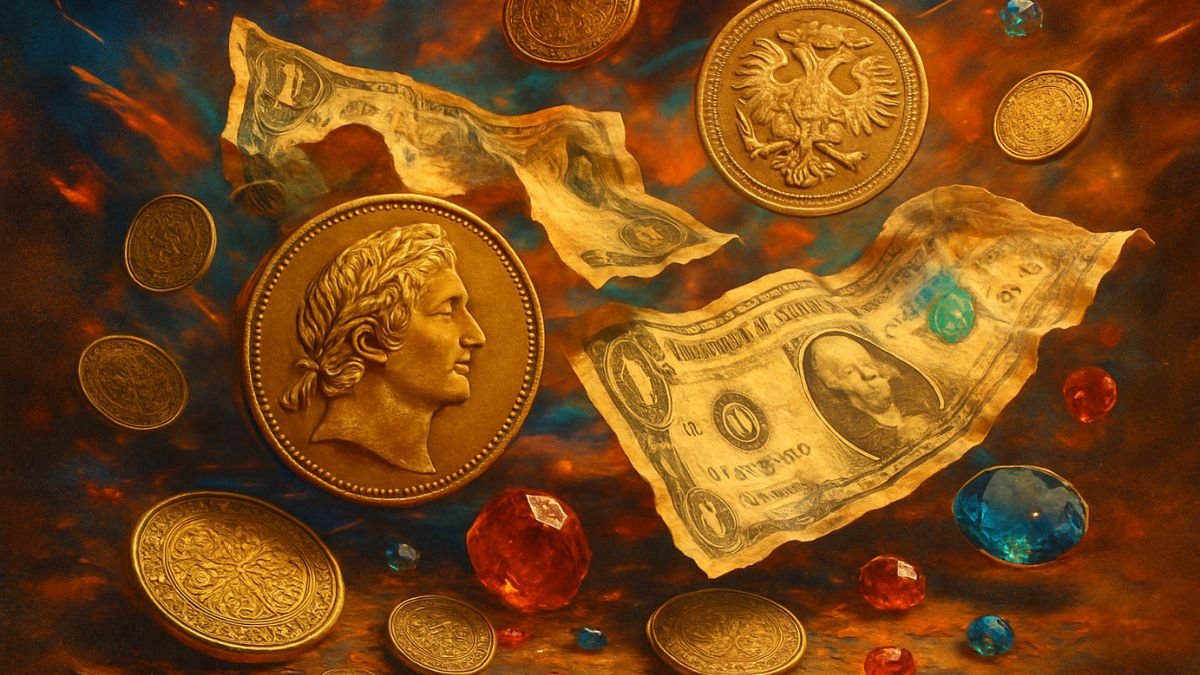
Welcome to the Great Exchange!
Have you ever stopped to think about that coin, card, or app you use to buy coffee? It’s just a piece of metal, plastic, or code, but it holds the power to get you almost anything you want. How did that happen? How did we go from trading seashells to tapping our phones to pay?
The history of money is the story of human ingenuity. It’s a wild tale of trust, power, innovation, and our constant search for better ways to cooperate and trade with one another. This isn't a stuffy economics test; it's a time-traveling adventure to discover one of the most important inventions in human history.
By taking this quiz, you will:
- Uncover Surprising Origins: Discover where the words "salary" and "dollar" come from and who really invented coins.
- Journey Through Time: Travel from ancient markets and the Silk Road to the first stock exchanges and the birth of cryptocurrency.
- Learn Through Discovery: With hints to guide you and feedback that tells the story behind each answer, every question is a new "aha!" moment.
- Appreciate Your Wallet: Gain a whole new perspective on the incredible system of trust that powers our global economy today.
So, are you ready to find out why your money has value? Let's make a trade—your time for some fascinating knowledge!
Learning Quiz
This is a learning quiz from English Plus Podcast, in which, you will be able to learn from your mistakes as much as you will learn from the answers you get right because we have added feedback for every single option in the quiz, and to help you choose the right answer if you're not sure, there are also hints for every single option for every question. So, there's learning all around this quiz, you can hardly call it quiz anymore! It's a learning quiz from English Plus Podcast.
Quiz Takeaways | The Story of Trust: What We've Learned
Welcome back, and well done! You've just taken a whirlwind tour through thousands of years of human history, all through the lens of one simple but powerful idea: money. The journey from trading salt to trading Bitcoin is really the story of human civilization itself. It's about how we learned to trust each other, cooperate on a massive scale, and create value out of thin air. Let's connect the dots from the quiz to see this incredible narrative unfold.
Our story began with the fundamental problem of bartering. As we saw, trading chickens for shoes only works if both people have exactly what the other wants. To solve this, humanity came up with its first brilliant idea: commodity money. Instead of trading goods directly, we started using a single, widely accepted item as a medium of exchange. This could be anything that people found valuable, like salt in ancient Rome (which gave us the word "salary") or cattle or grain. This was a huge leap forward, but carrying around heavy bags of salt or herds of cows was still inconvenient.
The next great revolution came from the Kingdom of Lydia, where they invented the world's first standardized coins. By stamping a piece of metal, the government guaranteed its weight and purity. This was a game-changer. For the first time, you had a form of money that was portable, durable, divisible, and universally trusted, at least within that kingdom. This idea spread like wildfire, fueling the economies of ancient Greece and Rome and making large-scale trade much easier. This trade flowed along great networks like the Silk Road, which didn't just carry goods, but also new ideas and technologies.
One of those revolutionary ideas came from China: paper money. This was perhaps the greatest leap of faith in financial history. The idea that a simple piece of paper could have value, just because a government said it did, was extraordinary. It was a move from money having intrinsic value (like a gold coin) to having purely symbolic value.
As we moved into the late Middle Ages and the Renaissance in Europe, the mechanisms of trade became more sophisticated. Merchant alliances like the Hanseatic League controlled trade in entire regions. And in the Age of Exploration, driven by the economic theory of Mercantilism (the belief that a nation's wealth was its pile of gold), a new entity was born: the joint-stock company. The Dutch East India Company was the first to sell shares to the public, allowing them to fund massive, risky ventures. To trade these shares, the world's first stock exchange was born in Amsterdam. This was the birth of modern corporate finance.
The intellectual foundation for our modern economy was laid by thinkers like Adam Smith. He argued against mercantilism, proposing that a nation's wealth was its productivity, not its gold. He described the "invisible hand" of the free market, a powerful idea that still shapes economic policy today. To create stability in this growing global market, nations adopted the Gold Standard, linking their paper money directly to a fixed amount of gold. This was a system of representative money—your paper note was essentially a claim check for real gold in a vault.
The 20th century shattered and rebuilt this entire system. After the chaos of two world wars and the Great Depression, the Allied nations met at Bretton Woods in 1944. They created a new system, making the U.S. dollar the world's reserve currency, which was itself backed by gold. They also created the International Monetary Fund (IMF) and the World Bank to manage the global economy. But this system lasted less than 30 years. In 1971, President Nixon severed the U.S. dollar's link to gold, and the entire world moved into the era of pure fiat money. Today, the value of our money is based solely on trust in the governments that issue it. This flexible system allows for more economic tools, but as we saw with the concept of hyperinflation, it also carries great risks if that trust is broken.
The final chapter of our story is the digital revolution. The invention of the credit card began the process of dematerializing money, separating the purchase from the payment. And today, we are in the midst of another great experiment with the rise of cryptocurrencies like Bitcoin. This is an attempt to create a new kind of money, one that is purely digital and decentralized, without any government or bank in control.
From a handful of salt to a line of code, the story of money is the story of our search for a better tool to facilitate trust and trade. It’s a story that is still being written, and it’s one we are all a part of every single day. The next time you make a purchase, take a moment to appreciate the thousands of years of human history that make that simple transaction possible.






0 Comments