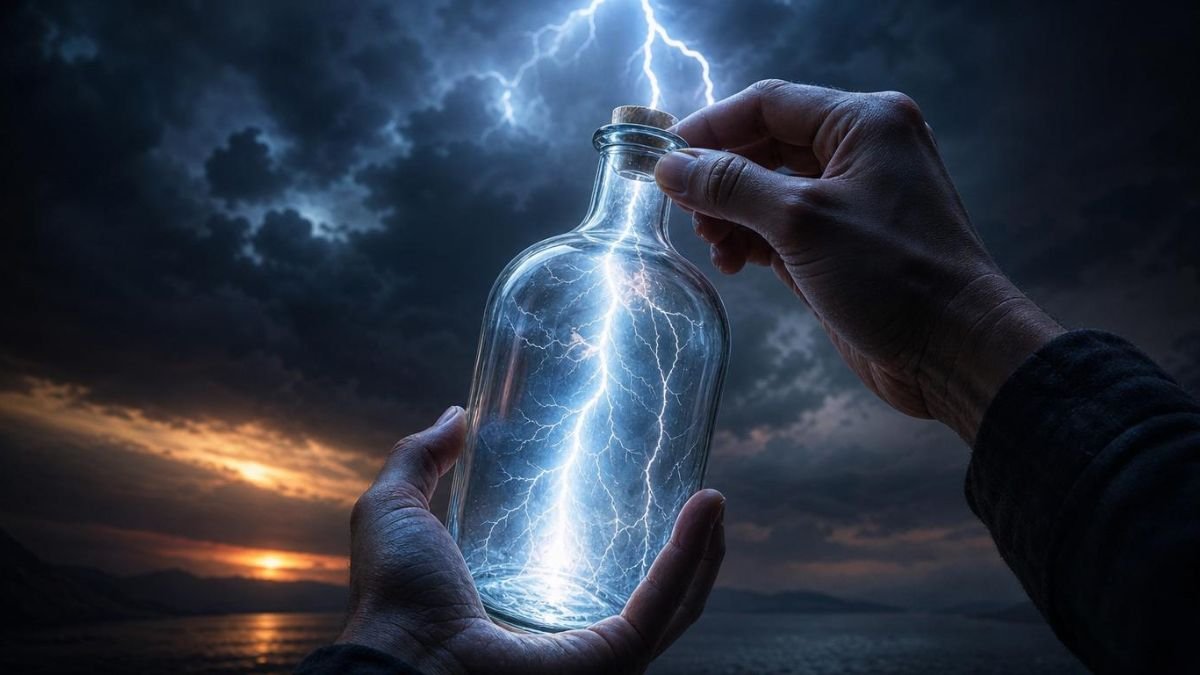
What do you call a moment so perfect that you know, even as it's happening, you'll never be able to make it happen again?
We have a phrase for that, and it might be the most beautiful impossible instruction in the language: catch lightning in a bottle. Just sit with the image for a second before we take it apart. Lightning — the wildest, fastest, most uncontainable thing in the sky. A jagged crack of raw power that's there and gone in a fraction of a second, that you can't schedule, can't predict, can't summon. And a bottle — small, still, ordinary, made of glass. The phrase asks you to put one inside the other. To take the untamable and hold it in your hand.
Of course it's impossible. That's the whole soul of it. When we say someone caught lightning in a bottle, we're not saying they did something difficult. We're saying they did something that shouldn't be possible at all — and somehow, for one shining moment, they pulled it off. The band that recorded an album that should have been an ordinary session and instead made something that would outlive them. The team that had no business winning and won anyway. The night everything aligned — the light, the people, the mood, the timing — in a way you couldn't reproduce if you tried it a thousand times.
And notice — this is the tender part — you usually can't. That's built into the phrase, too. You caught lightning in a bottle, singular. Not you catch it whenever you like. The whole ache of it is that it happened once, and everyone spends the rest of their lives trying to make it happen again, and it just won't come. Bands chase the sound of their first great record for decades. People try to recreate the perfect night by going back to the same place with the same people, and it falls flat, because the magic was never in the place. It was in the collision — of chance and readiness, of a hundred things that all happened to be true at once and will never all be true again.
Because here's what lightning actually is, underneath the poetry. It's not just luck, and it's not just skill. It's the exact moment they meet. Lightning needs a charge in the sky and a path to the ground — two conditions, both necessary, neither enough alone. And catching lightning in a bottle is like that. You need the raw, uncontrollable gift from the sky — the inspiration, the chance, the thing you can't manufacture. But you also need the bottle. You need to have done the work, to be standing in the right field with the glass already in your hand, ready, when the sky finally cracks open.
That's what I find so quietly hopeful in this phrase, underneath its impossibility. Yes, the lightning is out of your control. You cannot make it strike. But the bottle — the bottle is yours. The preparation is yours. The years of practice, the readiness, the fact that you showed up and kept showing up on all the ordinary days when nothing struck at all — that's the part you get to control. You can't summon the lightning. But you can make very sure that if it ever comes, you're standing there with the glass open.
And maybe that reframes the whole thing. We tell the story of lightning-in-a-bottle moments as though they were pure luck, as though magic just fell out of the sky onto the fortunate. But nobody catches lightning who wasn't already out in the storm. The moment looks like an accident. It was actually a readiness that had been waiting years for its chance.
There's something else here, too, something bittersweet. Part of why these moments are so precious is precisely that we can't repeat them. If you could catch lightning any time you wanted, it would stop being lightning. It would be a lamp. Reliable, useful, dull. The whole thrill is in the wildness, the once-ness, the fact that it came unbidden and left just as fast and you were lucky enough to be holding a bottle when it did. Trying to force it again isn't just hard — it slightly misunderstands what it was. The magic and the impossibility of repeating it are the same thing.
And there's a strange comfort hidden in that, if you've ever felt the pressure of trying to repeat your own best moment. Maybe you did something once that you can't seem to match, and you've been quietly ashamed of the falling-off, as though the magic was yours and you've somehow let it slip. But the phrase gently absolves you. You never owned the lightning. Nobody does. It came to you — it wasn't summoned by you — and the fact that it hasn't come again doesn't mean you've lost your gift. It means the sky is on its own schedule, and always was. Your job was never to command the storm. Your job was only, ever, to keep carrying the glass.
So maybe the wisest way to hold this phrase is with both hands open. Do the work. Carry the bottle everywhere. Be ready. And then — and this is the hard part — let go of demanding the strike. Show up in the field, glass in hand, not because you can command the sky, but because you'd hate to be caught empty-handed the one night it decides to split open.
And when it does happen — when the lightning finds you, and something impossible pours into your ordinary glass and lights it up from the inside — don't spend it wishing you could keep it forever. You can't. That was never the deal. Just look at it. Marvel that it happened at all. And know that you'll spend a long time telling the story of the night the sky chose you.
Here's my question to carry with you. If you can't control when the lightning strikes, only whether you're ready — then are you carrying your bottle? Are you out in the storm at all? Or are you standing safe indoors, dry and empty-handed, waiting for a magic you've made no room to catch?






0 Comments