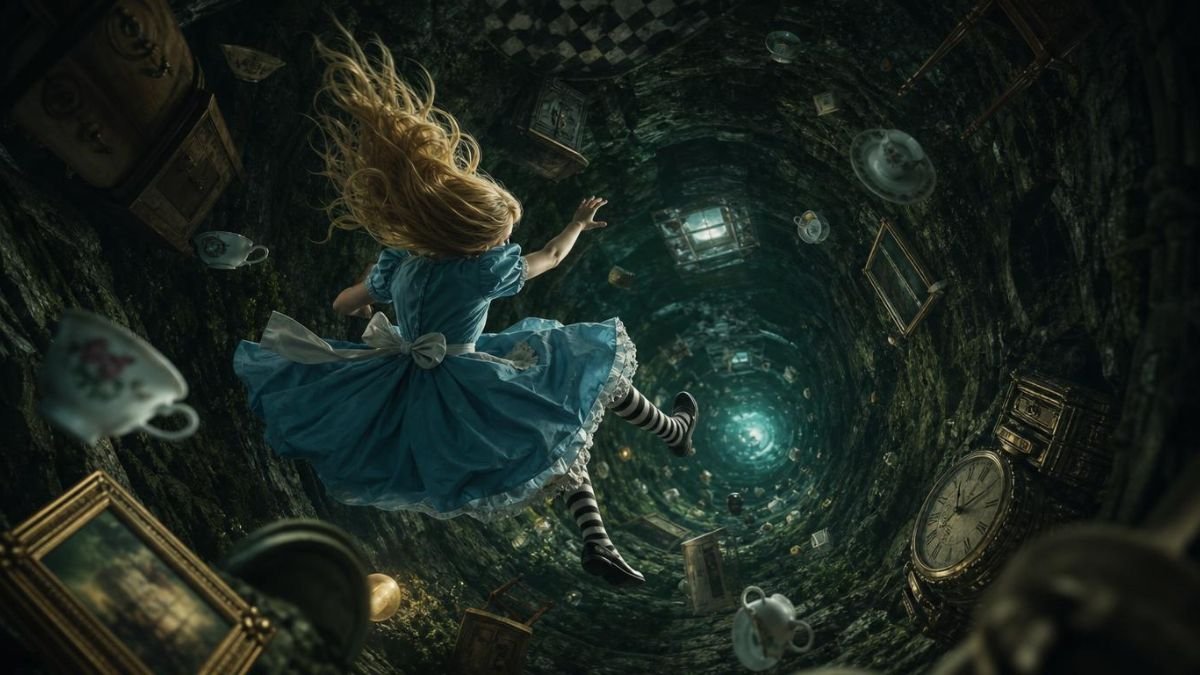
When was the last time a single small question swallowed your whole evening?
You know the feeling. You looked something up — just one thing, just to settle it — and one link led to another, and that one raised a question you'd never thought to ask, and you followed it, and followed it, and when you finally looked up, hours had vanished and you were somewhere you never planned to be, holding knowledge you didn't know you wanted. You went down the rabbit hole. And here's the thing — you probably say that phrase like a small confession, a little guilty. But I want to make the case that it might describe one of the best things a human mind can do.
The phrase comes, of course, from Alice. She sees a white rabbit in a waistcoat, checking a pocket watch, muttering that he's late — and instead of doing the sensible thing, instead of staying safely in the ordinary field where she belongs, she follows him. Down the rabbit hole. And the moment she does, the ordinary world closes over her head and she falls — slowly, dreamily — into a place with entirely different rules. That's the whole image. Curiosity leads you off the map, and you go, and the ground gives way, and you find yourself falling into a world you didn't know was underneath the one you knew.
And notice how perfectly the physical image captures the mental experience. A rabbit hole in real life is small. Unassuming. Easy to miss in the grass. You'd never guess how deep it goes just by looking at the opening. That's exactly how it feels to fall into a subject. The entrance is tiny — one offhand question, one thing you half-noticed — and you have no idea, stepping in, that the tunnel goes down for miles. That the small question opens into a chamber, and the chamber into a cavern, and the cavern into a whole underground world you could spend years exploring.
There's a wildness to it, too, that I love. When you go down a rabbit hole, you lose control of where you're going. That's essential to the phrase. You don't march down a rabbit hole with a plan. You fall. The subject pulls you. One question generates the next, and the next, and you're no longer choosing your path so much as being led by your own hunger to know. Time distorts — hours feel like minutes, exactly the way they do in dreams. And you forget, for a while, the sensible thing you were supposed to be doing, because something more interesting has taken hold of you.
Now, I won't pretend there's no danger here, because there is, and the phrase knows it. We say rabbit hole with a note of warning for a reason. You can fall into holes that lead nowhere good — obsessions that eat your days, spirals of worry that dress themselves up as research, dark tunnels of information that leave you more lost than when you started. The same curiosity that leads you to wonder can lead you to lose yourself entirely, down a hole with no bottom, chasing a rabbit that was never really there. The falling that feels like wonder can also be the falling that feels like drowning. It matters which hole you go down.
But — and this is what I want you to hear — the falling itself, the willingness to follow a question off the edge of the known, is one of the most human and marvelous impulses you have. Every discovery that ever changed the world started with someone who saw the white rabbit and, against all good sense, decided to follow it. Someone who couldn't leave the small question alone. Who fell into a subject and kept falling because they had to know what was at the bottom. The rabbit hole is where casual interest becomes real understanding. You cannot get deep by staying on the surface, by looking things up neatly and closing the tab. Depth requires the fall. It requires letting a subject pull you further than you meant to go.
And there's a joy in it that we don't celebrate enough — the pure, useless, glorious joy of being carried away by wanting to know. Not for a grade. Not for a job. Not because it's useful. Just because the question grabbed you and wouldn't let go, and following it felt like the most alive thing in the world. That falling feeling, that loss of time, that emergence hours later blinking and changed — that's not a waste. That's your mind doing the thing it was made to do. That's wonder in motion.
So I'd gently push back on the guilt we attach to this phrase. Yes, choose your rabbit holes with some care — some tunnels are worth the fall and some aren't. But don't lose the impulse itself. Don't become the sensible person who sees the white rabbit and stays in the field. The field is safe, and the field is flat, and nothing extraordinary was ever found by refusing to follow the strange thing into the ground.
Alice's whole adventure — every impossible, beautiful, transforming thing that happened to her — only happened because she followed. Because she was curious enough to fall. And she came back changed, as you always do from a good rabbit hole, carrying a world that most people walking that same field never even suspected was there.
Here's my question for you to fall into. If every deep thing you know began with a small question you chose to follow past the point of sense — then what white rabbit have you been ignoring lately, telling yourself you don't have time to follow? And what world might be waiting just underneath the one you're standing in?




0 Comments