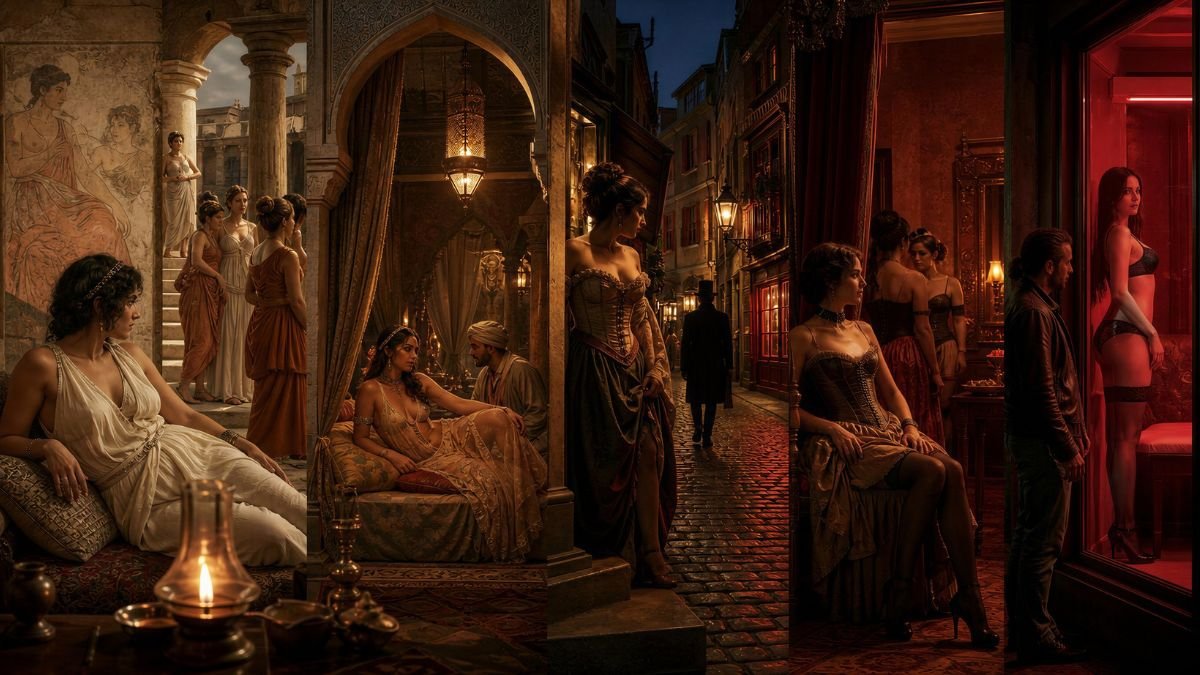
What do you do with a society that publicly proclaims that respectable women are pure, modest, and above the desires of the flesh — and privately maintains an enormous industry staffed by hundreds of thousands of women who are treated as the exact opposite?
If you are Victorian Britain, you do two things simultaneously. You build one of the most elaborate systems of public moral enforcement in Western history — including, incidentally, a sexual purity movement, an extensive police force with a specific remit to patrol public indecency, and an entire genre of literature dedicated to the dangers of the fallen woman. And you also maintain the commercial sex industry with complete operational normalcy, just on the other side of a carefully managed social partition that allows respectable people to pretend it doesn't exist while ensuring it remains available for their use.
The Victorians did not invent hypocrisy — we have seen ample evidence of that in every previous century. But they elevated it to an almost architectural achievement. The gap between the official story and the operational reality of Victorian sexuality is one of the most thoroughly documented in history, and what makes it so instructive is precisely that documentation. Victorians wrote about everything. They kept records. They commissioned surveys. They published investigative journalism. And the result is that we know, in considerable detail, exactly what was happening in the shadows of one of the most moralizing societies in Western history.
The Scale: What Victorian London Actually Looked Like
Let's start with numbers, because the scale is remarkable.
Contemporary estimates of the number of women engaged in commercial sex in mid-nineteenth century London vary enormously — partly because definitions varied, partly because no one was conducting rigorous social surveys with modern methodology, and partly because the industry operated across a vast spectrum from visible street sex work to the completely invisible arrangements of wealthy kept women. William Acton, a physician who in 1857 published a landmark study called Prostitution, Considered in Its Moral, Social, and Sanitary Aspects, estimated approximately eighty thousand women in London alone. Other estimates ranged lower. The police, who obviously had more direct contact with street-level sex work, recorded tens of thousands of women known to them in any given year.
Whatever the exact number, the social geography of Victorian London was organized around this industry in ways that were visible to anyone who looked — which, of course, was precisely what the respectable classes tried not to do.
The Haymarket district in central London was notorious for its nighttime commercial sex economy. The Strand had its associated networks. Certain neighborhoods — Whitechapel, Spitalfields, Soho — had concentrations of cheaper street-level trade. Higher-end commercial arrangements operated in Mayfair and St. James's, in discreet houses that catered to wealthy men and employed something closer to what we might call the Victorian version of the high-end courtesan. The two ends of this market were so socially and economically distant from each other that they barely seemed like the same thing — and that was precisely the point.
At the street level, the women working in Whitechapel and Spitalfields were doing so in conditions of poverty that defy comfortable description. Many were doing piece work and selling sex simultaneously to survive. They were vulnerable to violence from clients, from the men who controlled access to sleeping spaces, and from police harassment. They were frequently drunk, not as a moral failing but as a rational response to conditions of constant stress and danger in a culture that provided them no other coping mechanisms. They were, on average, significantly younger than their poverty made them look, and they were dying faster than their actual age should have predicted.
The women who worked in Mayfair houses were not wealthy — their economic security depended entirely on maintaining the favor of wealthy patrons, and that security had the shelf life of youth — but they were protected from street-level violence, they had access to better food and shelter, and they occupied something like a recognized social role that gave them some degree of predictability. The absolute difference in safety and survival between the two ends of the Victorian commercial sex market was a function of class as much as anything else, and it illustrates a pattern we have seen repeatedly: the industry's risks are distributed in inverse proportion to the power of those taking them.
The Contagious Diseases Acts: The Law Against Women
The most important piece of Victorian legislation relating to commercial sex is also one of the most straightforwardly unjust.
The Contagious Diseases Acts were a series of three Parliamentary acts passed in 1864, 1866, and 1869. They were initially aimed at garrison towns and naval ports — places where military personnel were concentrated and where venereal disease transmission rates were high enough to concern the army and navy as a military readiness issue. The logic was simple: the army could not function effectively if large numbers of its men were incapacitated by disease. Something had to be done.
What was done was this: in towns subject to the Acts, a plain-clothes police officer could identify a woman he believed to be a prostitute — solely on his own judgment, without evidence or formal charge — and require her to submit to a compulsory medical examination for venereal disease. If she refused, she could be imprisoned for up to a month. If the examination found infection, she could be forcibly detained in what was called a Lock Hospital for up to three months for treatment.
The men who visited commercial sex workers were not subject to any examination. Not subject to any requirement to disclose infection. Not subject to any regulation whatsoever. The entire regulatory apparatus was directed entirely at women.
There is no medical logic that supports this asymmetry. Venereal disease transmission is a two-way phenomenon. An infected man who visited multiple women was just as much a vector of transmission as an infected woman who saw multiple men — more so, given the power dynamics of the industry and the relative leverage that clients had over the terms of any given encounter. But the Contagious Diseases Acts were not designed around medical logic. They were designed around a moral assumption: that the women were the source of infection, the men were the victims of it, and therefore the regulatory burden should fall entirely on the women.
This assumption was not unchallenged. The campaign to repeal the Contagious Diseases Acts, led primarily by Josephine Butler — one of the great social reformers of the Victorian period — was one of the first genuinely feminist mass political campaigns in British history. Butler argued, clearly and publicly, that the Acts were a form of legislative rape: forcing women to submit to intimate physical examination under threat of imprisonment, with no legal recourse, on the word of a single police officer. She organized women across the country to petition Parliament. She spoke publicly about sexual matters in a way that Victorian convention considered completely inappropriate for a respectable woman. She was, to put it mildly, not universally popular.
But she was effective. The Contagious Diseases Acts were suspended in 1883 and repealed in 1886, a genuine legislative victory for the campaign Butler had led. It was also the beginning of a much broader understanding that the regulation of commercial sex, as historically practiced, consistently placed its burdens on women while extending its protections to men.
The Maiden Tribute: Child Exploitation and Investigative Journalism
In 1885, William Thomas Stead, the editor of the Pall Mall Gazette, published a series of articles titled "The Maiden Tribute of Modern Babylon" — one of the most sensational pieces of investigative journalism in the nineteenth century, and one that had a direct legislative consequence.
Stead had investigated, with the cooperation of Josephine Butler and a reformed brothel-keeper named Rebecca Jarrett, the network of child sexual exploitation operating in London. His investigation found — and this is not comfortable to read — that it was possible, in 1885 London, to purchase a young girl for a specific sum, with the transaction conducted openly through networks of procurers who operated in the poorest districts of the city. The girls in question were typically from destitute families who either did not know what they were selling their daughters into or who, in the most desperate cases, did know and had no alternative.
Stead's articles described this network in explicit enough terms to provoke massive public outrage. The series sparked public demonstrations, including a march of some two hundred thousand people through the streets of London — one of the largest protest marches in Victorian history — demanding legislation to protect children from sexual exploitation.
Parliament responded. The Criminal Law Amendment Act of 1885 raised the age of sexual consent in England from thirteen to sixteen, strengthened laws against procuring, and made certain forms of organized exploitation newly criminal. It was a genuine legislative achievement.
And then Stead went to prison.
In order to demonstrate that a child could be purchased for commercial sexual exploitation, Stead had actually purchased a thirteen-year-old girl named Eliza Armstrong from her mother — paying five pounds, and then placing her in the care of the Salvation Army rather than in a brothel. The problem was that Stead had not obtained the consent of Eliza's father, who appears to have been unaware of the transaction and who had not agreed to it. He was prosecuted for abduction and served three months in prison.
The Stead case is a remarkable collision of genuine moral purpose, reckless methodology, and the particular blindness that sometimes afflicts even sympathetic observers — Stead had not thought carefully enough about Eliza Armstrong as a person with her own family, her own story, and her own claims on the process. His rescue operation had treated a child as an instrument of journalism in a way that was, whatever its intentions, its own kind of violation. He served his time. He never apologized, which says something about his character. But the legislation he helped produce was real, and the children it protected were real.
The Literature of the Fallen Woman
Before we leave the Victorians, it's worth spending a moment on how they talked about this industry in their culture, because the cultural conversation is as revealing as the legal one.
Victorian literature is obsessed with the fallen woman — the woman who has lost her sexual purity and whose descent into ruin is depicted with a combination of tragic sympathy and stern moral lesson. Thomas Hardy's Tess of the d'Urbervilles, Elizabeth Gaskell's Ruth, Wilkie Collins's various morally complicated women — the Victorian novel is full of women destroyed by sexual transgression, their fates functioning as cautionary tales about the importance of female purity.
What's notable about this literature is what it almost never shows: the men responsible for the women's situations being held to account. Alec d'Urberville rapes Tess and eventually dies for it, but only because Tess kills him in a moment of desperation that the novel itself frames as desperate rather than righteous. The men who seduce and abandon women in Victorian fiction typically move on with their lives while the women are destroyed. The moral economy of Victorian literature placed the entire cost of sexual transgression on women and almost none of it on men.
This is not just a literary observation. It reflects the actual distribution of consequences in Victorian society. A woman who had "fallen" could be disowned by her family, barred from respectable employment, and pushed into deeper desperation by the very social censure that was supposed to protect society from vice. The man who had "fallen" her — well, he might experience some social embarrassment. He might not.
The word "fallen" itself deserves attention. It implies that the woman's condition is a matter of moral gravity, of descent from a natural height. It frames commercial sex as a personal moral failure rather than a structural economic phenomenon. It places the entire analytical frame on the individual woman's character rather than on the conditions that produced her situation. The Victorians perfected this rhetorical move, and it is one that has retained remarkable longevity in public discourse about this industry right up to the present day.
Discussion Questions
The Contagious Diseases Acts placed the entire regulatory burden for venereal disease on women while leaving men completely unregulated. What does that asymmetry reveal about whose health Victorian law was actually designed to protect?
Victorian commercial sex operated across an extreme class spectrum, from the desperate street-level trade in Whitechapel to the discreet arrangements of Mayfair. What does that class stratification tell us about who bears the risks of commercial sex and who is shielded from them?
W.T. Stead exposed child sexual exploitation, went to prison for his methodology, and helped produce genuinely protective legislation. How do you evaluate the ethics of that outcome?
The Victorian concept of the "fallen woman" placed moral responsibility entirely on women while exempting men from consequences. Where do you still see that moral asymmetry operating in contemporary culture and law?






0 Comments