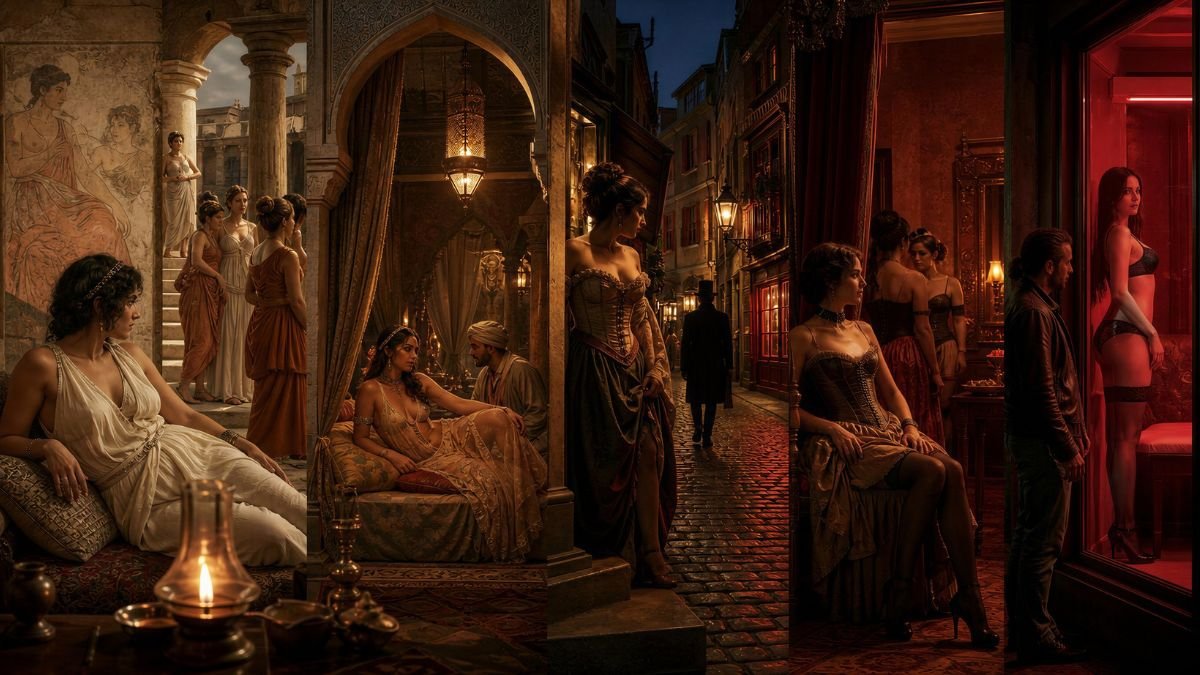
What do you do when you believe something is sinful, you believe you can't stop it, and you realize you might as well make money from it — and somehow convince yourself this is the reasonable position?
This is, roughly speaking, the theological and administrative position that much of medieval Europe arrived at regarding commercial sex. And the fact that this position was articulated, defended, and institutionalized by one of the most powerful religious institutions in world history — the Catholic Church — tells us something important about the difference between official morality and operational reality.
We are now in the medieval period, roughly from the fall of the Western Roman Empire in the fifth century through to the end of the fifteenth century — a thousand years of complicated, contradictory, deeply human history. And if the ancient world built the architecture of commercial sex, the Middle Ages inherited that architecture, slapped a coat of religious guilt on the outside, and then continued using it while arguing loudly about whether they should.
Augustine and the Theology of Necessary Evil
To understand the medieval Church's position on commercial sex, you need to understand Augustine of Hippo, the fourth and fifth-century theologian whose ideas about sin, sexuality, and human nature shaped Western Christianity for more than a thousand years.
Augustine's personal history is relevant here. Before his conversion to Christianity, he lived for years with a concubine whom he clearly loved and who bore him a son, and his writings about that period — particularly in his Confessions — are remarkable for their psychological honesty about desire, guilt, and the difficulty of abandoning what you know is pleasurable. When Augustine became a Christian and a bishop, he developed a theology of sexuality that was simultaneously deeply suspicious of physical desire and strikingly realistic about human weakness.
In his massive theological work The City of God, Augustine addressed the question of commercial sex directly. His conclusion was something that later commentators would describe as the "necessary evil" doctrine. Augustine wrote — and I'm paraphrasing his position rather than his exact language — that prostitution was like a sewer in a palace: disgusting, but if you removed it, the entire building would fill with filth. Better to keep the sewer confined and functioning than to eliminate it and deal with the overflow.
What Augustine meant by this is that if commercial sex were eliminated, he believed that frustrated male desire would overflow into greater evils — adultery, rape, the seduction of respectable women, the disruption of the Christian family. Prostitution, in this view, was a drain for male sexuality that, if removed, would flood more important social institutions. The women providing this service were, in this framework, necessary instruments of social stability. They were not to be respected. They were not to be treated with dignity. But they were to be tolerated, for the good of everyone else.
Thomas Aquinas, the great thirteenth-century theologian, repeated Augustine's argument almost verbatim in his Summa Theologica. This is significant. Aquinas is not a fringe thinker. His theological synthesis is arguably the most important intellectual project of medieval Christianity. And his position on commercial sex was: it is sinful, it is regrettable, and it should be tolerated as a lesser evil.
This theology gave license — in the most literal sense — to the entire medieval system of regulated commercial sex. If the Church's greatest thinkers said it had to exist, then city governments could regulate it with a clear institutional conscience.
The Medieval Brothel: Geography and Organization
By the twelfth and thirteenth centuries, licensed brothels were a standard feature of urban life across much of Europe. The pattern was similar from city to city, from London to Paris to Venice to the cities of the Holy Roman Empire: a specific area designated for commercial sex, usually outside the main city walls or along the waterfront, often near tanneries and other industries considered too smelly or disruptive for the center of town. The choice of location was not accidental. Placing the vice district outside the walls or at the urban margins served a social function: it made it simultaneously accessible and invisible. Men could visit. Respectable people could claim they never saw it.
In London, the most famous medieval sex district was Southwark, just across the Thames from the City of London proper. The establishments there were called stews — originally the word referred to heated bathhouses, which were genuine establishments but which, in the medieval period, had evolved to include sexual services as part of their offerings. Southwark was outside the jurisdiction of the City of London, which meant its establishments operated under the authority of the Bishop of Winchester. And this is where the medieval religious contradiction becomes fully concrete: the Bishop of Winchester — a senior Church official — held the lease on the land where the Southwark stews operated. The women who worked there were even known colloquially as "Winchester geese." The Church was, through the mechanism of property ownership, collecting income from commercial sex.
This was not entirely hypocritical by the standards of the time, strange as that sounds. Medieval bishops were also secular lords with political and economic responsibilities. The income from Southwark went into the same treasury that funded charitable work, churches, and the administrative apparatus of the diocese. The moral theology said one thing; the economics required another. And the medieval Church was experienced enough in managing human contradiction to hold both without visible discomfort.
Similar patterns existed across Europe. In Venice, the state-operated Castelletto was established in the fourteenth century — a state-regulated brothel that employed licensed women, set prices, and attempted to prevent women from working outside the official system. In Avignon, in France, Queen Joanna of Naples authorized a municipal brothel in the fourteenth century, specifying its location, its operational rules, and the requirement that the women working there undergo regular health inspections. In German cities, the civic brothel — the Frauenhaus, literally "women's house" — was a normal civic institution, sometimes used to entertain important visiting dignitaries, sometimes funded directly from the municipal treasury.
The Women: Who They Were and How They Got There
Let us be very specific about who the women in these medieval systems actually were, because the institutional history can obscure the human reality.
They were overwhelmingly poor. The economic structure of medieval Europe left women with very limited legal and economic rights. Widows, women abandoned by husbands, women whose families had been destroyed by war or plague or famine, women from the lowest economic tier with no dowry and no marriage prospects, orphans and migrants — these were the women who ended up in the stews and the brothels and the Frauenhauser.
They were frequently young. Very young, by modern standards. Medieval society did not have a modern conception of childhood or adolescence, and girls who found themselves in desperate economic circumstances could be pushed into commercial sex before their mid-teens. This is not a comfortable fact. It should not be glossed over.
Many of them were there involuntarily. Debt bondage was a standard recruitment mechanism: a woman or girl would be given an advance, a loan, or simply incur a debt for her room and board, and then find herself unable to leave because she owed more than she could ever earn back. This is not a modern invention. It is documented in medieval sources. It is one of the oldest mechanisms of coerced labor in this industry, and we will see it again in every subsequent century.
War produced a constant supply. Medieval Europe was almost continuously at war somewhere, and warfare produced displaced women — camp followers who serviced armies and whose position was precarious in the extreme, women captured from defeated populations, women whose towns had been sacked and whose families had been killed and who had absolutely nothing left. Military campaigns had their own organized commercial sex operations, which army commanders and church officials mostly chose to look away from.
The Crusades: Commerce and the Holy War
Speaking of armies and the Church, the Crusades — those extraordinary medieval military campaigns aimed at recovering Jerusalem and the Holy Land from Muslim rule — are a chapter that deserves specific attention in any history of commercial sex.
The Crusading armies were followed by enormous numbers of camp followers, including substantial numbers of women providing sexual services. Chronicles of the Crusades — written by clerics who were clearly uncomfortable with what they were observing — mention these women with some frequency, usually in the context of moral panic about how their presence was bringing God's disfavor down on the campaign. The First Crusade, which ultimately succeeded in capturing Jerusalem in 1099, was followed by the usual clerical debate about whether the presence of these women had endangered the enterprise.
The meeting of Crusading armies with the cities and cultures of the Middle East also produced its own specific commercial sex economy. The port cities through which Crusading forces passed — Constantinople, Antioch, Acre — developed substantial commercial sex districts that served the international military traffic. The wealth and cultural prestige of Constantinople in particular made it a center of luxury trade of all kinds, including the high-end version of commercial sex that served wealthy merchants, diplomats, and military commanders.
There is also the deeply uncomfortable history of enslaved women brought back from Crusading campaigns as part of the general spoils of war. Islamic and Byzantine sources document this. Western European chronicles mention it more obliquely. The Crusades, celebrated in medieval culture as a religious enterprise, were also a large-scale economic operation that produced, among other things, a significant traffic in human beings.
Leprosy, Plague, and the First Health Regulations
The medieval period also saw the emergence of something genuinely new in the history of commercial sex regulation: the explicit connection between the industry and public health, and the use of public health rationale to regulate it.
The Black Death, which struck Europe in the mid-fourteenth century and killed somewhere between one-third and one-half of the entire European population in a few devastating years, transformed everything it touched, including attitudes toward the body, mortality, and disease. In the aftermath of the plague, municipal authorities became considerably more attentive to the relationship between sexual commerce and disease transmission. Health inspections of women in licensed brothels became more common in city regulations. Requirements that women suspected of illness be excluded from establishments appear in municipal codes.
This is the origin of a regulatory logic that will become enormously important in later centuries — the idea that the solution to the public health risks of commercial sex is not to change the conditions under which it operates, not to improve the situation of the women involved, but to inspect and police the bodies of those women while leaving the industry's structural conditions intact. The woman is the vector of disease. The man is the consumer who needs to be protected. The regulatory apparatus is organized accordingly. This logic will reach its most developed and most damaging form in the Victorian period, but its roots are here, in the medieval city's response to epidemic disease.
The Church's Other Hand: Magdalene Houses and Redemption
It would be unfair to present the medieval Church's relationship to commercial sex as purely one of institutional tolerance and financial benefit. There was also a genuine tradition of what might be called redemptive intervention — houses specifically established to provide women who wanted to leave the trade with shelter, support, and a path to a different life.
These institutions were called Magdalene houses, after Mary Magdalene — the figure from the New Testament whom medieval tradition had fused with the unnamed sinful woman who washed Jesus's feet, making her into a repentant prostitute. (Modern scholarship is fairly clear that this fusion was a mistake and that the actual Mary Magdalene was nothing of the sort, but the medieval tradition held, and her image as the reformed fallen woman became enormously influential.) Magdalene houses appeared in European cities from the twelfth century onward. They were usually run by religious communities, often by nuns. They offered women a place to live, religious instruction, domestic training, and the possibility of marriage or taking religious vows.
The Magdalene house tradition is complicated, as most medieval institutions are. At its best, it represented a genuine extension of compassion to women in desperate circumstances. At its worst, it functioned as a mechanism of social control — taking women off the streets not for their benefit but to reduce visible disorder, training them in submissive domestic roles, requiring religious conversion as the price of assistance, and placing them under the authority of religious institutions that had their own interests in maintaining a certain kind of moral order.
The Magdalene house tradition would persist well into the modern period, most infamously in the Magdalene laundries of twentieth-century Ireland, where women deemed sexually deviant were essentially imprisoned in church-run institutions and used as unpaid labor. The compassion and the coercion were always braided together. That is not a comfortable thing to acknowledge about an institution rooted in the name of a woman the tradition treated with enormous tenderness. But it is true.
What the Middle Ages Got Right — and Wrong — About the Problem
The medieval period's approach to commercial sex was, in many ways, a sophisticated attempt to manage an industry that it genuinely believed could not be eliminated. The theology gave it a rationale. The licensing system gave it a structure. The geographic marginalization gave it a social boundary. The Magdalene houses gave it an exit strategy. In purely administrative terms, it was a coherent system.
But it was a system built on a foundation of structural injustice. The women in the brothels were there primarily because they had no other options. The men visiting those brothels faced no legal, social, or moral penalty. The Church condemned both parties in theory and benefited from one of them in practice. The municipal authorities regulated the industry without protecting its participants. The language of "necessary evil" made the exploitation of real human beings into an abstract theological category, which is one of history's most reliable mechanisms for avoiding moral responsibility.
The Middle Ages did not invent these problems. It inherited them from the ancient world. But it did systematize them in ways that made them harder, not easier, to dislodge. The next centuries would try various approaches — crackdown, displacement, criminalization, and eventually the elaborate Victorian machinery of public decency and private vice — without resolving the fundamental contradiction.
That fundamental contradiction is still with us today. Which is, perhaps, why this history still matters.
Discussion Questions
Augustine's argument that tolerating a lesser evil prevents greater ones became the theological justification for licensed brothels across medieval Europe. Is this logic ever defensible, or does it always protect the industry rather than the people in it?
Medieval women entered commercial sex through poverty, war, debt, and the collapse of family support. How does structural coercion of this kind differ from the modern legal concept of consent?
The geographic placement of vice districts — Southwark across the river, brothels outside the city walls — served a social function of managed invisibility. Where do we observe that same logic in contemporary cities and societies?
The Magdalene house offered women a path out of commercial sex, but at the price of religious conformity and institutional control. When does a "rescue" institution cross the line into a different kind of exploitation?






0 Comments