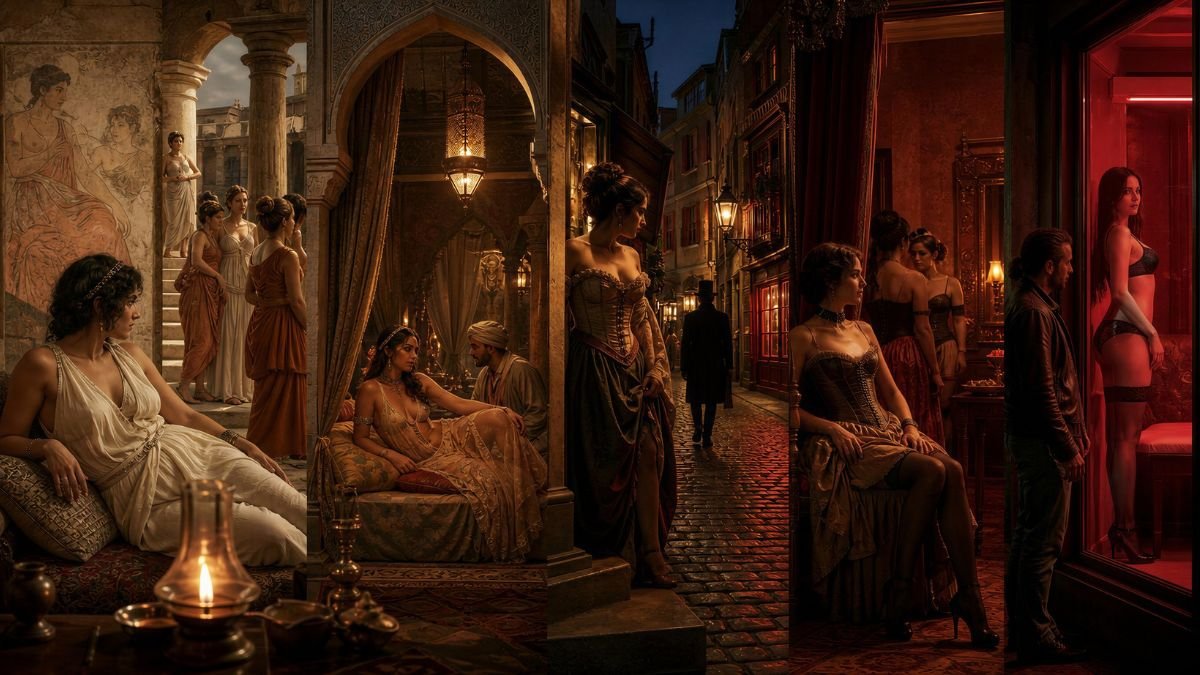
What does it mean to have enormous cultural influence, genuine artistic accomplishment, and significant social presence — while still being ultimately defined by your availability to men of means?
That is the central question of this episode, and it is one that I find genuinely troubling in the most productive sense — the kind of troubling that forces you to think more carefully rather than less.
We are moving into a period that tends to get considerably more romanticized than what came before, which is itself worth examining. The Renaissance courtesan has been the subject of novels, films, operas, and biographies that celebrate her intelligence and charm. The geisha has been covered in a Hollywood film that made about half a billion dollars. The Ottoman harem has generated an entire subgenre of fantasy that says more about European anxieties than it does about Ottoman reality. In all three cases, the romanticization does something specific and somewhat dishonest: it takes the most exceptional individuals in these systems and uses them to obscure the structural reality of everyone else.
We're going to look at all three — and we're going to look at both the exceptional individuals and the structural reality.
The Cortigiana Onesta: The Honest Courtesan
The Italian Renaissance, roughly from the fourteenth through the sixteenth centuries, produced one of the most extraordinary cultural environments in human history. It also produced a category of woman called the cortigiana onesta — the "honest courtesan," which sounds like an oxymoron but was, in Renaissance cultural logic, a precise social designation.
The cortigiana onesta was distinguished from the cortigiana di lume — the common prostitute — by her level of education, her social skills, and the type of relationship she offered to her patrons. She was not simply selling sex. She was offering intellectual and cultural companionship, artistic collaboration, and sophisticated social partnership to wealthy men — primarily merchants, nobles, and church officials — who wanted a companion that a respectable wife, confined to domestic life and largely excluded from male intellectual culture, could not provide.
She was expected to be literate — not just functionally literate but genuinely educated in Latin, literature, philosophy, and the arts. She was expected to play music, often to a high standard. She was expected to be able to hold her own in philosophical debate, to compose verse, to discuss theology and humanism with the same men who debated these things with each other in the academies and courts of Florence, Venice, Rome, and Milan. And some of them — a remarkable number, actually — genuinely could.
The most famous of all Italian Renaissance courtesans is probably Veronica Franco of Venice, born in 1546. Franco was the daughter of a courtesan, which was one of the primary routes into the profession — the children of courtesans had few other paths, and some had been effectively trained from childhood. Franco became one of the most celebrated intellectuals of Venetian society. She published two volumes of poetry. Her verse was sophisticated, humanist in its sensibility, and included remarkable meditations on her own situation — at once proud of her cultural achievements and unflinching about the constraints she operated within. When the French King Henri III visited Venice, he specifically requested to meet Veronica Franco. She was one of the first sights of Venice that powerful visitors wanted to see.
She was also, in her later years, tried before the Venetian Inquisition on charges of witchcraft — a prosecution she successfully defended against, partly by her own wit and partly because she had powerful friends. She spent time in poverty after losing her patrons. She died without security. The arc of her life illustrates exactly the precariousness behind the glamour: the cortigiana onesta was one serious illness, one lost patron, or one shift in social fashion away from destitution.
What the cortigiana onesta system tells us about Renaissance Italy is fascinating. It tells us that the culture valued intellectual women enough to create a specific social role for them — but only outside the institution of marriage. It tells us that humanist ideals of education and rational discourse were genuinely extended to women — but only to women who had sacrificed the protection of family and legal marriage to access them. The most intellectually free women in Renaissance Italy were the ones most structurally vulnerable. There's something almost cruelly elegant about that contradiction.
The Ottoman Imperial Harem: Power, Not Just Prison
When Western Europeans in the nineteenth century thought about the Ottoman Empire's harem system, they thought primarily in terms of captivity, sensuality, and Oriental despotism. Paintings by artists like Jean-Auguste-Dominique Ingres depicted harem scenes of languid, available women in ways that said rather a lot about European male fantasy and rather little about actual Ottoman institutions. The word "harem" became shorthand for a kind of sexualized captivity that served as both a critique of Islam and a projection of desire.
The actual institution was considerably more complex.
The Ottoman imperial harem — the harem of the Topkapi Palace in Constantinople — was not primarily a sexual institution. It was an administrative and political one. It was, functionally, the royal household: the domestic organization of the sultan's family and the women who managed it. Its head was not the sultan but the Valide Sultan — the sultan's mother — who wielded genuine political power, controlled significant resources, coordinated political alliances, and in some periods was one of the most powerful figures in the Ottoman Empire. This era of female political influence, from roughly the mid-sixteenth to the mid-seventeenth century, is known to historians as the Sultanate of Women — a period when imperial mothers and imperial favorites shaped Ottoman policy, negotiated with foreign powers, and effectively governed the empire alongside or through their sons.
That is not a story about captive women. That is a story about female political power operating through the specific institutional channels available to women in a court society.
At the same time, the harem system was built on slavery. The women who entered the imperial household, including those who became powerful favorites or important officials, were often enslaved — purchased at markets or received as gifts from vassal states. Their path to power ran directly through their bodies and through the children they bore for the sultan. Women who bore sons gained enormous status and influence. Women who did not could spend their lives in the lower tiers of the institution, doing domestic work and dying in obscurity. And women who fell out of favor could be married off, exiled, or simply forgotten.
The harem was not a prison in the simple sense that Ingres painted it. It was a structured society with its own hierarchy, its own politics, its own career trajectories, and its own internal dynamics of competition and alliance. But it was a society that operated entirely within the framework of male sovereignty and female instrumentality. The power that women wielded within it was real. The structural constraints that defined it were absolute.
The Geisha: Art, Ambiguity, and Misrepresentation
The geisha tradition of Japan is perhaps the most thoroughly misunderstood subject in this entire series — which is saying something.
The word geisha means, literally, "person of arts" or "artistic person." The geisha were professional entertainers trained in traditional Japanese music, dance, poetry, tea ceremony, and conversation. They inhabited a specific social world called the karyukai — the "flower and willow world" — that was carefully organized, professionally structured, and socially distinct from the mainstream. In the great entertainment districts of cities like Kyoto, Osaka, and Tokyo, geisha worked in ochaya — teahouses — as professional hostesses, providing refined entertainment to wealthy male clients.
The fundamental misrepresentation of geisha in Western culture — a misrepresentation that began in the nineteenth century when Western visitors first encountered these women and has persisted through a very famous novel — is the conflation of the geisha with the yūjo, the prostitute. These were distinct categories within the Japanese entertainment world, with different training, different institutions, different social status, and different relationships to their clients.
The yūjo, or "woman of pleasure," was a sex worker in a more direct sense — operating in licensed pleasure quarters like the Yoshiwara in Edo, providing sexual services as the primary transaction. The Yoshiwara was an extraordinary institution in its own right: a walled entertainment district, established by the Tokugawa shogunate in the seventeenth century, with its own elaborate internal hierarchy, its own culture, its own aesthetics, and its own brutal economics. Women in the Yoshiwara were often indentured — sold by poor families, or contracted by brothel owners in arrangements that were functionally debt bondage. The most celebrated of the Yoshiwara's high-ranking courtesans, called oiran, were cultural icons with enormous artistic polish and essentially no personal freedom. They could not leave the district. They were property, in the most precise legal sense.
The geisha tradition developed partly in response to and alongside the Yoshiwara system, but it was institutionally distinct. A geisha's primary offering was artistic performance and refined social entertainment. The question of whether any individual geisha also provided sexual services to a patron — which certainly happened in various forms — is a question of individual circumstance and relationship, not a defining feature of the institution.
What both systems — geisha and yūjo — shared was a relentless economic logic. Both trained young women in highly skilled arts, at enormous expense, and then required years of labor to repay that investment. Both operated within systems where the woman's beauty and youth were her primary economic assets, with a clear expiration date. Both placed women in positions of cultural prestige and structural precarity simultaneously. The system celebrated what it produced and discarded what it used up. That logic is not unique to Japan. It is one of the most consistent features of every system in this series.
The Pattern Underneath the Romance
What the cortigiana onesta, the Ottoman imperial favorite, and the geisha tradition share — beneath all the cultural specificity, the poetry, the music, the political intrigue — is a single structural pattern: these systems took women with limited economic and legal options, invested in their beauty and skills, placed them in proximity to powerful men, and extracted value from them under conditions that the women themselves did not control.
The most exceptional individuals within these systems — Veronica Franco, the Valide Sultan Kosem, the famous oiran Takao of the Yoshiwara — could achieve extraordinary things within those constraints. Their achievements were real. Their intelligence, artistry, and sometimes their courage were genuine. None of that cancels the structural reality.
Romance and exploitation are not mutually exclusive. That is one of the most important lessons of this history, and one that is relevant well beyond the specific subject of this series. Whenever a system produces beautiful things, we should ask who paid for those beautiful things, and whether they got to choose to pay.
In the next episode, we move from the cultural sophistication of courts and entertainment districts to the brutal mechanics of empire — because the history of colonial expansion is also, inescapably, a history of what happens to women's bodies when one civilization systematically subordinates another.
Discussion Questions
Veronica Franco achieved genuine literary and intellectual distinction as a courtesan, yet died without security. What does her arc tell us about the relationship between cultural achievement and structural protection for women?
The Ottoman harem produced powerful political actors — the Valide Sultans who shaped imperial policy. Does the presence of genuine power within an institution built on slavery change our moral assessment of that institution?
The geisha tradition drew careful distinctions between artistic entertainment and sexual commerce. How meaningful was that distinction for the women inside the system, and what purpose did the distinction serve for the culture outside it?
All three systems in this episode celebrated the women within them while ultimately treating them as instruments of male desire. How do we honor genuine achievement without obscuring the structural conditions that produced it?






0 Comments