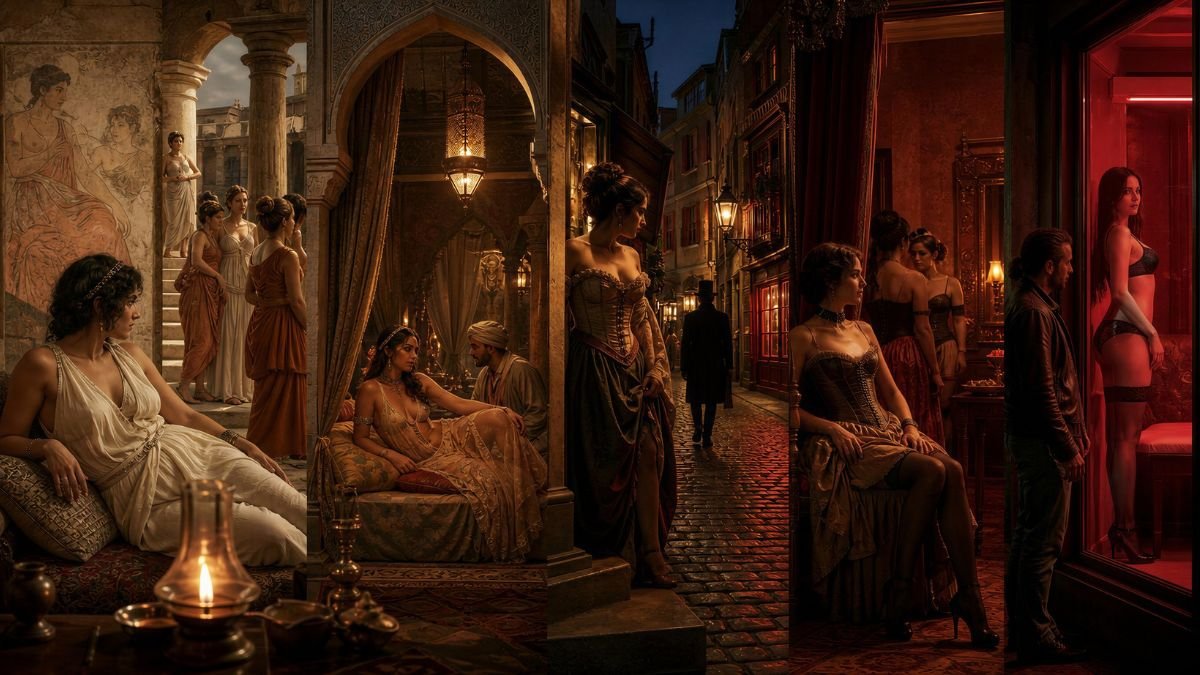
Series Overview
Few industries have shaped human civilization as quietly and persistently as the commodification of sex. From ancient temple rituals and the brothels of Rome to the coded language of Victorian classified ads, the rise of online platforms, and the ongoing global fight against trafficking — the story of sex as a business is inseparable from the story of power, poverty, gender, law, and what societies choose to hide. This series does not sensationalize. It does not titillate. It investigates — with honesty, historical rigor, and deep respect for the human beings at the center of this story. Across ten episodes, we trace the economic, cultural, and political forces that have shaped this industry across millennia, asking not just how it operated, but who benefited, who suffered, and what we still refuse to see.
Series Episode Outline
Episode 1: In the Beginning: Sex, Temples, and the First Economies
Mesopotamia, ancient Near East, sacred prostitution debate, early commercial sex
Episode 2: Greece, Rome, and the Architecture of Desire
Greek hetaerae, Roman lupanaria, class, citizenship, legal frameworks
Episode 3: The Middle Ages: God, Sin, and Regulation
Church ambivalence, licensed brothels, Crusades, medieval urban economies
Episode 4: Courtesans, Kings, and the Politics of Pleasure
Renaissance courtesans, Ottoman odalisques, mistresses as political actors
Episode 5: The Colonial Export: Race, Empire, and the Global Trade
Colonialism, racialized exploitation, port towns, military prostitution
Episode 6: Victorian Shadows: The Underground Economy of the Empire
Victorian hypocrisy, the Contagious Diseases Acts, underground networks
Episode 7: The 20th Century: Wars, Migration, and the Criminalization Wave
WWI/WWII, comfort women, criminalization movements, moral panics
Episode 8: The Business Model: How the Industry Actually Works
Pimping structures, trafficking economics, debt bondage, the money trail
Episode 9: The Digital Turn: Platforms, Algorithms, and OnlyFans
Internet, FOSTA-SESTA, OnlyFans, decriminalization debates, tech complicity
Episode 10: Where Do We Go From Here: Laws, Justice, and Human Dignity
The Nordic model, full criminalization, decriminalization, survivor voices, path forward
Episode 01 | In the Beginning: Sex, Temples, and the First Economies
What if the first known economy built around sex wasn't sinful, wasn't shameful, and wasn't even considered unusual — what if it was, in the most literal sense of the word, sacred?
That question is the starting point for everything we're going to explore in this series. And I want to be honest with you right from the beginning: this series is not going to be comfortable. It's going to be honest. Those are not always the same thing, and we're going to spend ten episodes discovering exactly how different they can be.
We're talking about one of the most persistent, most lucrative, most complex, and most morally fraught businesses in human history. And the reason it's so difficult to talk about clearly is that it touches everything — economics, gender, power, religion, law, survival, desire, and the very nature of what we consider human dignity. So before we get into ancient Mesopotamia, let me just say clearly what this series is and is not.
This is not a series designed to titillate. It's not voyeurism dressed up as history. It's a serious examination of how one particular industry shaped — and was shaped by — the societies that produced it. We are going to talk about exploitation. We are going to name the people who built systems of abuse. We are going to look at the human cost of this industry in unflinching detail when the story demands it. And we are going to do all of that with deep respect for the people — past and present — who lived and died inside these systems, often with very little choice in the matter.
All right. Let's go back about five thousand years.
Sumer: Where Writing, Law, and Commerce Were Born Together
The civilization of Sumer, located in what is now southern Iraq, has a strong claim to being the cradle of organized human life as we recognize it today. The Sumerians gave us writing — specifically cuneiform, those little wedge-shaped marks pressed into clay tablets. They gave us the wheel. They gave us complex urban centers, bureaucratic administration, agricultural surpluses large enough to support specialized labor, and some of the earliest legal codes ever recorded. They also gave us some of the earliest written references to commercial sex, which, if you think about it, is actually very on-brand for a civilization that basically invented accounting.
The great city of Uruk — one of the first true cities in human history, home to somewhere between forty and eighty thousand people at its height — was also the setting for the Epic of Gilgamesh, the oldest surviving epic poem in human literature. And if you've read it, or even just heard of it, you probably know that one of its pivotal characters is a woman named Shamhat. Shamhat is described in the text as a harimtu — a word that scholars have variously translated as prostitute, sacred woman, or temple votary, and the disagreement over that translation is itself a window into one of history's most contested debates.
In the Epic of Gilgamesh, Shamhat is sent by Gilgamesh's people to civilize the wild man Enkidu, who has been living among animals in the wilderness. She spends six days and seven nights with him — the text is not ambiguous about what happens — and through this encounter, Enkidu becomes human in the fullest sense. He acquires language, social understanding, and consciousness. He is separated from the animal world and brought into civilization. In other words, the oldest surviving work of literature uses a sexually active woman — quite possibly a professional one — as the literal agent of human civilization.
That is not a small thing.
The Sacred Prostitution Debate: What the Evidence Actually Says
For most of the nineteenth and early twentieth centuries, Western historians operated on what they called a fairly confident assumption: that the ancient Near East, and Mesopotamia in particular, had a widespread institution of sacred prostitution — the idea that temples employed women (and sometimes men) who engaged in sex with worshippers as part of religious ritual, with the proceeds going to the temple treasury.
This theory was primarily built on two ancient sources. The first was the Greek historian Herodotus, writing in the fifth century BCE, who described a Babylonian custom in which every woman was required to sit in the temple of Aphrodite — by which he meant the Babylonian goddess Ishtar — and have sex with the first stranger who paid her. Herodotus was fascinated by this, finding it both bizarre and worth several detailed paragraphs. The second source was a handful of cuneiform texts and temple records that mentioned categories of women with ambiguous titles — naditu, qadishtu, harimtu — living within or attached to temple complexes.
Here's the problem: subsequent decades of more rigorous scholarship have significantly complicated this picture. Julia Assante, Stephanie Budin, and other historians who've dug deeply into the Mesopotamian record have argued that Herodotus was almost certainly embellishing — he had a habit of writing what his Greek audience would find exotic and remarkable about foreign peoples, and there is no Babylonian source that corroborates the universal temple-sex-obligation story he describes. The women attached to temples, the argument goes, were often high-status religious functionaries whose roles have been misunderstood through the lens of later, sex-negative cultural assumptions.
Stephanie Budin's 2008 book The Myth of Sacred Prostitution in Antiquity is probably the most thorough demolition of the traditional theory. She goes through source after source — Greek, Roman, biblical, and Mesopotamian — and argues that in almost every case, the evidence for institutionalized sacred prostitution collapses under careful examination. What we actually have, she suggests, are terms for women with ambiguous social roles, the biases of Greek and Roman writers projecting sexual license onto cultures they found strange, and later Christian writers eager to paint paganism as depraved.
And yet — and this is where it gets genuinely complicated — other scholars argue that Budin swings the pendulum too far in the other direction. There are Mesopotamian texts that seem to describe women receiving silver for sexual services in temple contexts. The harimtu appears in legal texts as a specific category of person. The evidence, while nowhere near as clean as the nineteenth century assumed, is not entirely blank.
What does this debate actually tell us? A few things.
First, it tells us that history — even very old history — is not a fixed thing. What we think we know keeps changing as scholars develop new tools, new theoretical frameworks, and new willingness to question assumptions. Second, it tells us that the people who recorded ancient history were not neutral observers. They had their own reasons — political, religious, cultural — for describing other societies the way they did. And third, and perhaps most importantly, it tells us that the question of what makes a transaction sacred versus shameful versus criminal is never an objective one. It depends entirely on who is asking, when they are asking it, and what assumptions they bring to the question.
The Harimtu: A Life Between Categories
Setting the sacred prostitution debate aside for a moment, there is solid evidence that commercial sex existed as an economic reality in ancient Mesopotamia, regardless of whether any of it had religious dimensions.
The harimtu — that word from the Gilgamesh epic — appears in cuneiform legal texts, in letters, in literary compositions, and in administrative records. Scholars largely agree that it refers to a woman who lived outside the conventional household structure. She was not a wife. She was not under the legal guardianship of a father or husband in the normal sense. She had a degree of economic independence that married women did not — she could own property, she could inherit, and she could conduct business transactions in her own name. She also appears in inheritance law as a specific category: the Code of Hammurabi, that famous legal document from eighteenth century BCE Babylon, specifically addresses the inheritance rights of a harimtu, suggesting she was common enough to require legal consideration.
The Code of Hammurabi is worth lingering on for a moment, because it tells us something fascinating about how ancient Babylon balanced what we might call pragmatism with moral regulation. The code did not prohibit the harimtu. It did not criminalize her existence or her activities. It regulated her relationship to the inheritance system and in some passages actually extended protections to her. At the same time, the code makes it clear that certain categories of women — daughters of priests, for instance — could not become harimtu. There was a class structure at work. There was a sense that certain women's bodies were protected from commerce in ways that other women's bodies were not.
Sound familiar? It should, because that pattern — the body as property, the regulation of which bodies are available for purchase and which are not, the protection of elite women's "honor" through the sacrifice of lower-status women's autonomy — is one that we are going to trace across five thousand years of this series. It is one of the most persistent themes in the entire history of this industry.
Egypt, Greece, and the Early Near East: A Quick Survey
Mesopotamia is where our written evidence is richest for this earliest period, but it was not alone. Ancient Egypt has its own body of evidence. There are papyri and ostraca — fragments of pottery used as writing surfaces — that appear to reference transactions for sex. There is iconography from certain entertainment-district areas of cities like Memphis that is suggestive of organized commercial sex. Egyptian literature includes figures who seem to function in roles similar to the harimtu. The details are less rich than what we have from Mesopotamia, but the basic picture is consistent: in urban centers, wherever you had trade, surplus, and population density, you had commercial sex.
Ancient Israel is complicated and contested. The Hebrew Bible uses several terms — zonah, qedeshah — that have been translated in various combinations as "prostitute" and "cult prostitute" or "sacred prostitute." The story of Tamar, in Genesis, involves her disguising herself as a zonah to trick her father-in-law Judah into sleeping with her, suggesting that prostitutes had a specific recognizable appearance or location that could be imitated. The story of Rahab in Joshua features a prostitute who hides Israelite spies and is rewarded for it. The prophetic books rail against what they describe as cultic sexual practices. Whether any of these references map onto a formal institution or simply onto the general existence of women who sold sex for economic survival is another matter of scholarly disagreement — but the references are there, and they tell us something about social reality.
The Economic Logic of the Earliest Trade
Let's step back from the debates for a moment and think about the pure economic logic of all of this, because it's important to understand.
In the ancient world, women's economic options were radically constrained. The typical path was marriage and the management of a household. Women who ended up outside that structure — widows, divorced women, women from poor families with no dowry, women displaced by war or famine — had very limited ways of surviving economically. Commercial sex was one of them. It did not require capital investment. It did not require training in a craft guild. It did not require land ownership. It required a body and a willingness — or a necessity — to use it.
This is not glamorous. It is not sacred. It is a survival strategy shaped by structural inequality. And understanding it as such — as an economic phenomenon rooted in limited options rather than as a moral failure or a mysterious cultural practice — is crucial to understanding everything that comes later in this story.
There's also the demand side to consider. Ancient cities were full of men — soldiers, merchants, laborers, sailors — who were away from home for extended periods. Markets, ports, garrison towns, and temple precincts were all places where men with money and time and distance from social constraint gathered. Commerce followed demand. It always has.
None of this excuses exploitation. None of this diminishes the question of agency. But it grounds the conversation in material reality, which is where history belongs.
What the Earliest Evidence Tells Us About Power
Here is perhaps the most important thing to take away from this first episode: in the very earliest traces of commercial sex that we can find in the historical record, we already see all the structural dynamics that will define this industry for the next five millennia.
We see the intersection of gender and economics, where women with the fewest options are most likely to be found in commercial sex. We see the intersection of class and moral judgment, where elite women's bodies are protected and lower-status women's bodies are available. We see the intersection of law and exploitation, where legal systems acknowledge and regulate the industry without eliminating it. We see the role of religion and morality in both justifying and condemning the same practice, depending on who is doing the judging. And we see the role of commerce and urban density in creating both supply and demand.
These are not ancient problems. They are live ones. The next nine episodes are going to show you exactly how live.
Discussion Questions
What does the debate over sacred prostitution in ancient Mesopotamia reveal about how modern assumptions shape our reading of the past?
If the harimtu occupied a specific, legally recognized social role in ancient Babylon, what does that tell us about how societies balance moral discomfort with economic reality?
The Code of Hammurabi protected the harimtu's inheritance rights while also restricting which women could become one. What does that double logic tell us about who ancient law was actually designed to protect?
How might the story of sex as a business have unfolded differently if ancient economies had offered women more economic paths? Is that even a useful counterfactual to consider?






0 Comments