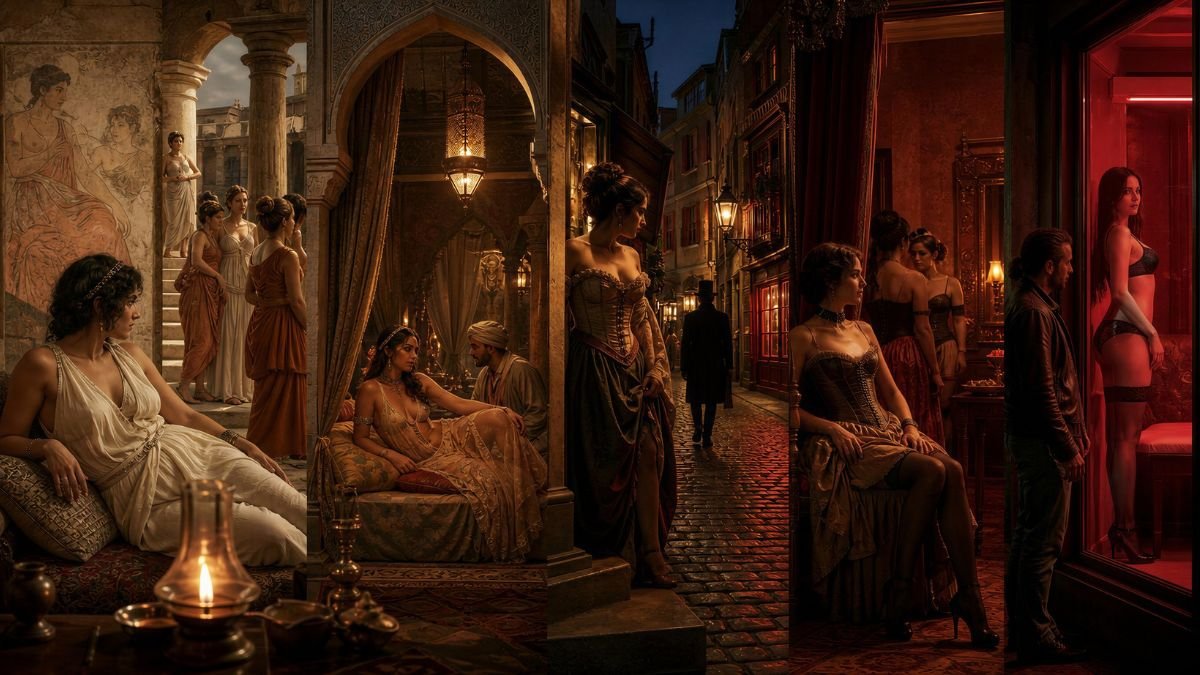
What if one of the most celebrated intellectual cultures in human history — a civilization that gave us philosophy, democracy, and the foundations of Western thought — built its social life around a system that turned most of the people providing pleasure into property?
That is not a rhetorical question. It is, unfortunately, a historical description.
We are moving forward in time, from Mesopotamia and the ancient Near East to the Mediterranean — specifically to Athens in its classical period, roughly the fifth and fourth centuries BCE, and then to Rome at its imperial height. Two civilizations that still shape our assumptions about law, democracy, beauty, reason, and human dignity. Two civilizations that also built some of the most elaborately regulated, deeply embedded, and extensively documented systems of commercial sex in the ancient world.
Let's be careful here. "Regulated" and "documented" are not the same as "fair" or "humane." What the Greeks and Romans actually created was a sophisticated architecture for managing desire in ways that served male citizens — and that relied almost entirely on the labor of people who had very little say in the matter.
Athens: The Tiered System of Women
To understand commercial sex in classical Athens, you first have to understand what Athenian democracy actually was, because it is considerably more exclusive than the word "democracy" suggests to modern ears.
Athenian democracy extended rights to free adult male citizens. That's it. Women — regardless of birth status — had no political rights, could not own property in their own names in most circumstances, could not appear in court, and were expected to remain within the household as wives, daughters, and mothers, as far from public life as possible. The respectable Athenian wife, the gunē, was essentially invisible to public life by design. She managed the household, bore legitimate children, and kept herself well away from the male world of the agora, the symposium, and the gymnasium.
Then there was everyone else.
Ancient Athens had a layered system of women who provided sexual and companionship services to men, and the distinctions between these categories were taken very seriously by the Greeks themselves — even if they all shared the basic reality of being women in a society that gave women very little protection.
At the top of this informal hierarchy was the hetaira — often translated as "companion" or "courtesan," though neither English word quite captures it. The hetaira was an educated, socially skilled woman who provided intellectual companionship, conversation, and sexual partnership to wealthy men. She was not a wife. She was not under male guardianship in the conventional sense. She ran her own household, received men as guests, attended symposia where respectable wives never appeared, and participated in the philosophical and artistic conversations that defined Athenian intellectual life. Some hetaerae were genuinely celebrated figures. Aspasia of Miletus, the companion of the great Athenian statesman Pericles, was reportedly so brilliant that Socrates praised her publicly and admitted sending his students to learn rhetoric from her. She is one of the most intellectually significant women in the ancient record — and she was a hetaira.
The paradox of the hetaira is a remarkable one. She had more actual freedom, more education, and more social visibility than the respectable Athenian wife. She participated in intellectual culture. She had her own money. And yet she was entirely outside the protection that legal marriage offered. Her children could not be legitimate citizens. Her position depended entirely on the goodwill of her patrons. She was, in a structural sense, completely dependent on men — just in a different way than the wife was.
Below the hetaira, socially and economically, were the auletrides — the flute girls and entertainers who performed at symposia and were expected to be sexually available after the performance. And further down still were the pornai — a word that should look familiar, because it is the direct ancestor of the English word pornography. The pornai were typically enslaved women working in brothels called porneia, owned by men called pornoboskoi. They had the least freedom, the least protection, and the most dangerous conditions of anyone in this system. They were property, in the most literal legal sense of the word.
This is the part that tends to get glossed over in romanticized accounts of Athenian culture: the majority of the women providing sexual services in classical Athens were enslaved. They were not free women making economic choices. They were people who had been captured in war, purchased at slave markets, or born into servitude, and their bodies were commodities owned by others. Whatever intellectual freedoms the hetaira enjoyed, they rested on a foundation of mass forced labor.
Solon and the State-Sponsored Brothel
One of the most remarkable figures in the history of commercial sex regulation is Solon of Athens, the famous lawgiver who is credited — by ancient sources, with varying degrees of reliability — with founding state-sponsored brothels in Athens in the early sixth century BCE, decades before the classical period.
The story, reported by several ancient writers, goes like this: Solon, concerned about the social stability of Athens and the potential for adultery to disrupt the property-inheritance system that underpinned Athenian citizenship, established public brothels staffed by enslaved women. The cost was deliberately set low — one obol, a tiny amount — to make access available to all free male citizens. The logic, as ancient commentators explain it, was essentially democratic: if all men could afford sexual access without needing to seduce or assault citizens' wives, the civic order would be protected.
This is a genuinely astonishing piece of public policy to contemplate. The state — the same state that would develop democracy, philosophy, and the rule of law — explicitly entered the business of enslaving women for mass sexual access in order to protect the property and honor of citizens' wives. The protection of some women was achieved through the total sacrifice of other women's freedom. And this was not considered a scandal. It was described by ancient writers as pragmatic, even civic-minded.
We will see this exact same logic — the protection of some women through the sacrifice of others — repeated in dozens of different forms across the entire history of this industry. It is one of its most consistent and most disturbing patterns.
Rome: The Lupanar and the License
Rome took what Greece had built and scaled it up to match its imperial ambitions.
The Roman approach to commercial sex was characterized by a combination of intense regulation, comprehensive taxation, and profound moral condemnation — all at the same time. The Romans did not see any contradiction in this. If anything, it was a very Roman approach to a problem: categorize it, control it, tax it, and then write poems about how disgraceful it was.
The basic architecture of Roman commercial sex centered on the lupanare — brothels, from the Latin lupa, meaning she-wolf, which was slang for prostitute. (Roman slang, I should note, was extremely creative. This is one of the milder examples.) These were physical structures, often purpose-built, with individual small rooms off a central corridor, stone bed platforms built into the walls, and frequently explicit paintings above the room doors — which some scholars have interpreted as a menu of services, though others think they were simply decorative. The famous Lupanar of Pompeii, preserved by the ash of Vesuvius, is the best surviving example: a two-story building with ten rooms, the stone beds still visible, the paintings still on the walls. It is one of the most-visited buildings in Pompeii today.
But Roman commercial sex extended far beyond purpose-built brothels. Taverns, inns, bathhouses, and theaters were all associated with sex work in Roman sources. The boundary between entertainment, food service, and sexual commerce was porous and often nonexistent. Women who worked in these establishments — cauponae, or female tavern keepers and servers — were automatically assumed to be sexually available, regardless of whether they actually were. Roman law essentially created a class of women who were presumed to have forfeited their claim to sexual respectability simply by working in public commercial spaces.
The legal framework was elaborate. Women who worked as prostitutes were required to register with the aediles — the city magistrates responsible for public order — and receive a license called a licentia. They were required to adopt a pseudonym, because using their real name in their profession was considered an offense to the family honor. They were excluded from the protections against sexual assault that applied to freeborn women — a Roman law called the lex Iulia de vi publica provided criminal penalties for sexually assaulting a "respectable" woman, but women who had registered as prostitutes were explicitly excluded from this protection. The license that theoretically regulated their profession simultaneously stripped them of the right to seek legal protection against abuse.
And the state taxed all of it. The vectigal meretricium — the prostitution tax — was a regular part of Roman fiscal administration. The emperor Caligula, who is remembered for many things, codified and systematized this tax. The tax applied not just to active prostitutes but, in some periods, to former prostitutes who had retired from the trade. Having once sold sex was, in the eyes of Roman fiscal law, a permanent status.
Slavery and the Roman Economy of Desire
Just as in Athens, the human reality beneath the Roman regulatory framework was largely one of slavery and coercion.
Enslaved people formed the backbone of the Roman sex trade. They could be purchased at markets specifically for brothel work. Owners of enslaved people could and did prostitute them for profit. Roman law recognized the owner's right to do this. An enslaved person could not legally refuse. There was no provision for consent.
Some Roman jurists worried about this, not from a concern about the enslaved person's welfare but from a concern about the owner's social dignity — there was a real Roman legal debate about whether an enslaved woman who had been prostituted by her owner could later be freed and reclaim social respectability. The concern was not her suffering. The concern was the social contamination that might spread to a respectable household.
There were also free poor women who entered commercial sex because their economic alternatives were genuinely nonexistent. Widows, abandoned women, women from desperately poor families — all appear in Roman sources. And there were women somewhere in the middle, who had relative autonomy and worked for themselves rather than for an owner. The meretrix — the registered prostitute — could in theory be a free woman conducting her own affairs. Some clearly were.
But the default assumption, built into Roman law and Roman social structure, was that the women doing this work had forfeited their claim to full humanity. They were infames — a legal category that included prostitutes, gladiators, actors, and others considered to have degraded themselves through their public activities. Infamia meant the loss of certain civic rights, including the right to testify in court and the right to bring a legal suit. You could be taxed. You could be regulated. You just couldn't expect the law to protect you.
The Cultural Mirror: What Rome and Greece Tell Themselves
It's worth spending a moment on how both cultures talked about this industry in their literature and philosophy, because the gap between the social reality and the cultural narrative is instructive.
Greek philosophy had genuinely interesting things to say about eros — about desire, about love, about the relationship between physical pleasure and spiritual elevation. Plato's Symposium, one of the greatest works of philosophy ever written, is set at a drinking party where a group of men, including Socrates, give speeches about the nature of love. Women are entirely absent except as brief references. The philosophy of desire in ancient Greece was conducted almost entirely among men about their desires, with the people most affected by the actual economics of that desire invisible in the conversation.
Roman literature swings between two poles. On one end, there is the frank, cheerful, often very funny acknowledgment of commercial sex as a fact of life — Horace, Ovid, and others treat it with a kind of relaxed pragmatism. On the other end, there is an intense moralistic tradition — represented above all by figures like Cato the Elder — that wrings its hands about the collapse of Roman virtue while doing essentially nothing to change the system that the moralizing culture produced and depended on.
There is something almost contemporary about that second tradition. The people most loudly concerned about the moral dimensions of this industry are almost never the people asking hard questions about its structural causes. They are usually the people most invested in maintaining the social arrangements that produce it.
The Long Shadow of Athens and Rome
The reason we spend time on Greece and Rome is not just historical completeness. It is because the frameworks that Athens and Rome developed — the tiered social categories, the legal distinction between protected women and available women, the state regulation model, the taxation approach, the assumption that commercial sex is manageable but not eliminable — shaped Western legal and cultural thinking about this industry for the next two thousand years.
When European states in the Middle Ages began building regulated brothels, they were drawing on Roman precedent. When Victorian reformers debated public health legislation, they were reworking Roman legal categories. When modern policy debates oppose the Nordic Model against full decriminalization, they are, in a philosophical sense, still arguing about questions that Roman jurists formalized in the first century BCE.
The architecture of desire that Greece and Rome built was not demolished when their empires fell. It was inherited, modified, and reconstructed by every civilization that came after. Understanding that architecture is essential to understanding where we are today.
And where we're going next: the Middle Ages, where the Church — which had very strong opinions about all of this — found itself doing something considerably more complicated than simply condemning it.
Discussion Questions
The hetaira of Athens had more social freedom and intellectual life than the respectable Athenian wife, yet remained fundamentally dependent on male patronage. What does this paradox reveal about the relationship between freedom and security for women throughout history?
Rome taxed, licensed, and regulated commercial sex while simultaneously declaring its practitioners legally inferior. Is it possible for a state to regulate an industry without normalizing its worst elements?
The concept of infamia in Roman law stripped certain workers of civic protections. Can you identify any contemporary parallels to this dynamic?
Given that both Greek and Roman commercial sex relied heavily on enslaved people, how should we think about the "classical" heritage these civilizations represent — including in our own legal and political traditions?






0 Comments