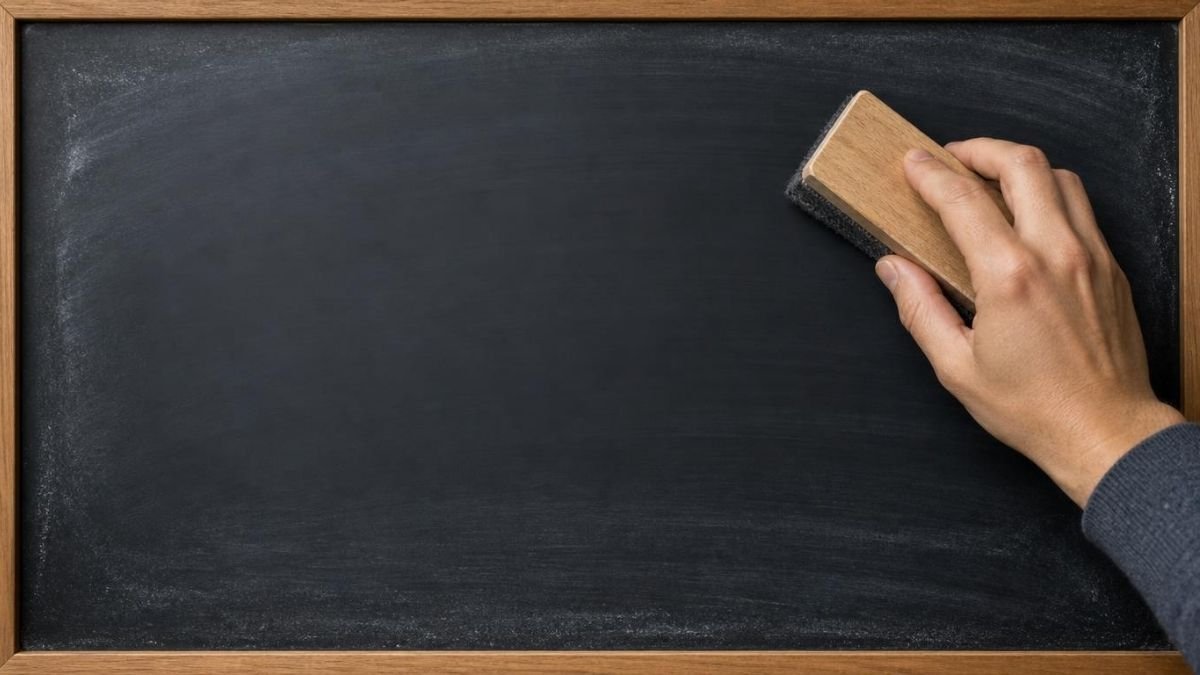
Have you ever wondered why we imagine forgiveness as an act of cleaning?
Because that's what this phrase is, quite literally. Wipe the slate clean. Not forgive, not release, not absolve — wipe. It's a housekeeping verb. A cloth-and-elbow verb. The same thing you'd do to a kitchen counter.
And the slate was real. In taverns and shops across Britain, before anyone kept proper books for small customers, a slate board hung behind the bar. When you couldn't pay that night, the publican chalked up what you owed — your name, a mark for each drink. It stayed there, visible, in front of everyone, until you settled. And when you finally paid, someone took a cloth and wiped it off, and the board was blank again, and you were free.
That's where the phrase comes from. That's where chalk it up comes from too, and on the slate, and settling your account.
And I want you to notice the material, because the whole meaning is in it. Slate and chalk. Chalk is powder pressed into a stick. It doesn't soak in. It doesn't stain. It sits on the surface of the stone, held there by nothing but friction, waiting to be removed.
Whoever set up that system was making a quiet statement about debt: this is temporary by design. It could have been carved. It could have been inked into a ledger that lasts a hundred years. Instead, the record of what you owed was deliberately written in the most erasable substance available — because everyone involved expected the debt to end.
I find that genuinely beautiful, and it says something about how we ought to keep our own records.
Because most of us do not write in chalk. Most of us carve.
Think about the ledger you keep on the people who've wronged you. Is it chalk? Or is it cut into stone — permanent, detailed, retrievable at speed, complete with dates and exact wording? Many of us can produce, on demand, a fully itemized account of something somebody said eleven years ago. That's not a slate. That's an engraving, and we've been maintaining it.
And notice: nobody made you write it that way. The medium was your choice. Every grievance you hold is held in a material you selected — and the reason some fade and some last decades is very rarely the size of the offense. It's what you decided to write them in.
Now, the phrase has a second, harder truth in it, and I don't want to skip it.
Wiping the slate is an act. Someone has to do it. It doesn't happen by time passing — chalk left on a board stays legible for years. And in the original setting, only one person could do it: the one who was owed. The debtor couldn't reach behind the bar and wipe their own name off. That would be theft.
Which means forgiveness, in this image, belongs entirely to the injured party, and it is a decision, not a mood. You don't wake up one morning having drifted into it. Someone reaches up with a cloth, deliberately, and removes what is genuinely, accurately, fairly there.
And that's the part that makes the phrase honest rather than sentimental. The debt was real. The chalk was not a mistake — you did drink those drinks. Wiping the slate never claims the marks were wrong. It claims that the account is now closed anyway, by choice, at cost to the person closing it.
That's why forgiveness that pretends nothing happened is not forgiveness. It's just refusing to write anything down, which is a different act entirely — and usually a worse one, because unrecorded debts don't disappear; they turn up sideways, years later, in a tone of voice.
Now — the harder direction. Wiping your own slate.
We use this phrase most often about fresh starts. A new year, a new city, a new job: a chance to wipe the slate clean. And here's where the metaphor gets complicated, because most people's heaviest slate is the one they keep on themselves.
And you cannot wipe that one from behind the bar. You're both parties. You're the publican and the debtor, which means you're standing there holding the cloth in one hand and a long list of your own failures in the other, and the whole question is whether you'll allow yourself to do what you'd allow a stranger.
Most people won't. Most people are far better publicans for other people's debts than their own. We'll wipe a friend's slate on a Tuesday afternoon and keep our own board fully chalked from 2004 onward.
But there's also an honest limit, and I want to say it plainly. Some things shouldn't be wiped, and the phrase can be used to rush people. There's a version of wipe the slate clean that means stop bringing it up, I'm bored of being in trouble — and that's not forgiveness, that's a demand. A slate should be wiped when the debt is settled or when the one owed genuinely chooses to release it. Not because the debtor is impatient.
And there's one final thing about slates that I love, and it's the reason I'd keep this metaphor over the modern ones.
A wiped slate is not a new slate. It's the same board. Anyone who has ever cleaned a chalkboard knows it never goes truly white — there's a haze, a ghost, a faint memory of what was there. And that's exactly right. Forgiveness doesn't produce amnesia. It produces a usable surface. The point isn't that nothing was ever written; the point is that there's room to write again.
So the honest version of this phrase isn't pretend it never happened. It's this board is available for something new. And that's all anyone actually needs.
So here's what I'll leave you with. Think of a slate you've been keeping — one with somebody's name at the top, chalked in careful detail, hanging behind the bar of you for years. And ask yourself two things. First: what did you write it in, and did anyone make you choose that material? And second: who's the only person who can reach up and wipe it — and what exactly are you waiting for before you do?









0 Comments