Introduction
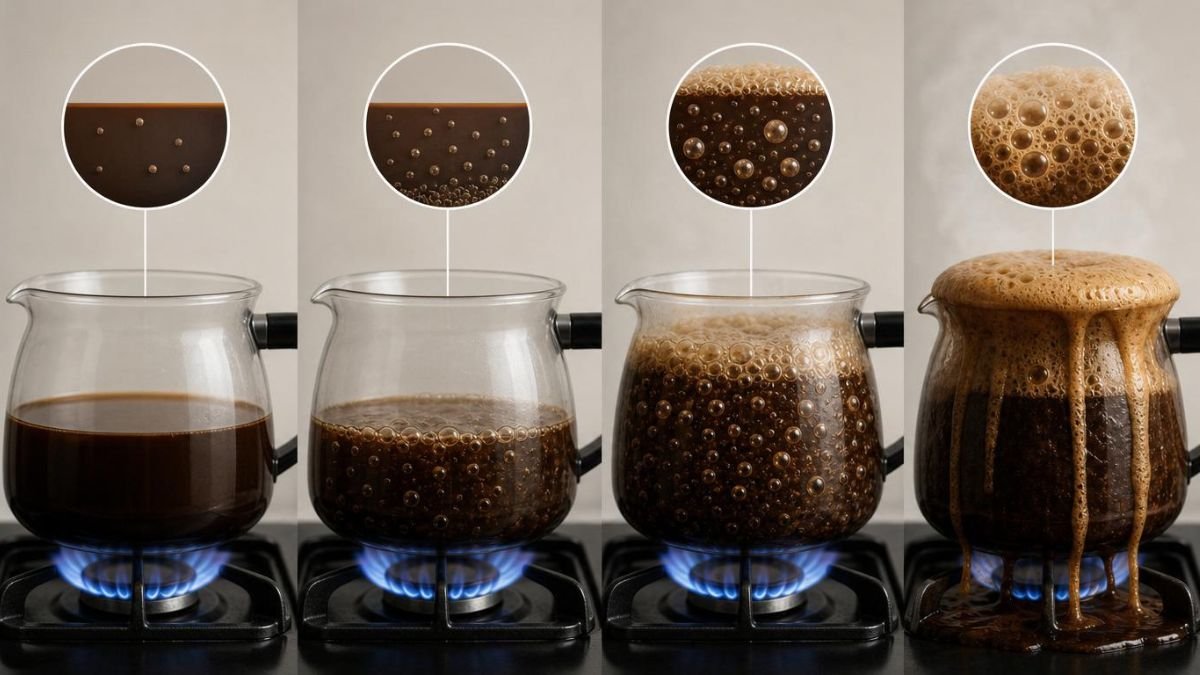
Almost everyone who regularly uses a microwave has experienced it at least once: you heat a cup of coffee or water, you reach in to get it, you add a spoonful of sugar or creamer, and the liquid suddenly erupts — boiling violently, overflowing the cup, scalding your hands, and making a spectacular mess. And you stand there for a moment, looking at the disaster, thinking: what just happened? It was fine a second ago. Now it is on the ceiling.
What happened has a name: superheating. And understanding it involves a physical phenomenon so counterintuitive that it requires you to revise something you probably thought you understood perfectly well — the relationship between temperature and boiling. The short version is this: in a microwave, liquids can be heated to above their boiling point without actually boiling, because boiling requires something that microwaved liquids often lack. When that missing ingredient suddenly appears — when you stir the liquid, or add a substance, or introduce any kind of disturbance — the liquid boils all at once, explosively, in an instant. This is called bumping, and it can and has caused genuine burns and injuries.
This is a Why It Happens episode, and our job is to take a familiar, annoying, slightly baffling everyday phenomenon and explain it in a way that is genuinely illuminating without requiring a physics degree to follow. We are also doing close reading, because explanatory writing — the kind that takes a complex mechanism and makes it accessible — has very specific techniques that are worth learning both as a reader and a writer. How does a writer manage technical vocabulary? How do they calibrate what the reader already knows against what needs to be explained? How do they use analogy without sacrificing accuracy? These are the close reading questions we are asking today. Let's start with your coffee.
The Article
Have you ever been personally ambushed by your own coffee? Not in the metaphorical sense — in the quite literal sense of reaching into a microwave and having a cup of liquid suddenly decide it would rather be somewhere else, violently and immediately? If so, you have experienced one of the most counterintuitive phenomena in everyday physics: superheating. And the reason why coffee overflows when heated is considerably stranger and more interesting than "the microwave made it too hot."
Normal boiling is something you understand intuitively, even if you have never thought about the mechanism. You put a pot of water on a stove. You heat it. Bubbles form — first at the bottom, then rising through the water, popping at the surface. The boiling point of water is approximately 100 degrees Celsius at sea level, and this is when the liquid water transitions to steam at a rate fast enough to produce visible bubbling. The bubbles are critical to this process. But bubbles do not simply appear in water because the temperature is right. They need somewhere to start.
The process of bubble formation is called nucleation — from the Latin word for nucleus, or seed. A bubble of steam requires a nucleation site to begin forming: a tiny irregularity, scratch, or imperfection on the surface of a container; a gas molecule; a tiny piece of dust or particulate matter suspended in the liquid. On a stovetop, metal pots have countless microscopic surface imperfections that provide abundant nucleation sites, and the heating is gradual enough that bubbles form continuously and steadily from the beginning of the heating process. Boiling happens regularly and visibly.
A smooth glass or ceramic cup in a microwave is a different environment entirely. The cup's interior surface may be far smoother than a metal pot, providing fewer nucleation sites. The microwave heats the liquid not by conducting heat from a hot surface but by directly exciting the water molecules themselves, which means the liquid heats more evenly throughout its volume rather than from the bottom up. Without a continuous supply of nucleation sites and without the heat gradient that encourages steady bubble formation, the liquid can be heated past 100 degrees Celsius — past its normal boiling point — without ever starting to boil. This is superheating: a metastable state in which the liquid is hot enough to boil but has not yet found a way to start.
The superheated state is both physically real and genuinely precarious. The liquid is holding enormous amounts of stored energy in the form of heat. It wants to transition to steam. The only thing preventing it from doing so is the absence of a nucleation site. Any disturbance — a scratch on the cup, a grain of sugar, a spoon, a piece of instant coffee granule — can provide that nucleation site. And when it does, the liquid does not begin to boil gently. It boils explosively, converting from liquid to steam almost simultaneously throughout the superheated volume. This is the bumping that you experience as your coffee erupting from the cup. All the energy that should have been released gradually throughout the heating process is released in a fraction of a second.
The severity of the effect depends on several factors: how smooth the cup's surface is (smoother containers are more dangerous), how long the liquid has been heated (longer heating builds more stored energy), whether the liquid has been previously boiled or stirred (which depletes dissolved gases that might otherwise have provided nucleation sites), and whether the liquid contains anything — coffee grounds, milk proteins, sugar — that might introduce nucleation sites during heating. Plain distilled water in a very smooth cup is the most dangerous scenario. Your morning coffee, with all its complex dissolved compounds, is somewhat less likely to superheat severely than a cup of pure water — but it is not immune.
The superheating phenomenon also explains something else that puzzles people: why does adding sugar, a spoon, or a stir to a recently microwaved liquid sometimes produce a violent boiling response even if the liquid seemed calm? The act of stirring or adding a substance introduces exactly the kind of nucleation site that the superheated liquid has been waiting for. The energy releases, the liquid flashes to steam, and you find yourself wearing your afternoon coffee. This is not the microwave's fault, the cup's fault, or your fault. It is physics, operating as physics does, without regard for the inconvenience of the people in the kitchen.
Practically, the safest approach is to avoid long, continuous microwave heating of water or water-based liquids in smooth containers. Heat in shorter intervals. Leave a non-metallic object — like a wooden chopstick or a coffee stirrer — in the liquid during heating to provide continuous nucleation sites. Use a cup that has some surface texture. Let the liquid rest for a full thirty seconds before removing it from the microwave, to allow any superheated state to gently resolve. And do not, whatever you do, add anything to a liquid that you have just removed from a microwave without first checking that it is not suspiciously, eerily still and silent.
The next time you heat your coffee and it comes out of the microwave perfectly calm and motionless — not a single bubble, not a whisper of steam — you might want to treat that calm not as reassurance but as information. The stillness is not peace. It is potential energy, waiting for the right moment. Give it a gentle stir, then step back and let it figure itself out before you reach in.
Does it change how you experience ordinary everyday moments — heating coffee, boiling water, watching rain on glass — to know that physics is doing something extraordinary in each of them, even when everything looks completely still?
Close Reading Analysis
Paragraph 1: "Have you ever been personally ambushed by your own coffee?"
Question: the word "ambushed" is military vocabulary applied to a cup of coffee. What is this figure of speech, and why does the writer use it here rather than a more straightforward description?
"Ambushed" is a metaphor — specifically, it is anthropomorphism combined with battlefield vocabulary, applied to an inanimate domestic object. The effect is immediately comic: the coffee is not hot; it is plotting against you. This light humor at the very start of a science article serves a specific purpose: it disarms the reader who might expect dry, technical explanation and signals that this will be an accessible, personality-driven explanation rather than a textbook passage. Starting with a metaphor that produces a small laugh is a way of creating goodwill and signaling tone before the technical content begins. In science communication, managing the reader's relationship with the material is as important as the accuracy of the content — and a well-chosen surprising metaphor at the opening is one of the most effective tools for building that relationship.
Paragraph 2: "Normal boiling is something you understand intuitively, even if you have never thought about the mechanism."
Question: the phrase "even if you have never thought about the mechanism" — what does this qualify, and why is it important for the writer to acknowledge the distinction between intuitive understanding and mechanistic understanding?
This distinction is central to the article's pedagogical project. "Intuitive understanding" means you know what boiling looks like and roughly what to expect from it — you have lived experience with it. "Mechanistic understanding" means you know why it happens, what physical processes produce the behavior you observe. Most people have the first kind and not the second — and that is completely fine for daily life. But the article is about to reveal that the mechanistic understanding produces a very different set of expectations than the intuitive one. Acknowledging the distinction upfront does two things: it respects the reader's existing knowledge (you're not ignorant; you're intuitive), and it sets up the gap that the article is about to close. This is excellent pedagogical framing: it places the reader's prior knowledge accurately before introducing the complication.
Paragraph 3: nucleation:
Question: the paragraph introduces "nucleation" and then immediately provides an etymology: "from the Latin word for nucleus, or seed." Why might a science writer include etymology in a technical explanation, and what does knowing the root word add to your understanding of the term?
Etymology serves memory and understanding simultaneously. "Nucleation" as a standalone term is opaque — it gives no clues to its meaning. "From the Latin for nucleus/seed" immediately makes it concrete: nucleation is the process of seeding, the process by which something starts from a core. This makes the concept more memorable because it attaches to a sensory, biological image (a seed germinating) rather than remaining abstract. For ESL learners specifically, etymology is an extraordinarily powerful vocabulary tool — it reveals the logic inside technical terms and allows you to make intelligent guesses about the meaning of related words. A writer who provides etymology as part of technical explanation is giving you a tool that lasts beyond the article.
Paragraph 4: "The cup's interior surface may be far smoother..."
Question: the paragraph introduces two contrasting environments — the stovetop metal pot and the microwave ceramic cup — and explains how their different physical properties produce different boiling behaviors. What is this comparison technique called, and what makes it effective for explanation?
This is a comparative contrast structure — using two familiar scenarios with different outcomes to isolate the variable responsible for the difference. By establishing what happens normally on a stovetop first (nucleation sites abundant, heat gradient regular, boiling steady), and then introducing the microwave environment where those conditions are absent, the writer allows you to see the variable that matters: nucleation sites and the heating method. The contrast makes the mechanism visible. Without the comparison, you would need to understand the mechanism in the abstract. With it, you can see what difference the mechanism makes. Comparative contrast is one of the most effective structures in explanatory writing because it uses the known to illuminate the unknown.
Paragraph 5: superheating described:
Question: the paragraph calls the superheated state "metastable." What does "metastable" mean, and why is this technical term more precise than "unstable" would be?
"Metastable" means stable in the absence of disturbance but capable of sudden, dramatic transition to a more stable state if disturbed. It is different from simply "unstable" — which would imply that the state cannot be maintained at all. A metastable state can persist indefinitely if nothing disturbs it, but it is one perturbation away from a dramatic change. The superheated liquid in your microwave is metastable: it is holding its liquid state apparently stably, but any nucleation event will trigger the transition to vapor. "Unstable" would not capture this — an unstable state would boil on its own without needing a trigger. "Metastable" is the precise word for a state that appears stable but is not fundamentally so. Recognizing when a technical term is doing more work than its everyday alternative would do is a core skill in advanced scientific reading.
Closing question:
"Does it change how you experience ordinary everyday moments — heating coffee, boiling water, watching rain on glass — to know that physics is doing something extraordinary in each of them, even when everything looks completely still?"
The phrase "even when everything looks completely still" is a callback to the warning in the paragraph just before: the suspiciously still and silent cup is not peaceful, it is energetic. The closing question broadens this from coffee to the whole category of everyday phenomena that hide complex physics behind their ordinary appearance. It is also a question about wonder — about whether understanding the mechanism enriches the experience of the phenomenon or simply demystifies it. The honest answer is that it does both, and the question is designed to leave you in that productive place: knowing more, and finding more to notice because of what you know.
Speaking & Writing Challenges
Writing Challenge
Choose an everyday physical or biological phenomenon that most people experience without understanding the mechanism — rain, steam, echoes, goosebumps, the smell of rain on pavement, why ice floats, anything that catches your curiosity. Write a 400–500 word explanatory paragraph that: (1) opens with an engaging description of the experience (using specific sensory detail), (2) explains the mechanism using at least one analogy and one technical term with an etymology or definition, (3) identifies the point where intuitive understanding and mechanistic understanding diverge, and (4) closes with an observation that makes the reader notice the phenomenon differently next time. Pay attention to sentence rhythm — use at least one moment of deliberate short sentences for impact.
Speaking Challenge
Prepare a two-minute explanation of the superheating phenomenon for a friend who has just had the coffee explosion experience in their kitchen. The challenge: your friend is annoyed and slightly burned, so your tone needs to be both sympathetic and genuinely informative. Open with a validation of their experience, explain what happened and why in plain English (no jargon without definition), give them one practical piece of advice to prevent it in the future, and end with something that makes the whole experience feel less like a disaster and more like an accidentally vivid physics lesson. This practices the register management that advanced English requires: moving between empathy, explanation, and information while keeping the listener engaged.








0 Comments