Introduction
There is a small rust-colored dot that moves across the night sky, and for thousands of years human beings have looked at it and thought about war. The Romans called it Mars. The Greeks called it Ares. The Babylonians called it Nergal. And in Persia, they called it Bahram, after a god whose name means, roughly, "the one who smashes whatever stands in the way." That is an extraordinary thing when you consider it. Cultures separated by mountains, deserts, languages, and centuries all looked at the same faint red pinprick and arrived at the same conclusion: that thing up there is dangerous, and it is probably armed.
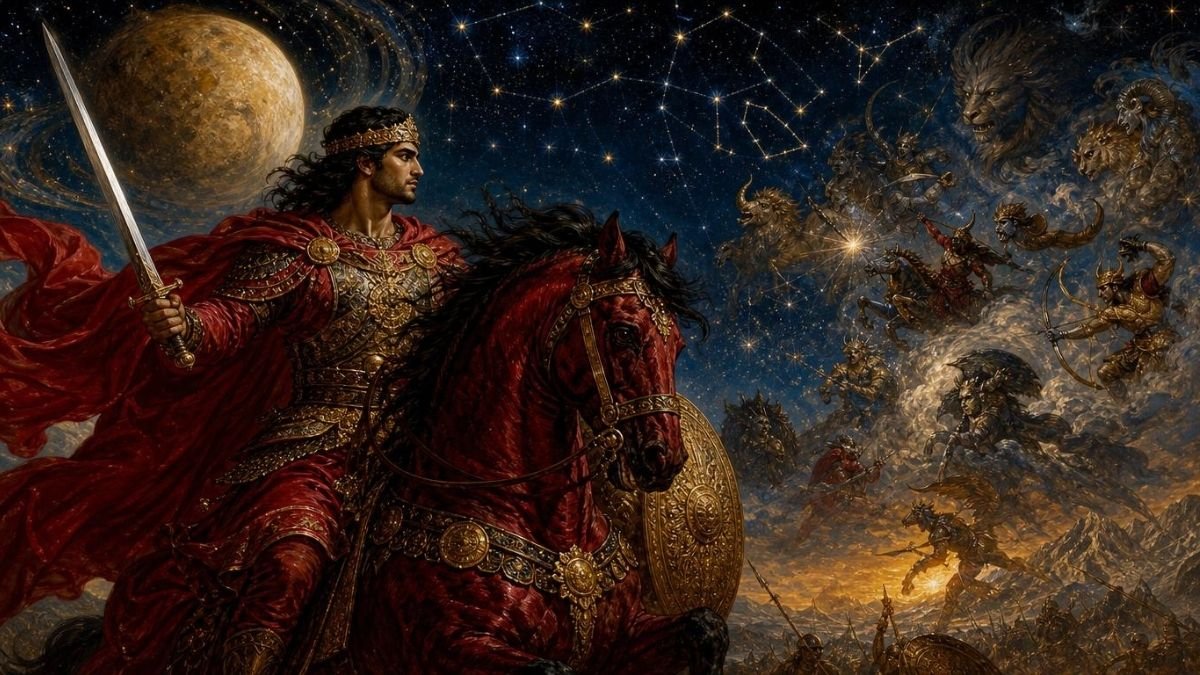
But the Persian version has a twist that the others don't. In Zoroastrian cosmology, the fixed stars are an army of the good, arranged in disciplined ranks by a wise creator, while the wandering planets are rebels, saboteurs, agents of chaos who slipped into the sky and refuse to hold formation. Which means that Bahram, the god of victory, shares a name with a planet that is, cosmologically speaking, on the wrong side. The Persian night sky is not a decoration. It's a battlefield, and the battle is still going on.
This article is going to take you through that story: where the Crimson Warrior came from, why he could turn into a boar and a raven and a fifteen-year-old boy, how he traveled from ancient hymns into Armenian poetry and Kushan coinage and a twelfth-century romance about seven domed pavilions, and what he still has to say to us.
Now, about the way you're going to read it. Close reading is the practice of slowing down and paying deliberate attention to how a text works, not merely what it says. Most of us learn a language by reading fast and wide, and that works beautifully until it stops working. You reach a point where you understand everything and notice nothing. You can follow a news article but not feel the sneer buried in one adjective. You can write a clear paragraph but not a memorable one. That's the intermediate plateau, and you cannot read your way off it by reading more of the same, more quickly.
What moves you is depth. Stopping at the end of a paragraph and asking why the writer chose that word instead of its three synonyms. Noticing that a sentence delays its main verb for eleven words because the delay creates tension. Asking what a myth assumes about the world before it says anything at all. That kind of attention rewires how you read, and because reading feeds speaking and writing, it rewires those too. The questions after each paragraph are the engine of this lesson. Try to answer them before you look at the analysis. Getting them wrong on your own is worth more than getting them right by reading ahead.
The Crimson Warrior
Go outside tonight, assuming the clouds cooperate, and find Mars. It isn't spectacular. It's a modest orange-red dot that doesn't twinkle the way the stars do, sitting there with the calm confidence of something that knows it will still be there tomorrow. The redness, we now know, comes from iron oxide, which is to say the entire planet is gently rusting. But for the people of ancient Iran, that color meant one thing, and it wasn't chemistry. It was blood, and fire, and the flush that rises in a face just before a fight. They named the planet Bahram, and behind that name stood one of the oldest and strangest figures in Persian religion: a god who was less a person than a force, less a warrior than the very quality of winning.
Close reading questions:
- Why does the writer open with an anticlimax, insisting that Mars "isn't spectacular"?
- What effect does the phrase "gently rusting" have on your sense of scale, and why might a writer deliberately shrink a planet before enlarging a god?
- What is the difference between a god who is "a warrior" and a god who is "the quality of winning"?
His oldest name is Avestan, the sacred language of the Zoroastrian scriptures, and it is Verethragna. Scholars still argue over the precise translation, but the sense of it is something like "the smashing of resistance" or "the breaking of obstruction." Notice that this is not a name in the way that Zeus or Odin is a name. It's a description of an event. The Bahram Yasht, the hymn dedicated to him, doesn't give us a biography or a family tree or a palace on a mountain. Instead it gives us a list of shapes. Verethragna appears to the prophet Zoroaster ten times, and each time he arrives in a different body: a violent wind, a bull with golden horns, a white horse with golden ears, a rutting camel, a boar with cutting tusks, a boy of fifteen, a great bird, a wild ram, a wild goat, and finally a man carrying a golden sword.
Close reading questions:
- What does it tell us about a culture when its god of victory has ten forms and no fixed face?
- Why might the hymn end the sequence with a human being holding a weapon rather than beginning with one?
- Choose one of the ten forms and argue for why it belongs on a list about victory.
That list is not random, and it repays a moment of attention. A boar is not a noble animal. A camel in rut is not a dignified one. A boy of fifteen is not, by most standards, an intimidating opponent. What unites these creatures is not majesty but momentum: the boar charges, the wind drives, the horse runs, the fifteen-year-old is at the exact age where a human being is fastest and least sensible about danger. Verethragna is not the god of armies or of strategy or of glorious kingship. He is the god of the moment when something that was blocked suddenly gives way. Anyone who has ever spent three hours on a problem and then solved it in nine seconds has met him.
Close reading questions:
- How does the writer use anticlimax and humor here to make a serious argument about symbolism?
- The paragraph claims the unifying idea is "momentum" rather than "majesty." What evidence supports that reading, and can you construct a rival reading?
- Why does the final sentence shift from ancient myth to ordinary daily experience, and does it earn that shift?
There is a deeper history under all this, and it's one of the great stories of comparative mythology. Long before Zoroaster, the ancestors of the Iranians and the ancestors of the Indians were one people speaking one language, and they worshiped a hero-god who slew a monster of obstruction. In India he kept his personality and became Indra, the thunderous, boisterous, soma-drinking king of the gods, and his epithet was Vritrahan, slayer of Vritra. In Iran, something remarkable happened. The monster-slaying stayed, but the monster-slayer dissolved. The epithet outlived the god. Iranians kept the abstract power, Verethragna, and Indra himself was demoted so thoroughly that his name survives in Zoroastrian texts as the name of a demon. Two branches of one family looked at the same inherited figure, and one crowned him while the other blacklisted him.
Close reading questions:
- What does the phrase "the epithet outlived the god" mean in your own words, and why is it a more elegant formulation than a plain paraphrase?
- What might motivate a religious reformer to convert a beloved inherited god into a demon?
- How does knowing this shared origin change the way you understand either tradition?
Now put him back in the sky, because that is where the story gets genuinely peculiar. Zoroastrian cosmology, as laid out in later works like the Bundahishn, describes the heavens as a military encampment. The fixed stars are the good creation, drawn up in formation, and four great star-chieftains command the four quarters of the sky. Tishtar, whom most scholars identify with Sirius, holds the east. Vanand, probably Vega, holds the west. Haftoring, the Seven Signs, which we call the Big Dipper, guards the north. The planets, by contrast, are intruders. They wander. They reverse direction. They refuse to keep step, and in this system that is not charming eccentricity but treason. So we arrive at a magnificent contradiction: Bahram is the name of the yazata of victory, and Bahram is also the name of a planet classified as a hostile force.
Close reading questions:
- Why would a culture interpret irregular motion as morally suspicious?
- What does the contradiction between Bahram the god and Bahram the planet suggest about how mythologies handle inconsistency?
- The writer calls the contradiction "magnificent" rather than "confusing." What does that word choice reveal about the article's attitude toward myth?
The most vivid battle in that sky belongs not to Bahram but to Tishtrya, and Bahram lends him a body for it. In the hymn to Tishtrya, the star takes the form of a white horse with golden ears and descends to the great sea to bring rain. Waiting for him is Apaosha, the demon of drought, in the form of a hideous black horse, hairless and stripped. They fight. And here is the detail that stops you: Tishtrya loses the first round. He is driven back, not because the demon is stronger, but because human beings have not given him enough worship, and a star that goes unhonored fights weakly. Only after Ahura Mazda himself makes an offering does the white horse gather strength, drive the black horse back, and release the waters over a cracked and thirsty world.
Close reading questions:
- What theological idea is smuggled inside the detail that Tishtrya is weakened by insufficient worship?
- Compare the color coding of this battle, white against black, with the crimson of Bahram: are these the same symbolic system or two different ones?
- Why might a culture in an arid landscape tell its most dramatic star-story about rain rather than about war?
Colors do a great deal of quiet work in mythology, and crimson works hardest of all. Red is the color of the blood inside us and the fire outside us, the two substances most obviously associated with being alive and with ceasing to be. It is also, conveniently, the color of Mars, and cultures with no contact whatsoever kept arriving at the same association. We still carry it in our calendars without noticing. Tuesday is Mars's day: mardi in French, martes in Spanish, and in English, Tiw's day, after a Germanic war god the Romans decided was their Mars in a foreign hat. Every Tuesday, in a dozen languages, we quietly say the name of a war god and then go to a meeting.
Close reading questions:
- What is the argumentative purpose of the last sentence, and how does its comic deflation affect the credibility of the paragraph?
- Why does the writer describe Tiw as "their Mars in a foreign hat," and what historical process is being compressed into that joke?
- Does the fact that unrelated cultures link red with war prove something universal about human beings, or can you think of another explanation?
Gods have a habit of climbing down out of the sky and into human history, and Bahram did it with enthusiasm. Six Sasanian kings took his name, which is a bit like six consecutive monarchs deciding to be called Victory. The highest grade of Zoroastrian sacred fire is the Atash Bahram, the Victory Fire, kindled through a ritual of enormous complexity and tended for centuries without being allowed to go out. And one king in particular, Bahram V, became so wrapped in legend that the historical man is nearly invisible beneath it. They called him Bahram Gur, Bahram of the Wild Ass, because of his obsession with hunting the onager, and the stories say he died as he had lived, chasing one into a marsh that swallowed him whole.
Close reading questions:
- What is the rhetorical effect of translating the royal name literally as "six consecutive monarchs deciding to be called Victory"?
- Why do you think a fire, of all things, was named after a god of smashing?
- What does the manner of Bahram Gur's legendary death suggest about how the tradition judged him?
That legendary king is where the Crimson Warrior finally becomes literature. In the twelfth century, the poet Nizami Ganjavi wrote the Haft Peykar, the Seven Portraits, in which Bahram Gur builds seven domed pavilions, each one a different color, each assigned to a planet, a day, a region of the world, and a princess who tells him a story. Tuesday's dome is red. It belongs to Mars, to Bahram's own planet, to the color of his name. And the tale told inside it is not a war story at all. It concerns a princess in a fortress who kills every suitor who fails her riddles, and a suitor who wins her by refusing to fight the fortress and choosing instead to think. The god of smashing gets a chamber, and in that chamber the moral is that force is the second-best tool.
Close reading questions:
- Why might a poet deliberately place a non-violent story inside the red, martial pavilion?
- How does the structure of the Haft Peykar, which maps colors onto planets, days, and regions, reflect a particular view of how the universe is organized?
- What does it mean to say that a myth "becomes literature," and what is gained and lost in that transition?
He traveled, too, and shape-shifted across borders as easily as he had shape-shifted in the hymn. On the coins of the Kushan emperor Kanishka, minted in what is now Afghanistan and Pakistan, he appears with his name spelled in Greek letters as Orlagno. In Armenia he became Vahagn, called the dragon-reaper, and a surviving fragment of a birth-song describes him coming into the world out of a burning reed with hair of flame and eyes like two suns. It is one of the oldest scraps of Armenian poetry we have, and it is essentially about a god being born on fire. Whatever else the Crimson Warrior was, he was extremely portable.
Close reading questions:
- What does the survival of Vahagn's birth-song as one of Armenia's oldest poems suggest about the relationship between myth and language preservation?
- Why do borrowed gods so often change their names but keep their functions?
- What is the tone of the phrase "extremely portable," and is that tone appropriate for the subject?
So what do we do with him now? The temptation is to file the Crimson Warrior under primitive war-worship and move on, but that misreads him badly. He was never a celebration of violence for its own sake. He was an answer to a question that has not aged: what is the thing that finally breaks a deadlock, and how do you tell the difference between a force that clears the road and a force that destroys the traveler? The Persians named that force, gave it ten bodies, put it in the sky, tied it to the calendar, and then, centuries later, wrote a poem in which it sits in a red room and learns that the smartest victory is the one that doesn't require a battle. That is not a primitive idea. That is a culture arguing with itself across a thousand years, and doing it in public.
Close reading questions:
- How does the writer use a rhetorical question to reframe the entire article?
- What is the distinction being drawn between "a force that clears the road" and "a force that destroys the traveler," and can you give a modern example of each?
- What does the final image of "a culture arguing with itself across a thousand years" suggest about how traditions actually work?
We currently have robots on Mars. They roll slowly across a rust-colored desert taking photographs of rocks, and every image they send back is a small correction to a very old idea. And yet nobody has renamed the planet. It is still Mars, still Bahram, still the Crimson Warrior, because we discovered long ago that we needed somewhere to put the part of ourselves that wants to break through walls. Here is the thing to keep thinking about after you close this page: if a civilization a thousand years from now looks up at whatever we've built and tries to work out what we believed, which of our names will give us away?
The Deep Analysis
Why does the writer open with an anticlimax, insisting that Mars "isn't spectacular"?
The opening deliberately withholds grandeur, and it does so for three reasons. First, credibility. An article about a war god has an obvious temptation toward inflated language, and by starting with a small orange dot that does very little, the writer signals restraint and earns the reader's trust for the larger claims to come. Second, contrast. If the planet is unimpressive, then everything humans built on top of it, gods, calendars, dynasties, poetry, is revealed as a human achievement rather than an obvious response to an obvious sight. The imagination becomes the subject. Third, invitation. Anticlimax creates a small gap that the reader instinctively wants filled. The word "spectacular" is chosen precisely because it is the word we would expect the article to use approvingly. Denying it in the first sentence establishes the article's voice as skeptical, dry, and observational. Watch for this technique in your own writing: the confident negative opening is one of the most reliable ways to sound like an authority rather than an enthusiast.
What effect does the phrase "gently rusting" have on your sense of scale, and why might a writer deliberately shrink a planet before enlarging a god?
"Gently rusting" is a deliberate collision of registers. "Rusting" belongs to bicycles, garden gates, and neglected tools; "gently" softens it further into something almost domestic. Applying that vocabulary to an entire planet produces a tiny shock, because the register is far too small for the object. The effect is to make Mars ordinary, even a little sad, and this matters structurally. The article's central argument is that the mythology is the interesting part, not the astronomy. By deflating the physical object first, the writer clears space for the god to occupy. This is a fundamental principle of persuasive structure: control the reader's sense of proportion before making your claim. Note also the grammatical choice of the present participle "rusting" rather than "that rusts." Participles suggest an ongoing, unfinished process, which is exactly the sensation the sentence wants, corrosion happening slowly and continuously in the background of everything else.
What is the difference between a god who is "a warrior" and a god who is "the quality of winning"?
This distinction is the intellectual spine of the whole article, so it deserves careful handling. A warrior god is a personality: he has a name, a temper, a parentage, a set of enemies, and a body you could paint. Ares sulks, Odin schemes, Indra drinks. A god who is a quality has no such stability. Verethragna is closer to a personified abstraction, the noun "victory" given just enough shape to receive a hymn. The consequence is theological. You cannot tell stories about an abstraction in the usual way, which is precisely why the Bahram Yasht gives us a catalog of forms instead of a narrative. It also changes what worship means. You do not petition a quality for favors as you would a king; you invoke it, you try to embody it, you ask for it to be present in you. Zoroastrianism's tendency to abstract and moralize its divine figures is one of its distinctive intellectual features, and Verethragna is the clearest example of it.
What does it tell us about a culture when its god of victory has ten forms and no fixed face?
It tells us that the culture was more interested in function than in identity. A fixed face invites a fixed relationship: you know who you are praying to, what he looks like, what he wants. Ten faces suggest that the divine is something that occurs rather than someone who exists, and that it can occur in a storm, an animal, a bird, or a boy. There is also a practical dimension. A shape-shifting god is enormously adaptable across a large, diverse empire; local traditions can attach their own sacred animal to him without contradiction. And there is an epistemological dimension worth considering: a god with ten forms is a god who resists being fully known. The hymn's structure enacts a kind of humility, presenting the divine as a series of approximations rather than a single portrait. Compare this to traditions that forbid images entirely and you'll notice they arrive at a similar conclusion from the opposite direction.
Why might the hymn end the sequence with a human being holding a weapon rather than beginning with one?
Order is argument. Beginning with the man would have implied that the human form is the true one and the animals are metaphors for it. Ending with him implies the reverse: that the elemental, the animal, and the wild are prior, and that the armed human is the last and most specific expression of a force that existed long before humanity did. The sequence moves roughly from the impersonal toward the personal, from wind to animals to a boy to a fully equipped man, which reads almost like an evolution or a descent into concreteness. There's also a ritual logic. A hymn recited by human beings ends by placing the god in a form the reciter can imitate. The last image is the one you carry away, and the worshiper carries away not a whirlwind but a figure he could, on a good day, aspire to resemble.
Choose one of the ten forms and argue for why it belongs on a list about victory.
Take the camel in rut, which is the form modern readers find most bewildering and slightly comic. A male camel in rut is a genuinely alarming animal: enormous, foul-tempered, roaring, foaming, and utterly unstoppable in pursuit of what it wants. For a people whose economy and warfare depended on camels, this was not exotic imagery but a familiar and frightening sight. The form belongs on the list because it captures a specific dimension of victory that a horse or a sword cannot: overwhelming, indiscriminate insistence. The horse is speed, the boar is aggression, the wind is force, and the camel is sheer refusal to be deterred. Note also what this reveals about symbolic systems generally. Symbols are drawn from what a culture actually sees. Our own metaphors for unstoppable force tend to involve trains and bulldozers, which will look equally strange in a thousand years.
How does the writer use anticlimax and humor to make a serious argument about symbolism?
The third paragraph runs a sequence of three deflating statements, "a boar is not a noble animal," and so on, before pivoting on the word "momentum." The humor is doing analytical work rather than merely entertaining. By listing what these forms are not, the writer eliminates the reader's default assumption, that a war god's symbols should be dignified, and creates a puzzle. The reader now genuinely wants to know what these creatures have in common, which means the answer lands as a discovery instead of an assertion. This is a technique worth stealing: establish an expectation, itemize its failure, then supply the explanation. Note also the rhythm. Three short parallel negative sentences followed by one longer sentence that resolves them is a classic pattern, and its effectiveness comes from the physical relief of the longer sentence after the staccato ones.
The paragraph claims the unifying idea is "momentum" rather than "majesty." What evidence supports that reading, and can you construct a rival reading?
The evidence is strong: wind, charging boar, running horse, rutting camel, and a fifteen-year-old all share directional, uncontainable motion. But a good close reader always tests the thesis. A rival reading might emphasize fertility and vigor rather than momentum, since the bull, the ram, the goat, and the rutting camel are all conspicuously virile animals, and the boy of fifteen is at the threshold of reproductive maturity. Under this reading, Verethragna represents life-force, of which martial victory is only one expression. A third reading might emphasize completeness: the list covers air, land, and sky, wild and domestic, animal and human, suggesting that victory can arrive from any quarter of creation. None of these readings is wrong. The skill being practiced here is holding multiple defensible interpretations simultaneously and judging which the text best supports, which is exactly what separates advanced reading from adequate reading.
Why does the final sentence of that paragraph shift from ancient myth to ordinary daily experience, and does it earn that shift?
The sentence about solving a problem in nine seconds after three hours is doing something risky. Applying a war god to a mundane frustration could easily feel like a cheap modernization. It works because the article has already redefined Verethragna as a quality rather than a person. Once victory means "the moment obstruction gives way," the mundane example is not a reduction but a genuine instance. The sentence also performs the article's larger thesis, that these myths are still legible, without stating it. Notice the grammar: "Anyone who has ever spent three hours on a problem and then solved it in nine seconds has met him." The present perfect places the experience in the reader's own accumulated past, and the verb "met" treats the god as still circulating, both of which are choices, not accidents.
What does the phrase "the epithet outlived the god" mean, and why is it more elegant than a plain paraphrase?
Literally, it means that Vritrahan, originally a descriptive title attached to a deity, survived in Iran as an independent divine figure while the deity who bore it, Indra, did not survive in a positive form. The elegance comes from compression and personification. "Outlived" treats both the epithet and the god as living things capable of dying, which turns a technical point in comparative philology into a small drama. A plain paraphrase would require two clauses and a subordinate structure; this version needs four words. Advanced writing very often consists of finding the verb that carries the argument, and "outlived" is that verb here. When you're revising your own work, look for sentences where you've explained a relationship in six words and ask whether a single well-chosen verb could enact it instead.
What might motivate a religious reformer to convert a beloved inherited god into a demon?
Several forces typically combine. Doctrinally, a reform that centers on one supreme creator must do something with the crowd of inherited deities, and the available options are absorption, demotion, or demonization. Ethically, if the reform emphasizes truth, order, and responsibility, a god associated with intoxication, brawling, and raiding becomes an embarrassment rather than an asset. Socially, and this is often decisive, the old gods are patronized by an existing priestly or warrior class, and demonizing them is a way of demonizing their sponsors. Reform is rarely only about ideas. It is also worth noting that demonization is a backhanded compliment: you do not bother to condemn a god nobody worships. The presence of Indra on a Zoroastrian demon list is evidence that people were still worshiping him, which is a useful reminder that religious texts describe the arguments of their time rather than settled facts.
How does knowing the shared Indo-Iranian origin change how you understand either tradition?
It converts two closed systems into one open conversation. Read alone, the Vedic Indra and the Zoroastrian demon Indra are unrelated facts. Read together, they become a record of a specific historical divergence, and each tradition starts to explain the other. The Zoroastrian condemnation tells you what the reform was reacting against; the Vedic celebration tells you what was being rejected. This is the fundamental method of comparative mythology, and it comes with a warning: it is very easy to overreach, to assume that similarity proves common origin when it might prove borrowing or independent invention. Responsible comparison requires linguistic evidence, and here the linguistics is unusually solid, since Vritrahan and Verethragna are recognizably the same word by regular sound correspondences.
Why would a culture interpret irregular motion as morally suspicious?
Because in a cosmology where goodness is identified with order, predictability is not merely convenient but virtuous. The fixed stars rise and set on schedule, hold their positions relative to one another, and can be relied upon for navigation and calendars. They are, in a very concrete sense, trustworthy. Planets do none of this. They drift against the background, change speed, and periodically appear to reverse direction, which is called retrograde motion and results from Earth overtaking them in orbit. Without that explanation, a body that stops and goes backward looks less like a natural phenomenon and more like a decision. The moral vocabulary follows almost automatically: to break formation is to defect. It's worth noticing that our own language retains a trace of this, since "planet" comes from a Greek word for wanderer, and "disaster" originally meant something like "bad star."
What does the contradiction between Bahram the god and Bahram the planet suggest about how mythologies handle inconsistency?
It suggests that mythologies are not systems in the way that philosophies are, and that treating them as systems produces false problems. A mythology is a sediment, layers deposited by different eras, regions, and institutions, each responding to different needs. The yazata Verethragna comes from an ancient hymnic tradition; the demonization of the planets comes from a later cosmological synthesis absorbing Mesopotamian astrology into a dualist framework. These layers coexisted because nobody was required to reconcile them, and because the two Bahrams operated in different contexts, one liturgical and one astrological. The mistake modern readers make is assuming that contradiction indicates confusion. Often it indicates depth. A tradition rich enough to contain an argument with itself is more alive than one that has been tidied into consistency.
The writer calls the contradiction "magnificent" rather than "confusing." What does that reveal?
It reveals the article's entire posture toward its material. "Confusing" would locate the problem in the myth and position the writer as its judge. "Magnificent" locates the interest in the myth and positions the writer as its admirer. This is an ethical choice as much as a stylistic one, particularly when writing about another culture's sacred material, and it shapes how the reader receives everything that follows. Adjectives are where a writer's values leak out, which is why close reading pays disproportionate attention to them. When you read persuasive or journalistic prose in English, try isolating just the adjectives and adverbs in a paragraph and asking what attitude they collectively express. You will often find the argument hiding there rather than in the claims.
What theological idea is smuggled inside the detail that Tishtrya is weakened by insufficient worship?
An enormous one: that the outcome of the cosmic struggle depends partly on human behavior. In most dualist systems the human role is to choose a side; here, humans are load-bearing. Ritual is not flattery directed at a being who does not need it but an actual transfer of strength to a champion who does. This gives the Zoroastrian worshiper a striking dignity and an equally striking burden, since drought becomes, in part, a collective failure. The word "smuggled" in the question is precise, because the idea is never stated as doctrine. It arrives inside a narrative detail, which is how myths characteristically transmit their most demanding claims. A stated doctrine invites debate; a story detail is absorbed. This is worth remembering whenever you analyze persuasive narrative, including advertising and political rhetoric.
Compare the color coding of the Tishtrya battle with the crimson of Bahram: same system or two different ones?
They are two systems, and distinguishing them is good analytical practice. The white-versus-black opposition is moral and absolute, mapping directly onto a dualism of good and evil, light and darkness, water and drought. There is nothing ambiguous about it. The crimson of Bahram is not part of an opposition at all; it is descriptive and physiological, deriving from blood, fire, and the observed color of a planet. Red in this system does not have an opposite. It's also morally neutral in a way that black is not, since blood and fire are both necessary and dangerous. Recognizing that a text contains multiple, non-matching symbolic systems is a genuinely advanced reading skill. The lazy move is to flatten everything into one code; the better move is to ask which system is operating in which passage and why.
Why might an arid culture tell its most dramatic star-story about rain rather than war?
Because myth is generally about what a society fears losing, and in the Iranian plateau that is water. A war can be lost and survived; a failed rainy season kills everyone equally, including the victors. It's also significant that the drought demon must be defeated by a warrior in a battle, because that framing converts an impersonal catastrophe into a conflict with an opponent, and conflicts can be influenced. Meteorological bad luck offers no role to the sufferer; a war being fought overhead offers a very clear one, which returns us to the theology of worship as reinforcement. There's a broader lesson here for reading any mythology: identify the ecological and economic conditions of the people telling it, and a surprising amount of the imagery stops looking arbitrary.
What is the argumentative purpose of the sentence about saying a war god's name and then going to a meeting?
Its purpose is to convert an abstract claim into a felt one. The paragraph argues that ancient mythology persists inside modern life unnoticed, and rather than asserting this, the sentence makes the reader experience it by pointing at their own Tuesday. The comic deflation, the bathos of "and then go to a meeting," is what makes it memorable, but it also carries the actual point: the survival is unnoticed precisely because it is trivial. Humor here increases rather than reduces credibility, because it demonstrates that the writer knows the difference between a genuine survival and a mystical one. Note the syntactic economy as well. The joke depends entirely on the sequencing of two clauses joined by "and then," with no commentary. Explaining a joke kills it; the sentence trusts the reader, which is itself flattering and builds goodwill.
Why "their Mars in a foreign hat," and what historical process is compressed into that joke?
The process is what scholars call interpretatio romana, the Roman habit of identifying foreign deities with their own rather than treating them as separate beings. Encountering a Germanic god associated with war and law, the Romans classified him as a local version of Mars, which is how the Latin dies Martis became Tiw's day in Germanic languages. "In a foreign hat" compresses this into an image that captures both the perceptiveness and the arrogance of the practice, since the Romans were noticing a real functional similarity while also assuming their own pantheon was the standard against which others were measured. The joke's economy is instructive. A sentence of scholarly explanation is replaced by a costume metaphor that leaves the reader with a picture. When you want to make a technical point in accessible prose, look for the physical image that contains the abstraction.
Does the red-war association across unrelated cultures prove something universal about human beings?
It suggests something, but proof is too strong. The most economical explanation is shared human biology and shared physical environment rather than a shared mental archetype: all humans bleed red, all fire is red or orange, and everyone on Earth sees the same reddish planet. Given those constants, convergent symbolism is unsurprising and does not require a collective unconscious to explain it. It's also worth resisting the tidiness of the claim by looking for counterexamples, since red carries strong associations with luck, prosperity, and marriage in Chinese tradition, and with royalty and mourning in various others. Colors are overdetermined, carrying several meanings at once, and the meaning activated depends on context. The disciplined position is that red-as-violence is very widespread and well motivated, but that "universal" is a word to use sparingly.
What is the rhetorical effect of glossing the royal name as "six consecutive monarchs deciding to be called Victory"?
Translation as defamiliarization. Because "Bahram" is a proper name to English readers, it passes through the mind without meaning, exactly as "Victor" or "Nike" does. Rendering it literally restores the strangeness the original audience would not have experienced but the modern reader needs in order to notice anything. The comic phrasing also delivers a real historical observation about Sasanian royal ideology, in which kingship and divinely granted victory were fused, and taking the name was a political statement rather than a family tradition. As a reading strategy, translating names is enormously productive across all literature. Try it with the names in any myth you study and watch how much argument was hiding in plain sight.
Why was a fire named after a god of smashing?
Because fire in Zoroastrianism is the paramount symbol of purity, truth, and the presence of the divine, and the Atash Bahram is the highest of the three grades of sacred fire, consecrated through an elaborate process that gathers flames from many different sources. Naming it for victory reframes what victory means. The fire does not smash anything; it endures, sometimes for many centuries, tended continuously. The implication is that the ultimate victory is not conquest but persistence, the refusal to be extinguished. This is a considerable philosophical development from the boar and the storm wind, and it shows the same tradition reinterpreting its own central term over time. It also pairs beautifully with the color argument, since fire is red, and here the red is protective and sustaining rather than destructive.
What does Bahram Gur's legendary death suggest about how the tradition judged him?
Legendary deaths are verdicts. To die pursuing the animal that gave you your nickname, swallowed by a marsh that leaves no body, is a death of poetic completeness and gentle irony. It is not a shameful end, but neither is it heroic in the battlefield sense; the tradition is saying that his defining passion consumed him, which is a mixed judgment delivered without a word of criticism. The disappearance is especially pointed, since a king who vanishes leaves no tomb, and a hunter who is swallowed by the earth has, in a sense, been hunted. Compare this to the deaths assigned to other legendary figures and you'll notice how consistently the manner of death functions as commentary. When you encounter a legendary death in any tradition, ask what it is arguing.
Why might Nizami place a non-violent story inside the red, martial pavilion?
Because the Haft Peykar is a work about the education of a king, and its structure is designed to move Bahram Gur from appetite toward wisdom. Placing a story about winning through intelligence in the chamber dedicated to his own planet and his own name is a direct instruction to its protagonist and its royal readers: your namesake force is real, but it is not your best instrument. The choice also demonstrates the sophistication of Persian literary culture, which inherited the symbolic system and then argued with it from inside rather than discarding it. Nizami does not deny that Mars means force; he redefines what forcefulness is. There's a general principle here about how traditions change. The most effective reinterpretation usually keeps the old container and quietly replaces the contents.
How does the Haft Peykar's mapping of colors onto planets, days, and regions reflect a view of the universe?
It reflects a correspondence cosmology, the widely held premodern conviction that the levels of reality are linked by systematic analogy, so that a color, a planet, a day, a metal, a temperament, and a region are all expressions of a single underlying principle. Under this view the universe is not a collection of separate facts but a coherent design in which everything rhymes, and knowing one term of the pattern gives you access to the others. This is why the structure feels satisfying even to readers who don't believe a word of it. It also has literary consequences: the poem's architecture is itself an argument, because a story placed in the red dome on Tuesday is already commented upon before it begins. Modern readers usually have to be told this, since we have largely lost the habit of reading structure as meaning.
What does it mean for a myth to "become literature," and what is gained and lost?
The transition is from communal, anonymous, authoritative material to individual, authored, interpretive material. What is gained is depth, artistry, psychological complexity, and the capacity for irony, since an author can shape a myth toward a specific meaning in a way that collective transmission cannot. What is lost is a certain kind of authority and openness. A myth belongs to everyone and can be retold freely; a poem belongs to its poet and to a text. Nizami's Bahram Gur is a richer character than the legendary one but also a fixed one. There is also a shift in audience, from a whole society to a literate elite. Neither state is superior, but noticing which one you are reading changes the questions you should ask, since you can ask a poem about its author's intentions and you cannot meaningfully ask that of a myth.
What does the survival of Vahagn's birth-song suggest about myth and language preservation?
That mythological poetry is unusually durable because it is metrical, formulaic, memorable, and emotionally charged, and because it tends to be quoted inside other works even after its own context is lost. The Vahagn fragment survives because a historian quoted it, which is how a great deal of ancient poetry reaches us. There's a broader point about the relationship between language and identity: hymns and epics often become the anchor texts of a literary language, so that preserving the myth and preserving the language become the same activity. The fragment is also evidence of cultural transmission in action, since an Iranian deity has been fully naturalized into Armenian tradition and given a distinctly local birth narrative. Borrowing is not passive reception. It's a creative act, and the borrowed god usually comes out changed.
Why do borrowed gods change names but keep functions?
Because names are phonological accidents while functions answer needs. A community adopting a foreign deity adapts the name to its own sound system almost automatically, producing Verethragna to Orlagno to Vahagn, but it adopts the god in the first place because there is a role to fill, and that role determines what he does. Function is the payload; the name is the packaging. There are exceptions worth noting, since sometimes a name is imported without its original function and acquires a new one locally, and sometimes the name is retained precisely because it sounds foreign and therefore powerful. But the general pattern holds, and it is why comparative mythologists track functions and epithets rather than names alone when reconstructing relationships between traditions.
What is the tone of "extremely portable," and is it appropriate?
The tone is dry and mildly irreverent, applying the vocabulary of luggage to a deity. It is appropriate for three reasons. It matches the voice established from the first paragraph, so it doesn't jar. It makes a genuine point compactly, that this god's abstract, function-based nature made him unusually easy to transfer across cultures, precisely because he was not tied to a specific landscape, lineage, or temple. And it is affectionate rather than mocking, which is the crucial distinction. Irreverence directed at a living community's beliefs can be cruel; irreverence directed at the mechanics of cultural transmission is simply lively. When writing about sacred material in English, the tonal question is not whether you may be funny but what exactly you are being funny about.
How does the closing rhetorical question reframe the article, and what is the distinction between clearing the road and destroying the traveler?
The question, "what is the thing that finally breaks a deadlock," retroactively reveals that the article has not been about a war god at all but about a problem, and that Verethragna was Persia's proposed answer to it. This is a common and powerful essay structure: present the material, then disclose the question it was answering. The distinction that follows is between force that removes an obstacle and force that consumes what the obstacle was blocking access to, and it is the ethical heart of the piece. Modern examples are easy to generate: a strike that wins a contract versus one that bankrupts the employer, a surgery that removes a tumor versus one the patient does not survive, an argument that resolves a marriage's stalemate versus one that ends the marriage. The final image of "a culture arguing with itself across a thousand years" makes the article's implicit thesis explicit, that traditions are not fixed inheritances but ongoing debates, and that the Haft Peykar is best understood as a reply to the Bahram Yasht.
Writing Challenge
Choose one object, place, or phenomenon that you can see from where you live: a mountain, a river, a particular building, a wind that arrives at the same time each year, a bird that everyone in your area recognizes. Now write between 500 and 700 words inventing the mythology that a culture might have built around it, and then arguing for what that mythology would reveal about the people who built it.
Your piece must do four things. It should give your figure a name that is a description rather than a personal name, in the manner of Verethragna, and you should translate that name for your reader. It should assign your figure at least three distinct forms, and each form must be drawn from something the imagined culture would actually see. It should include one internal contradiction, some way in which the tradition disagrees with itself, and you should treat that contradiction as evidence of depth rather than as a flaw. And it should end with a later reinterpretation, a moment when someone in the tradition keeps the old symbol and changes its meaning, as Nizami did with the red dome.
Two constraints on style. Begin with an anticlimax, deliberately underselling your subject in the first sentence. And somewhere in the piece, use the technique of literal translation to defamiliarize a name, showing your reader the meaning that habit had hidden.
Speaking Challenge
Prepare and deliver a four-to-five-minute spoken argument, recorded if possible, on this proposition: "Every society keeps a god of victory, whether or not it admits to it."
You may argue for or against, but you must do three things regardless of your position. Open by defining what you mean by "god of victory" in your own terms, borrowing from the article's distinction between a personality and a quality. Support your argument with at least two examples from outside Persian mythology, drawn from history, contemporary culture, sports, business, politics, or your own society's language and holidays. And spend at least one full minute on the strongest objection to your own position before answering it, because an argument that has not been tested out loud is only half an argument.
For the final thirty seconds, drop the argument entirely and answer this instead, briefly and personally: what is the last obstacle in your own life that suddenly gave way, and what actually broke it? Force, patience, cleverness, luck, or somebody else's help? Notice, as you say it, which of those you were secretly hoping the answer would be.








0 Comments