Introduction
Here is something to consider the next time you get the hiccups and find them annoying: you are experiencing a reflex that may have been useful to your evolutionary ancestors approximately 370 million years ago, when they had gills and were learning to breathe air. You have the hiccup. The hiccup, in a sense, has you. And understanding why gives you a small but genuinely interesting window into how evolution works, how your body works, and how curious you are allowed to be about the things you take entirely for granted.
Hiccups are one of those phenomena that almost everyone dismisses as trivially minor and rarely thinks about for more than a moment — which is a shame, because the chain of events that produces a hiccup involves your diaphragm, your vagus nerve, your brainstem, ancient fetal breathing patterns, and possibly the aquatic respiratory heritage of your pre-amphibian ancestors. For something that usually goes away in five minutes, that is an impressive resumé.
Today we are going to read closely and carefully about why hiccups happen — not to the depth of a medical textbook, but deeply enough to genuinely understand what is going on and to feel that specific pleasure of a mystery solved, even a small one. We are also going to use the article as a close reading lesson, because explanatory writing — the kind that takes a phenomenon and unpacks it for a general audience — has specific rhetorical and grammatical features that reward careful analysis. Learning to read this kind of writing well will permanently improve both your comprehension and your ability to explain complex things clearly in English. Let's get into it.
The Article
Why do we hiccup? It's a question that almost nobody asks out loud, partly because hiccups are annoying rather than interesting, and partly because they usually stop before you've had time to wonder. But if you sit with the question for a moment, it opens into something genuinely surprising: a story about ancient evolutionary inheritance, neurological complexity, and the remarkable fact that your body still contains reflexes that may be millions of years old and no longer serve any obvious purpose. The hiccup is, in its quiet and irritating way, a small miracle.
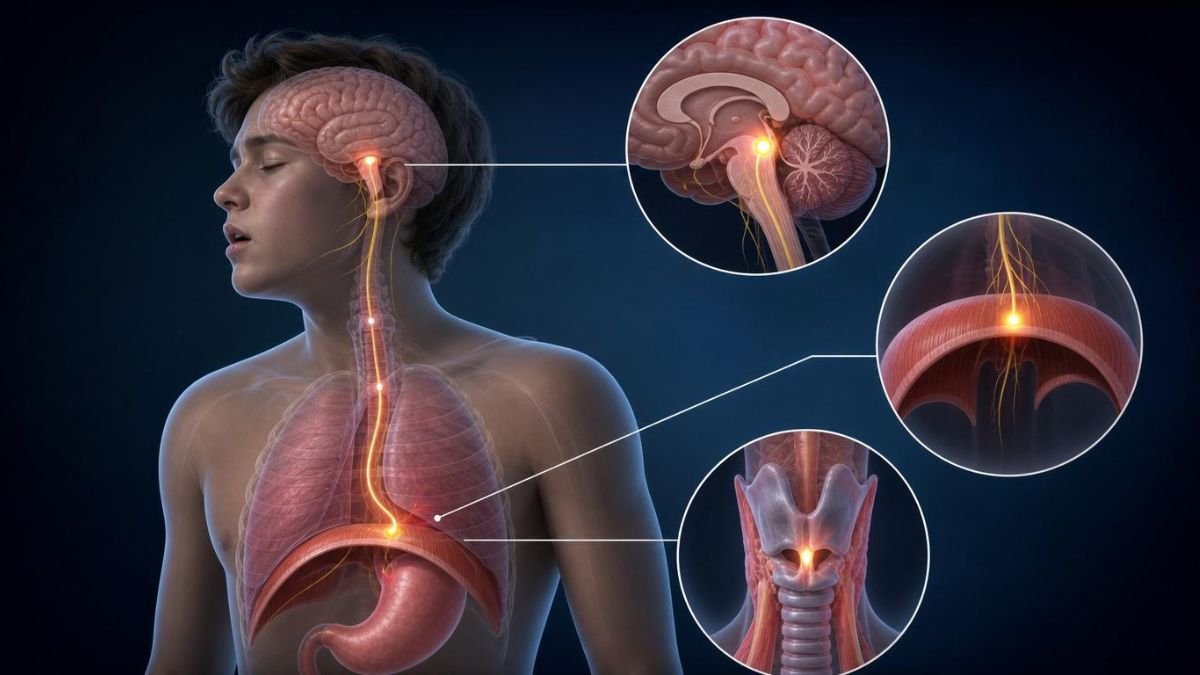
The mechanics are straightforward enough to describe. A hiccup begins when your diaphragm — the large, dome-shaped muscle beneath your lungs that is responsible for breathing — undergoes an involuntary spasm. This spasm causes a sudden, sharp inhalation of air. Almost simultaneously, your glottis — the opening between your vocal cords — snaps shut, stopping that rush of air abruptly. The collision of rushing air against the suddenly closed glottis is what produces the characteristic sound. Hic. That is it. The whole event, from spasm to sound, takes about thirty-five milliseconds.
But why does the diaphragm spasm in the first place? The trigger is typically the vagus nerve or the phrenic nerve — the two main nerves that control the diaphragm — being irritated or stimulated in a way that produces a reflex response. Eating too fast, swallowing air, drinking carbonated beverages, sudden temperature changes in the stomach, excitement, or stress can all trigger this irritation. Alcohol is a particularly reliable trigger because it irritates both the stomach lining and the vagus nerve directly. The reflex arc is quick and involuntary: the nerve sends a signal, the diaphragm responds, the glottis closes, you hiccup. Your conscious mind is not consulted. You do not decide to hiccup. It simply happens to you, which is one of the things that makes it so irritating — it is your own body acting without your permission.
The more interesting question is not what causes hiccups mechanically, but why the reflex exists at all. Most reflexes serve a clear biological purpose: blinking protects the eyes, coughing clears the airway, gagging prevents choking. But the hiccup appears to accomplish nothing useful. You do not feel better after a hiccup. Your airway is not clearer. No threat has been averted. It simply happens and then, usually, stops. This apparent purposelessness has made the hiccup a puzzle for evolutionary biologists.
One of the most compelling explanations was proposed by the neuroscientist Neil Shubin and elaborated by physician Daniel Howes: the hiccup may be an evolutionary remnant — a vestigial reflex inherited from our amphibian ancestors. Here is the argument. Before air-breathing vertebrates evolved, our aquatic ancestors breathed using gills. To push water over their gills, they used a reflex that closed the glottis while pumping water through their gill slits. When vertebrates began to develop lungs and make the transition from water to land, they needed to manage the fact that they now had both gills and primitive lungs during a transitional period. The tadpole — which starts with gills and develops lungs — still uses a breathing pattern that resembles the hiccup remarkably closely: a rapid inhalation followed by glottis closure to prevent water from entering the lungs. The parallel is striking. The hiccup, on this reading, is an evolutionary echo — the ghost of a reflex that was once essential for survival in a very different body and a very different world.
Further supporting this hypothesis is the fact that the neural circuitry that produces hiccups is located in a very old part of the brainstem — the part of the brain we share with the most ancient vertebrates. It is not a new development. It is not a recent adaptation. It is ancient machinery, still running, still occasionally misfiring, in a body that has long since evolved past the need it was built to serve. We are, in this small way, still partly the fish we used to be.
There is also a more recently proposed explanation that focuses not on evolutionary ancestry but on an immediate developmental function. Research has suggested that hiccups may play a role in the development of breathing coordination in fetuses and newborns. Fetuses hiccup remarkably frequently in the womb — hiccupping is one of the earliest movements detectable by ultrasound, beginning around the eighth or ninth week of pregnancy. Some researchers believe that fetal hiccupping may help develop and strengthen the respiratory muscles and test the neural circuitry responsible for breathing before the lungs are needed for actual air-breathing at birth. If this is correct, hiccups are not vestigial at all — they are essential developmental practice runs for the most important physical act you will ever perform. The adult hiccup, on this theory, is simply the same circuitry occasionally firing up when it is no longer needed, in the way that many biological systems produce occasional false positives.
The treatments that people swear by — holding your breath, drinking water upside down, being startled, breathing into a paper bag — mostly work, when they work, by increasing the carbon dioxide level in the blood or by stimulating the vagus nerve in a way that interrupts or overrides the hiccup reflex arc. There is no single universally reliable cure because the reflex can be triggered by many different kinds of nerve stimulation, and different interventions work for different causes. What is known is that hiccups lasting more than 48 hours are considered persistent and can indicate underlying medical conditions including gastroesophageal reflux, central nervous system disturbance, or metabolic issues — a reminder that even something as trivially familiar as a hiccup can, in its extreme form, be a signal worth paying attention to.
Most hiccups, of course, are not signals of anything except that you ate too fast or drank your soda too enthusiastically. But knowing what they are — knowing that the brief, involuntary spasm currently making you sound like a cartoon character is a reflex with roots potentially stretching back 370 million years to ancestors who breathed through gills on the floor of a Devonian sea — changes them slightly. Not enough to stop being annoyed, probably. But enough to be, just for a moment, genuinely amazed.
The next time your body acts without your permission, will you be annoyed — or will you be just a little curious about what ancient instruction your body is still following?
Close Reading Analysis
Paragraph 1:
Question: the article opens by suggesting that people don't ask why we hiccup partly because hiccups "are annoying rather than interesting." What rhetorical strategy does the writer use here, and why is it effective for a "Why It Happens" type of article?
The strategy is the pre-emptive acknowledgment of the reader's probable attitude. Rather than assuming the reader is curious about hiccups, the writer names the more likely initial attitude — mild annoyance, dismissal — and then pivots: "but if you sit with the question for a moment, it opens into something genuinely surprising." This is a form of inoculation rhetoric: by naming the resistance upfront, the writer disarms it. The reader who was tempted to click away or skim has been acknowledged and redirected. This is especially important for explaining everyday phenomena that people habitually ignore. The first job of explanatory writing is not to explain — it is to convince the reader that explanation is worth their time. This paragraph does that work before the science begins.
Paragraph 2: mechanics:
Question: the paragraph describes the mechanics of a hiccup and ends with the one-word sentence "Hic." What is the rhetorical effect of this sentence, and what does it demonstrate about sentence length variation as a tool?
"Hic." is a one-word sentence, a period, and a sound effect simultaneously. After several sentences of moderate complexity describing muscles, nerves, vocal cords, and timing measurements, the article reduces to a single syllable — mimicking the very event it has just explained. The effect is a kind of verbal demonstration: having understood the mechanism, you now get to hear the result. It is playful, but it also has genuine rhetorical function: the abrupt brevity after a run of detail creates a satisfying click, a sense of resolution. This demonstrates the principle that sentence length variation is not just about avoiding monotony — it can be deployed to create specific effects at specific moments. A short sentence after a long explanation is a period of emphasis. It says: here. This. Done.
Paragraph 3: nerve triggers:
Question: the sentence "Your conscious mind is not consulted. You do not decide to hiccup. It simply happens to you" — identify the rhetorical device at work in this sequence and explain its effect.
This is a tricolon in escalating specificity. The first clause ("Your conscious mind is not consulted") uses the passive voice to frame consciousness as excluded from a process — a formal, somewhat detached observation. The second ("You do not decide to hiccup") translates that into a direct, simple negative statement. The third ("It simply happens to you") is the most colloquial and the most visceral — "happens to you" implies something done to you rather than by you. Each sentence descends from the formal toward the personal, and the cumulative effect is to produce the specific feeling the writer wants you to notice: the strangeness and slight indignity of being subject to your own body's processes. The sequence performs the involuntariness it describes — by the third sentence, the reader feels it rather than just understanding it.
Paragraph 4: purposelessness:
Question: the paragraph raises the question of why the hiccup reflex exists by contrasting it with reflexes that clearly serve a purpose (blinking, coughing, gagging). What logical structure is this, and what does it set up for the paragraphs that follow?
This is an argumentative setup by contrast: establish a norm (reflexes have clear protective functions), then identify the anomaly (hiccups apparently don't). This structure creates what narratologists call narrative tension: a question has been posed that requires answering. The reader is now pulled forward by the need for resolution. This is a classic expository structure — problem / anomaly / resolution — and recognizing it allows you to anticipate the structure of explanatory writing before you reach the explanation. Advanced readers do this constantly: they recognize the argumentative architecture of a piece while reading, which allows them to track not just what is being said but where the argument is going. This is one of the clearest differences between reading at intermediate level and reading at advanced or proficiency level.
Paragraph 5: evolutionary explanation:
Question: the paragraph presents the evolutionary argument for hiccups using the word "compelling" before presenting the evidence. What is the rhetorical risk of signaling your verdict before presenting the evidence, and how does the writer manage it?
Pre-evaluating evidence ("one of the most compelling explanations") before presenting it is a rhetorical gamble: it tells the reader what to think before they have had a chance to evaluate independently. The risk is that it feels like manipulation — you are being steered toward a conclusion before seeing the facts. The writer manages this risk in two ways. First, by using "one of the most compelling" rather than "the correct" or "the definitive" — this is a claim about persuasive quality, not truth, and it acknowledges that other explanations exist (the developmental hypothesis, presented later). Second, by then presenting the evidence in logical sequence and letting it carry the argument. The pre-evaluation warms the reader toward the explanation; the evidence then does the actual persuasive work. This is a practical lesson in signposting: use evaluative language to guide, not to replace, the evidence.
Paragraph 6: ancient brainstem:
Question: "We are, in this small way, still partly the fish we used to be." Analyze this sentence — its grammatical structure, its tone, and its relationship to the scientific argument in the paragraph.
Grammatically, the sentence uses a parenthetical hedge ("in this small way") that qualifies the claim without undermining it. The phrase "the fish we used to be" uses the past tense of identity — "we used to be" — which claims an ancestral relationship without overclaiming a direct equivalence. It does not say "we are fish" (false) or "we are descended from fish" (technically complex) but "the fish we used to be" — a colloquial, direct, evolutionarily accurate formulation that compresses millions of years of evolutionary history into six words. Tonally, it is the closest the article comes to wonder. After several paragraphs of mechanism and hypothesis, this sentence allows the reader to feel the strangeness and scale of what has been described. The best science writing has moments like this: where the scientific fact, fully understood, produces genuine aesthetic and emotional response. That is what this sentence is reaching for, and it reaches it.
Speaking and Writing Challenges
Writing Challenge
Choose any everyday phenomenon you have always taken for granted — it can be physiological (why do we yawn, why do we sneeze, why do we blush), physical (why does ice float, why does hot water make noise in a kettle), or behavioral (why do we say "hello" when we answer the phone). Research it briefly and write a 350–450 word explanatory paragraph that: (1) opens with a hook that reframes the familiar as strange or fascinating, (2) explains the mechanism in accessible language using at least one analogy, and (3) ends with either an evolutionary or developmental connection that surprises the reader. Pay particular attention to sentence length variation as a rhetorical tool.
Speaking Challenge
Prepare a two-minute "did you know" style spoken explanation of something in the natural world that most people never think about. The constraints: (1) open with the question "why do we / why does [phenomenon]," (2) explain the mechanism without reading from notes — use your own words, (3) include one moment of genuine expressed surprise or wonder (not performed — actually find something about your chosen topic that genuinely surprises you), and (4) end with a question that invites the listener to notice something they have previously ignored. This is practice for the kind of fluent, enthusiastic explanatory spoken English that marks a truly advanced English speaker.









0 Comments