Introduction
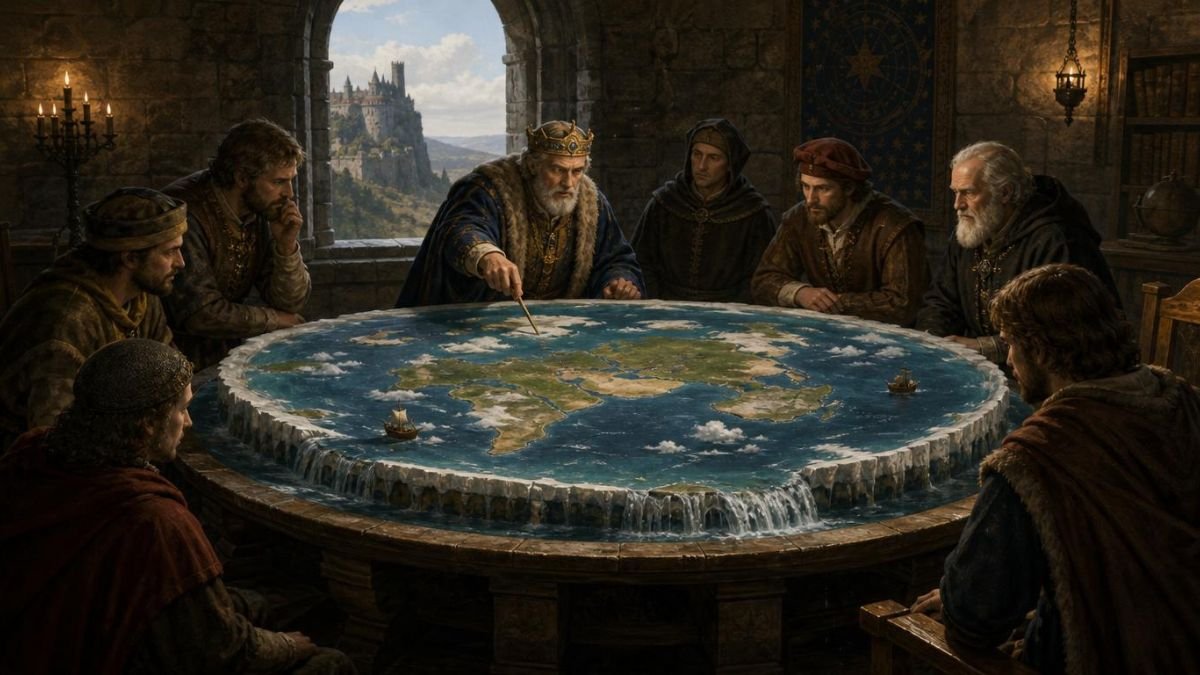
Here is a belief that many educated, intelligent people hold with complete confidence: that in the Middle Ages, everyone thought the Earth was flat, and that Christopher Columbus was a brave revolutionary who had to fight the ignorant flat-Earth crowd just to get permission to sail west. It is a tidy story. It positions the medieval period as a dark valley of superstition from which the Renaissance heroically climbed out. It makes Columbus look good. It makes medieval people look bad. And it is almost entirely false.
The medieval flat earth myth is one of the most stubborn pieces of historical misinformation in circulation, and its persistence is itself fascinating. Where does a myth like this come from? Why does it stick? And what does it tell us about our own relationship with the past — and with our instinct to feel superior to people who came before us?
This is the territory we are entering today. We are going to bust a myth. But more importantly, we are going to learn something about how myths get made and believed, and why critical thinking — the real kind, not just the bumper sticker kind — is a practice that requires specific, learnable skills. That is also why we are doing a close reading of today's article: because reading carefully, questioning assumptions in text, and learning to identify the rhetoric behind a confident-sounding claim is the same skill you need to stop believing things that sound plausible but aren't true. Mythbusting and close reading are, at the deepest level, the same activity. Let's get into it.
The Article
What does it say about us that we love the story of medieval flat-Earth believers so much that we refused to let go of it even after historians repeatedly proved it was false? Because that is exactly what happened. The medieval flat earth myth — the idea that people in the Middle Ages thought you would fall off the edge of the world if you sailed too far — has been comprehensively debunked by historians for well over a century. And yet it persists, cheerfully, in school textbooks, popular documentaries, and casual conversation all over the world. The myth has outlasted its own refutation. That fact is worth sitting with.
The ancient Greeks had it figured out centuries before the medieval period even began. Pythagoras proposed a spherical Earth in the sixth century BCE. Aristotle provided empirical evidence for it — noting, among other things, that the Earth casts a curved shadow on the moon during lunar eclipses — in the fourth century BCE. Eratosthenes, in the third century BCE, not only accepted a spherical Earth but calculated its circumference with remarkable accuracy using nothing more than a stick, the sun, and an understanding of geometry. He was off by somewhere between two and fifteen percent, depending on which version of his measurement you use. Not bad for someone working without a satellite.
This knowledge did not disappear during the Middle Ages. It was preserved, taught, and elaborated upon. Medieval scholars — working in universities that began appearing across Europe in the twelfth century — treated the spherical Earth as a basic, established fact. Thomas Aquinas wrote about it. Dante built it into the cosmological architecture of the Divine Comedy, which was written in the early fourteenth century and which every literate European of the time read. Roger Bacon described geographical principles that assumed a spherical Earth. Islamic scholars, whose learning was indispensable to medieval European intellectual life, had been working with a spherical Earth model for centuries, producing sophisticated astronomical tables and geographic calculations that required it. The idea that medieval people believed in a flat Earth is not just wrong — it is the opposite of the truth.
So where did the myth come from? The primary culprits, identified by historians including Jeffrey Burton Russell in his definitive 1991 study "Inventing the Flat Earth," are two nineteenth-century writers. Washington Irving, in his fictionalized 1828 biography of Christopher Columbus, invented a dramatic scene in which Columbus argues before a council of ignorant, flat-Earth-believing Spanish churchmen. It never happened. And John William Draper and Andrew Dickson White, writing in the latter half of the nineteenth century, promoted a "conflict thesis" — the idea that the history of Western civilization is fundamentally a war between science and religion, with religion always on the wrong side. Their work was enormously influential and enormously tendentious, meaning it distorted history to support a predetermined conclusion. The flat-Earth medieval people were useful characters in their narrative: they illustrated the ignorance that "religion" allegedly imposed on Europe.
The conflict thesis has been largely discredited by historians of science and religion for decades. But it shaped popular education so thoroughly that its ghost still walks. We still teach children that Columbus proved the Earth was round. He didn't — educated people already knew it was round. The actual argument between Columbus and the Spanish scholars was about the size of the Earth, and on that question, the scholars were correct. They thought Columbus's estimate of the distance to Asia was too small — and it was. He made it to the Americas by accident, on the basis of a miscalculation. That is a much less heroic story than the one we were taught, which may be precisely why we weren't taught it.
This brings us to the most interesting question the flat-Earth myth raises: why do we need to believe that people in the past were ignorant? There is a psychological comfort in imagining previous centuries as darker, more confused, and more superstitious than our own. It places us at the pinnacle of a upward-moving story in which human beings get progressively smarter, freer, and more enlightened. But actual history is messier than that. People in the Middle Ages were not uniformly ignorant. They were people — curious, intelligent, spiritually serious, politically complicated people operating within the intellectual frameworks available to them, some of which were more sophisticated than we give them credit for, and some of which were limited in ways we can now see clearly. Just like us, in other words.
The flat-Earth myth, it turns out, is less about medieval people and more about modern people. It is a mirror. And what it reflects is our own need for the story of progress, our own desire to stand at the top of history's hill and look down at how far we've come. The next time someone confidently tells you that medieval people thought the Earth was flat, you now have a choice: you can nod along, or you can ask where that story actually came from. One of those responses is the beginning of critical thinking. The other one is how myths keep their grip.
What other confident "facts" about history, science, or human nature are you carrying around without ever having examined where they came from — and what it costs you to believe them?
Close Reading Analysis
Paragraph 1: "What does it say about us that we love the story of medieval flat-Earth believers so much that we refused to let go of it even after historians repeatedly proved it was false?"
First question: the opening question is about "us" rather than "them" — about the people who believe the myth rather than the medieval people the myth is about. Why is this a more confrontational and interesting opening than a question that focuses on medieval people?
Second question: the phrase "The myth has outlasted its own refutation" — unpack this sentence. What does it mean, and why is it important?
Starting with "us" rather than "them" is an immediate reversal of expectations. A mythbuster article might be expected to open with a focus on the mistaken belief and the historical evidence against it. Instead, this one opens by implicating the reader — by pointing the analytical finger inward rather than backward. This is a more sophisticated and more honest rhetorical move, because the article's real subject is not medieval ignorance but modern credulity. The opening question earns the right to be irritating, because the best critical thinking challenges your self-image, not just other people's mistakes. This opening says: the problem is not the Middle Ages. The problem is us, right now. That is a harder and more interesting argument to make.
"The myth has outlasted its own refutation" is a philosophically dense sentence. Normally, when something is proven false, the false belief should disappear. That is how we imagine rational discourse works. But this sentence quietly dismantles that optimistic model: sometimes a false belief is so useful, so culturally embedded, or so emotionally satisfying that evidence against it is simply ignored. The myth's survival is described not as a puzzle but as something that requires explanation — and that explanation turns out to be the real subject of the article. This sentence is the article's thesis in miniature, and recognizing a thesis when it is embedded in a short, memorable sentence rather than announced with signposting language ("this article argues...") is a key advanced reading skill.
Paragraph 2: "The ancient Greeks had it figured out centuries before the medieval period even began..."
Question: the sentence "He was off by somewhere between two and fifteen percent, depending on which version of his measurement you use. Not bad for someone working without a satellite." — what is the tonal effect of this final sentence, and what rhetorical technique does it use?
"Not bad for someone working without a satellite" is an example of litotes — understatement for ironic effect. Calculating the circumference of the Earth within two to fifteen percent accuracy using only a stick and geometry is a staggering intellectual achievement. The response "not bad" deliberately undersells the achievement, and that gap between the magnitude of the feat and the casualness of the evaluation creates a wry humor that makes the point more effectively than breathless admiration would. It also, crucially, has a rhetorical function: it gestures toward modern readers who might be tempted to condescend to ancient scientists, and it deflects that condescension with gentle irony. You want to underestimate them? "Not bad" is what you get. The tone is light, but the argument is firm.
Paragraph 3: "This knowledge did not disappear during the Middle Ages..."
Question: the paragraph uses a list of names and works — Thomas Aquinas, Dante, Roger Bacon, Islamic scholars — to build its case. Critically, the paragraph does not say "some scholars knew." It says "medieval scholars treated the spherical Earth as a basic, established fact." What is the difference between these two claims, and why does it matter?
The word "basic" is doing important logical work. "Some scholars knew the Earth was spherical" would suggest a minority, specialist knowledge — an exception to a general rule of ignorance. "A basic, established fact" means it was ordinary, unremarkable, taken for granted — the opposite of exceptional. The argument is not that a few geniuses were ahead of their time. The argument is that the spherical Earth was the consensus, the starting point for educated discussion, not a controversial position. This distinction matters because the myth's power depends on the idea of isolated, lonely medieval intellectuals defending reason against the dark tide of popular flat-Earth belief. The evidence suggests no such drama existed. The Earth was round. Everyone who had read anything knew it. There was nothing to defend.
Also note the inclusion of Islamic scholars: this is intellectually honest and historically essential, because a significant portion of Greek scientific knowledge reached medieval European universities through Arabic translations and Islamic scholarship. Omitting this would be both factually incomplete and ideologically distorted.
Paragraph 4: "So where did the myth come from?"
Question: the word "tendentious" is used to describe the work of Draper and White. What does "tendentious" mean, and why is it a stronger and more precise word than "biased" or "unfair"?
"Tendentious" means having a strong tendency toward a particular point of view, usually used critically to mean that a piece of writing distorts its material to support a predetermined conclusion. It is stronger than "biased" because bias implies a leaning you might not be fully aware of — a product of your background or perspective. "Tendentious" implies deliberate distortion in service of an agenda. It is more accusatory, more precise, and more historically specific. The point is not that Draper and White were slightly unfair — it is that their entire project was structured to produce a certain narrative regardless of what the evidence said. That is a serious scholarly charge, and using the right word to make it is part of what makes historical writing credible.
Paragraph 5: "The conflict thesis has been largely discredited..."
Question: the paragraph reveals that Columbus's actual argument with the Spanish scholars was about the size of the Earth, and that the scholars were correct, not Columbus. How does this revelation function structurally in the article's argument?
This is a reversal narrative — a moment in which the expected roles of hero and villain are swapped. The scholars who are normally cast as ignorant obstacles were actually right. Columbus, cast as the brave visionary, was actually wrong on the key empirical question. This reversal serves the article's central argument perfectly: the mythologized version of the story is not just slightly inaccurate but structurally inverted. It doesn't just get details wrong; it assigns the intelligence and ignorance to the wrong people entirely. Structurally, this paragraph is the payoff of the historical evidence laid out in paragraphs two through four: all that evidence builds to this reversal, which is why it lands with force. Learning to recognize the structural positioning of a reversal — and to build toward one in your own writing — is a sophisticated compositional skill.
Paragraph 6: "This brings us to the most interesting question the flat-Earth myth raises: why do we need to believe that people in the past were ignorant?"
Question: the phrase "the story of progress" — what is implied by putting the word "story" next to "progress"? What does calling it a "story" do to the concept of progress?
Calling progress a "story" rather than a "fact" is a subtle but significant move. It implies that progress is a narrative we construct, not simply a truth we observe. Narratives have authors, purposes, audiences, and selectively chosen evidence. By labeling the linear upward movement of history a "story," the writer quietly shifts it from the category of established fact to the category of interpretive choice. This is not necessarily an argument that progress doesn't exist — but it is an argument that the particular story we tell about progress (medieval darkness → Renaissance light → modern enlightenment) is a construction, and constructions can be examined, questioned, and revised. This is the philosophical core of the article, and it is delivered in a single word — "story" — without a single note of fanfare.
Closing Question:
"What other confident 'facts' about history, science, or human nature are you carrying around without ever having examined where they came from — and what it costs you to believe them?"
The quotation marks around "facts" are a typographical choice worth discussing. By placing "facts" in scare quotes, the writer signals skepticism about the category: these are not facts but things that wear the costume of facts. The phrase "what it costs you to believe them" is particularly interesting — it assumes that beliefs have costs, that what we accept without examination is not neutral but has consequences for how we see the world, interact with others, and understand our place in history. This is an invitation to epistemological humility — the recognition that knowing how you know something is as important as knowing the something itself.
Speaking and Writing Challenges
Writing Challenge
Think of a belief you hold — about history, culture, science, or human behavior — that you have never really examined. Research it briefly (it can be anything from a proverb to a historical "fact" you learned in school). Write a 350–450 word analytical paragraph in which you: (1) state the belief and describe how you came to hold it, (2) examine the evidence for and against it, and (3) reach a conclusion about whether the belief holds up. Use at least one precise, sophisticated word (like "tendentious" or "litotes") in your analysis, and make sure your paragraph has a clear structural argument — not just a list of observations.
Speaking Challenge
Prepare a two-minute spoken argument for the following position: "We are not as different from people in the Middle Ages as we like to think." You do not need to personally agree with this position — the challenge is to make the strongest possible case for it using evidence and reasoning. The goal is to practice the kind of structured spoken argument that distinguishes fluent, persuasive English from simply expressing opinions. Focus on using specific examples, connecting your points explicitly ("this suggests that," "which means," "and this is why"), and ending with a clear conclusion.







0 Comments