Introduction
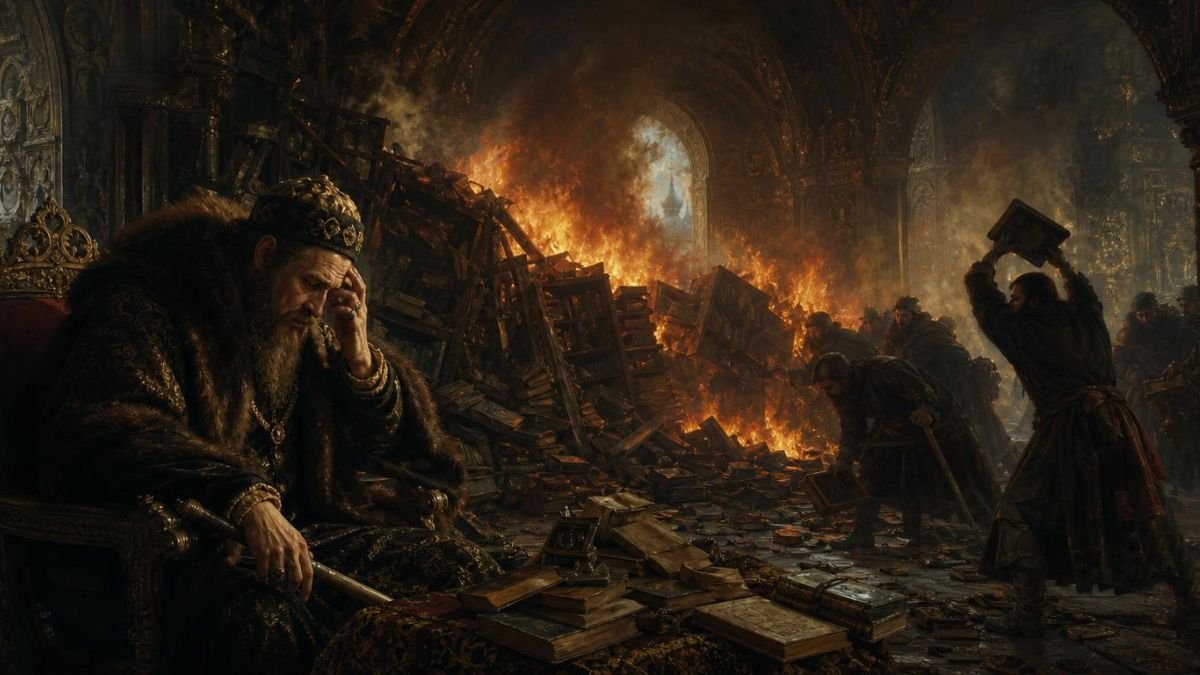
There is a particular kind of mystery that is more intoxicating than the kind with a solution. Not the puzzle that waits patiently to be solved, but the one that may never be — the one where the evidence is fragmentary, the trail is cold, and every answer opens five new questions. The library of Ivan the Terrible belongs to this category, and it has been driving historians, archaeologists, and curious people slowly, pleasantly mad for centuries.
The story — and it may be partly story — goes something like this: Ivan IV of Russia, better known as Ivan the Terrible, possessed a legendary private library of ancient manuscripts, some of which may have descended from the Byzantine imperial collection brought to Moscow by the Paleologus dynasty. This library supposedly contained texts that had not been seen in the Western world for centuries — works of Cicero, lost plays of Tacitus, perhaps even lost books of Livy. When Ivan died in 1584, the library's fate became unknown. Rumor, speculation, and occasional archaeological excitement have kept the question alive ever since.
Why read about this closely? Because mystery writing — the kind that deals with historical uncertainties rather than fictional detectives — is a specific genre of non-fiction that requires its own analytical skills. It must maintain intellectual honesty (acknowledging what is not known) while sustaining narrative energy (keeping you reading despite the absence of a resolution). It uses rhetorical hedges carefully. It evaluates evidence without overstating it. It holds multiple possibilities open simultaneously. These are sophisticated skills in both writing and reading, and they are among the most valuable you can develop in English — because almost all serious thinking, in any field, requires comfort with uncertainty. Let's go find something that may not be there.
The Article
What is the most valuable thing that has ever simply disappeared? Not been stolen, or destroyed, or lost in a disaster with witnesses — but quietly, inexplicably ceased to be findable, leaving behind only whispers, fragments of testimony, and several centuries of people digging hopefully in the wrong place? The library of Ivan the Terrible may well qualify. And whether it exists or not — which is far from settled — the search for it has produced one of history's most enduring and illuminating quests.
The story of the Liberia, as it is sometimes called, begins not with Ivan himself but with a woman who may have never existed exactly as described: Sophia Palaiologina, niece of Constantine XI, the last Byzantine emperor, who married Ivan III of Russia in 1472. According to the tradition that feeds the library legend, Sophia brought with her to Moscow a remarkable dowry: a collection of ancient manuscripts, the remnant of the Byzantine imperial library that had been assembled in Constantinople over centuries and represented some of the finest preserved texts of the classical world. When Constantinople fell to the Ottomans in 1453, survivors carried what they could. The story goes that the cream of the Byzantine library went east with Sophia, to the safety of the emerging Russian state.
Whether Sophia actually brought such a library is already contested. The first detailed account of its existence comes from a sixteenth-century source: Johann Wettermann, a German pastor who claimed to have been taken to see the library by Ivan IV, and who described an astonishing collection of Greek and Latin manuscripts. Wettermann's account was not recorded until decades after the supposed visit, and the account's reliability has been debated ever since. Other early sources — including a 1575 letter from a man named Johannes Schlitte, who claimed to have seen the library — add tantalizing but inconsistent details. The evidence is of the kind that historians find simultaneously compelling and maddeningly unreliable: it exists, it is specific, and it cannot be independently verified.
The physical location of the library — assuming it survived — is the central puzzle. Ivan the Terrible was known for using an extensive network of underground passages and secret chambers beneath the Moscow Kremlin and surrounding structures, which he reportedly used for political imprisonments, torture, and the storage of treasures. The theory most pursued by twentieth-century Russian archaeologists is that the library was stored in one of these underground spaces, possibly beneath the Kremlin's Archangel Cathedral or in a system of tunnels connecting various Kremlin structures. Excavations were conducted in 1929, 1972, and at various other points during the Soviet period. Nothing was found, though the searches were not exhaustive — much of the Kremlin's underground infrastructure remains unexplored due to structural and political sensitivity.
The mystery deepened considerably in the nineteenth century when a Russian archaeologist named Ignaty Stelletsky dedicated decades of his life to the search. He claimed to have identified the exact tunnels where the library was stored, based on his reading of historical maps and documents, and repeatedly petitioned the Soviet government for permission to conduct a full excavation. Permission was intermittently granted and then withdrawn. When the German invasion in 1941 suddenly made the project impossible, Stelletsky's life work was interrupted. He died in 1949, having never found the library but never abandoning his conviction that it was real and findable. His case is both moving and instructive: a man who turned a mystery into a vocation and found, as such people often do, that the search consumed him rather than the other way around.
Could the library have been destroyed? Fires devastated Moscow in 1547 and 1571, during Ivan's reign. The Time of Troubles in the early seventeenth century saw widespread destruction of Moscow. Polish forces occupied the Kremlin from 1610 to 1612. Any of these events could have reduced a collection of ancient manuscripts to ash. The counter-argument made by those who believe the library survives is that Ivan was famously paranoid about his treasures and would have moved them to the deepest, most protected underground storage available rather than leave them vulnerable to fire or invasion. This is plausible. It is also exactly the kind of argument that belief systems tend to generate: each objection is answered by a new layer of assumption about what the evidence must be showing, rather than an actual piece of evidence.
And then there is the most skeptical position of all: that the library may have been substantially mythologized even during Ivan's own lifetime. Ivan IV was a man who cultivated an image of terrifying power and immeasurable wealth. A legendary private library of unparalleled ancient manuscripts would have been a potent status symbol — evidence of cultural legitimacy connecting Russia to the full weight of Byzantine and classical heritage. Did such a library exist in the form described by the early accounts, or did a more modest collection of manuscripts grow in the retelling into something legendary? We genuinely do not know. The archaeological absence of evidence is not, as scientists and philosophers are careful to note, the same as the evidence of absence. Something may be there. Or nothing may be there. Both are possible, and both remain, for now, equally unverifiable.
The library of Ivan the Terrible endures as a mystery not because we are bad at searching but because searching has limits. What lies beneath an occupied, politically sensitive, structurally complex site like the Kremlin may not be discoverable until conditions change in ways nobody can currently predict. In the meantime, the mystery does what the best mysteries do: it keeps the question open, keeps the imagination alive, and reminds us that the past is not a closed book but a collection of rooms, most of which we have not yet entered.
If the library does exist, somewhere under centuries of stone and earth — what would it mean for our understanding of what survived the ancient world? And if it doesn't exist, what does the five-century persistence of the belief in it tell us about the human need to believe that the past held something we have lost?
Close Reading Analysis
Paragraph 1:
Question: the opening asks "What is the most valuable thing that has ever simply disappeared?" rather than "Did Ivan the Terrible really have a lost library?" Why is this a more effective opening, and what does the choice of the word "simply" contribute?
The broader question — "most valuable thing that has ever simply disappeared" — opens the article into a larger category before narrowing to the specific case. This is a funnel structure: move from the wide to the narrow. It positions the Ivan library mystery not as a niche historical curiosity but as an instance of a universal human experience: the loss of something priceless. The word "simply" is doing something subtle and powerful. Things can disappear in dramatic ways — destroyed, stolen, burned. "Simply ceased to be findable" suggests a disappearance without spectacle, without explanation, without even the dignity of a clear ending. That is philosophically more unsettling than a dramatic destruction, because it implies the possibility of survival — the thing may still be out there, merely hidden. The word "simply" makes the mystery feel more open, and therefore more present.
Paragraph 2: Sophia Palaiologina:
Question: the paragraph introduces Sophia with the phrase "a woman who may have never existed exactly as described." What is the epistemological function of this phrasing, and why does it matter that the skepticism is introduced immediately rather than later?
"May have never existed exactly as described" is a precise and intellectually honest formulation. It is not saying Sophia did not exist — she almost certainly did. It is saying that the version of Sophia that feeds the library legend — the Byzantine princess bringing classical treasures to Russia — may be a constructed narrative. Introducing this skepticism immediately, before the reader has had time to fully invest in the legend, is good historical writing practice. It establishes the epistemic ground rules: we are not reading a story, we are evaluating evidence. Delaying the skepticism until later in the article would allow the reader to build a false investment in the legend's truth, which would then require undoing. Fronting the qualification respects the reader's intelligence and models honest inquiry from the first paragraph.
Paragraph 3: Johann Wettermann:
Question: the paragraph describes the early evidence as "simultaneously compelling and maddeningly unreliable." The word "maddeningly" is an emotional word in a historical analysis. What is the effect of allowing this emotional quality into what might otherwise be a dry evidential assessment?
"Maddeningly" is a personal, embodied word — it describes the emotional experience of the historian, not just a characteristic of the evidence. Allowing this word into a historical analysis is a deliberate tonal choice: it humanizes the relationship between the researcher and the material. Evidence that is simultaneously compelling and unreliable does not simply present a logical problem; it produces a specific emotional frustration that many researchers know well. By naming that frustration, the writer creates identification between the reader and the experience of historical research. This is one of the strategies that distinguishes narrative non-fiction from dry academic writing: it allows the emotional texture of intellectual work to be visible without sacrificing rigor.
Paragraph 4: the underground Kremlin:
Question: the paragraph notes that "much of the Kremlin's underground infrastructure remains unexplored due to structural and political sensitivity." The word "political" is placed alongside "structural" without elaboration. What does the writer accomplish by naming "political" as an obstacle without explaining it further?
Naming "political" without elaborating is a deliberate strategic omission. It plants a fact — there are political reasons why the Kremlin has not been fully excavated — without turning the article into a political analysis. For the mystery narrative, this is the right choice: the political obstacle confirms that the mystery has not been definitively closed, while keeping the focus on the historical puzzle rather than contemporary Russian politics. But for the critical reader, the planted detail rewards attention: if political sensitivity is an obstacle to excavation, what does that imply? Either that there is something politically inconvenient under the Kremlin, or that the Russian government simply does not permit excavations in politically sensitive areas. The word does real work without requiring paragraphs of context. That is an advanced economy of language.
Paragraph 5: Stelletsky:
Question: the sentence "a man who turned a mystery into a vocation and found, as such people often do, that the search consumed him rather than the other way around" — what philosophical observation is embedded in this sentence, and what grammatical structure is used to deliver it?
The philosophical observation is about the nature of obsessive quests: that what begins as a search for an external object can become a defining internal identity, in which the quest shapes the searcher more than any possible discovery would. This is a gentle but genuine psychological insight, delivered through the inverted expectation in "consumed him rather than the other way around." The expected syntax would be "he consumed the mystery" — meaning he solved it, mastered it, contained it. "It consumed him" reverses the agency. The grammar mirrors the argument: agency runs the wrong way. This kind of syntactic inversion — where the structure of the sentence enacts the meaning — is a technique at the higher end of the compositional range. Recognizing it and using it deliberately is a signature of writing at C2 level.
Paragraph 6: possible destruction:
Question: the paragraph notes that belief in the library's survival generates arguments of a specific kind: "each objection is answered by a new layer of assumption... rather than an actual piece of evidence." What logical fallacy is being identified here, and why is the writer careful not to state it explicitly?
The logical pattern being identified is unfalsifiability: a belief system that generates a new defensive assumption for every objection, such that no evidence could ever disprove it. This is sometimes called an ad hoc rescue — when a theory is protected from refutation not by evidence but by the addition of auxiliary hypotheses. The writer identifies this pattern but does not name it explicitly ("this is a logical fallacy"), which is rhetorically wiser. Explicitly labeling something a fallacy can feel aggressive, even condescending — it tells the reader what to think rather than showing them the evidence and letting them reach the conclusion. By describing the pattern and leaving the conclusion implicit, the writer models the very critical thinking skill the article is teaching. The reader who recognizes the unfalsifiability pattern has done the intellectual work themselves; that work is theirs, not the writer's.
Speaking and Writing Challenges
Writing Challenge
Research briefly a historical mystery that you find genuinely fascinating — it can be anything from a vanished civilization to an unexplained event to a person who disappeared without explanation. Write a 400–500 word analytical summary in which you: (1) describe what is known about the mystery, (2) evaluate the quality of the evidence (using hedging language like "reportedly," "allegedly," "according to sources that have been questioned"), and (3) identify at least one moment where a belief in a particular explanation might be protected from falsification by assumptions rather than evidence. Aim for the tone of honest, engaged uncertainty that models good historical thinking.
Speaking Challenge
Prepare a two-minute spoken summary of any unsolved mystery you genuinely find interesting. Structure it as follows: thirty seconds establishing what is known, forty-five seconds surveying the main theories and their evidence, fifteen seconds identifying the most significant obstacle to resolution, and thirty seconds of personal reflection on why the mystery appeals to you. The goal is to practice maintaining a clear logical structure through spoken argument while also practicing the fluent use of epistemic hedges: "it has been suggested," "one possible explanation is," "there is no conclusive evidence that," etc.







0 Comments