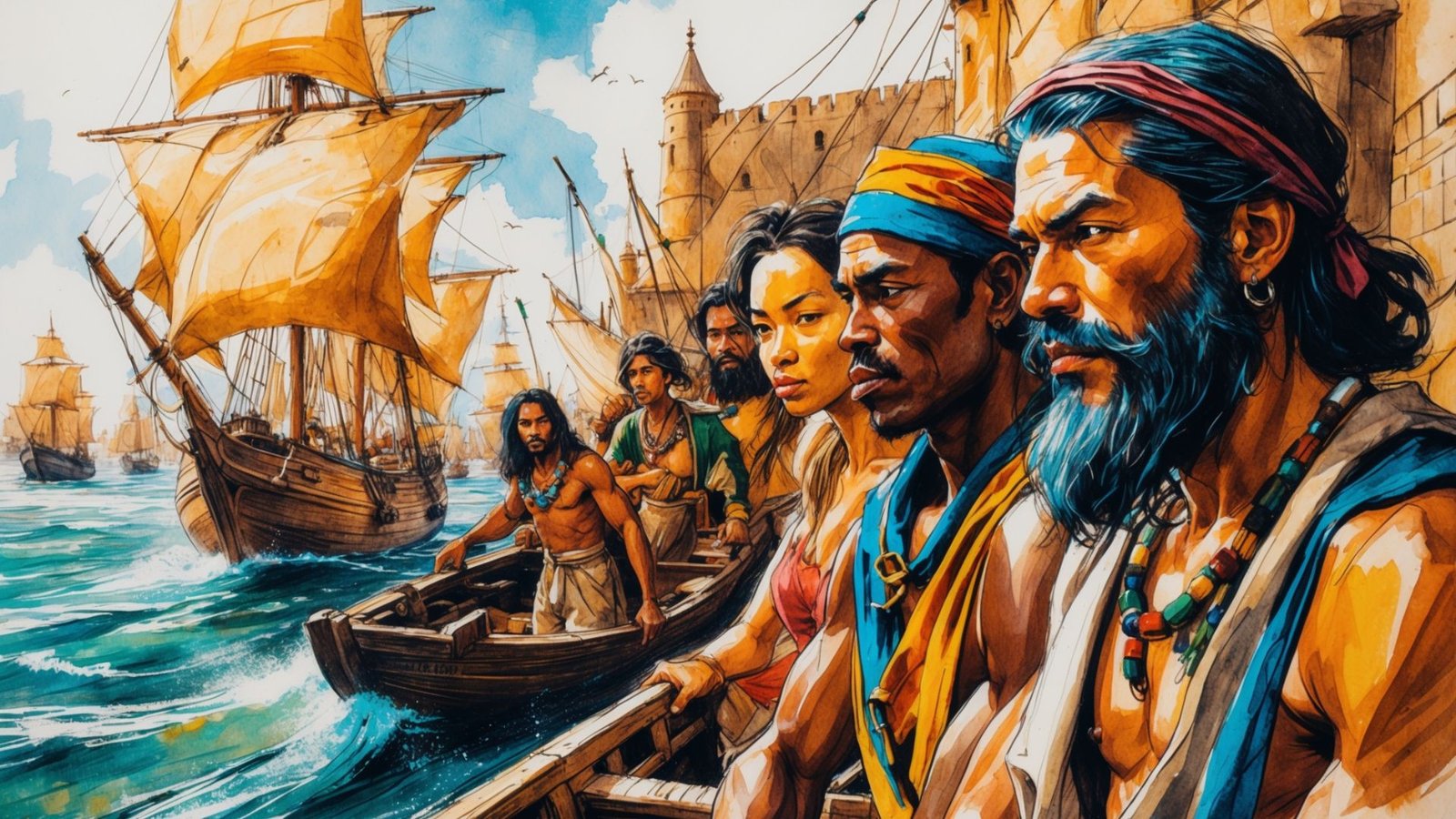
Conquering Listening Exams: The Impact of the Age of Exploration
Welcome back to our listening practice series. If you're preparing for a high-stakes English exam like the TOEFL or IELTS, you know that the listening section often features academic lectures on historical topics. These lectures test your ability to follow a timeline, understand cause-and-effect relationships, and grasp the complex, long-term consequences of historical events.
Let's review some key strategies for historical lectures:
- Listen for Dates and Timelines: The speaker will often guide you through events chronologically. Don't try to memorize every single date, but listen for how they connect to each other to form a sequence of events.
- Identify Cause and Effect: History is a story of "this happened, which led to that." Listen for signal words like "because," "as a result," "consequently," and "therefore." Understanding these connections is often more important than remembering isolated facts.
- Grasp the "Big Picture" Consequences: Lectures rarely just list events. They analyze their impact. As you listen, ask yourself: What were the economic, social, political, and cultural results of these events?
Today's lecture is about the Age of Exploration. It's a topic rich with details, but your goal is to understand the broad, transformative impacts that the speaker highlights. Let's begin.
Listen
Listening Quiz
Listening Transcript: Please do not read the transcript before you listen and take the quiz
Good afternoon. Today, we turn our attention to a period that fundamentally reshaped the world map and the course of human history: the Age of Exploration. Spanning roughly from the early 15th to the early 17th century, this era was characterized by an unprecedented wave of European maritime voyages. While we often think of celebrated figures like Columbus, da Gama, and Magellan, the true significance of this period lies not just in the voyages themselves, but in their profound and often devastating consequences.
The initial impetus for this era was largely economic. The fall of Constantinople in 1453 disrupted the established overland trade routes to the East, making valuable goods like spices, silk, and opium exorbitantly expensive for Europeans. This created a powerful incentive for maritime nations, particularly Portugal and Spain, to find a direct sea route to Asia. Advances in shipbuilding, such as the development of the caravel—a light, fast, and maneuverable ship—and navigational instruments like the astrolabe and magnetic compass, provided the necessary tools to venture into the unknown.
The voyages, of course, did not just lead to Asia. They led to the "New World"—the Americas—and initiated a process that would irrevocably connect the Eastern and Western Hemispheres. This connection triggered one of the most significant events in global history, an event we now call the Columbian Exchange. This wasn't a trade network in the modern sense; it was a widespread transfer of plants, animals, culture, human populations, technology, and ideas between the Americas, West Africa, and the Old World.
From the Americas, Europe received crops that would become staples, fundamentally changing its diet and demography. Think of the potato, maize (or corn), and tomatoes. The potato, in particular, was a game-changer. It could grow in poor soil and was incredibly calorie-dense, helping to fuel a population boom in Europe. In return, the Old World introduced horses, cattle, pigs, and wheat to the Americas. The horse, for example, dramatically altered the lifestyles of many Native American tribes on the Great Plains, transforming their methods of hunting and warfare.
However, the Columbian Exchange had a darker, more catastrophic side. Europeans inadvertently brought with them infectious diseases to which the indigenous populations of the Americas had no immunity. Smallpox, measles, and influenza swept through the continents, causing a demographic catastrophe of staggering proportions. Historians estimate that in the century following Columbus's arrival, the indigenous population may have declined by as much as 90%. This depopulation was a key factor that enabled European colonization and the subsequent exploitation of the Americas' resources.
The economic consequences were equally transformative. The vast quantities of silver and gold extracted from mines in Mexico and Peru and shipped back to Spain created immense wealth for the Spanish crown, but also triggered massive inflation across Europe. This period also saw the rise of a new economic theory: mercantilism. European powers viewed their colonies as sources of raw materials and markets for their manufactured goods, establishing a system designed to enrich the mother country. This laid the groundwork for a global economy, but one that was built on exploitation and inequality.
Furthermore, the Age of Exploration fueled the transatlantic slave trade. As indigenous populations succumbed to disease, European colonizers turned to Africa to supply the labor needed for their lucrative sugar and tobacco plantations in the Americas. Millions of Africans were forcibly transported across the Atlantic in brutal conditions, a horrific chapter of history with deep and lasting social and cultural scars that persist to this day.
In conclusion, to view the Age of Exploration merely as a series of heroic voyages is to miss the larger picture. It was an era of profound global integration, but this integration was not a meeting of equals. It led to unprecedented biological and cultural exchanges, the rise of European maritime empires, and the establishment of a global economic system. But it also brought about demographic collapse, widespread subjugation, and the horrors of the transatlantic slave trade. It was the birth of our modern, interconnected world, but it was a birth marked by both remarkable discovery and profound tragedy.
Advanced Vocabulary and Phrases
- Maritime: This is an adjective related to the sea, shipping, or navigation.
- How we used it: We talked about "European maritime voyages," which simply means voyages that took place on the sea.
- Unprecedented: An adjective meaning never done or known before.
- How we used it: The lecture described the voyages as an "unprecedented wave," meaning that such a large number of extensive sea voyages had never happened before in history.
- Impetus: This is a noun that means the force or motivation that makes something happen.
- How we used it: The disruption of trade routes was the economic impetus—the main push or driving force—for finding a sea route to Asia.
- Irrevocably: An adverb that means in a way that cannot be changed, reversed, or recovered.
- How we used it: The connection between the hemispheres was irrevocably changed, meaning it was a permanent change that couldn't be undone.
- Staples: In this context, a staple is a main or important element of something, especially of a diet.
- How we used it: Crops like potatoes and maize became staples in Europe, meaning they became primary, everyday foods for the general population.
- Demographic catastrophe: A noun phrase describing a disastrous event that causes a massive decline in a population.
- How we used it: The spread of European diseases in the Americas led to a demographic catastrophe, referring to the tragic death of a huge percentage of the indigenous population.
- Indigenous: This is an adjective that means originating or occurring naturally in a particular place; native.
- How we used it: The indigenous populations of the Americas were the people who were already living there before the arrival of Europeans.
- Exorbitantly: An adverb that describes something as being unreasonably high, usually in price.
- How we used it: Spices became exorbitantly expensive, meaning the price was far higher than what was reasonable, which motivated the search for new trade routes.
- Subjugation: This is a noun that means the action of bringing someone or something under domination or control.
- How we used it: The lecturer mentioned "widespread subjugation," referring to the process of European powers conquering and controlling the native peoples of the lands they explored.
- Inadvertently: An adverb meaning without intention; accidentally.
- How we used it: Europeans inadvertently brought diseases with them, meaning they didn't do it on purpose, but it happened as an unintended consequence of their arrival.









0 Comments