Introduction
You probably know the Sun as the thing that keeps you warm, grows your food, and occasionally causes terrible glare on your phone screen. But the Sun is doing something far more extraordinary that almost nobody mentions in everyday conversation: it is building and maintaining a colossal invisible bubble that wraps around the entire solar system — all eight planets, all the comets, all the drifting rock and ice — and shields everything inside from some of the most lethal radiation in the galaxy. Without this bubble, the development of complex life on Earth would have been a much harder — possibly impossible — proposition.
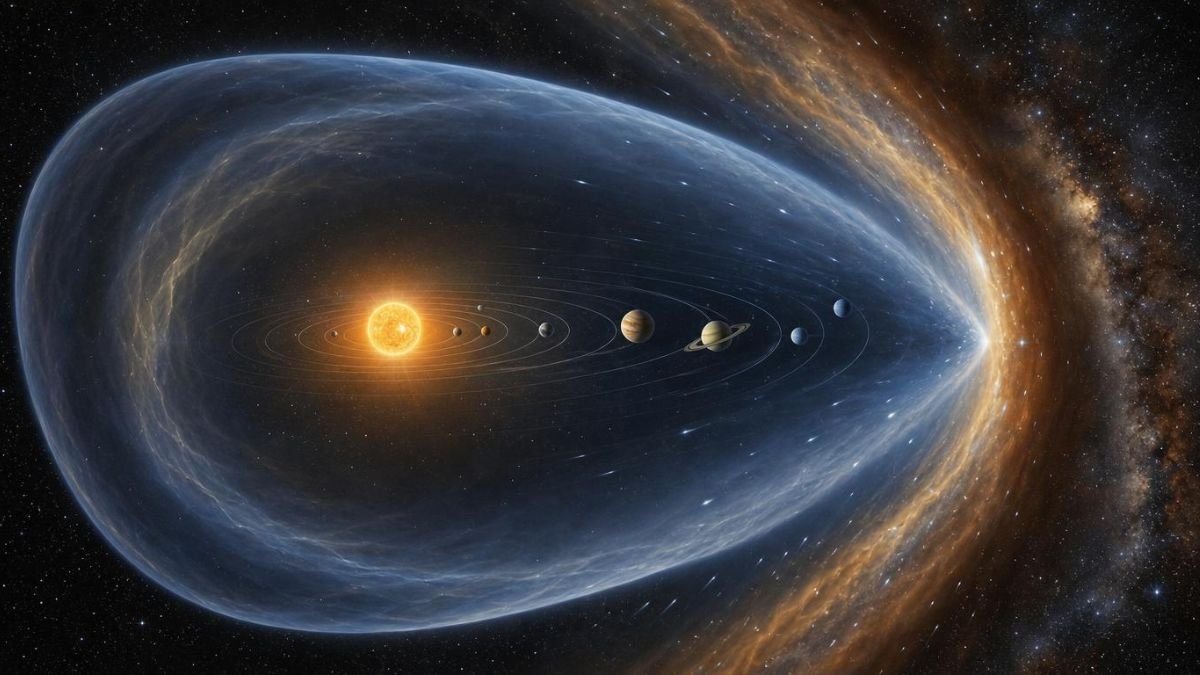
This bubble is called the heliosphere, and it is one of the most fascinating and underappreciated structures in the cosmos. It extends roughly 100 to 150 astronomical units from the Sun in the direction facing the galactic wind, and even further in the trailing direction — the exact size and shape are still being actively studied. To put that in terms that feel meaningful: the heliosphere stretches far beyond the orbit of Neptune and extends into a region of space so remote that it took the Voyager 1 spacecraft — launched in 1977 and traveling at speeds that would circle the Earth fourteen times per second — until 2012 to finally leave it.
Today we are going to learn about this structure — what it is, how it works, what threatens it, and what it tells us about our place in a much larger and more dangerous universe than we usually think about on a Tuesday morning. We are also going to read this article closely and carefully, because the language of science writing — with its precise vocabulary, its use of analogy, its management of scale — is one of the most rewarding kinds of writing to analyze. Learning to read science this way will permanently change both your English and your relationship with the natural world. Let's begin.
The Article
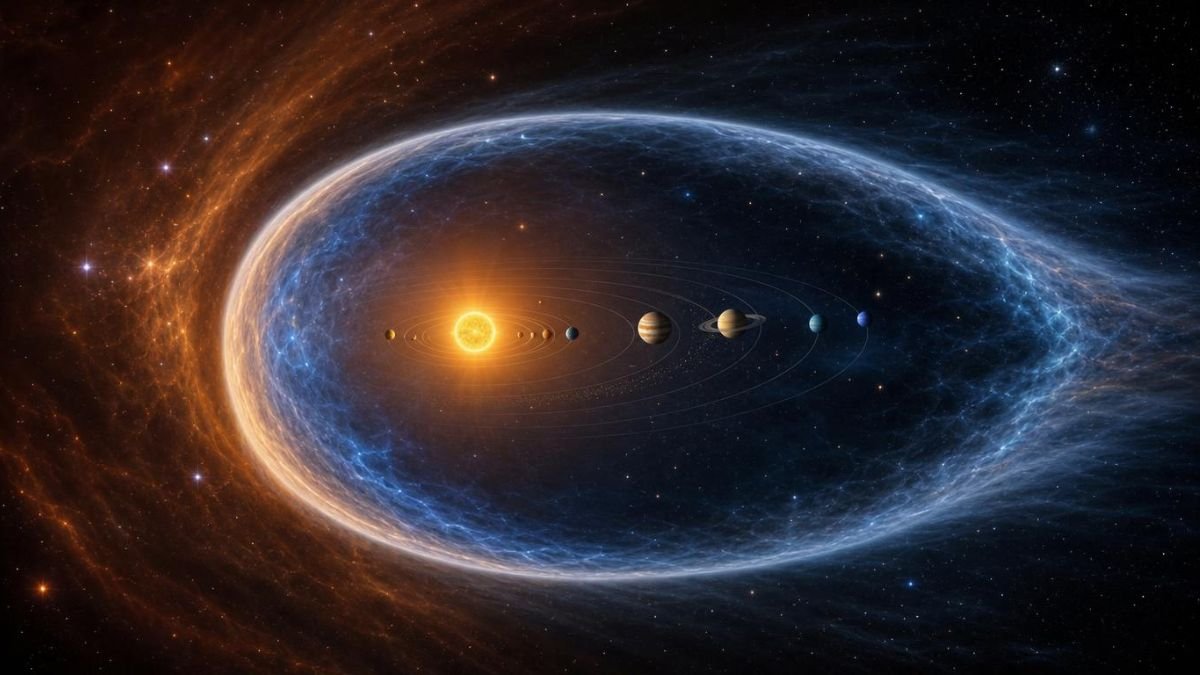
What if the most important thing the Sun does for you every day is not the thing you can feel on your skin? The Sun's warmth is magnificent, and its light is essential, but arguably the greatest service our star performs is invisible, constant, and occurring billions of miles away from where you're sitting right now. The heliosphere — the Sun's protective bubble — is a vast magnetic and plasma structure that encompasses our entire solar system and stands between us and the relentless, bone-deep radiation of the broader galaxy. And it is extraordinary.
The heliosphere is generated by the solar wind: a continuous stream of charged particles — primarily electrons and protons — that the Sun blows outward in all directions at speeds of roughly 400 to 800 kilometers per second. This is not a metaphorical wind. It is a literal stream of matter, stripped from the Sun's corona and hurled into space at speeds that would carry you from the Earth to the Moon in about ten minutes. As the solar wind expands outward into space, it creates a region of influence — a bubble of solar plasma and magnetic field — that pushes against the interstellar medium, the thin soup of gas, dust, and cosmic rays that fills the space between star systems. The boundary where the solar wind's pressure balances the pressure of the interstellar medium is what defines the edge of the heliosphere.
That edge has two important features. The first is called the termination shock: the point, roughly 80 to 100 astronomical units from the Sun, where the solar wind abruptly slows from supersonic to subsonic speed as it begins to encounter the resistance of the interstellar medium. The Voyager probes crossed this boundary — Voyager 1 in 2004, Voyager 2 in 2007 — and the data they sent back allowed scientists to characterize what this turbulent region actually behaves like. Beyond the termination shock lies the heliosheath — a vast, churning region of slowed solar wind roughly 30 to 40 astronomical units thick, full of turbulence and magnetic complexity. And at the outer boundary of the heliosheath is the heliopause: the true edge of the solar system in the most meaningful physical sense, the place where the Sun's matter ends and the interstellar medium takes over. Voyager 1 crossed the heliopause in August 2012, becoming the first human-made object to enter interstellar space.
What exactly is the heliosphere protecting us from? Primarily from galactic cosmic rays: high-energy particles, mostly protons and atomic nuclei, that have been accelerated to extraordinary speeds by distant supernova explosions and other violent cosmic events across the galaxy. These particles fly through interstellar space at nearly the speed of light, carrying enormous energy. When they enter the heliosphere, many of them are deflected or scattered by the Sun's magnetic field and the turbulent structure of the heliosheath. The heliosphere does not block them all — some galactic cosmic rays do reach Earth, and our atmosphere provides additional protection — but it reduces the flux significantly. Studies of the Voyager data suggest that the cosmic ray intensity in interstellar space is two to three times higher than what we experience within the heliosphere. If the heliosphere were significantly weaker — which could happen during periods when the Sun is less active — the bombardment of cosmic rays reaching Earth's surface would increase substantially.
The shape of the heliosphere is not a perfect sphere, despite the "bubble" metaphor that is so convenient for communication. The Sun and our solar system are moving through the galaxy at about 230 kilometers per second, traveling in the direction of the constellation Hercules. This motion creates an asymmetry: the heliosphere is compressed on the leading side, facing the direction of travel, and stretched out in the trailing direction, potentially forming a long tail — a heliospheric wake, analogous to the wake left by a boat. Some scientists prefer the image of a comet's shape — blunt on the leading face, tapering into a tail behind. But even the shape is still debated. The New Horizons spacecraft, which flew past Pluto in 2015, is now heading outward and will eventually provide additional data about the heliosphere's structure from a different angle than the Voyager probes.
The heliosphere also varies in size and strength over time. The Sun goes through roughly eleven-year cycles of activity — moving between solar minimum, when sunspot activity is low and the solar wind is quieter, and solar maximum, when solar activity peaks, sunspots proliferate, and the solar wind intensifies. During solar maximum, the heliosphere expands somewhat and offers slightly better protection against galactic cosmic rays. During solar minimum, it contracts. This variability means that the cosmic ray environment at Earth fluctuates in a regular, predictable cycle — a fact with implications for everything from astronaut health on long-duration missions to the rate of certain kinds of atmospheric chemistry.
There is also a much longer-term variation to consider: the Sun is currently passing through a region of the galaxy known as the Local Interstellar Cloud — a region of slightly denser and hotter interstellar medium. As the Sun moves through the galaxy over millions of years, it will pass through regions of varying density. If it were ever to pass through a particularly dense molecular cloud, the increased pressure from the interstellar medium could compress the heliosphere dramatically — potentially exposing the inner solar system to significantly higher cosmic ray flux. Some researchers have speculated that such passages, over geological time, may have contributed to mass extinction events on Earth, though this remains a hypothesis rather than an established finding.
The deeper you look at the heliosphere, the more remarkable it becomes — not just as a physical structure but as a reminder of how dependent even the most local and familiar aspects of our existence are on vast, impersonal cosmic processes playing out on scales we can barely imagine. The warmth on your skin on a summer afternoon and the protection of an invisible magnetic bubble stretching billions of miles into the dark are both, in a deep sense, the same Sun. Both products of the same star that has been burning for 4.6 billion years and, by most estimates, has about five billion left.
When you look up at the Sun — carefully, not directly — do you see a lamp, or do you see an architect? Because it has been building your home since before your planet had a crust to stand on.
Close Reading Analysis
Paragraph 1:
Question: the opening sentence asks "What if the most important thing the Sun does for you every day is not the thing you can feel on your skin?" How does this opening question use the second-person address ("you") to do more than simply engage the reader?
The second-person address here is not merely a stylistic choice for warmth and engagement — it is doing an argumentative function. By saying "what the Sun does for you," the writer is establishing a direct personal stake. The heliosphere is not an interesting fact about distant space; it is relevant to you, specifically and personally. This creates what rhetoricians call proxemics — the management of psychological distance between the topic and the reader. Science writing often struggles with irrelevance: the reader can appreciate intellectually that a distant cosmic structure is fascinating without feeling it has anything to do with them. The second-person address collapses that distance preemptively. Notice the word "feel" in "the thing you can feel on your skin" — it is physical, tactile, immediate. Science writing at its best anchors the abstract in the sensory.
Paragraph 2: the solar wind:
Question: the writer says the solar wind is "not a metaphorical wind" and then immediately describes it as "a literal stream of matter." Why is this explicit clarification of "not metaphorical / but literal" necessary in science writing, and what does it tell you about the challenges of science communication?
Science writing frequently uses analogies and metaphors to make abstract concepts accessible — "solar wind," "protective bubble," "termination shock." But these tools carry a risk: the reader may not know when the metaphor ends and the physical reality begins. By explicitly flagging "this is not a metaphorical wind," the writer is managing that risk: they are saying "I know I have been using convenient figurative language, and here is where I want you to understand that the underlying reality is genuinely, physically that." This metacommunicative move — a comment on the language being used rather than on the subject itself — is a sophisticated tool in science communication. Advanced readers and writers should be alert to these moments where the writer steps briefly outside the argument to comment on the language. They are often markers of intellectual care.
Paragraph 3: termination shock, heliosheath, heliopause:
Question: the paragraph introduces three technical terms in sequence: termination shock, heliosheath, heliopause. Each is defined immediately after being named. What does this sequence tell you about how technical vocabulary works in specialist writing, and how can you use this strategy in your own analytical writing?
Each technical term is handled with the same structure: name, then immediate definition in accessible language. This is called the appositive definition technique — placing a definition in apposition to a term, either in the same sentence or immediately after it. It allows the writer to use precise technical vocabulary (which signals expertise and precision) without alienating a non-specialist reader (who needs accessibility). In your own writing, this technique is invaluable when you want to use a sophisticated or specialized term without stopping the flow of your argument for a lengthy explanation. The discipline is in the brevity: one tight sentence of definition, then move on. Notice also that the definitions grow slightly less detailed as the paragraph proceeds — by the third term (heliopause), the writer can trust that the reader has understood the pattern and can absorb a shorter definition.
Paragraph 4: cosmic ray protection:
Question: the paragraph states that cosmic ray intensity in interstellar space is "two to three times higher than what we experience within the heliosphere." How does the use of specific numbers (rather than vague qualifiers like "much higher" or "significantly higher") function in scientific persuasion?
Specific numbers are one of the most powerful tools in scientific writing, and their power is largely rhetorical as well as factual. "Much higher" is vague — it is an impression. "Two to three times higher" is a quantity — it is a measurement. Even if the reader cannot immediately feel the difference between those numbers and a vaguer description, the specificity signals that the claim is based on data rather than impression. It creates trust. It also creates tractability: you can do something with a specific number. You can compare it to other things. You can evaluate whether it is big or small. Vague qualifiers close down thinking; specific numbers open it up. In your own writing — particularly analytical and argumentative writing — replacing vague intensifiers ("very," "extremely," "significantly") with specific quantities whenever possible is one of the most efficient ways to improve your writing's credibility.
Paragraph 5: shape of the heliosphere:
Question: the paragraph notes that the heliosphere "is not a perfect sphere, despite the 'bubble' metaphor that is so convenient for communication." What does the writer's explicit acknowledgment of the convenience (and inaccuracy) of their own earlier metaphor tell you about the epistemological values embedded in good science writing?
This self-correction is a mark of intellectual honesty and is a specific epistemological value: the willingness to complicate your own simplifications when simplicity becomes misleading. The writer used "bubble" because it is the most communicable image — and then explicitly acknowledged that the image is not accurate. This is not inconsistency; it is calibration. Good science communication does this regularly: it simplifies first to make a concept accessible, then complicates as the reader's understanding develops. The ideal is not the simplest possible explanation but the simplest explanation that doesn't create false impressions. Knowing when your metaphor is becoming a liability — and being willing to say so — is a mature cognitive and rhetorical skill.
Closing metaphor:
"When you look up at the Sun — carefully, not directly — do you see a lamp, or do you see an architect?"
The parenthetical "carefully, not directly" is a tiny gem of tone management. It is simultaneously practical advice (don't look directly at the Sun), a brief moment of self-aware humor (the writer pausing mid-cosmic-reflection to deliver safety guidance), and a humanizing touch — the writer is present with you, not just delivering information from a podium. The metaphors themselves — lamp versus architect — are carefully calibrated. A lamp provides light passively. An architect builds with intention and structure over time. The question asks whether your mental model of the Sun is adequate to the reality the article has just revealed: not a simple heat source but a builder of cosmic infrastructure that has been at work for 4.6 billion years. Ending with a binary question that is also a provocation to revise a conceptual framework is excellent science writing — because the goal of science communication, at its best, is not to add a fact but to change how you see.
Speaking and Writing Challenges
Writing Challenge
Choose something familiar and everyday — rain, fire, gravity, sleep, or anything else you take for granted — and write a 350–450 word explanatory paragraph for a general audience. Your challenge is to: (1) explain the actual mechanism behind the phenomenon in accessible but precise language, (2) use at least one well-constructed analogy, (3) include one moment where you acknowledge the limitation of that analogy (as modeled in the heliosphere article), and (4) end with a question or observation that reframes how the reader sees this everyday thing.
Speaking Challenge
Prepare a two-minute explanation of the heliosphere — or any scientific concept you genuinely find fascinating — for an imaginary ten-year-old. The constraint is that you cannot use any technical vocabulary without immediately defining it, you must include at least one comparison to something familiar, and you must convey genuine enthusiasm. Then, without pausing, give a thirty-second extension in which you tell the ten-year-old one thing about this concept that is still unknown or debated. The goal is to practice the range of register that advanced English speakers can command — from accessible explanation to honest scientific uncertainty.







0 Comments