Introduction
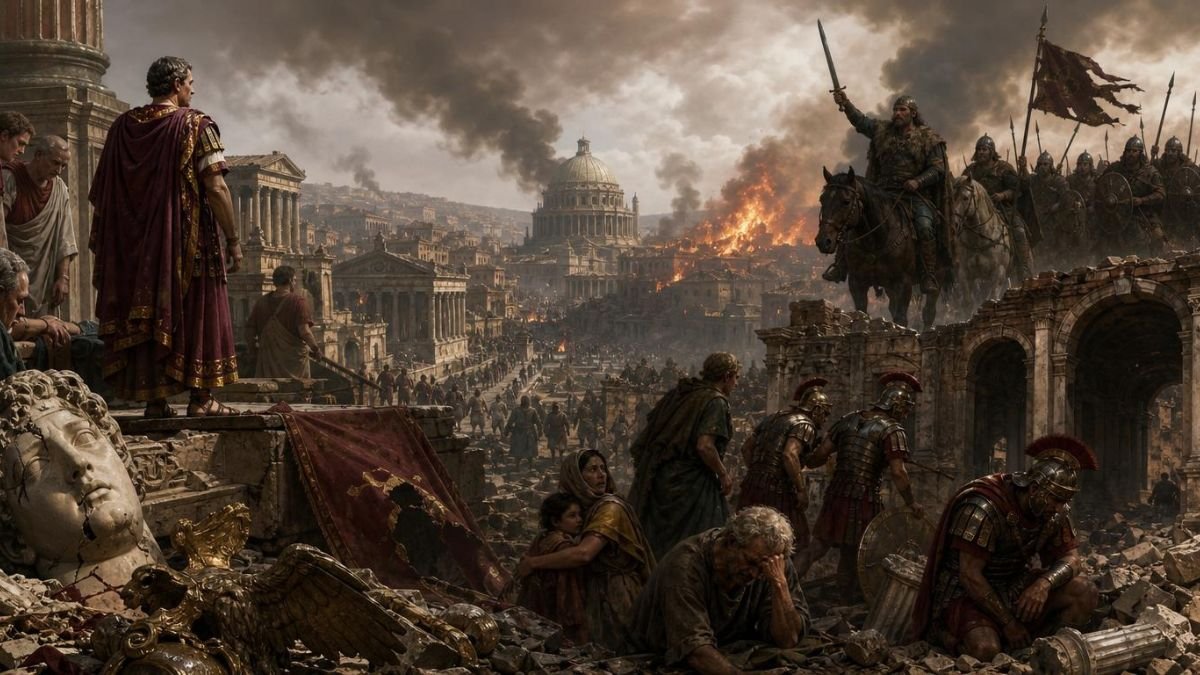
Few events in history have been analyzed, debated, and picked over more exhaustively than the fall of the Roman Empire. And few have produced less consensus. Historians have identified somewhere between two hundred and five hundred different causes, depending on which historian you ask and which century they were writing in. The fall of Rome has been blamed on Christianity (by Gibbon), on lead pipes (various), on political corruption, on military overextension, on economic collapse, on climate change, on pandemic disease, on barbarian invasions, on moral decline, on the end of civic virtue, and on the sheer impossibility of governing a territory that stretched from Scotland to Mesopotamia with the administrative technology of the ancient world. The most honest answer is probably "all of the above, interacting in ways that are still not fully understood."
What makes the fall of Rome endlessly fascinating is not just that it happened, but that it took so long — roughly two to three centuries of slow, uneven disintegration — and that it happened to an entity that had every reason to believe it was eternal. Rome had survived plagues, civil wars, foreign invasions, and periods of catastrophic political dysfunction before. It had a genius for adaptation. It absorbed the cultures it conquered. It was simultaneously rigid and flexible, brutal and remarkably tolerant, centralized and decentralized. When it fell, it fell from the inside as much as from the outside. That is the part that is hardest to look at directly.
Why read about this closely? Because historical narrative — the kind that must synthesize enormous complexity into a readable, coherent story — is one of the most challenging and rewarding types of writing to analyze. It makes choices constantly: which causes to emphasize, which voices to privilege, which metaphors to use, how to handle ambiguity and disagreement. Learning to read those choices consciously will change how you read any piece of complex writing — journalistic, academic, political, or literary. And it will permanently improve how you write and argue. Let's see what Rome can still teach us.
The Article
Is it possible for the greatest empire in history to die not with a bang but with a centuries-long administrative whimper? That is essentially what happened when the Roman Empire fell — and the fall of the Roman Empire's causes turn out to be less a dramatic story of conquest and defeat than a deeply uncomfortable mirror held up to the nature of complex civilizations and why they stop working. The mirror is uncomfortable because, if you look into it carefully, some of the reflections look remarkably like the present.
The first thing to understand about Rome's fall is that it was not a single event but a process — a gradual, uneven, and in many ways contested decline that historians date differently depending on which criteria they use. The conventional date is 476 CE, when the Germanic chieftain Odoacer deposed Romulus Augustulus, the last emperor of the Western Roman Empire. But this was largely symbolic: effective imperial authority in the West had been fragmenting for at least a century before that. The Eastern Roman Empire — based in Constantinople, which we now call Istanbul — continued for nearly another thousand years, finally falling in 1453 CE. So in a very real sense, Rome did not simply fall. Part of it transformed. Part of it endured. Part of it became something else entirely.
The military pressures on Rome in its final centuries were real and enormous. From the third century CE onward, the empire faced an accelerating series of incursions from peoples along its extensive frontiers: the Visigoths, the Huns, the Vandals, the Ostrogoths, and others. These were not simply primitive tribes overrunning a sophisticated civilization — many of these peoples had long and complex relationships with Rome, serving in its armies, trading with its merchants, absorbing its culture. The Visigoths who sacked Rome in 410 CE had been in Roman service for decades. The "barbarian invasions" were, in significant part, the product of Rome's own policies of using external peoples as military auxiliaries — and then failing to integrate them, compensate them adequately, or honor the agreements that had been made.
But military pressure alone does not explain Rome's collapse. Internal political dysfunction played an equally critical role. Between 235 and 284 CE — a period known as the Crisis of the Third Century — Rome had approximately fifty emperors, most of whom died violently in office. The political system that had produced stability for centuries had degenerated into a cycle of military strongmen seizing power, ruling briefly, and being overthrown by the next ambitious general. Governance became short-term and reactive. Long-term infrastructure, administrative capacity, and institutional trust all deteriorated. The Roman Senate, which had once been a genuine governing body, became increasingly ceremonial. The bureaucracy expanded but became simultaneously more expensive and less effective. The currency was debased so severely — with silver coins containing less and less actual silver — that inflation spiraled. Trade contracted. The economic foundations that had funded the military and the administrative apparatus began to crack.
There is also the factor of structural overextension. At its height, the Roman Empire covered approximately five million square kilometers and governed an estimated fifty to sixty million people. Governing this territory required an administrative apparatus, a road network, a postal system, and a military presence on thousands of miles of frontiers — all of which required revenue, which required taxation, which required a functioning economy and a reliable census, which required administrative capacity and trust in institutions. When any of these elements began to fail, the others came under additional strain. The empire was a system, and systems under sustained stress become brittle.
The role of Christianity in Rome's fall has been debated since Edward Gibbon argued in the eighteenth century that the new religion diverted Roman energies away from civic virtue and military prowess toward otherworldly concerns. Most contemporary historians find this argument overstated. But there is a more nuanced version worth considering: the adoption of Christianity as the state religion under Constantine in the fourth century accelerated changes to Roman cultural and civic identity that were already underway. The empire that had been structured around civic religion, public ritual, and the cult of the emperor found itself reorganizing around a different set of institutions, loyalties, and values. These transitions were not necessarily bad — but they were disruptive, and they coincided with other sources of stress.
Climate and disease also played roles that are only recently being quantified with the tools of modern science. The Antonine Plague of 165–180 CE and the Plague of Cyprian of 249–262 CE caused enormous mortality — some estimates suggest that the Plague of Cyprian killed five thousand people per day in Rome at its peak. Pollen records, tree rings, and ice cores have revealed that the Roman Climate Optimum — a period of relatively warm, stable, wet conditions that had supported Roman agricultural productivity — ended in the third century CE, replaced by a cooler, more volatile period that reduced agricultural yields across the empire's territory. Human societies under economic, political, and military stress become significantly more vulnerable to the additional shock of climate disruption and pandemic disease.
Perhaps most importantly, Rome fell in part because it stopped believing it could survive. The cultural confidence that had sustained Roman identity through centuries of challenge — the belief in Roman order, Roman law, Roman civilization as the natural and superior form of human organization — eroded. When people stop believing in the institutions and values that hold a complex society together, those institutions become much harder to maintain. Trust is not a soft, secondary factor in civilizational health. It is structural. When it goes, everything becomes more fragile.
The fall of Rome does not have a single lesson. But it does have a persistent, uncomfortable question at its center: at what point does the cost of maintaining a complex system exceed the capacity of the people within it to sustain the belief that the effort is worth making? And when you look at the combination of political dysfunction, economic stress, military overextension, institutional erosion, climate disruption, and cultural fragmentation that brought down Rome — does any of that sound, even faintly, like anything happening today?
Close Reading Analysis
Paragraph 1: "Is it possible for the greatest empire in history to die not with a bang but with a centuries-long administrative whimper?"
Question one: the phrase "not with a bang but with a whimper" — where does this come from, and what does its use here demonstrate about how writers use allusion?
Question two: the word "administrative" is placed in front of "whimper," which is not a word normally modified by administrative. What is the effect of this unusual collocation?
"Not with a bang but with a whimper" is an allusion to the final lines of T.S. Eliot's 1925 poem "The Hollow Men": "This is the way the world ends / Not with a bang but a whimper." Eliot was describing the spiritual exhaustion of post-World War I civilization. By deploying this allusion, the writer does several things simultaneously: they connect Rome's fall to a modern poetic meditation on civilizational decline, they place the article within a tradition of thinking about how great things end, and they signal cultural literacy — an awareness of literature beyond the immediate topic. Allusion is a tool that rewards the reader who recognizes it (with the pleasure of connection) while still being meaningful to the reader who doesn't (the basic contrast between dramatic and quiet endings is clear without knowing Eliot). Learning to recognize allusions — and to use them strategically in your own writing — is a key marker of advanced English use.
"Administrative whimper" is a deliberate incongruity. "Whimper" is an emotional, almost childlike word — it suggests the small, helpless sound of exhaustion or defeat. "Administrative" is bureaucratic, cold, functional. Placing them together creates an effect of ironic deflation: the greatest empire in history did not end heroically but in the small, inglorious sound of systems failing to function. This is called a zeugma of mood — yoking together registers that do not normally coexist, to comic or ironic effect.
Paragraph 2: "The first thing to understand about Rome's fall is that it was not a single event but a process..."
Question: the paragraph ends with three parallel sentences: "Part of it transformed. Part of it endured. Part of it became something else entirely." What rhetorical structure is this, and what does the escalating final phrase "something else entirely" add?
This is an anaphora — a rhetorical figure in which successive clauses begin with the same word or phrase. Here, "Part of it" begins each of the three short sentences. The repetition creates rhythm and finality, and the parallel structure suggests that these three fates are comparable in weight and significance. But the third element breaks the pattern slightly: "something else entirely" is more mysterious, more open-ended than "transformed" or "endured." This is deliberate: the first two fates can be described with single verbs. The third resists that precision. The Eastern Roman Empire's transformation into what we might call Byzantine civilization is genuinely difficult to categorize — it is too continuous to call a collapse, too changed to simply call a continuation. "Something else entirely" honest acknowledges this complexity by refusing to force it into a simpler category.
Paragraph 3: "The military pressures on Rome in its final centuries were real and enormous..."
Question: the paragraph notes that many so-called "barbarian" invaders had "long and complex relationships with Rome, serving in its armies, trading with its merchants, absorbing its culture." Why is this detail important, and what does it complicate in the conventional narrative of Rome's fall?
The conventional narrative of Rome's fall treats it as an external event — civilization besieged by outsiders. This detail complicates that narrative fundamentally: the "barbarians" were not strangers to Rome. They were, in many cases, people who had been integrated into Roman military and economic life, who had fought for Rome, who had been promised things by Rome that Rome did not deliver. The sack of Rome by the Visigoths in 410 CE was, on this reading, less an invasion from outside than a breakdown of internal agreements — a failure of the Roman political system to honor its commitments to people who had been, in practical terms, part of the Roman system. This reframing matters because it shifts the locus of responsibility: Rome was not simply overwhelmed by outside forces. It failed to maintain the relationships and agreements that had made its extended reach possible. The "barbarian invasion" narrative is, at least partially, Roman imperial propaganda — and recognizing that is an act of critical historical reading.
Paragraph 4: "But military pressure alone does not explain Rome's collapse..."
Question: the paragraph describes a period of fifty emperors in approximately fifty years, most killed in office. The word used is "degenerated" — "the political system that had produced stability for centuries had degenerated." What does "degenerated" imply about the direction and nature of the change, and why is it a stronger choice than "changed" or "deteriorated"?
"Degenerated" means to decline from a higher or better state to a lower or worse one — it implies not just change or deterioration but a reversal of a prior developmental achievement. The political system did not simply change; it fell back from something that had been built with difficulty. "Deteriorated" would suggest a gradual wearing away, like erosion. "Degenerated" suggests a more active unraveling, a reversal of quality. The word also carries a slightly clinical connotation — used in biology to describe tissue or organisms losing their organized structure — which subtly reinforces the idea that Rome's political collapse was a kind of systemic organic failure, not just a series of individual bad decisions.
Paragraph 5: "There is also the factor of structural overextension..."
Question: the paragraph describes Rome as "a system," and says "systems under sustained stress become brittle." What is the intellectual move being made by describing an empire as a system? What does this framing include that a purely political or military framing would exclude?
Describing Rome as a system is a move from historical narrative to systems thinking — a mode of analysis that looks at how components interact, how feedback loops work, how stress in one part of a system propagates through others. The political history framing would focus on emperors and decisions. The military history framing would focus on battles and frontiers. The systems framing asks: how did the road network depend on taxation, which depended on census accuracy, which depended on administrative trust, which depended on institutional stability? Systems thinking reveals the interdependencies that purely political or military analysis misses. It also provides a more honest account of how complex things fail — not usually because of a single catastrophic decision but because of cascading, mutually reinforcing failures across multiple domains simultaneously.
Paragraphs 6-7 — Christianity, climate, disease:
Question: the paragraph on Christianity presents Gibbon's argument and then qualifies it with "most contemporary historians find this argument overstated." What does this phrase tell you about how scholarly consensus works, and why is it important that the writer presents both Gibbon's argument and its qualification rather than simply dismissing Gibbon?
"Most contemporary historians find this argument overstated" is a claim about scholarly consensus at a specific moment in time ("contemporary"). It acknowledges that Gibbon's argument was once highly influential — it shaped thinking about Rome for two centuries — while signaling that the balance of historical scholarship has shifted. Presenting Gibbon's argument before qualifying it is intellectually honest: it gives you a real position to evaluate rather than setting up a straw man. This is what good historical and analytical writing does: it engages seriously with positions it ultimately disagrees with, because understanding why an argument was compelling is part of understanding both the argument and the truth. In your own writing, presenting a position before complicating it is both more intellectually honest and more rhetorically effective than simply dismissing it.
Closing question:
"Does any of that sound, even faintly, like anything happening today?"
The phrase "even faintly" is a hedge that is actually an intensifier: by saying "even faintly," the writer is acknowledging that the parallel might seem exaggerated while simultaneously suggesting that even a faint resemblance should be alarming. It is a rhetorical wink — the answer the question expects is obviously yes, the parallels are not faint at all, but the understatement allows the reader to arrive at that conclusion with a sense of discovering it themselves rather than being told. This is one of the most effective techniques in persuasive writing: lead the reader to your conclusion while appearing to give them the freedom to reach it independently.
Speaking & Writing Challenges
Writing Challenge
Choose any complex event from history — it can be a revolution, a collapse, a war, or a transformation of any kind — and write a 400–500 word analytical paragraph arguing for what you consider the single most important underlying cause. Your challenge: (1) acknowledge the complexity (there are many causes), (2) make a clear argument for your chosen cause, (3) acknowledge and respond to at least one counterargument, and (4) end with a connection to a present-day situation. Use at least one systems-thinking observation (showing how different factors interacted) and at least one moment of precise word choice that you can justify.
Speaking Challenge
Prepare a two-minute spoken argument for the following position: "The most important lesson we can learn from the fall of Rome is about the relationship between institutional trust and civilizational health." You do not need to personally believe this is the single most important lesson — the challenge is to make the strongest possible case for it. Structure your argument as: thirty seconds establishing the claim, sixty seconds presenting evidence from Rome, thirty seconds connecting to today. Focus on fluency, the clear signposting of your argument ("first," "more importantly," "this suggests that"), and avoiding the temptation to qualify everything until your argument disappears.






0 Comments