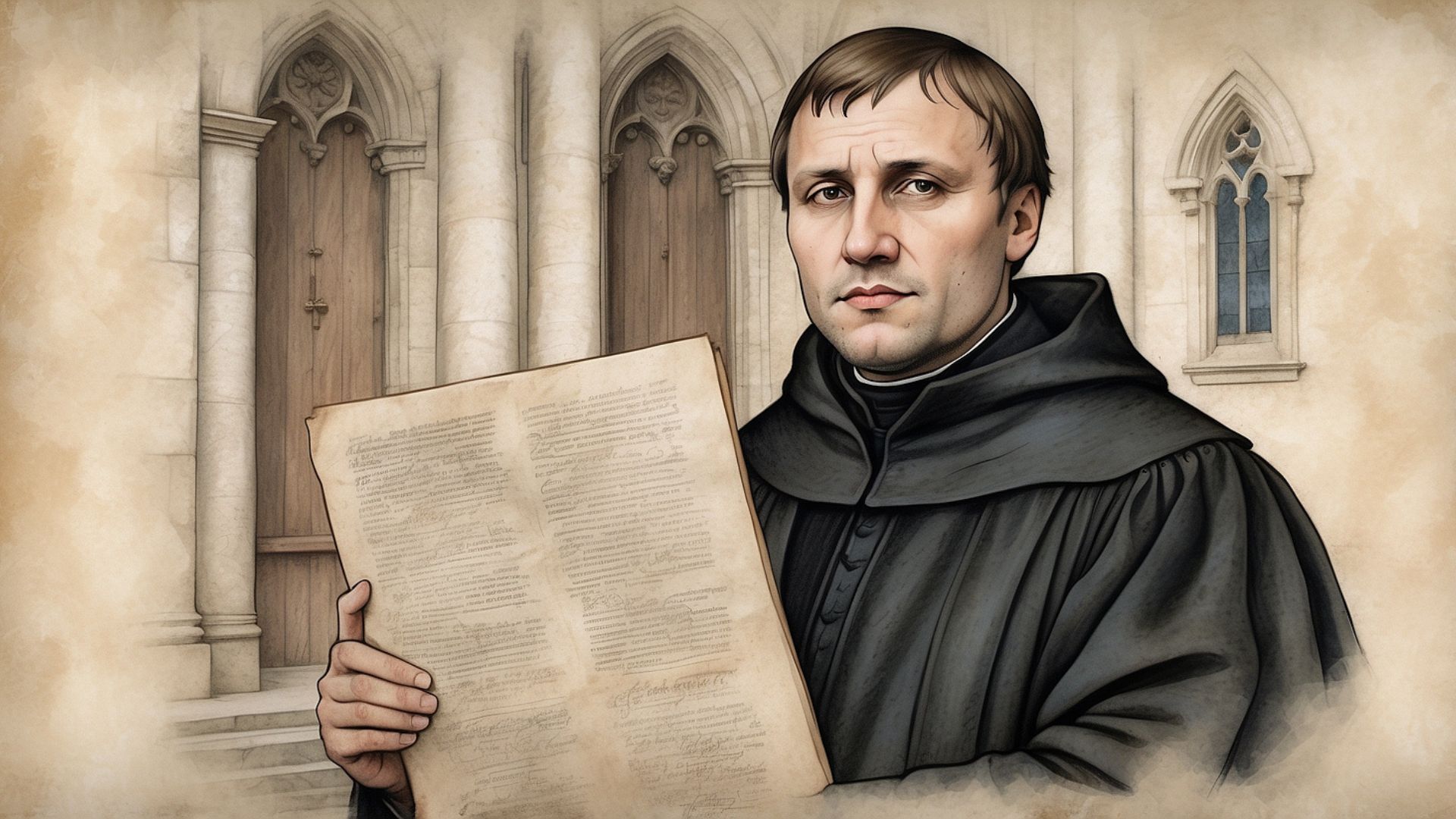
Martin Luther’s name is synonymous with the Protestant Reformation, a period of monumental religious and social upheaval. Born in 1483 in Eisleben, Germany, Luther was destined to become a central figure in challenging the Catholic Church’s authority. What began as a personal journey of faith ended up becoming a movement that redefined Christianity, shifted political power in Europe, and paved the way for religious freedom. This article will explore the life of Martin Luther, the ideas that shaped his beliefs, and the legacy that continues to resonate today.
Luther’s Early Life and Spiritual Crisis
Luther wasn’t always a rebel. His father wanted him to become a lawyer, but a life-changing experience during a thunderstorm led Luther to make a promise—if he survived, he would dedicate his life to God. True to his word, he became a monk and later a priest, immersing himself in religious study. But instead of finding peace, Luther wrestled with guilt and fear, struggling to understand how anyone could earn salvation. This personal crisis would later become the foundation for one of his most radical ideas: that salvation is a gift of grace, not something earned through good works or indulgences.
The 95 Theses and the Spark of Reformation
The turning point in Luther’s life came in 1517 when he posted his famous 95 Theses on the door of the Wittenberg Castle Church. In this document, Luther criticized the Catholic Church’s practice of selling indulgences—certificates that promised forgiveness of sins in exchange for money. Luther believed that such practices were not only unethical but also contrary to the core teachings of Christianity. His theses were intended to spark a debate among scholars, but instead, they ignited a firestorm that spread throughout Europe.
Luther’s message resonated with people who were frustrated with the Church’s corruption and hunger for power. His writings, translated into the common language and distributed widely thanks to the printing press, reached a vast audience. For the first time, ordinary people had access to religious ideas that challenged the Church’s monopoly on spiritual truth.
Excommunication and Standing His Ground
Luther’s growing influence did not go unnoticed. The Catholic Church demanded that he recant his writings, but Luther refused. In 1521, he was excommunicated and summoned to the Diet of Worms, a council where he was expected to defend his views. There, Luther famously declared, “Here I stand, I can do no other.” His refusal to back down solidified his role as a leader of the Reformation and set the stage for profound changes in the religious and political landscape of Europe.
After the Diet of Worms, Luther went into hiding, protected by sympathetic German princes. During this time, he translated the Bible into German, making it accessible to ordinary people for the first time. This act not only spread his ideas but also revolutionized religious education and literacy.
The Reformation’s Impact on Religion and Society
Luther’s ideas led to the formation of Protestantism, a branch of Christianity that rejected the authority of the Pope and emphasized individual faith and scripture. The Reformation shattered the religious unity of Europe, leading to the rise of various Protestant denominations and sparking conflicts between Catholics and Protestants. It also had profound social and political effects, empowering local rulers to challenge the authority of the Church and contributing to the rise of nation-states.
Luther’s belief in the “priesthood of all believers” was revolutionary. It suggested that every person, not just clergy, could have a direct relationship with God. This idea planted the seeds for modern concepts of religious freedom, equality, and personal responsibility in matters of faith.
Luther’s Legacy and Controversies
While Martin Luther’s contributions to religious reform are undeniable, his legacy is not without controversy. In his later years, Luther made harsh statements about certain groups, particularly Jews, which have cast a shadow over his otherwise remarkable achievements. These writings have sparked debate about how we should view historical figures whose ideas were both groundbreaking and deeply flawed.
Despite these controversies, Luther’s impact on the world remains significant. His teachings continue to influence Christian theology, and his emphasis on education and literacy laid the groundwork for the development of public education in many parts of the world.
Martin Luther’s life was marked by faith, courage, and controversy. His refusal to accept the status quo and his commitment to following his conscience reshaped the religious and political landscape of Europe and beyond. Through the Protestant Reformation, he empowered individuals to seek their own understanding of faith, challenging the idea that spiritual truth could be controlled by any one institution. Luther’s story reminds us that even one person, armed with conviction and determination, can change the course of history. His legacy lives on, not just in churches, but in the principles of freedom, equality, and personal responsibility that continue to shape our world today.
Let’s Talk
Martin Luther’s story isn’t just a history lesson—it’s one of those tales that makes you stop and think. I mean, here’s a guy who stood up to one of the most powerful institutions in the world, knowing full well it could cost him his life. That kind of courage is hard to wrap your head around, isn’t it? Imagine calling out the system not just for a policy change, but for something as deeply ingrained as spiritual authority. It makes you wonder—how far would you go for your beliefs? Would you stand your ground if it meant losing everything, or would you look for a safer way out?
What really sticks with me is that Luther didn’t start out trying to launch a revolution. He just wanted to have a conversation—an academic debate about what he saw as abuses in the Church. But things snowballed, and before he knew it, he was at the center of a movement that would change history. It makes you think about how even small actions—like posting a list of ideas on a door—can set off a chain reaction. How many times have you done something, thinking it was no big deal, only to realize later that it changed everything?
And then there’s the Diet of Worms. I always chuckle a bit at that name—sounds like a weird medieval food festival. But jokes aside, that moment when Luther stood there, refusing to back down, is incredible. “Here I stand, I can do no other.” Can you imagine being in that situation, knowing that the easiest thing to do would be to recant and save yourself? Yet Luther chose to stand by his beliefs, even though it could’ve cost him his life. That kind of moment makes you wonder—what’s your “Here I stand” moment? What’s the line you wouldn’t cross, no matter what?
Another thing I find fascinating is how Luther’s ideas empowered ordinary people. The idea that everyone could have a direct relationship with God, without needing a priest as a middleman, was revolutionary. It’s easy to take that for granted today, but back then, it flipped everything upside down. It’s a bit like the first time someone handed you a smartphone and said, “Here, now you have access to everything.” Suddenly, the knowledge and power that used to belong to a select few were available to everyone. What do you think that kind of shift would’ve felt like—liberating? Overwhelming? Maybe a bit of both?
Luther’s story also reminds us that big changes don’t come without conflict. The Reformation sparked wars, divided families, and reshaped countries. It wasn’t all smooth sailing, and not everyone agreed with Luther’s ideas, even within the reform movement. That’s the thing with change—it’s messy. You can’t control how people will respond, and sometimes, even good intentions lead to unintended consequences. It makes me think—how do we handle that tension between wanting to stand up for what’s right and knowing that change will disrupt the status quo?
And, of course, Luther’s legacy isn’t without its darker side. His harsh writings about Jews later in life are hard to reconcile with the positive aspects of his legacy. It’s a reminder that even heroes have flaws. It’s uncomfortable, but it’s important to recognize that people can do great things and still have serious shortcomings. How do we make sense of that? Can we celebrate someone’s achievements while acknowledging their faults, or do those flaws overshadow everything else?
At the end of the day, Martin Luther’s story isn’t just about religion—it’s about courage, conviction, and the power of ideas. It’s about standing up for what you believe, even when it’s hard, and accepting that change isn’t neat or easy. So, what do you think? What’s one belief or value you’d defend no matter what? And how do you decide when to push for change and when to adapt? Luther’s story challenges us to think about where we stand—and, more importantly, why we stand there.
Let’s Learn Vocabulary in Context
Let’s dive into some of the key words from the story of Martin Luther and how they show up in everyday life. First, there’s “reform.” In Luther’s context, reform meant making changes to fix what was broken within the Church. But reform isn’t just for history books—it’s something we talk about all the time. Think about when people push for reforms in education or healthcare. You might say, “We need to reform our office workflow—it’s way too chaotic.” Reform is all about making things better, even if it shakes things up.
Next, we have “conviction.” Luther stood by his beliefs with unshakable conviction, even when it wasn’t easy. Conviction means having a strong belief in something, no matter the consequences. In daily life, you might say, “I have a strong conviction that kindness always wins.” It’s what gives us the courage to stand firm when things get tough.
“Excommunication” sounds dramatic, but it essentially means being kicked out of a group or community. While it’s usually tied to religious settings, it can show up in different ways in our lives. Ever felt excommunicated from a friend group after a disagreement? It’s that uncomfortable feeling of being shut out or excluded.
“Debate” is another important word. Luther’s 95 Theses started as an attempt to spark debate, a respectful exchange of ideas. We engage in debates all the time, whether we’re arguing over the best pizza toppings or discussing serious social issues. The key is to keep it respectful—debate is meant to open minds, not close doors.
Let’s talk about “heresy.” Back in Luther’s time, anything that went against the Church’s teachings was considered heresy. These days, heresy can be used more playfully. “You don’t like chocolate? That’s heresy!” It’s a fun way to call out opinions that go against the norm—though with a lot less at stake than in Luther’s day.
“Monopoly” is another interesting word from the discussion. The Catholic Church had a spiritual monopoly, meaning they controlled access to religious truths. We use monopoly today when one company dominates an industry. Ever play the board game? It’s a pretty good lesson in how monopolies make it hard for anyone else to succeed.
“Authority” is something Luther directly challenged. Authority is the power to make decisions and enforce rules, whether it’s a teacher, a government, or your boss. But we also deal with questions of authority in everyday situations. Ever had to ask yourself, “Does this person really have the authority to tell me what to do?” It’s all about knowing who holds power—and whether they should.
“Translation” plays a big role in Luther’s story. Translating the Bible into German gave ordinary people access to ideas they hadn’t been able to explore before. We also use translation metaphorically. When you explain a complicated idea to someone in simpler terms, you’re kind of translating it. “Let me translate this tech jargon for you.”
“Legacy” refers to what someone leaves behind after they’re gone. Luther’s legacy isn’t just in religion—it’s in how we think about individual freedom and standing up for what’s right. We often talk about legacy in personal ways too. “Grandma’s recipe book is her legacy to us.” It’s about the impact someone leaves on the world or on those around them.
Lastly, let’s look at “protest.” The Protestant Reformation got its name from protest—standing up against something you believe is wrong. Protest doesn’t have to mean marching in the streets; it can be as simple as saying, “I protest this decision—I think we can do better.” It’s about speaking up, even when it’s uncomfortable.
Here are a couple of questions to think about: What’s a belief or value that you hold with conviction, even if others disagree? And when was the last time you had to protest something, big or small, to stand up for what you thought was right?









0 Comments