INTRODUCTION
Is it possible for someone to be genuinely necessary and genuinely dangerous at the same time? Not just tolerated despite their danger, but needed because of it? The Norse myth of Loki has been sitting with that question for well over a thousand years and has never given a comfortable answer — because the comfortable answer would not be true.
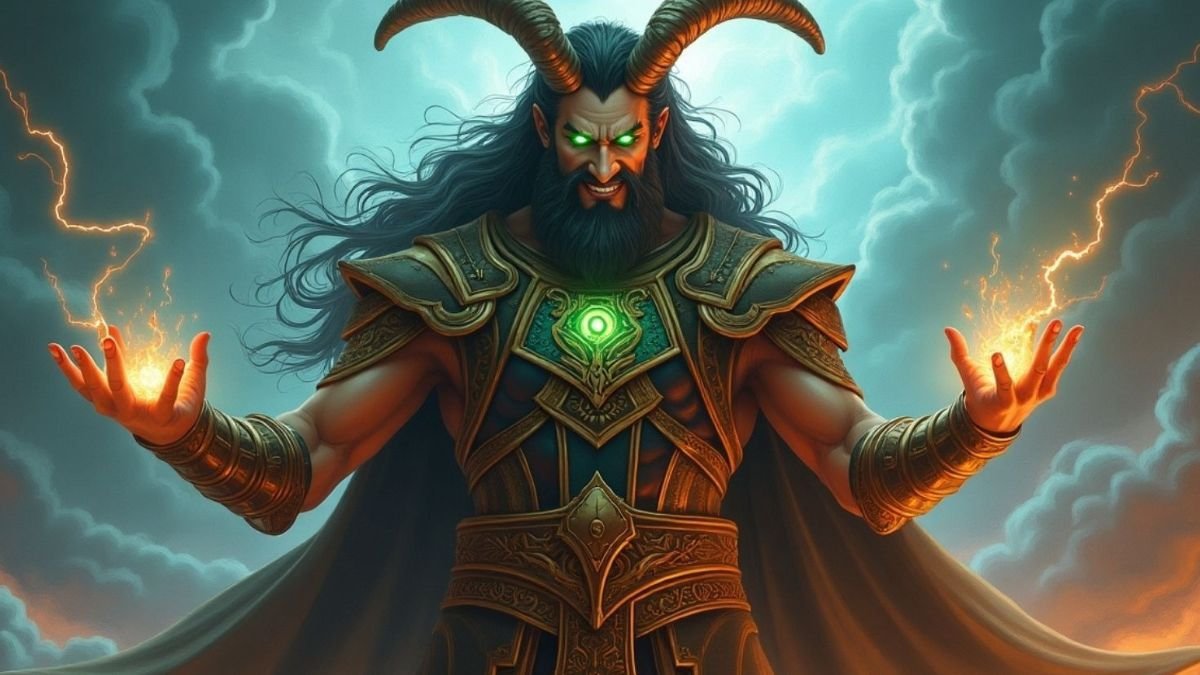
Loki is the most complicated figure in Norse mythology. He is not a villain, exactly. He is not a hero, exactly. He is the trickster god — a shape-shifting, boundary-crossing, chronically unreliable companion to the gods who makes the world more interesting, more perilous, and ultimately more itself by refusing to be contained by any single role. He mothers monsters. He saves Asgard. He fathers the end of the world. He is the god of fire in some traditions, of mischief in others, and of transformation in almost all of them. His stories are funny and terrifying and strangely beautiful, and they ask questions about creativity, chaos, belonging, and the nature of change that modern literature, psychology, and philosophy are still wrestling with.
Today we are going to follow Loki through some of his most revealing stories, examine what his character encodes about Norse cosmological thinking, and use the whole experience as a close reading lesson. Why close reading? Because Loki's stories, like the best mythology, are dense with layers — and learning to peel those layers back, to ask what a word is doing, what a structural choice means, what lies beneath the surface of a sentence, is exactly the practice that takes English from functional to genuinely advanced. The Norse storytellers were remarkably sophisticated, and the writers who have analyzed and adapted their work have brought their own sophistication to the task. That sophistication rewards slow, attentive reading. Let's give it what it deserves.
The Article
What kind of a god gets himself into so much trouble that he has to rescue himself from his own schemes — and then, several stories later, causes the apocalypse? The Norse myth of Loki trickery and transformation is a portrait of a being so constitutionally unable to stay in a lane that the lanes themselves eventually run out. Loki is the great paradox of Norse mythology: the god without whom Asgard could not have been built or defended, and the god who ultimately tears it apart. He is the most human of the gods — not because he is weak or modest, but because he contains the full, unresolved complexity that human beings recognize in themselves and rarely acknowledge out loud.
Loki enters the Norse mythos as Odin's blood-brother — a status achieved through a ritual of mingled blood that in Norse culture created bonds comparable to family. He is not a god in the sense of the Aesir gods; he is a giant by parentage, an outsider who has been brought inside. This liminal position — never entirely belonging to the world he inhabits — is central to understanding everything Loki does. He sees Asgard from both inside and outside simultaneously, which gives him both his extraordinary usefulness and his extraordinary unpredictability. He can find solutions the gods cannot find because he thinks from angles they cannot access. And he can betray the gods in ways they cannot anticipate because he was never fully one of them to begin with.
The stories that best illuminate Loki's character involve his role as a problem-solver who creates as many problems as he solves. In the story of the building of Asgard's walls, Loki persuades the gods to accept an offer from a giant master-builder who proposes to build impregnable walls around Asgard in exchange for the sun, the moon, and the goddess Freya. The gods accept, assuming the builder cannot finish in time — but the builder has a magical horse named Svadilfari who does the work of ten ordinary horses. When it becomes clear that the builder will win, the gods demand that Loki fix the mess he created. He does so by transforming into a mare, distracting the builder's horse, and running with him into the forest for three days. The walls are not finished. The builder is revealed as a frost giant and killed by Thor. And several months later, Loki gives birth — as a mare — to Sleipnir, Odin's eight-legged horse, arguably the finest horse in all the nine worlds. The story is simultaneously a dirty joke, a creative-problem resolution, a gender-bending shapeshifting episode, and a demonstration that Loki's solutions always produce unexpected offspring.
The most celebrated of Loki's tricks involves the god Baldr — the most beloved of the gods, so perfect and so universally cherished that the other gods spend their time throwing things at him for the pleasure of watching everything harmlessly miss. Frigg, Baldr's mother, has extracted oaths from every living and non-living thing not to harm her son — everything except mistletoe, which she considered too young and harmless to bother with. Loki finds out about the mistletoe exception, fashions a dart from it, and guides the blind god Höðr's hand in throwing it at Baldr during the gods' game of throwing things at him. Baldr dies. The world grieves. And Loki — who cannot stop himself even when the stakes are catastrophic — goes on to disrupt Baldr's funeral, insult every major deity in a stunning piece of poetic defamation called the Lokasenna, and eventually kill the goddess Skaði's servant, which triggers his final imprisonment: bound beneath the earth with the entrails of his own son, serpent venom dripping onto his face, until Ragnarök.
What is Loki doing in the story of Baldr's death? On one level, he is being the agent of chaos and grief that eventually forces Ragnarök — the twilight of the gods, the end of the world. On another level, he is exposing the gods' hubris: Frigg's attempt to protect Baldr from all harm was always incomplete, and Loki merely finds the gap. On yet another level, he is enacting something like a cosmic version of the critique that outsiders always make of closed systems: your armor has a weakness, and no amount of elaborate protection changes that. The mistletoe exception is not an accident. It is the structural impossibility of perfect protection. Loki does not create the vulnerability. He merely exploits it.
The psychology of Loki resonates so powerfully in modern culture — he has been analyzed through the lenses of Jungian shadow theory, narrative theory, gender studies, and political philosophy — precisely because his character encodes a tension that human societies never resolve: the tension between order and chaos, between stability and creativity, between the comfort of clear categories and the transformative power of their disruption. Loki is the god who makes categories uncomfortable. He is male and female, god and giant, friend and enemy, ally and saboteur. He embodies the principle that the most creative forces in any system are often also its most destabilizing ones, and that systems which try to eliminate all instability eliminate their own capacity for growth and adaptation along with it.
Ragnarök, the Norse end of the world, is caused — or enabled, or merely accompanied — by Loki's final rebellion. Freed from his prison, he commands a ship of the dead and leads the giants against the gods in the final battle from which no one emerges unchanged. The world ends and is reborn. And Loki, in death as in life, is impossible to place neatly: agent of destruction or instrument of necessary renewal? The Norse storytellers are wise enough not to say.
When you encounter someone in your own life whose creativity and chaos are inseparable — who makes things more interesting and more difficult in equal measure — do you find yourself drawn to their energy or guarded against it? And what does your answer reveal about your own relationship with the necessary disorder that every genuine transformation requires?
Close Reading Analysis
Paragraph 1: "What kind of a god gets himself into so much trouble that he has to rescue himself from his own schemes — and then, several stories later, causes the apocalypse?"
First question: the opening question spans from individual mischief ("rescue himself from his own schemes") to cosmic consequence ("causes the apocalypse"). What does this range of scale accomplish rhetorically, and why is placing the apocalypse at the end particularly effective?
Second question: the phrase "constitutionally unable to stay in a lane" — what register does "stay in a lane" belong to, and what is the effect of using modern slang in a discussion of ancient mythology?
The question moves from small (personal mischief) to vast (apocalypse) in a single breath, establishing Loki's essential quality before any details have been given: his trouble-making is not bounded, not contained, not proportional. Other gods get into trouble. Loki gets into trouble that ends the world. The escalation from the absurdly mundane (rescuing himself from his own schemes, which has the quality of an exasperated eye-roll) to the cosmically catastrophic creates a tonal contrast that is also a character study. And placing the apocalypse at the end of the sentence gives it the most emphatic position — in English, the end of a sentence carries the most stress, the most weight. "Causes the apocalypse" lands like a full stop on everything.
"Stay in a lane" is modern American highway idiom — it means to remain in your designated role or domain. Using it in a discussion of Norse mythology is a deliberate tonal collision, and the effect is twofold. First, it creates humor through anachronism — the absurdity of applying contemporary road-use metaphors to Viking gods is briefly comic. Second, it creates accessibility: a reader who might feel intimidated by Norse mythology is immediately grounded in a phrase they know. This technique — mixing registers, using contemporary idiom alongside classical content — is characteristic of engaging popular writing about historical and mythological subjects, and learning to do it well is a sophisticated authorial skill.
Paragraph 2: Loki as blood-brother to Odin:
Question one: the paragraph describes Loki's position as "liminal" — existing at the threshold between categories. What does "liminal" mean etymologically, and why is it the precise word for Loki's situation?
Question two: "He can find solutions the gods cannot find because he thinks from angles they cannot access." This sentence uses a spatial metaphor — angles — for a cognitive process. What does this metaphor add to the description of Loki's problem-solving, and what does it imply about the relationship between perspective and creativity?
"Liminal" comes from the Latin "limen," meaning threshold. A liminal space is a threshold space — a between-place that belongs fully to neither of the categories on either side of it. Loki's liminality — giant by birth, god by blood-brotherhood, belonging entirely to neither — is the source of both his gifts and his dangers. He cannot be fully trusted because he is never fully one of them, but he cannot be fully dispensed with because his outside-inside perspective gives him access to solutions that purely inside perspectives miss. The word "liminal" is doing more than "in-between" or "outsider" would do — it specifically places Loki in a threshold position, which is spatially metaphorical in a way that accurately captures his structural role in the mythos.
"He thinks from angles they cannot access" is a spatial metaphor for cognitive perspective. "Angles" implies that thinking is like looking — that the same object or problem looks different depending on where you are standing, and that standing in an unusual position (liminal, between-categories) gives access to angles that conventional positions preclude. This is a significant claim about the relationship between creativity and outsider status: the most creative solutions often come from people who are not fully inside the system they are solving problems for, because full insiders have normalized the constraints that the creative solution transcends. Loki's productivity comes directly from his displacement.
Paragraph 3: the building of Asgard's walls:
Question: the paragraph ends with a triple characterization of the story: "a dirty joke, a creative-problem resolution, a gender-bending shapeshifting episode." What does this list accomplish, and what does the coexistence of these categories within a single story reveal about how myth operates?
The triple characterization is a demonstration of mythological multivalence — the ability of a single story to function simultaneously at multiple levels of meaning. "A dirty joke" acknowledges the surface comedy of the story (Loki becoming a mare and running off into the forest with the builder's horse has an obvious ribald dimension). "A creative-problem resolution" names the practical narrative function. "A gender-bending shapeshifting episode" names the cosmological significance: Loki crosses the most fundamental biological categories, and this crossing is productive rather than merely transgressive — it produces Sleipnir, the greatest horse in existence. The coexistence of these categories is not accidental. The best mythological stories operate at all levels simultaneously, which is why they survive for millennia — each level of meaning speaks to a different audience, a different need, a different question. Great myths are not monosemous (single-meaning); they are polysemous (many-meaning). Recognizing this is one of the most important insights in reading mythology closely.
Paragraph 4: Baldr's death:
Question: the paragraph describes the gods playing the game of "throwing things at Baldr for the pleasure of watching everything harmlessly miss." What is the tonal quality of this description, and why is the gods' game significant beyond mere entertainment?
The description of the gods throwing things at Baldr has a quality of cheerful absurdity — it is not the kind of divine activity usually associated with solemn Nordic mythology. The tone here is gently satirical: the gods are not majestic in this moment; they are playing a silly game that is premised on Baldr's invulnerability. This tonal choice is important because it humanizes the gods and, subtly, makes their hubris visible. The game reveals that Baldr's invulnerability has been so completely assured by Frigg's oaths that it has become an entertainment rather than a protection. The very confidence that makes the gods comfortable playing the game is the same confidence that makes them careless — that makes Frigg skip the mistletoe oath because she considers it too minor to bother with. The satire of the game is the satire of excessive confidence in one's own defenses. And as in all good satire, the punch line is not funny: Loki's dart flies true.
Paragraph 5: "What is Loki doing in the story of Baldr's death?"
Question: the paragraph offers three consecutive interpretations of Loki's role: agent of chaos, exposer of hubris, outsider critique of closed systems. What is the analytical structure of this tricolon of interpretations, and what does offering three interpretations rather than one do for the reader's understanding?
This is a hermeneutic tricolon — three consecutive interpretations of the same event at escalating levels of depth. The first interpretation (agent of chaos) is the surface reading: Loki causes death and grief. The second (exposer of hubris) is the structural reading: Loki reveals the fatal flaw in Frigg's overconfident protection. The third (outsider critique of closed systems) is the philosophical reading: Loki enacts the structural impossibility of perfect security for any closed system. Each interpretation is valid; none is complete by itself. Offering all three teaches the reader that mythological events do not have single interpretations — they are designed to sustain multiple, overlapping meanings. This is exactly the hermeneutic richness that makes mythology durable. The analytical move of layering interpretations — starting with the most obvious and progressively deepening — is also a model for your own analytical writing: start with what the text appears to be doing, then ask what it is actually doing, then ask what it is structurally or philosophically encoding.
Paragraph 6: Loki as psychological and cultural symbol:
Question: the paragraph says Loki "embodies the principle that the most creative forces in any system are often also its most destabilizing ones, and that systems which try to eliminate all instability eliminate their own capacity for growth and adaptation along with it." How does this argument connect mythology to organizational theory or social theory, and what makes this connection legitimate rather than forced?
The connection between Loki's mythological function and organizational or social theory is legitimate because both are addressing the same structural phenomenon: the relationship between stability and creativity in complex systems. Mythology encodes cultural knowledge in narrative form. Organizational theory encodes it in analytical form. Both are observing the same pattern in human experience — that creative disruption is often simultaneous with social disruption, and that attempts to eliminate one tend to eliminate the other. Loki is the mythological expression of a principle that modern complexity theory, organizational psychology, and evolutionary biology have independently rediscovered: that some degree of instability, variation, and deviation is necessary for adaptation and growth. The mythology did not produce the theoretical insight — both the mythology and the theory are responses to the same observed feature of human and natural systems. Recognizing this connection is not forcing mythology into modern categories; it is recognizing that mythology was always already encoding insights that modern disciplines later formalized.
Closing question:
"When you encounter someone in your own life whose creativity and chaos are inseparable — who makes things more interesting and more difficult in equal measure — do you find yourself drawn to their energy or guarded against it?"
The question applies the mythological pattern directly to personal experience by naming the specific quality: someone whose creativity and chaos are "inseparable." This is precisely Loki's condition — not someone who is sometimes creative and sometimes chaotic, but someone for whom the two are constitutionally linked. The question asks for an honest self-assessment of your own relationship to that quality, which is simultaneously a question about what you value, what you fear, and what you have needed from the people in your life. The second question — "what does your answer reveal about your own relationship with the necessary disorder that every genuine transformation requires?" — deepens it further: it connects the personal assessment to a broader philosophical claim (transformation requires disorder) and asks whether you have accepted or resisted that claim in practice. This is the kind of self-interrogation that great mythology has always provoked.
Speaking & Writing Challenges
Writing Challenge
Think of a figure from your own cultural tradition — mythological, historical, or literary — who shares Loki's quality of being simultaneously indispensable and dangerous, creative and destructive, belonging and not-belonging. Write a 400–500 word analytical paragraph that: (1) introduces the figure and their liminal position, (2) describes one key story or episode that reveals this dual quality, (3) offers three interpretations of that story at escalating depth, and (4) connects the figure to a broader principle about creativity and disruption in human systems. Use at least one register-mixing moment (contemporary idiom in a historical context) and at least one tonal contrast.
Speaking Challenge
Prepare a two-minute spoken argument for the following position: "Every functional group, organization, or community needs its Loki — a creative disruptor who sees from the outside." You do not have to personally believe this. Make the strongest possible case for it using at least one example from history or mythology, one example from your own experience or observation, and one acknowledgment of the position's limitation. The goal is to practice making sustained, structured spoken arguments about complex ideas — the kind of argument that requires you to hold multiple threads simultaneously and bring them together into a coherent position.




0 Comments