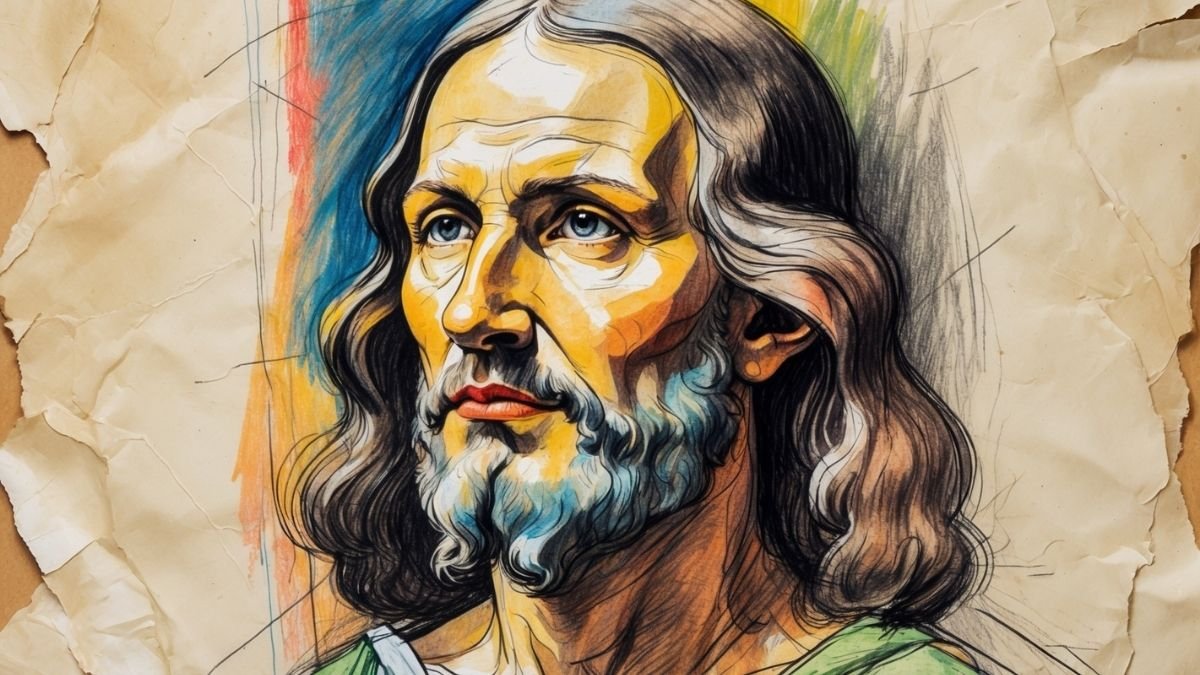
Audio Episode
[ppp_patron_only level=5]
Leonardo da Vinci_ Renaissance Man of Relentless Curiosity Transcript: Click to Open
Leonardo da Vinci Renaissance Man of Relentless Curiosity
What if the most famous artist in history was actually a secret scientist? Could one person truly master art, engineering, anatomy, and maybe even predict the causes of tides, like centuries before his time? And how did a man with almost no formal education become the ultimate renaissance man? Welcome to a new introduction to a learning quiz from English Plus Podcast. What you’re going to listen to is to help you ace the quiz. But if you prefer to attempt the quiz right away, you can do that because we have added hints and feedback for every option.
And that’s what makes it a learning quiz and a fun one, if you ask me. But now let’s talk a little about what you may learn from this quiz. Okay, so when we think Leonardo da Vinci, yeah, the Mona Lisa pops right into mind, doesn’t it? It almost always does.
It’s iconic. But there’s just so much more. To really get him, we need to look way beyond that painting, that smile.
We’re talking about a mind that was just relentlessly curious. So brilliant. Honestly, we’re still kind of catching up centuries later.
It’s fascinating how his beginnings sort of set that stage. I mean, his name, Leonardo from Vinci. Right.
Tells you where he’s from. Exactly. Humble origins.
Born 1452, Tuscany. And the key thing, very little formal schooling. So mostly self-taught then? Pretty much.
The world was his classroom, you could say. And maybe that lack of structure, you know, actually freed his thinking. That makes sense.
And it leads straight into his core idea, the Sapir-Vidir. Yes. To know how to see.
It wasn’t just glancing at things. It was about truly understanding them, how they worked. He really believed in looking, experimenting, not just reading old books.
That philosophy was absolutely central. It’s how he unlocks so much. He questioned, he observed, he tested things for himself.
It really makes you wonder, doesn’t it? How much does really seeing that Sapir-Vidir affect how you understand things, your own world? That’s a great question. How much do we just skim the surface daily? Exactly. How much do we miss? Which probably explains why his talent was so, well, obvious, even really young.
He was apprenticed to Andrea del Verrocchio in Florence. And there’s that famous story, right, about the angel he painted in Verrocchio’s Baptism of Christ? Oh, yeah. The legend.
That it was so good, so lifelike, Verrocchio supposedly just gave up painting himself. Well, whether that’s literally true or, you know, maybe a bit exaggerated over time. Your stories grow.
It still powerfully shows that his talent was just undeniable right from the get-go. Exceptional. But his mind was just too restless for just painting, wasn’t it? While others focused on canvases, he’s filling thousands of notebook pages.
Thousands. It’s incredible. And the weirdest part? Writing it all backwards.
In mirror script. Uh-huh. It feels like a code, almost.
Yeah. Like he was trying to keep his discoveries secret. It really makes you think.
Imagine a genius today. What would their notebooks look like? Phones? Encrypted files? Good point. How would they hide things? His notebooks were just this private universe packed with observations, inventions, everything.
And inside those notebooks, some incredibly detailed anatomy. Which was, uh, pretty risky back then. Oh, highly controversial.
Dissecting human bodies wasn’t exactly encouraged. But he did it. To understand firsthand how muscles, bones, organs actually work, he needed to see it.
And the drawings he produced, they’re just breathtakingly accurate, even now. Wow. They weren’t just art, they were serious scientific records, way ahead of their time.
And that knowledge fed directly back into his art. Making the figures seem so real. Precisely.
Think of the Vitruvian Man. That’s the perfect fusion, isn’t it? Art and science investigating human proportions together. He wasn’t just happy understanding how things were, though.
He was always dreaming about what could be. The inventor side. Right.
The engineering. Especially flight. He was obsessed studying birds, their wings, their movements.
Trying to figure out the mechanics. And designing these amazing flying machines, the Ornithopters. Yeah, based on bird flight.
But it wasn’t just flying machines. He designed an armored car, too. Like an early tank.
Sort of. Looked like a turtle. Yeah.
And get this, a mechanical knight. Some people call it the first humanoid robot. No way.
A robot. Well, a design for one, at least. Plus, he did serious work as a military engineer for Cesar Borgia.
His maps were revolutionary. Reps, too. Is there anything he didn’t do? They were so accurate, they basically changed cartography.
Truly visionary stuff. And this is where it gets really interesting. How art and science just merge for him.
He studied the world like a scientist. But, like, with a poet’s sensitivity. That’s a good way to put it.
He was fascinated by water, for example. And he figured out centuries early that the moon’s gravity causes tides. Before Newton.
It’s incredible. He was also looking at rocks. Fossils.
Right. Realizing they were ancient life. And understanding that meant the Earth had to be much, much older than people thought back then.
So geology, too. Geology, botany, astronomy. He even dabbled in music.
It all stemmed from this one single drive. To understand how everything worked. The interconnectedness of it all.
But, ironically, that same incredible curiosity, it might have been his biggest weakness as an artist, in a way. How do you mean? Well, he was famously slow. A procrastinator.
He’d get sidetracked by some new scientific puzzle or an engineering idea. Ah, right. Leading to unfinished paintings.
Exactly. Like the Adoration of the Magi. You can almost picture him getting distracted, mid-brushstroke, by, I don’t know, the structure of a bird’s wing.
It is kind of tragicomic, isn’t it? And that experimental drive sometimes backfired badly. Like with the Battle of Angieri. Precisely.
His huge mural. He tried some new painting technique he’d developed. And it failed.
Completely. It didn’t last. The whole mass of artwork was just lost.
A terrible loss, really. Even The Last Supper, which we do still have, thankfully. It’s a story of flawed genius, too, isn’t it? In terms of technique, yes.
He didn’t use the standard fresco method, painting on wet plaster. He painted on a dry wall. Which let him work slowly, meticulously, get every detail perfect.
But the paint didn’t bond properly. It started flaking almost right away. So we’re lucky it’s still there at all.
Extremely lucky. It’s a testament to its power that it survived, even in its fragile state. It’s just such a masterpiece of human emotion.
Which brings us back, full circle almost, to the Mona Lisa. Because in a way, it feels like the ultimate synthesis of everything he learned. I think that’s exactly right.
It’s not just a portrait. It’s where all his different studies converge. Okay, break that down.
How? Well, that mysterious smile, right. That comes from his sfumato technique, that smoky blurred effect. No sharp edges, so it seems to shift to live.
Ah, the smoky look. Got it. Then look at her hands, rendered so perfectly.
That’s his deep anatomical knowledge right there. From all those dissections. Exactly.
And the background, that weird, almost dreamlike landscape. Yeah, it’s not just a standard background. That’s his geology.
His studies of rock formations, water erosion, atmosphere. It’s all in there. It’s like a summary of a lifetime of looking, of seeing.
Wow. Okay, I see it now. It’s everything together.
It really is. So his later years, he ended up leaving Italy. Yes, he moved to France.
King Francis, I was a huge admirer and invited him. A nice final chapter then. Seems like it.
He lived in a beautiful manor, reportedly had the title, first painter, engineer, and architect to the king. Surrounded by his notebooks and paintings, including the Mona Lisa, until he passed away in 1519. A fitting end for such a mind.
And ultimately, what Leonardo really shows us, I think, is that art and science aren’t separate things. Or they don’t have to be. Whose side’s the same coin? Exactly.
Both driven by this deep human need to understand the world, understand our place in it. He truly embodies that renaissance man ideal, limitless curiosity, boundless skill. So, thinking about that, if Leonardo could be driven by that kind of, well, boundless curiosity, that seper videre, how might embracing that same idea change how you approach learning? Or just understanding things today, what new connections might you see if you really try to know how to see? Something to think about.
We hope you learned a lot from this intro, but that doesn’t mean you shouldn’t take the quiz anymore. There’s still a lot to learn from the quiz, because as we told you at the beginning of the episode, there are hints and feedback for every single option in the multiple choice quiz, so you will learn from your mistakes as much as you will learn from the answers you get right. That’s why we call it an English Plus Learning Quiz.
So go ahead and give it a go. And with this, we reach the end of another learning quiz from English Plus Podcast. Don’t forget to check out our website, EnglishPlusPodcast.com, not only for quizzes, but to take your English and knowledge to the next level.
Thank you for listening, stay curious, and never stop learning.
[/ppp_patron_only]
Introduction
Ready to Explore the Mind of a Genius?
We all know the name Leonardo da Vinci. We think of the Mona Lisa’s mysterious smile or the epic scene of The Last Supper. But what if I told you that the man who created these masterpieces also spent his nights studying human anatomy, designing machines that could fly, and filling thousands of pages with inventions that were centuries ahead of their time?
This isn’t your average history quiz. Think of it as a conversation, a chance for us to explore the vast, curious, and sometimes strange world of the ultimate “Renaissance Man.” I’m not here to test you, but to share the story of a man who was so much more than a painter. He was an artist, a scientist, an inventor, an engineer, a musician—a true genius whose curiosity knew no bounds.
By joining me on this little journey, you’ll:
- Discover the Unexpected: Uncover surprising facts about Leonardo’s life and inventions that you won’t find in most art history books.
- Connect the Dots: See how his study of science made his art better, and how his artistic eye influenced his engineering designs.
- Learn Through Story: Engage with history in a fun, interactive way, with feedback that tells the story behind each question.
- Gain a New Appreciation: See the Mona Lisa not just as a painting, but as the result of a lifetime of relentless curiosity.
So, are you ready to peek inside Leonardo da Vinci’s notebooks and see what we can find? Let’s get started.
Learning Quiz
This is a learning quiz from English Plus Podcast, in which, you will be able to learn from your mistakes as much as you will learn from the answers you get right because we have added feedback for every single option in the quiz, and to help you choose the right answer if you’re not sure, there are also hints for every single option for every question. So, there’s learning all around this quiz, you can hardly call it quiz anymore! It’s a learning quiz from English Plus Podcast.
[ppp_patron_only level=5]
[/ppp_patron_only]
Quiz Takeaways
Hello and welcome to the world of Leonardo da Vinci. When we hear his name, our minds often conjure up a single image: the soft, mysterious smile of the Mona Lisa. But to truly understand Leonardo, we have to look past the frame of that one painting and into the mind of the man who created it—a mind so restless, so curious, and so brilliant that 500 years later, we are still trying to catch up.
Our story begins not in a grand palace, but in the rolling hills of Tuscany, near the small town of Vinci. That’s what his name means, “Leonardo from Vinci.” Born in 1452, he had very little formal education. He was largely self-taught, and his school was the world around him. His guiding principle was simple: Saper vedere, to know how to see. He believed that the best way to learn was not from dusty old books, but from direct observation and experimentation. This was the key that unlocked his genius.
As a young boy, he was apprenticed to the artist Andrea del Verrocchio in Florence. Legend has it that when Leonardo was asked to paint a single angel in his master’s work, “The Baptism of Christ,” the result was so breathtakingly beautiful and lifelike that Verrocchio laid down his brush and never painted again. Whether that’s true or not, it speaks to the fact that Leonardo’s talent was undeniable from the very beginning.
But his mind couldn’t be contained by a painter’s studio. While his contemporaries were focused on art, Leonardo was filling thousands of notebook pages, all written in his peculiar backwards mirror script. What was in them? Everything.
He was an anatomist. At a time when it was deeply controversial, he conducted dissections of human corpses to understand how the body worked. His drawings of muscles, bones, and organs are astonishingly accurate. This scientific knowledge is what allowed him to paint figures that looked so real. His famous drawing, the Vitruvian Man, wasn’t just a sketch; it was a scientific investigation into the perfect proportions of the human form, a perfect marriage of art and science.
He was an inventor and engineer. Obsessed with the idea of flight, he studied the anatomy of birds and designed incredible flying machines, or “ornithopters.” He designed an armored car shaped like a turtle, a mechanical knight that is considered the first humanoid robot, and countless other devices for both war and peace. He worked as a military engineer for the ruthless warlord Cesare Borgia, creating maps so accurate and modern they changed the course of cartography.
He was a scientist who studied the world with a poet’s eye. He was fascinated by water, and he was one of the first people to correctly understand that the moon’s gravity causes the tides. He studied geology and realized that fossils were the remains of ancient life, concluding that the Earth was far older than anyone of his time believed. He was a botanist, an astronomer, and a musician. He simply wanted to know how everything worked.
This insatiable curiosity, however, was also his greatest weakness as an artist. He was a notorious procrastinator, often distracted by a new scientific query or a new idea. He left many masterpieces unfinished, like “The Adoration of the Magi.” He was hired to paint a huge, glorious mural of “The Battle of Anghiari,” but he experimented with a new technique that failed, and the painting was tragically lost forever.
Even his most famous work, The Last Supper, is a story of flawed genius. Instead of using the durable, traditional fresco method of painting on wet plaster, he experimented with painting on a dry wall. This allowed him to work slowly and perfect every detail, but it also meant the paint began to flake off the wall almost immediately. We are lucky to have it at all.
And then there is the Mona Lisa. It is a portrait of Lisa Gherardini, the wife of a Florentine merchant. But it’s so much more. It’s the culmination of everything he had learned. The smile is ambiguous because of his signature artistic technique, sfumato, a smoky, blurry effect with no hard lines. The hands are perfectly rendered because of his anatomical knowledge. The strange, dreamlike landscape in the background is a product of his geological studies. It’s not just a portrait; it’s a summary of a lifetime of relentless observation.
In his old age, Leonardo left Italy for good. He was invited to France by King Francis I, a young king who admired him deeply. He was given a beautiful manor house and the title of “First Painter, Engineer and Architect to the King.” There, surrounded by his notebooks and a few of his favorite paintings, including the Mona Lisa, he spent his final years, until his death in 1519.
Leonardo da Vinci teaches us that art and science are not separate things. They are two sides of the same coin: the desire to understand the world and our place in it. He is the ultimate “Renaissance Man,” a symbol of what the human mind is capable of when it is driven by a curiosity that knows no limits.









0 Comments