Introduction
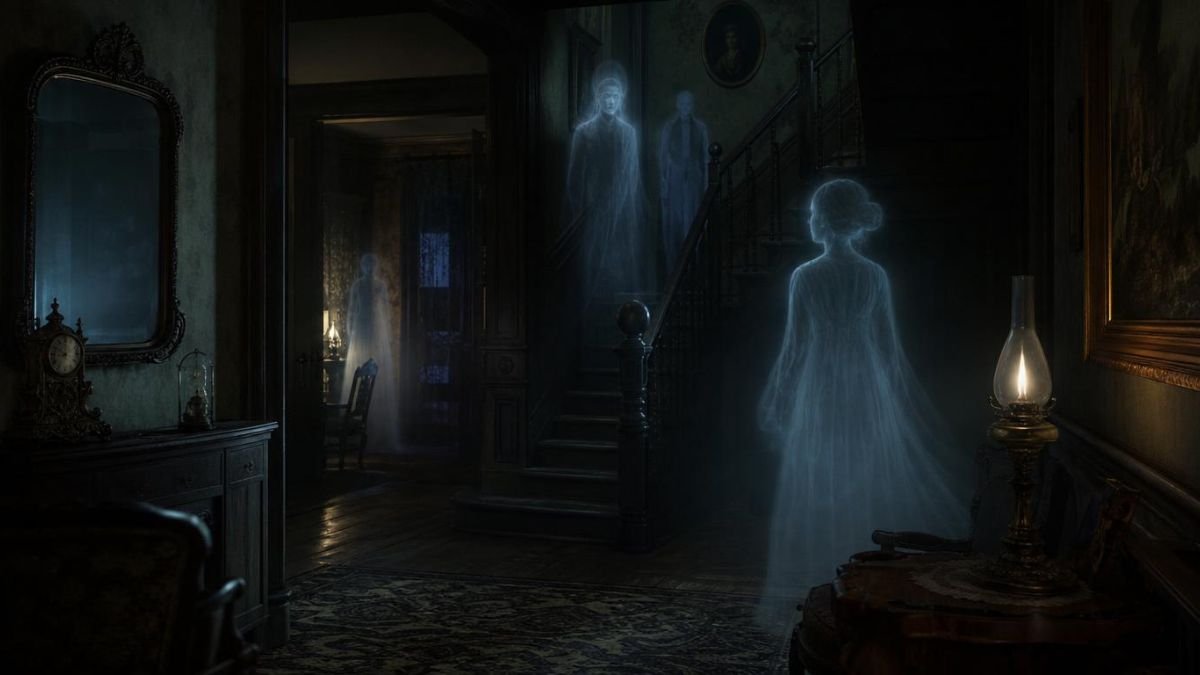
Raise your hand if you have never, not even for a second, felt genuinely spooked in an old house or a dark hallway or a graveyard at night. Anyone? Thought so. There is something in us — in virtually all of us, across every culture, every century, every level of education and skepticism — that responds to the possibility of ghosts with a visceral, primal attention that no amount of rational knowledge seems to entirely extinguish. You can know, intellectually, that there are no ghosts in your childhood home. And you can still run up the basement stairs faster than strictly necessary at eleven o'clock at night.
The question of whether ghosts are real is one that modern rational culture tries to answer too quickly. The typical skeptic says "no" before the question has finished being asked. The typical believer says "yes" and produces a photo that looks suspiciously like a camera strap. But the honest answer — the one that actually respects what is happening when people have ghost experiences — is considerably more interesting than either response. Because something is definitely happening. The question is what.
Today's Mythbuster episode is going to do what good mythbusting always does: not simply say "that's false" and move on, but actually look carefully at what people believe, why they believe it, what the evidence says about both the supernatural claim and the underlying experience, and what we lose and gain by replacing one kind of story with another. We are going to engage your inner child, your inner skeptic, your inner psychologist, and your inner philosopher simultaneously — which is, admittedly, a lot of inner people to manage at once.
And we are going to read the article very carefully, because this is a close reading episode. Close reading is the practice that transforms how you engage with language at every level — not just English, but any language, any text, any complex piece of thinking. It teaches you to slow down, to question, to find the argument inside the sentence, to notice what a word is doing rather than just what it is saying. That practice is the bridge between upper intermediate English and genuinely advanced English. And today, the topic we are crossing that bridge with is gloriously, perfectly appropriate: the most ancient, most universal, most stubbornly persistent thing in human experience that rational analysis has never quite managed to fully explain.
The Article
Have you ever walked into an old building and felt, with complete certainty, that you were not alone? Not seen anything, not heard anything — just felt it, in a way that bypassed your rational mind entirely and hit somewhere older and deeper and rather harder to argue with? You are not alone in that experience. Not by a long shot. The question of whether ghosts are real has occupied human minds since before writing was invented, and the fact that it is still being asked — enthusiastically, widely, and across every imaginable demographic — says something important about the nature of the experience itself, even if it does not settle the supernatural question.
Let's start where the honest investigation always should: with what we actually know. The supernatural claim — that ghosts are the disembodied consciousnesses of dead people, persisting in physical space after death and occasionally making themselves known to the living — has been studied, tested, and investigated by serious researchers and not-so-serious ones for well over a century. The Society for Psychical Research was founded in 1882 by serious scientists and intellectuals who wanted to investigate paranormal phenomena rigorously. More than a century of investigation — conducted by people who genuinely wanted to find evidence of the supernatural and had the academic resources to look — has not produced a single piece of evidence for the existence of ghosts that has withstood rigorous scientific scrutiny. Not one. That is not nothing. That is, in fact, quite significant. The absence of evidence after a century of motivated, intelligent searching is meaningfully different from the absence of evidence that comes from not looking.
And yet. The reports keep coming. They come from credible, rational, highly educated people. They come from cultures that have no cultural tradition of ghost belief. They come from people who were not expecting anything unusual and who are as baffled by their experience as anyone. Whatever is producing these experiences, it is not going away just because the scientific evidence for supernatural entities is thin. Which suggests the more productive question: not "are ghosts real in the supernatural sense?" but "what is actually happening when people have these experiences, and why is that happening so consistently across human history?"
The neurological and psychological answers are genuinely fascinating. Infrasound — sound frequencies below 20 Hz, below the threshold of human hearing — can be produced by industrial fans, wind moving through large spaces, and certain building resonance frequencies. Studies suggest that infrasound can cause feelings of unease, dread, and the uncanny sense of a presence in a room. The frequency of approximately 18.98 Hz has been associated with eyeball resonance, which can produce visual disturbances at the periphery of vision — which is, interestingly, exactly where most ghost sightings are reported to occur. So: old buildings, which often have unusual ventilation systems and resonance characteristics, can produce infrasonic frequencies that make you feel watched, uneasy, and occasionally convinced that something moved at the edge of your vision. Your rational mind is not broken. Your nervous system is responding, correctly, to something real — just not what it thinks it is.
There is also the hypnagogic state — the boundary between waking and sleep — which produces some of the most vivid, realistic, and terrifying perceptual experiences the human brain is capable of generating. Shadow figures, presences sitting on beds, voices calling from empty rooms: these are the classic experiences of hypnagogic and sleep paralysis states, and they are documented across cultures in terms that are almost identical to ghost encounter reports. Your brain, in these states, is generating experience rather than receiving it — and the experience it generates feels indistinguishable from external reality. This is not a malfunction. It is an extreme version of what your brain does all the time: construct a model of reality and present it to your consciousness as if it were unmediated perception.
The cultural dimension is equally important. Human beings are story-making creatures, and ghost stories are some of the oldest stories we have. They serve real and valuable functions: they give the dead a kind of presence and agency in the world of the living, which allows the living to process grief and maintain relationships with those they have lost. They make the morally significant visible — ghost stories often involve unresolved injustice, unpaid debts, secrets that must be revealed. They encode cultural anxieties about death, identity, and what survives after we are gone. A culture that tells ghost stories is a culture that is doing something important with its relationship to death, memory, and moral accountability. Declaring that ghost stories are simply false does not make those functions unnecessary — it just makes them homeless.
So where does all of this leave the question of whether ghosts are real? Here is the most honest answer: something real is happening every single time a person has what they experience as a ghost encounter. Their nervous system is responding to something — infrasound, a hypnagogic state, a subtle sensory cue that their pattern-recognition system has processed as the presence of another being. Their emotional and psychological state is real. Their need to make meaning from the experience is real. What is not real — or at least, for which there is no surviving evidence after a century of serious investigation — is the supernatural entity they are interpreting the experience through. The ghost, in that sense, is not what you see. The ghost is how you see it.
Here is the part where your inner child gets to have an opinion too: knowing all of this — knowing about infrasound and hypnagogic states and pattern recognition — does it make old buildings feel less creepy? Or does your nervous system, wise old thing that it is, simply not care about your rational conclusions and run up the stairs anyway?
The real mystery is not whether the ghosts are out there. The real mystery is the extraordinary sophistication of the human brain and human culture in finding the story that makes the experience meaningful. What does it say about us that we need the world to be haunted — that we reach instinctively for presence, continuity, and the persistence of those we have loved, even in the face of all rational evidence to the contrary?
Close Reading Analysis
Paragraph 1: "Have you ever walked into an old building and felt, with complete certainty, that you were not alone?"
Question one: the paragraph opens with a relatable, personal question and then says "You are not alone in that experience. Not by a long shot." What is the tonal function of "Not by a long shot," and why is informal language strategically placed here?
Question two: the phrase "bypassed your rational mind entirely and hit somewhere older and deeper and rather harder to argue with" — identify the three elements of this accumulating phrase and explain what each adds.
"Not by a long shot" is an idiomatic, informal expression meaning "not even close to alone." Placing it after the more formal "You are not alone in that experience" creates a deliberate tonal drop — from measured academic voice to casual, emphatic confirmation. The informality signals warmth and solidarity with the reader who has had this experience and might be mildly embarrassed to admit it. It says: this is completely normal and I am completely comfortable with it. This tonal management is important in a Mythbuster article about a subject that carries social stigma — admitting to ghost experiences can feel embarrassing in rational, educated circles. The informal confirmation lowers the social stakes and creates the safety for the reader to engage honestly.
"Older and deeper and rather harder to argue with" is an accumulating list of three elements, each adding a different dimension. "Older" places the response in deep evolutionary or developmental time — before rational faculties, before language. "Deeper" places it below the accessible layers of consciousness — in the pre-reflective, gut-level nervous system. "Rather harder to argue with" introduces a wry humor — the rational mind cannot simply overrule the nervous system by presenting a logical case. Each element in the accumulation adds a dimension of the inaccessibility of this response to rational override. The accumulation performs what it is describing: the layering of old, deep, and stubborn creates exactly the feeling of encountering something that will not yield to argument.
Paragraph 2: "The supernatural claim... has not produced a single piece of evidence for the existence of ghosts that has withstood rigorous scientific scrutiny. Not one."
Question: "Not one." is a two-word sentence fragment placed immediately after the full statement. What rhetorical function does the fragment serve, and why is a fragment specifically appropriate here rather than a complete sentence?
"Not one." is an emphatic standalone fragment — grammatically incomplete, rhetorically complete. Its function is to create a verbal full stop after the substantive claim, a moment of absolute emphasis. Complete sentences explain and qualify. Fragments assert and land. "Not one piece of surviving evidence" would be accurate but would allow the momentum to dissipate across the words. "Not one." stops everything, makes the claim the only thing in the room for a moment, and then the text moves on. The fragment is appropriate here precisely because the claim is so significant that it deserves to stand alone, unsupported by further syntax. In your own writing, using a deliberate fragment at a moment of maximum emphasis is a powerful tool — but only if used sparingly. Overuse neutralizes the effect immediately.
Paragraph 3: "And yet. The reports keep coming."
Question: "And yet." is used as a standalone two-word sentence before a new paragraph begins. What logical function does "and yet" serve in argumentation, and why is making it a standalone sentence rather than a conjunction in a longer sentence particularly effective?
"And yet" is a concessive pivot — it acknowledges a prior argument while introducing a complication or counterpoint. In longer form, it would appear as "And yet the reports keep coming despite this." As a standalone sentence, it performs a dramatic pause before the pivot: you have absorbed the skeptical argument (no evidence, not one piece), and now "And yet" stands alone, like a signpost at a fork in the road. It tells you: we are about to turn. Something is coming that the previous argument does not fully account for. The isolation of "And yet." as its own sentence gives the pivot structural weight — it is not buried in a subordinate clause but given its own architectural position in the text. This is a technique of structural emphasis: the position of a sentence element (its isolation, its length, its placement) is itself a form of meaning.
Paragraph 4: infrasound and eyeball resonance:
Question: the paragraph explains infrasound, describes its effects, and then notes that the frequency of 18.98 Hz has been "associated with eyeball resonance, which can produce visual disturbances at the periphery of vision — which is, interestingly, exactly where most ghost sightings are reported to occur." What is the rhetorical function of the word "interestingly," and what would be lost if it were removed?
"Interestingly" is a metacommentary word — it is the writer commenting on the content rather than simply presenting it. Its function is to pause the reader and signal: this connection is significant, and I want you to notice it. Without "interestingly," the connection between peripheral vision disturbances and peripheral ghost sightings would be present but might pass without registering. "Interestingly" frames it as the key evidential link — the moment where the scientific explanation connects most precisely to the reported experience. The word is also tonally honest: it acknowledges that this connection is genuinely interesting, which creates intellectual partnership between writer and reader rather than authoritative declaration. This is a small but important technique: using metacommentary words at key evidential moments to direct the reader's attention to what matters most.
Paragraph 5: hypnagogic state:
Question: the paragraph says "Your brain, in these states, is generating experience rather than receiving it." This is a fundamental claim about the nature of perception. How does this single sentence reframe the entire discussion of ghost experiences, and what does it imply about perception in general?
"Generating rather than receiving" is a philosophical bombshell disguised as a simple explanatory sentence. The default assumption about perception is that we receive the world — that reality is out there and we take it in. This sentence reverses that assumption for hypnagogic states, but the following sentence makes the truly radical move: "This is an extreme version of what your brain does all the time." If hypnagogic generation is an extreme version of normal perception, then normal perception is also partly generative rather than purely receptive. This connects the ghost discussion to the broader philosophical question from the previous episode in this series (the nature of reality) and implies that the line between "real experience" and "generated experience" is not as clear as it might seem. One sentence quietly bridges neuropsychology and philosophy of mind.
Paragraph 6: cultural functions of ghost stories:
Question: the paragraph argues that ghost stories "serve real and valuable functions." It then lists three: maintaining relationships with the dead, making the morally significant visible, and encoding cultural anxieties about death. What kind of analytical move is this, and why is identifying the functions of a belief separate from evaluating its truth?
This is a functionalist analysis — examining not whether a belief is true but what work it does in a community. Functionalism in social science distinguishes between the truth value of a belief and its social and psychological utility. A belief can be socially valuable and factually false simultaneously — or factually true and socially useless simultaneously. Ghost stories may not accurately describe supernatural entities, but they perform genuine psychological and social work around grief, moral accountability, and cultural anxiety about death. Separating these questions is intellectually important because it prevents a false binary: "ghosts are real / ghost stories are worthless" OR "ghost stories are valuable / therefore ghosts must be real." The functionalist move says: we can evaluate the stories on multiple axes simultaneously, and the outcome on one axis does not determine the outcome on another.
Closing question:
"What does it say about us that we need the world to be haunted — that we reach instinctively for presence, continuity, and the persistence of those we have loved, even in the face of all rational evidence to the contrary?"
"The world to be haunted" is a phrase that resonates beyond the literal ghost question. A haunted world is a world in which the past is not entirely gone, in which the dead have not entirely left, in which meaning and moral debt persist beyond the lives of the people who generated them. The closing question asks not whether ghosts exist but why we need them to. This is a question about human psychology, about grief, about the terror of absolute endings, about the comfort of persistence. It is also the most honest question the article can end with, because it points to the genuine reality beneath the supernatural claim: not that spirits float through walls, but that human love and human loss generate a need for continuation that no amount of rational evidence can fully satisfy.
Speaking & Writing Challenges
Writing Challenge
Think about something you believe — or used to believe — that rational analysis has made it difficult to maintain, but that you find yourself emotionally reluctant to fully give up. It could be something supernatural, something religious, something about human nature, something about love or fate. Write a 350–450 word paragraph exploring this tension honestly: the rational case against the belief, the emotional reality of the belief's function in your life, and your current position on where the two can coexist. Use at least one deliberate fragment for emphasis, one "And yet" pivot, and one functionalist move that separates the truth question from the utility question.
Speaking Challenge
Prepare a two-minute spoken exploration of the following question: "What would we lose if people completely stopped believing in ghosts?" You are not asked whether ghosts are real — you are asked what functions ghost belief serves and what the world would look like without it. Use at least one functionalist argument, one concrete example from cultural or personal experience, and end with a genuinely open question rather than a conclusion. The goal is to practice speaking philosophically about human beliefs without being either dismissive or credulous — the tone of engaged, honest inquiry.







0 Comments