Introduction
In the year 476 CE, a Germanic chieftain named Odoacer deposed the last Western Roman Emperor, a teenage boy named Romulus Augustulus, and sent him into comfortable exile in a villa by the sea. Most historians mark this as the end of the Roman Empire. But here is what those historians are usually careful to add: on the eastern shore of the Mediterranean, in a city built on a peninsula between Europe and Asia, a Roman Emperor was still sitting on his throne. He would continue to sit on it, as would his successors, for another nine hundred and seventy-seven years. The Roman Empire, in the East, simply kept going.
This eastern continuation — which we call the Byzantine Empire, though the Byzantines themselves called it simply "Romania" or the Roman Empire — is one of the most extraordinary civilizational stories ever told, and one of the most underappreciated. It bridges classical antiquity and the medieval world. It preserved vast quantities of Greek and Roman learning through periods when that learning was disappearing elsewhere. It shaped Orthodox Christianity and through it the cultures of Russia, Greece, the Balkans, and much of Eastern Europe. Its legal traditions fed directly into the legal codes of modern European states. And it held Constantinople — one of the greatest cities in human history — for over a thousand years, serving as the most important trading hub between Europe and Asia for most of that period.
Why read about it closely today? Because historical writing at its best is not just information delivery — it is an argument about why the past matters, built from selected evidence, shaped by rhetorical choices, and aimed at changing how you understand the present. Reading it carefully is how you learn to evaluate historical argument rather than simply receive it, how you build the analytical vocabulary to discuss complex events, and how you develop the written and spoken fluency that comes from engaging with serious ideas in serious language. Let's enter Constantinople together.
The Article
What if one of the most important civilizations in human history spent a thousand years being called the wrong name — even by the people who studied it? The rise of Byzantium from Rome to Constantinople is a story that suffers from a significant labeling problem: "Byzantine" was not what the Byzantines called themselves. They called themselves Romans, spoke Greek, and ruled from a city they called Constantinople. The word "Byzantine" was applied to them retroactively by Western European historians who wanted, for reasons both academic and political, to distinguish this eastern continuation from the Rome they recognized. Understanding why the name matters is the first step toward understanding what was really at stake.
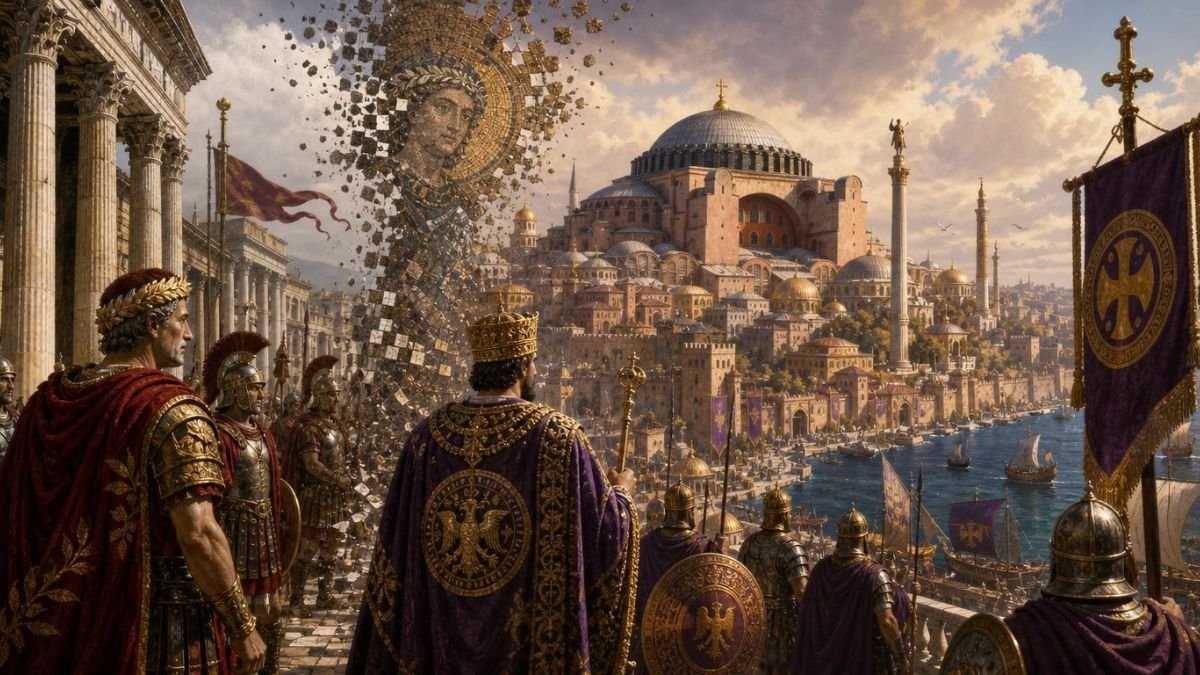
The decision that launched the Byzantine story was made by one of history's most consequential emperors: Constantine I, who ruled a reunified Roman Empire from 306 to 337 CE. Constantine did two things that reshaped the world. First, he issued the Edict of Milan in 313 CE, granting religious tolerance throughout the empire and beginning the process that would eventually make Christianity the official religion of Rome. Second, he founded — or more precisely, massively refounded — a new capital city on the site of the Greek city of Byzantium, on the Bosphorus strait that separates Europe from Asia. He called it Constantinople: the City of Constantine. It was consecrated in 330 CE, and from that moment, the center of gravity of the Roman Empire began its long eastward migration.
Why was this location so consequential? The Bosphorus is one of the most strategically extraordinary positions on earth. It is the only sea passage between the Black Sea and the Mediterranean, which made it the chokepoint of one of the ancient world's most important trade routes. The peninsula on which Constantinople was built was defensible on three sides by water, and a massive chain could be stretched across the Golden Horn inlet to prevent naval access. The city walls — begun under Constantine and significantly expanded under Emperor Theodosius II in the fifth century CE into a triple-layered system of moats, outer walls, and inner walls nearly twelve meters high — were arguably the greatest defensive fortifications of the ancient and medieval world. For over a thousand years, Constantinople was essentially impossible to capture by direct assault from the land. It fell only twice: once to the forces of the Fourth Crusade in 1204 — the most catastrophic act of friendly fire in medieval history — and finally to the Ottoman Turks under Mehmed II in 1453, using gunpowder artillery that made the old walls obsolete.
The civilization that flourished within those walls was a remarkable synthesis. The Byzantines spoke and wrote in Greek, but their political and legal identity was emphatically Roman. They carried the Roman law tradition forward in the Corpus Juris Civilis — the great legal codification commissioned by Emperor Justinian I in the sixth century CE — which became the foundation of civil law traditions across much of Europe. Their religious identity was shaped by Orthodox Christianity, with the Emperor occupying a position as the head of the church in a way that the Western Roman tradition, dominated by the Pope, did not recognize. Their art — the extraordinary mosaics, the icon tradition, the illuminated manuscripts — was a synthesis of Roman, Greek, and Near Eastern influences that produced something genuinely new and genuinely magnificent.
The reign of Justinian I (527–565 CE) represents the Byzantine Empire at its most ambitious and, in some ways, its most revealing. Justinian reconquered large portions of the Western Roman Empire — North Africa, Italy, parts of Spain — in a series of campaigns that briefly looked like the restoration of the old Rome. He built the Hagia Sophia in Constantinople, which remains one of the most extraordinary buildings ever constructed by human beings. He codified Roman law. He also nearly destroyed his empire in the process: the wars of reconquest were enormously expensive, his ambitious building programs strained the treasury, and the great plague of 541 CE — which spread along the same trade routes that made Constantinople rich — may have killed up to half the population of the empire. The reign of Justinian is a portrait of civilizational ambition and civilizational overreach simultaneously, which makes it extraordinarily interesting to study.
After Justinian, Byzantium contracted. The Islamic expansion of the seventh century CE removed North Africa, Egypt, Syria, and Palestine from Byzantine control — stripping away some of the empire's richest and most populous provinces. The Balkans were gradually settled by Slavic peoples. The Anatolian heartland came under sustained pressure from successive waves of Muslim powers. The empire that survived all of this was smaller, leaner, and in many ways more culturally focused than the late Roman behemoth it had descended from. It became something new while insisting it was something old — and that tension between inherited identity and lived reality is one of the most characteristic features of Byzantine civilization.
The legacy of the Byzantine Empire reaches further than most people realize. When Constantinople finally fell in 1453, thousands of Greek scholars fled to Western Europe, carrying with them manuscripts of ancient Greek texts that had been preserved in Byzantine libraries for centuries. This influx of Greek knowledge — of Plato, Aristotle, Archimedes, Euclid, and dozens of other ancient authors — was one of the key catalysts of the Renaissance. The Byzantine legal tradition fed into the legal codes of modern European states. The Orthodox Christian tradition shaped the cultures of Russia, Greece, Serbia, Bulgaria, Romania, and much of Eastern Europe. And the extraordinary artistic tradition of Byzantine mosaics and iconography continues to influence visual art to this day.
The Byzantine Empire's greatest achievement was, perhaps, simply its survival: the ability of a civilization to adapt, contract, and persist across eleven centuries in one of the most contested geographical positions on earth. If Rome fell with a whimper, Byzantium fell with a thunderclap — but it had the grace and the stubbornness to spend a thousand years making absolutely sure the rest of the world had learned everything it had to teach.
When you think about civilizations that shape the world but receive less credit than they deserve — whose contributions are absorbed into other traditions and renamed — which ones come to mind? And what would change about how we understand the present if we gave them the acknowledgment they were owed?
Close Reading Analysis
Paragraph 1: "What if one of the most important civilizations in human history spent a thousand years being called the wrong name — even by the people who studied it?"
Question: the opening question contains the phrase "even by the people who studied it." Why is this qualification particularly pointed, and what does it imply about the relationship between expertise and error?
"Even by the people who studied it" is a rhetorical escalation. Ordinary errors — common people getting things wrong — are expected and forgivable. But when the experts, the scholars, the people whose professional purpose is accuracy are also getting something fundamentally wrong, the error is more significant and the critique is more pointed. The qualification implies that scholarly expertise is not a guarantee of conceptual accuracy — that the labeling problem with "Byzantine" persisted not because of ignorance but because of deliberate or unreflective choices by people who knew enough to have made better choices. This is a critical thinking insight of considerable importance: the authority of expert consensus does not automatically guarantee its correctness, especially on questions of framing and naming.
Paragraph 2: Constantine's two decisions:
Question one: the paragraph says Constantine "issued the Edict of Milan in 313 CE, granting religious tolerance" and founded Constantinople. The two actions are presented as parallel "first... second" items. What does this parallel structure imply about their relative importance, and is the implied equivalence accurate?
Question two: the phrase "massively refounded" for what Constantine did to the city of Byzantium — why "refounded" rather than "founded," and why "massively"?
The parallel structure ("First... Second...") presents the two actions as equivalent in significance, and this parallel structure is doing a specific argumentative job: it elevates the founding of Constantinople to the same tier as the Edict of Milan, which most people would recognize as enormously important. This is a framing argument: by placing the two in parallel, the writer argues implicitly that the geographical relocation of power deserves the same historical weight as the religious transformation — and there is a strong case for this, since without Constantinople, the institutional survival of the Eastern Empire would have been far less likely, and with it, the survival of much Christian culture and ancient learning.
"Massively refounded" rather than "founded" acknowledges the historical reality that the city of Byzantium already existed at this site — it was a Greek city founded around 657 BCE. Constantine did not create a new city; he transformed an existing one beyond recognition. "Refounded" is historically accurate where "founded" would be a simplification. "Massively" is the qualifier that makes the transformation legible: this was not a renovation but a creation of a new city on the bones of an old one.
Paragraph 3: the location of Constantinople:
Question: the paragraph calls the 1204 sack of Constantinople by Crusaders "the most catastrophic act of friendly fire in medieval history." "Friendly fire" is a military term for accidentally attacking your own forces. What is the effect of applying this term to the Crusaders' sack of a Christian city, and what does it imply about the relationship between the Crusaders and Byzantium?
"Friendly fire" is a precise and devastating choice. In military usage, it describes killing members of your own side — an accident that is both tragic and particularly damaging to morale and cohesion. Applying it to the Crusaders' sack of Constantinople implies that the Crusaders and Byzantines were, in principle, allies — both Christian, both theoretically part of the same civilizational project of defending Christianity against Islamic expansion. The Crusaders attacking Constantinople was therefore not merely a military atrocity but a betrayal of alliance, a self-destructive act that weakened Christendom precisely when it claimed to be defending it. The term "friendly fire" encodes this complex betrayal in two words, and the qualifier "most catastrophic" makes the judgment explicit. This is an example of word choice doing historical argument.
Paragraph 4: the Byzantine synthesis:
Question: the paragraph describes the Corpus Juris Civilis as "the foundation of civil law traditions across much of Europe." What is the rhetorical function of the phrase "across much of Europe," and what would be lost if the writer had simply said "in Europe"?
"Across much of Europe" is a precision qualifier that prevents overclaiming. Not all European legal traditions descend from the Corpus Juris Civilis — common law traditions in England and Ireland developed through different channels. "Across much of Europe" is accurate where "in Europe" would be false. This is an example of a writer exercising the discipline to limit a claim to what can be defended rather than the broader version that might sound more impressive. In analytical writing, this kind of voluntary precision — limiting your claims to what is defensible — is a mark of intellectual integrity and actually increases rather than decreases your credibility with careful readers.
Paragraph 5: Justinian — ambition and overreach:
Question: the paragraph describes Justinian's reign as "a portrait of civilizational ambition and civilizational overreach simultaneously." What does the word "portrait" achieve here, and why use it rather than "example" or "illustration"?
A "portrait" is an artistic representation that captures both external features and internal character — a portrait does not just record what someone looks like; it attempts to convey who they are. Calling Justinian's reign a "portrait" rather than an "example" or "illustration" implies that it reveals something essential about the nature of Byzantine civilization, not just a particular instance of policy. It also suggests that the complexity — the ambition and the overreach coexisting — is not incidental to the story but definitional: this is what Byzantine civilization was like, at its most ambitious moment. The artistic metaphor also places the analysis in the register of interpretation rather than simple description, which is appropriate for a reign that historians have debated for centuries.
Closing question:
"When you think about civilizations that shape the world but receive less credit than they deserve — whose contributions are absorbed into other traditions and renamed — which ones come to mind?"
The phrase "absorbed into other traditions and renamed" is the key analytical concept embedded in the closing question. It echoes the article's opening concern with the misnaming of Byzantium, and it generalizes that concern into a pattern: civilizations whose contributions persist but are attributed to others, whose legacies are absorbed and renamed by subsequent inheritors. This is a question about historiographical justice — about whether history's credit system accurately reflects history's actual debts. The question invites the reader to think beyond Byzantium to other examples of this pattern, which is precisely the kind of generalization from specific to broader principle that advanced analytical thinking requires.
Speaking & Writing Challenges
Writing Challenge
Choose a civilization, culture, or historical tradition that you believe has been undervalued, misnamed, or had its contributions absorbed and attributed elsewhere. Write a 400–500 word argumentative paragraph making the case for its importance and the injustice of its relative obscurity. Use at least one parallel structure to present two or three comparable significant contributions, one precise qualifier that limits your claim to what can be defended, and one word choice that does argumentative work (like "friendly fire" in the article) rather than simply describing.
Speaking Challenge
Prepare a two-minute spoken argument for the following position: "The Byzantine Empire deserves to be treated as a distinct and significant civilization in its own right, not as a footnote to Roman history." Structure your argument: thirty seconds establishing the claim and why it matters, sixty seconds presenting your two strongest pieces of evidence, thirty seconds addressing the strongest counterargument and responding to it. Focus on maintaining confident declarative tone for your main claims while hedging appropriately when presenting contested historical interpretations.






0 Comments