Put on Your Detective Hat
In today’s digital world, information is everywhere. A single click can lead you to a groundbreaking scientific study, a hilarious satirical piece, or a piece of carefully crafted propaganda. But how do you tell them apart? Every website, article, and social media profile has a story to tell, not just in its content, but in its very structure and design. Knowing who is behind the information is the most critical skill for any modern reader.
Welcome to “Source Sleuth,” your training ground for becoming a digital detective. This quiz will challenge you with fictional (but realistic) scenarios, asking you to examine clues and deduce the nature of a source. You’ll learn to look past the headlines and investigate the “About Us” pages, the URLs, and the language used to determine if a source is credible, biased, or just having a laugh. The goal isn’t just to get the right answers, but to make source investigation an instinctive habit every time you go online.
Learning Quiz
This is a learning quiz from English Plus Podcast, in which, you will be able to learn from your mistakes as much as you will learn from the answers you get right because we have added feedback for every single option in the quiz, and to help you choose the right answer if you’re not sure, there are also hints for every single option for every question. So, there’s learning all around this quiz, you can hardly call it quiz anymore! It’s a learning quiz from English Plus Podcast.
Quiz Takeaways | Becoming a Digital Detective
Hello and welcome. In the quiz you just took, you stepped into the role of a “Source Sleuth,” a digital detective tasked with looking beyond the surface of information to figure out who created it, why they created it, and whether you can trust it. This isn’t just a game; it’s arguably the most essential skill for navigating the modern world. Every piece of information we consume has a source, and that source has a motive. Understanding that is the key to being an informed citizen, not a misinformed one.
Let’s break down the core habits of a good source sleuth. The first and most important habit is to always ask: “Who’s behind the information?” Before you even read the article, look for clues. The URL is your first stop. Is it a .com (commercial), a .org (often a non-profit), a .gov (government), or a .edu (educational institution)? These aren’t perfect rules, but they give you an immediate first impression of the source’s likely nature.
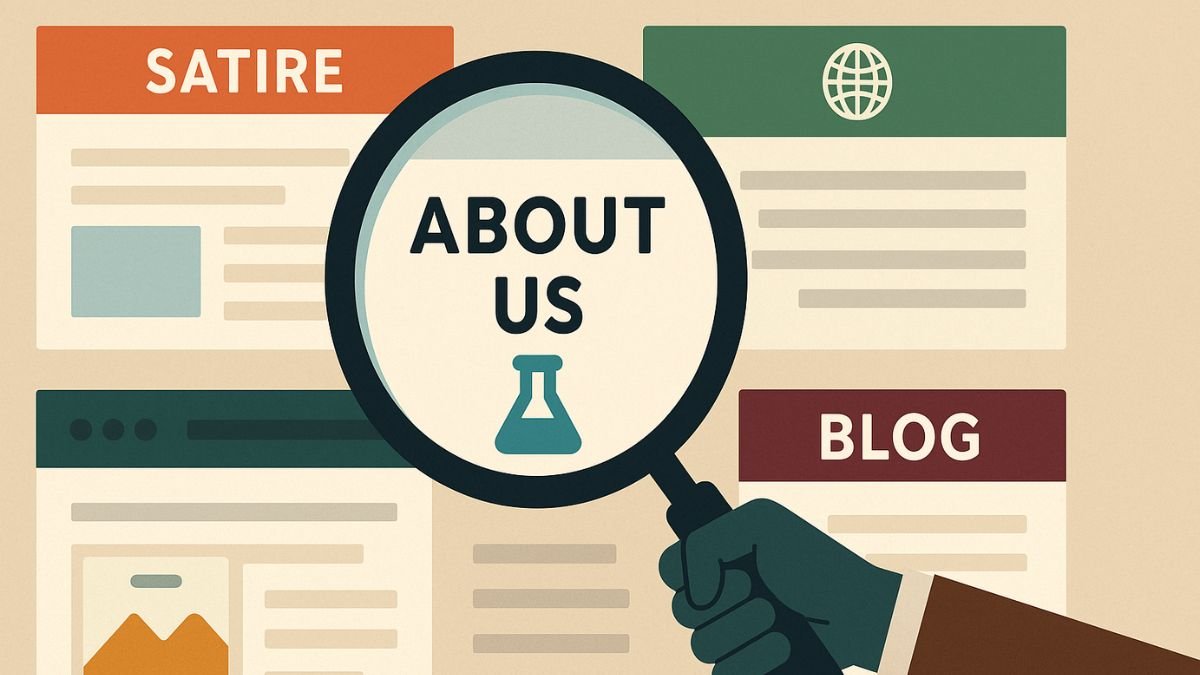
Once you’re on the site, your next mission is to find the “About Us” or “Mission Statement” page. This is where the source tells you, in its own words, who it is and what its goal is. A reputable news organization will talk about its commitment to journalistic standards. A scientific journal will detail its peer-review process. But an advocacy group, like our fictional “Citizens for a Greener Tomorrow,” will state its mission to promote a cause. And a think tank, like “The Institute for Economic Liberty,” will tell you it’s dedicated to promoting a specific ideology. This isn’t a secret; it’s a statement of purpose. It tells you the inherent bias of the source. Remember, bias isn’t always bad—an advocacy group for a cause you support has a bias you might agree with—but you need to know it’s there. The information they provide will be selected and framed to support their mission.
The next habit is to investigate the author. Is an author even listed? If not, that’s a red flag. If they are, who are they? Does the article about a medical breakthrough list the author as “Dr. Jane Smith, Professor of Virology at Johns Hopkins University,” or does it just say “Admin”? Verifiable credentials from relevant fields are a huge green flag. A personal blogger sharing their opinion is fine, but you must recognize that’s what it is: a personal anecdote, not an expert analysis.
Then, you must look for the evidence. Trustworthy sources show their work. A journalist will quote multiple sources with different perspectives. A scientist will cite previous studies. A historian will reference primary source documents. A source that makes big claims but provides no links, no citations, and no data is not to be trusted. Be especially wary of sources that rely on weak evidence, like celebrity endorsements or a single personal story, also known as anecdotal evidence. A powerful story can be persuasive, but it’s not data.
As you become a more practiced sleuth, you’ll start to recognize the distinct patterns of different types of sources. Satirical sites, like “The Daily Jest,” use humor and absurdity as their main tools. If a headline seems too wild to be true, it probably is. State-sponsored media often has a very professional look but a relentlessly one-sided perspective, praising one government while criticizing all others. Advocacy groups use powerful, emotional language to persuade you and often have a call to action, like signing a petition or making a donation. And unreliable personal blogs or conspiracy sites often give themselves away with poor design, grammatical errors, and a sensationalist, urgent tone.
Finally, the master-level skill for a source sleuth is to distinguish between different types of evidence. A single scientific study is good, but it’s just one data point. A systematic review or meta-analysis, which summarizes the findings of all the high-quality studies on a topic, is the gold standard for understanding the scientific consensus. In journalism, a report that includes multiple perspectives—from experts, officials, and people directly affected—is far more reliable than one that only tells one side of the story.
By making these actions—checking the URL, reading the “About Us” page, vetting the author, and looking for evidence—a reflexive habit, you change your relationship with information. You stop being a passive consumer and become an active, critical investigator. You build a mental filter that can help protect you from misinformation and propaganda, allowing you to find the credible, trustworthy information you need to make smart decisions for yourself and your community.









0 Comments