Introduction
Science is very good at explaining things. It has given us the composition of stars, the structure of DNA, the age of the universe, and the behavior of subatomic particles. It has mapped the deep ocean floor and sequenced the genomes of extinct species. It has explained earthquakes, auroras, tornadoes, and the color of the sky. It is reasonable, given all this, to feel that most natural phenomena have been satisfactorily explained and that the age of genuine mystery is largely over.
Ball lightning would like a word.
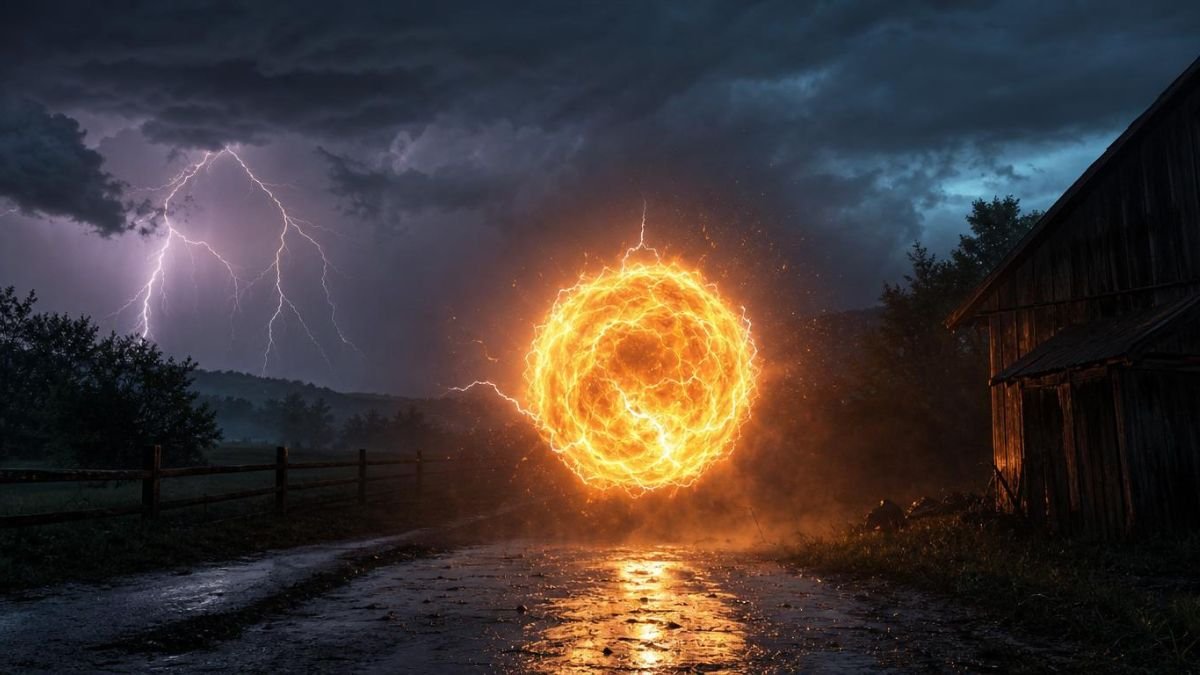
Ball lightning is a luminous, spherical phenomenon associated with thunderstorms — a glowing orb of light ranging in size from a marble to a beach ball, capable of floating through the air, passing through solid objects, hovering indoors, and disappearing either silently or with a loud explosion. It has been witnessed across centuries and across cultures. It has been photographed. It has been captured on video. Scientists have tried to reproduce it in laboratory conditions with partial, inconsistent success. And despite decades of serious research, there is still no scientific consensus on what ball lightning actually is — what physical mechanism produces it, how it maintains its coherent structure, or why it behaves the way witnesses consistently describe.
This is not a fringe phenomenon. Reports of ball lightning appear in the accounts of credible, scientifically literate observers — including several Nobel Prize-winning physicists who reported encounters. The phenomenon is real in the sense that something is being observed. What that something is remains, genuinely and fascinatingly, unknown.
We are reading about it closely today because mystery writing — writing that holds open questions honestly while surveying the available evidence — requires specific analytical skills that are enormously valuable in both English use and critical thinking. How do you write about something that is not fully understood without either overclaiming certainty or abandoning intellectual rigor? How do you distinguish between good evidence and wishful thinking? How do you sit with productive uncertainty — curious rather than anxious, open rather than credulous? These are the skills we are practicing today.
The Article
What would it take to convince you that something existed if you had never seen it yourself, if scientists could not agree on what it was, and if every theory proposed to explain it fell apart under scrutiny? This is the situation with ball lightning — one of the most persistently and legitimately mysterious natural phenomena ever documented — and the ball lightning unexplained atmospheric phenomenon it represents has been challenging scientific understanding for centuries, not because the evidence is weak but because the phenomenon itself is deeply strange.
The historical record of ball lightning reports stretches back at least to antiquity. Medieval European documents describe glowing spheres appearing during and after thunderstorms. Benjamin Franklin, who spent considerable energy studying electrical phenomena in the eighteenth century, described observations consistent with ball lightning. In the nineteenth and twentieth centuries, reports accumulated from sailors, pilots, military personnel, and scientists — people whose observations, on any other subject, would be considered reliable. In 1944, the physicist Pyotr Kapitsa, who later won the Nobel Prize, reported a detailed sighting. In 2014, Chinese scientists accidentally captured ball lightning on video and spectrographic analysis during a routine field measurement expedition — the most detailed scientific documentation of the phenomenon to date. The spectrographic data showed the object contained silicon, iron, calcium, and other elements consistent with soil composition, which has since become one of the most compelling clues for theoretical explanation.
The observed properties of ball lightning are consistent enough across thousands of reports to suggest that witness accounts are describing the same phenomenon rather than different misidentifications. The typical ball lightning object is spherical, ranging from about two centimeters to over a meter in diameter. It is luminous and can be various colors — most commonly white, orange, red, or blue. It tends to appear during or shortly after thunderstorms but has been observed in clear weather and even indoors. It moves — sometimes slowly, sometimes in sharp, unpredictable directions — and is often observed to pass through glass windows, walls, and other solid objects without apparent damage to either the object or the surface. It persists for seconds to minutes, far longer than any conventional electrical discharge. And then it disappears — either fading gradually or exploding with a sound sometimes described as a crack or pop.
The physical problem ball lightning poses is considerable. An object that is visibly luminous, maintaining a coherent spherical structure, moving autonomously, passing through solid matter, and persisting for seconds to minutes without an obvious energy source is not easily accommodated within conventional atmospheric physics. Lightning discharges are essentially instantaneous — the sustained, slowly moving, self-contained luminous sphere described by ball lightning witnesses doesn't fit the standard model of electrical discharge behavior. Something is generating or sustaining its energy. Something is maintaining its structure. And whatever is doing those things is doing so without the kind of violent energy release that conventional lightning produces.
The most widely discussed current hypothesis — associated largely with John Abrahamson and James Dinniss of the University of Canterbury — proposes that ball lightning is a burning sphere of silicon nanoparticles. On this model, when lightning strikes soil, it vaporizes silicon dioxide in the soil, which then condenses into a cloud of silicon nanoparticles. This cloud oxidizes slowly — burning — producing the glow and heat of ball lightning. The model accounts for the 2014 Chinese spectrographic data (which showed silicon and other soil elements), the typical location of sightings near the ground or after ground strikes, and the gradual or explosive termination (depending on the rate of oxidation). It is the most empirically grounded hypothesis available. But it does not yet fully account for ball lightning observed at altitude, the reported passage through solid objects, or the full range of observed colors and behaviors.
Other hypotheses include microwave radiation trapped by ionized air, tiny antimatter meteors annihilating in the atmosphere (now largely dismissed), atmospheric chemical reactions, and — more speculatively — plasmoids, self-contained magnetic plasma structures. Nuclear scientist David Turner proposed a model based on electrochemical reactions in moist air. Plasma physicist Eli Jerby has demonstrated the production of "fireball" phenomena in laboratory conditions using microwave drills, though whether these are genuine ball lightning or merely similar-looking phenomena is contested. The field of ball lightning research is full of promising partial explanations and stubborn remaining anomalies.
What makes ball lightning particularly interesting as an unsolved mystery is that it is not simply a matter of insufficient evidence. The 2014 spectrographic data represents genuine scientific measurement. The theoretical proposals are serious and well-informed. The phenomenon is sufficiently documented that it cannot be explained away as mass hallucination or misidentification of conventional phenomena. What it represents is a natural phenomenon that currently sits at the boundary of existing physical models — something that is real, observable, and consistent, and for which a complete, consensus explanation has not yet been achieved. Science is full of such boundary cases, and they are often where the most interesting theoretical advances eventually happen.
The persistence of ball lightning as an unexplained phenomenon across centuries and cultures, across scientifically trained observers and lay witnesses, across photographs and spectrographic data and laboratory attempts at replication — all without a complete explanation — is a healthy reminder that the natural world is not yet fully mapped. There are phenomena out there that our current models cannot entirely accommodate. That is not a failure of science. It is an invitation.
If ball lightning were finally fully explained tomorrow, would you feel satisfied — or just a little bit disappointed that one of the world's remaining genuine mysteries had been closed?
Close Reading Analysis
Paragraph 1: "What would it take to convince you that something existed if you had never seen it yourself, if scientists could not agree on what it was, and if every theory proposed to explain it fell apart under scrutiny?"
Question: this opening question sets up three conditions for disbelief. Why is structuring the opening as a conditional question with multiple clauses more effective than simply stating "ball lightning is mysterious and unexplained"?
The multi-clause conditional question forces the reader to actively construct the scenario rather than passively receiving the claim. By listing the three conditions — no personal sighting, no scientific consensus, every theory failing — the writer is building the epistemic challenge from the inside. The reader, having assembled the conditions themselves, arrives at the conclusion that this would indeed be a strange situation to be convinced about. This is more rhetorically effective than the declarative because it creates a sense of genuine puzzle before the subject has even been named. The technique is a kind of Socratic setup: pose the question, let the reader engage with the logic, then introduce the subject that fits the conditions exactly.
Paragraph 2: the historical record:
Question: the paragraph includes Pyotr Kapitsa — a Nobel Prize-winning physicist who reported a sighting. Why does the writer specifically mention his Nobel Prize, and what does this tell you about how credibility is established in mystery writing?
The Nobel Prize mention functions as a credibility anchor. In mystery writing, the immediate challenge is the reader's skepticism — ball lightning sounds like it could be a misidentification, a hoax, or a hallucination. By mentioning that a Nobel laureate reported a detailed sighting, the writer is pre-empting the dismissal. The implicit argument is: if someone of this scientific caliber reported this phenomenon, the appropriate response is not dismissal but curiosity and investigation. This is a form of argument from authority — normally a logical fallacy, but used carefully in contexts where established credibility genuinely is relevant evidence. The skill is knowing when credentialed testimony raises the epistemic stakes versus when it simply defers to authority inappropriately.
Paragraph 3: "The physical problem ball lightning poses is considerable."
Question: why does the paragraph list the properties of ball lightning in accumulating clauses — "that is visibly luminous, maintaining a coherent structure, moving autonomously, passing through solid matter, and persisting for seconds" — rather than presenting them in a table or numbered list?
The accumulating clause structure is rhetorical as well as informational. Each added property is an additional challenge to conventional physics — the list is not neutral enumeration but progressive complication. As each property is added, the implausibility of a conventional explanation increases. By the time you reach "persisting for seconds to minutes without an obvious energy source," the accumulated weight of anomalous properties creates a genuine sense of physical puzzle. A table or numbered list would present the properties with equal visual weight, without the forward momentum and building tension that the clause structure produces. In analytical and argumentative writing, the structure in which you present information shapes how the reader receives and evaluates it.
Paragraph 4: the silicon nanoparticle hypothesis:
Question: the paragraph notes that the Abrahamson-Dinniss hypothesis "does not yet fully account for" certain observed behaviors. How does the writer use this qualification, and why is openly stating a hypothesis's limitations actually a mark of stronger rather than weaker scientific writing?
"Does not yet fully account for" is a carefully hedged acknowledgment of explanatory gaps. The "yet" does important work: it implies that the model might be refined or extended to account for these phenomena, rather than that the model is fundamentally wrong. The "fully" implies partial accounting — the model explains some of the observations but not all. Stating these limitations openly is a mark of intellectual honesty that actually strengthens the writer's credibility: a writer who acknowledges what their favored explanation doesn't explain is more trustworthy than one who presents it as a complete solution. In scientific and analytical writing, acknowledging the limitations of your argument is not a weakness — it is evidence of genuine rigor.
Closing question:
"If ball lightning were finally fully explained tomorrow, would you feel satisfied — or just a little bit disappointed that one of the world's remaining genuine mysteries had been closed?"
This closing question does something philosophically interesting: it suggests that unsolved mysteries have value not just as problems to be solved but as sources of wonder that enriches our relationship with the world. The question is not asking whether you want ball lightning to remain unexplained permanently — it is asking you to notice the emotional texture of living in a world that still has genuine mysteries. The answer many readers will find, on reflection, is that there would indeed be something lost with the full explanation — not just the mystery itself but the particular quality of attention that a genuine, unresolved puzzle demands. This is a meditation on curiosity as a value in itself, embedded in a question about a glowing sphere.
Speaking & Writing Challenges
Writing Challenge
Choose any genuinely unresolved phenomenon that interests you — natural, historical, psychological, or social. Write a 400–500 word close investigation that: (1) establishes the reality of the phenomenon through specific evidence, (2) describes its anomalous properties — the things that make it hard to explain — in accumulating, precise language, (3) presents the strongest available hypothesis and acknowledges its limitations honestly, and (4) closes with a reflection on what the persistence of unexplained phenomena tells us about the limits of human knowledge. Focus particularly on using hedging language correctly throughout — the difference between "suggests," "implies," "may indicate," and "proves" is doing crucial intellectual work.
Speaking Challenge
Prepare a two-minute investigation report on ball lightning or any other genuine unexplained phenomenon, structured as if you were briefing a small committee. Cover: what is known (the evidence), what theories have been proposed and why they are incomplete, and what the phenomenon tells us about the current boundaries of scientific understanding. The challenge is to communicate genuine uncertainty without losing your authority as a speaker — practice phrases like "the most compelling current explanation is," "this remains contested because," and "what the evidence suggests, though does not prove, is."








0 Comments