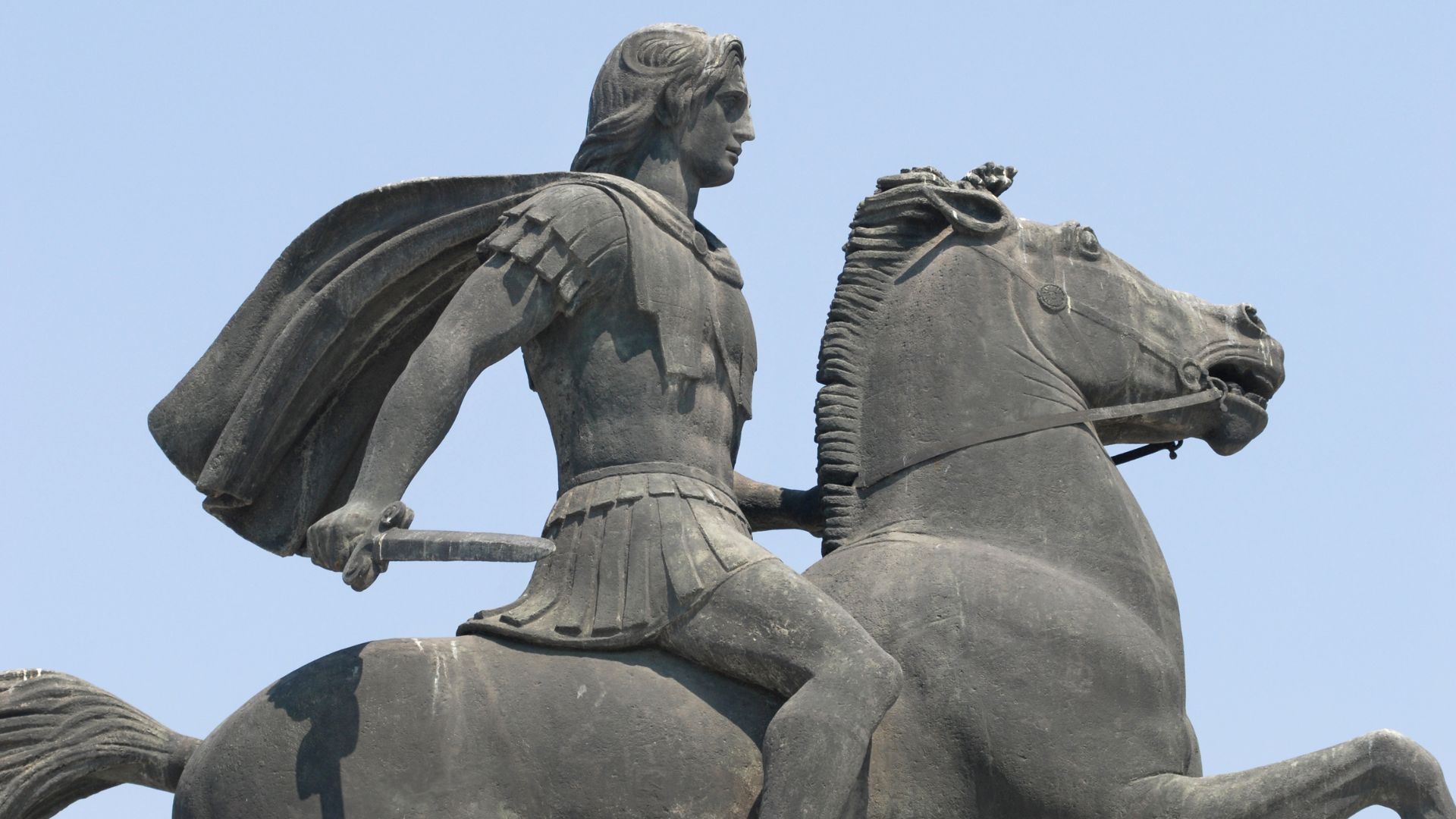
Introduction
He was a king, a commander, and a conqueror. Alexander the Great was so powerful some people called him a god. He was one of the greatest generals in history, and he built a vast empire that extended from the Mediterranean Sea to India.
Audio Episode
[ai_playlist id="16069"]
Interactive Transcript
ALEXANDER THE GREAT
He was a king, a commander, and a conqueror. Alexander the Great was so powerful some people called him a god. He was one of the greatest generals in history, and he built a vast empire that extended from the Mediterranean Sea to India.
ALEXANDER’S EARLY LIFE
Alexander was born in Macedonia in 356 bc. His father, King Philip II of Macedonia, hired the famous Greek philosopher Aristotle to tutor young Alexander. In the summer of 336 bc, Philip was murdered by one of his bodyguards. Alexander then became king.
Many people in Macedonia plotted against the young king, but Alexander was shrewd. He quickly ordered the execution of all the conspirators. At the same time, some Greek cities ruled by Macedonia rebelled and others threatened to seek independence. Alexander crushed the rebellions and restored Macedonian rule.
INVASION OF ASIA
Next, in 334 bc, Alexander turned his attention toward the Persian Empire (now Iran) in southwest Asia. Alexander led Macedonian and Greek soldiers to attack Darius III, Persia’s king. Their armies met at Issus in Syria in 333 bc, and fought a fierce battle. Alexander won, and Darius fled.
CONTROL OF EGYPT
Alexander then led his soldiers south, into Egypt. Alexander seized power from the pharaoh, who ruled Egypt on behalf of the Persians. The grateful Egyptians saw Alexander as a person who freed them, and they crowned him pharaoh. At the mouth of the Nile River in northern Egypt, Alexander founded a new city. He named the city Alexandria, and it became a famous center of learning.
CONQUEROR OF PERSIA
In 331 bc, Alexander led his troops back north into Persia. King Darius was eager for revenge. Alexander and Darius fought another great battle, this time at Gaugamela. Once again, Alexander won. The battle at Gaugamela ended centuries of Persian rule in Asia.
Alexander then turned south and conquered other important Persian cities. At Persepolis, he burned down Darius’s palace to show he had conquered the Persian Empire. In 330 bc, Alexander went north to find Darius again. This time, Darius was killed by his own men as he fled.
WORLD EMPIRE
Alexander was a military genius and a great explorer. But he also had a grand ambition. He wanted to rule a world empire where people could live in peace with one another. From 330 to 327 bc, Alexander led his soldiers east, through Afghanistan and into Central Asia. As he travelled, he built more cities. He recruited soldiers, merchants, and scholars from many lands to settle there. In 326 bc, Alexander turned south, into India. But by then his men were tired and weak. They were far from home in an unknown land. The soldiers rebelled and refused to go farther. Reluctantly, Alexander turned back. By 323 bc, he reached Babylon in Iraq. While there he caught a fever and died at the age of 33. His empire was divided among his generals.
Practice Worksheet (Downloadable PDF)










great lesson
Thank you. I’m glad you found it useful.