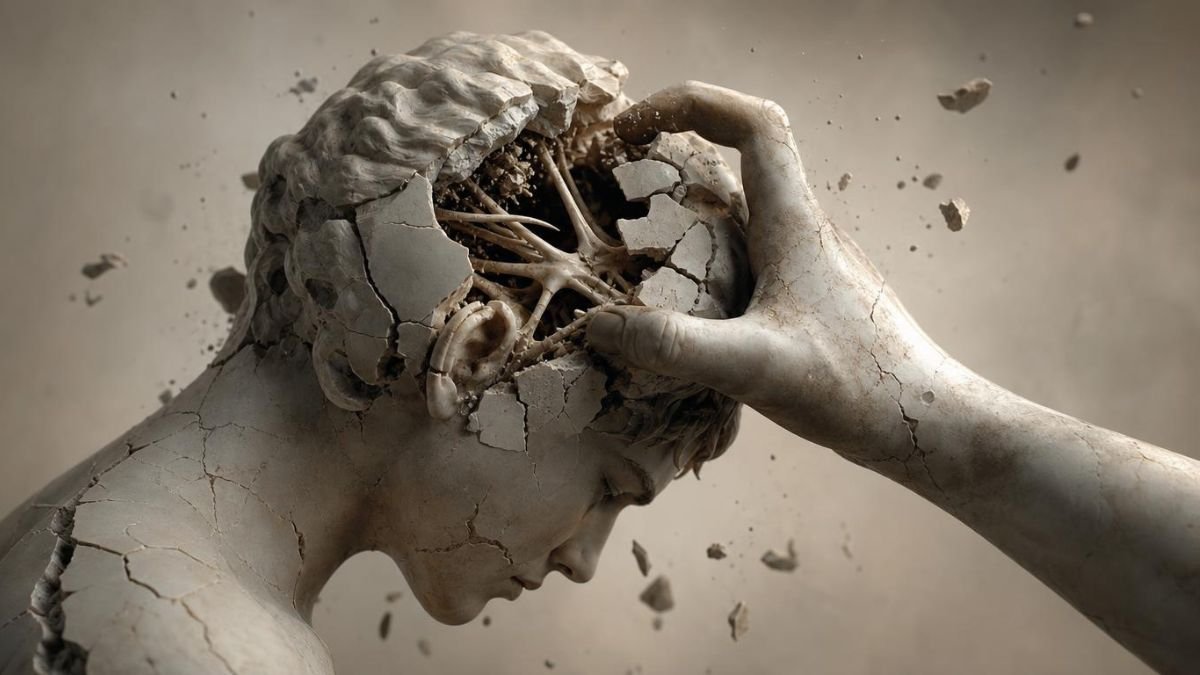
What if the thing you did to someone last Tuesday wasn't emotional at all, but orthopedic?
I want to start there, because Arabic starts there, and once you hear it you can't unhear it.
The phrase is kasr al-khatir. And to feel its weight you have to take it apart slowly, the way you'd take apart a watch.
Begin with khatir. It comes from a root, kh-t-r, that carries a strange and lovely double life. In one direction it means a thought that occurs to you — the notion that passes through, unbidden, the flicker that crosses the mind before you've decided to think it. In the other direction, the same root gives you khatar, danger, and the older physical sense of swaying, swinging, moving back and forth. A sword swayed. A branch swayed.
So khatir is not the mind. It's not the heart either, though people translate it that way. It's closer to the swaying part of you. The inner weather. The disposition you're carrying today that you didn't choose and can't quite name. It's what you mean when you say someone is in good spirits — not their beliefs, not their opinions, but the thing underneath those that tilts one way or the other before breakfast.
Now put kasr in front of it.
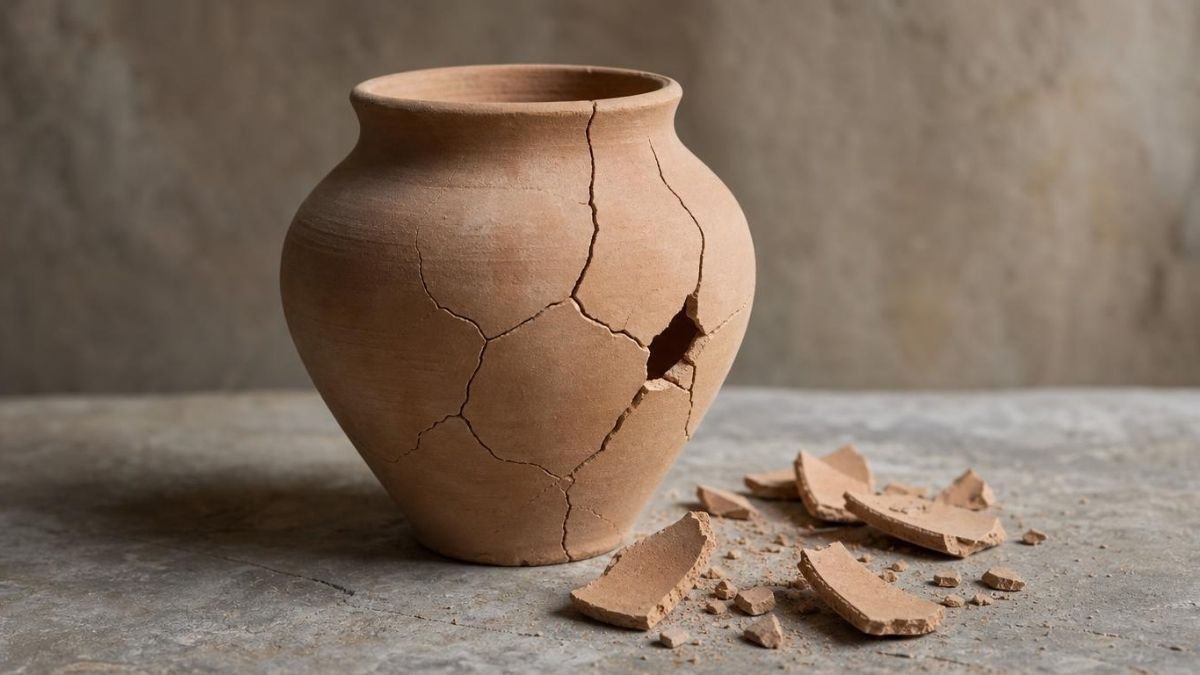
Kasr is fracture. It's the ordinary, unpoetic word a doctor uses for a broken arm. It's the word for a snapped branch, a cracked pot, a shattered rule. In Arabic grammar, kasra is the little mark that bends a letter's sound downward toward the floor. The root means: something that was whole and now is in pieces, and the pieces don't fit back the way they were.
Kasr al-khatir. Not "I hurt your feelings." I fractured the swaying thing inside you.
And here's what convinces me this isn't just a vivid figure of speech — that Arabic actually means it medically. There is a phrase that is its exact opposite, and it's used constantly, every day, in a dozen countries. Jabr al-khatir. The mending of the khatir. The setting of the broken bone.
Because jabr is a bone-setter's word. Long before it meant anything abstract, it meant to force displaced parts back into alignment. To reduce a fracture. To take what has been scattered and compel it back into one piece. In the ninth century, a scholar in Baghdad used that word for a book about restoring balance to equations — al-jabr. Which traveled across languages and centuries and arrived at your school desk as algebra.
So the vocabulary of emotional repair in Arabic and the vocabulary of mathematics come from the same place: the hands of someone straightening a broken limb.
That's the etymology. Now here's the part that changed how I think about the whole phrase.
Ask a materials scientist why bone is tough, and they will not say "because it's hard." Hardness isn't toughness. Glass is hard. Glass is also useless in a body, because when glass takes a hit it releases all that energy into a single crack that runs straight to the other side.
Bone survives because bone is engineered to break.
At the microscopic level, bone is bundles of mineralized collagen fibrils held together by what researchers call sacrificial bonds — weak chemical bonds whose entire job is to snap first. When a load comes through, thousands of these tiny bonds break, and each break absorbs a little energy, and the collagen molecule uncoils a little of the slack it was holding in reserve. The big fracture never happens because the small fractures happened everywhere. And here's the astonishing bit: many of those sacrificial bonds re-form. Given time and rest, the material reassembles its own capacity to be broken again.
Read that once more, because it's the whole episode. Bone does not survive impact by refusing to break. It survives by breaking in small, distributed, recoverable ways — and by having a system that comes back afterward and re-glues what came apart.
Which tells you exactly what kasr al-khatir is warning against.
The danger isn't that a person will be hurt. People take small fractures constantly; the disposition sways, absorbs, re-forms. The danger is the load that arrives all at once, in the wrong place, with nothing behind it to spread the energy — the sentence delivered publicly, the dismissal from the one person whose regard was structural, the door closed at the exact moment someone was leaning on it. That's not a bruise. That's a clean break through a load-bearing part, and it changes how the person stands for a long time afterward.
And it explains why jabr had to exist as a word. If you can fracture something in a person, then repair isn't a nicety — it's an intervention, with a technique, performed by hands. To do jabr al-khatir in Arab culture is not to apologize. It's often to say nothing about the injury at all. It's to send the food. To show up early. To give the person the seat facing the door. To hand them a small dignity in a form they can accept without having to admit anything was broken. It's a set of gestures for realigning someone quietly, so the thing can knit.
Now the honest complication, because I don't want to hand you a beautiful idea with no edges on it.
A culture that treats every wound as a fracture can become a culture where no one says anything true. If the khatir is that fragile, you flatter. You withhold the diagnosis. You let the friend go on with the doomed plan because correcting them would be kasr. And jabr can curdle, too — it can become a currency, a way of managing people with gestures instead of honesty, a bone-setting that keeps setting the same bone rather than asking what keeps breaking it.
The materials scientists have an answer to this as well, and it's not a comfortable one. Bone that is never loaded gets weaker. Take the stress away entirely — bed rest, weightlessness — and the body starts dismantling the very structure it isn't using. Protection past a certain point is its own kind of damage.
So the phrase isn't asking you to handle everyone like glass. It's asking you to know the difference between load and fracture. Between the honest weight that makes a person stronger for carrying it, and the blow that lands somewhere structural and takes years to knit.
Most of us can't tell the difference in the moment. That's the real problem. You can't see the break happen. There's no sound. The person keeps talking, keeps being polite, walks out of the room, and the fracture sets crooked over the following weeks because nobody came to do the jabr.
Which leaves me with a question I can't shake.
Somewhere out there is a person whose inner weather still tilts a certain way because of a sentence you said and forgot within an hour. And somewhere out there is a person still standing upright because of a small kindness you also forgot. If neither of you can remember which was which — what does that ask of the way you speak tomorrow?





0 Comments