INTRODUCTION
DANNY: Right. Before we start, I want you to do something for me. Close your eyes. Actually don't, some of you are driving. Just picture her. Cleopatra. Go.
I'll wait.
Okay. What did you get? Eyeliner. Probably a snake. Possibly a golden barge, possibly Elizabeth Taylor, possibly a Halloween costume you saw at a party in 2014. Almost certainly not what I've got in front of me tonight, which is a photograph of a scrap of papyrus from the Egyptian Fayum. It's a royal decree from 33 BCE. It grants a Roman businessman named Publius Canidius a very generous tax exemption on his imports and his exports. It is, by any measure, the single most boring document in the ancient world.
Except at the bottom, in a different hand from the scribe's, somebody has written one Greek word. Ginesthō.
"Make it happen."
Scholars have been arguing about that word for years, and nobody can prove it, but there is a genuine, real possibility that it was written by her. Not a love letter. Not a curse. Not a dramatic final testament with a snake in the basket. A queen initialing a tax break, the way a chief executive scrawls "approved" in the margin of a memo on a Tuesday.
And here's the thing I want you to notice, and be honest, because nobody's listening except me and about four hundred thousand of you. Did that feel like a letdown? Did some small part of you go, oh. Is that it?
Because if it did, that tells you the Cleopatra in your head isn't a monarch. She's a character. And somebody put her there deliberately, and that somebody won a war, and he's been dead for two thousand years and he's still winning.
So here's what we're doing tonight. Egypt is bankrupt. Rome is at the door with an invoice. There's a twenty-one-year reign, an economy in freefall, two of the most famous men in history, one civil war that got rebranded as a foreign invasion, and a body nobody has ever found.
And I'm going to sit across from her and tell her, to her face, that she lost.
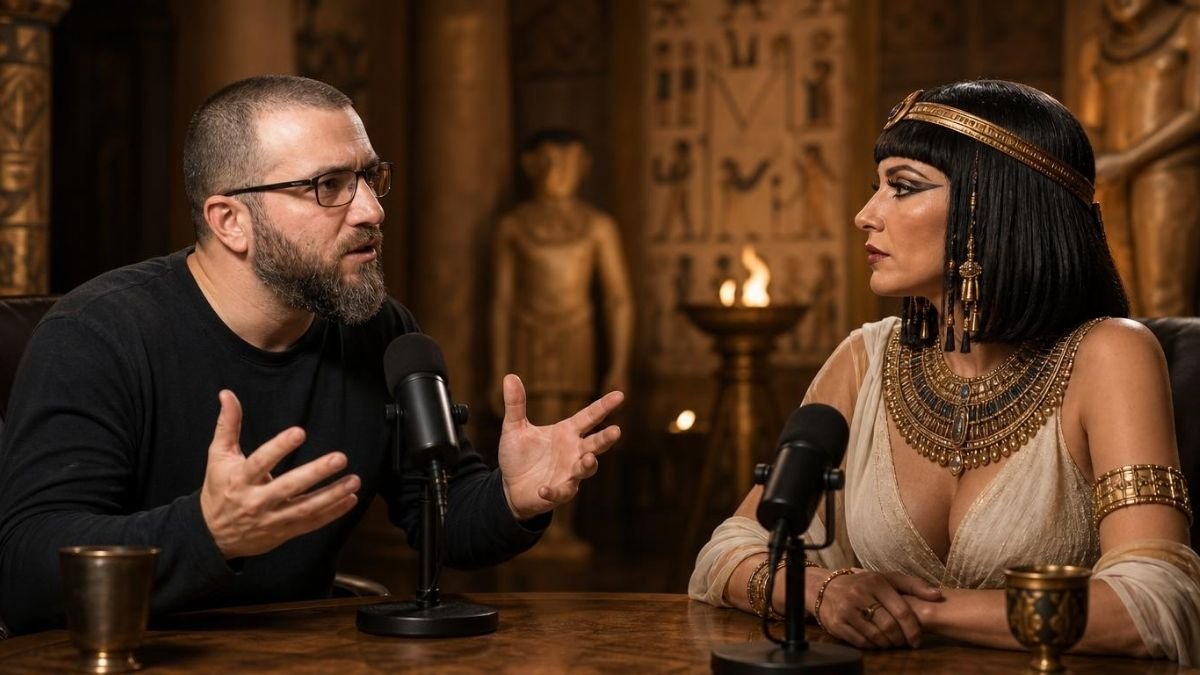
You know the drill. The lights go down, the desk stays where it is, and somebody who has been dead since August of 30 BCE walks into my studio and sits in the chair opposite. We don't explain the chair. Nobody explains the chair.
Cleopatra VII Philopator. Last pharaoh of Egypt. Let's go.
THE MOST BORING DOCUMENT IN THE WORLD
DANNY: Your Majesty. Welcome to the show.
CLEOPATRA: You may use my name. Everyone else has, for two thousand years, and none of them asked.
DANNY: Fair. Cleopatra, then. Can I start with a piece of paper?
CLEOPATRA: You may start wherever you like. I have been listening to men start wherever they like since I was eighteen.
DANNY: This is a papyrus from 33 BCE. Tax exemption for a Roman named Publius Canidius. Oil, wheat, imports, exports, the whole package. And there's a word at the bottom that might be yours. Ginesthō. Make it happen.
CLEOPATRA: Yes.
DANNY: Yes, it's yours?
CLEOPATRA: Yes, I signed a great many of those. Whether that particular one carries my hand, I could tell you, and you would have no way to verify it, and I have no interest in ending a two-hundred-year academic quarrel as a favor to a man with a microphone.
DANNY: Okay, I love that you're already refusing to help.
CLEOPATRA: I ran a kingdom. Refusing to help was most of the job.
DANNY: But you see my problem with that document. Because everyone in my century wants you to be a serious head of state, and I actually want that too, and the one artifact that might carry your handwriting is a tax break for a Roman war profiteer.
CLEOPATRA: Publius Canidius Crassus commanded legions in the east.
DANNY: Yes. Mark Antony's legions.
CLEOPATRA: Correct.
DANNY: So the one word we might have from you is a favor to your boyfriend's general.
CLEOPATRA: The one word you have from me is a queen paying for an army she could not raise herself, with a currency she could not print enough of, in a language the recipient could read, before a war she did not choose. You call it a favor. In my world it was called a treasury.
DANNY: See, that's a good line, but I want to sit here and be annoying about it for a second, because you just did something slick. You took "I gave a tax break to a crony" and translated it into "I financed the defense of my nation."
CLEOPATRA: Those are the same sentence. One of them is written by me and one of them is written by the man who hanged my son.
DANNY: Oh, we're getting to your son.
CLEOPATRA: I assumed we would. Everyone does. Nobody ever gets to my grain policy.
DANNY: We are absolutely getting to your grain policy, I've got four pages on your grain policy, you're going to be sick of your grain policy.
CLEOPATRA: Then you are already a better historian than Plutarch.
DANNY: That's a low bar and we're going to talk about him too. But let's start with the thing that makes my listeners uncomfortable, because I think it should. Cleopatra, you're not Egyptian.
CLEOPATRA: I was Queen of Egypt.
DANNY: That's not what I asked and you know it. Your family were Macedonian Greeks. Ptolemy, one of Alexander's generals, grabs Egypt when the empire gets carved up after Alexander dies. Your people ruled from Alexandria, which is a Greek city, in Greek, with Greek institutions, for three hundred years, and in three hundred years not one of your ancestors bothered to learn the language of the people they were taxing. That's not a monarchy. That's an occupation with better architecture.
CLEOPATRA: And I learned it.
DANNY: You learned it.
CLEOPATRA: I was the first of my line to speak to my own farmers without a Greek in the room translating what they were permitted to have said. Plutarch, whom you enjoy insulting, says I could speak with Ethiopians, Hebrews, Arabs, Syrians, Medes and Parthians, and that my tongue was an instrument of many strings. He did not intend it as a compliment. He was cataloguing the tools of a dangerous woman.
DANNY: Right, and here's where I get cynical, and I want you to push back hard, because I think you'll enjoy it.
CLEOPATRA: I have enjoyed less.
DANNY: You learned Egyptian at the exact moment you needed Egyptians. You're eighteen, the treasury's empty, Rome's calling in a loan, your brother's advisors want you dead, and you suddenly discover a deep personal affection for the language of the countryside. In my century we call that a listening tour. It happens about four weeks before an election, the politician turns up at a factory, they put on a hard hat that doesn't fit, and they discover a lifelong passion for regional manufacturing.
CLEOPATRA: Do the hats work?
DANNY: Sometimes.
CLEOPATRA: Then why do you sneer at mine? You have described the invention of politics and delivered it as an accusation. Of course I learned Egyptian because I needed Egypt. What is the alternative you would have preferred, Danny? That I learn it out of sentiment? That I take three hundred years of my family's contempt and correct it privately, for the good of my soul, and tell no one?
DANNY: I would've preferred your great-great-grandfather did it when it wasn't useful.
CLEOPATRA: So would I. He was busy having his brother's son dismembered.
DANNY: Yeah, we'll get to the family.
CLEOPATRA: You keep saying that.
DANNY: I'm building.
CLEOPATRA: You are stalling, because you have realized that the first blow did not land, and you are looking for a softer part of the body.
DANNY: Okay, that's genuinely rude.
CLEOPATRA: I was a Ptolemy. We began every conversation by locating the softer part of the body.
THE FAMILY FIRM
DANNY: Let's do the family, then, since you're so keen.
CLEOPATRA: I am not keen. I am resigned. Proceed.
DANNY: Because I want the audience to understand what you actually inherited, and I don't think most people do. Everyone imagines you walking into a golden throne room. What you actually walked into was a leveraged buyout gone wrong.
CLEOPATRA: Explain the term. I like the sound of it.
DANNY: It's when you buy something using borrowed money, and then the thing you bought has to generate enough cash to service the debt, and if it doesn't, the creditor owns you.
CLEOPATRA: Then yes. That is precisely what I inherited. My father bought his own throne back from Rome.
DANNY: Ptolemy the Twelfth. Nicknamed the Flute Player, which is the least intimidating royal nickname in world history.
CLEOPATRA: He was better at the flute than at governing, and he was not very good at the flute.
DANNY: He got thrown out of Alexandria, went to Rome, borrowed an absolutely obscene sum from a Roman financier at an interest rate that would make a payday lender blush, used it to bribe the right Romans, and came home on the back of a Roman army.
CLEOPATRA: And that army did not leave. That is the part your listeners must understand. The Gabinian soldiers remained in Alexandria as a garrison. There were Roman legionaries standing in my father's palace for years before I was old enough to argue with them. The independence of Egypt in my lifetime was a courtesy. The debt was the only thing in the room that was real.
DANNY: So when people say Rome conquered Egypt in 30 BCE, you'd say what?
CLEOPATRA: I would say Rome purchased Egypt in installments, beginning long before my birth, and in 30 BCE it simply took delivery.
DANNY: That's bleak.
CLEOPATRA: You asked for the inheritance.
DANNY: Alright, so you're eighteen. Fifty-one BCE. You're co-ruler with your little brother Ptolemy the Thirteenth, who's about ten.
CLEOPATRA: Who was a child, and a child is not a rival. His advisors were the rivals. Pothinus the eunuch held the treasury. Achillas held the army. Theodotus held the boy's education, which in practice meant he held the boy.
DANNY: And three years later they pushed you out.
CLEOPATRA: They pushed me out of the city. They did not push me out of the fight. I went east and I raised troops, and I want that noted, because the story that survives has me arriving in Caesar's rooms as a supplicant with nothing but my face. I arrived with an army in the field. The army was insufficient. It was not absent.
DANNY: Okay. But now we get to the part where I have to be a bit of a prosecutor.
CLEOPATRA: You have been a prosecutor since I sat down. You have simply been apologizing between questions.
DANNY: Your brother Ptolemy the Thirteenth drowns in the Nile in the war. Your other brother, Ptolemy the Fourteenth, who you then married, who was about fifteen, dies conveniently within weeks of Caesar's assassination, at the exact moment you needed your own son to be the co-ruler instead. And your sister Arsinoe, who had been paraded through Rome in chains in Caesar's triumph, is dragged out of a temple in Ephesus and killed on Antony's orders. At your request. And she was about twenty-seven.
CLEOPATRA: Yes.
DANNY: That's it? Yes?
CLEOPATRA: You wanted a confession. I have given you one in a single syllable and it has disappointed you, because you wanted to extract it.
DANNY: I wanted a defense.
CLEOPATRA: Then here is the defense, and you will not like it, because you will call it cynical and you will be correct. Arsinoe had been proclaimed queen by an Egyptian army in the field against me. She had commanded, through her tutor, forces that tried to kill me. She was granted her life by Caesar, and she used that life to sit in a temple in Ephesus, where the priests were already addressing her with a royal title. She was not a private woman at prayer. She was a standing alternative government with a legitimate claim and a foreign address.
DANNY: And your fifteen-year-old brother? What was his standing army?
CLEOPATRA: He was fifteen. In two years he would have been seventeen, and there would have been a Pothinus at his elbow, because there is always a Pothinus.
DANNY: So you killed a teenager for a crime he hadn't committed yet.
CLEOPATRA: I secured a succession.
DANNY: Say the first one. Go on. Say the first one out loud.
CLEOPATRA: You want the word "murder" in your recording.
DANNY: I want you to be honest for ten seconds in a row.
CLEOPATRA: I have been nothing else since I arrived, which is why you are agitated. You expected me to be charming. Yes, Danny. I killed a brother who was also my husband. My great-uncle Ptolemy the Eighth, whom your books call Potbelly, murdered his own son by his sister-wife, had the boy's body cut apart, and sent the pieces to the mother as a birthday gift. That was my family. I did not invent the practice. I did not even distinguish myself in it. In the annals of my dynasty I am a moderate.
DANNY: "I'm the moderate" is a hell of a defense.
CLEOPATRA: It is a historical one. You would prefer a moral one. I do not have a moral one, and neither does any monarch who lasted, and neither, I would remind you, does Rome. Rome cut the head from Pompey the Great. Rome nailed Cicero's hands to the speaker's platform, and Antony's wife Fulvia took a hairpin and pushed it through his tongue, in public, and Romans wrote about it as though it were a piece of theater. And then those same Romans composed odes about the monstrous foreign woman who had no respect for life.
DANNY: You keep doing this and it's very effective and I want to point it out, because I don't want the audience to be seduced.
CLEOPATRA: An unfortunate choice of verb.
DANNY: Deliberate choice of verb. You keep answering a question about your own conduct with a question about somebody else's. "Rome did worse." That's not a defense, that's a deflection. Every single tyrant I've ever had in that chair has run the same play. They all say the other guy started it.
CLEOPATRA: And every one of them was right about the other guy, and wrong to think it excused them. I am not asking for absolution. I am asking you to apply one standard. You have a category in your mind called "ruthless statecraft," and you put men in it, and you use words like "consolidation," and "he eliminated his rivals," and you say it almost admiringly. And you have a second category for me, and the word you use is "poisonous."
DANNY: That is genuinely a fair hit.
CLEOPATRA: I am aware.
DANNY: But I'm not letting go of it, because you don't get the feminist defense and the Ptolemaic defense at the same time. You can't tell me you're being judged by a sexist double standard, and then tell me that in your family this was all completely normal. Which is it? Were you a monster by your own culture's standards or weren't you?
CLEOPATRA: I was not.
DANNY: Then you don't get to be shocked that history calls you ruthless.
CLEOPATRA: I am not shocked that history calls me ruthless. I am shocked that history calls me only ruthless, and only in the bedroom, and that of the twenty-one years I governed, your century has retained the eyeliner and lost the currency reform. You may indict me for Arsinoe. I will stand for that. Indict me for the coinage as well. Indict me for the granaries. Indict me for something I did during working hours.
THE BEDSACK
DANNY: Then let's do 48 BCE. This is the famous one. This is the one your entire reputation is built on, and I want to take it apart in public.
CLEOPATRA: Take it apart.
DANNY: Caesar has beaten Pompey in Greece. Pompey runs to Egypt looking for shelter, and your brother's advisors do the math and decide that a dead Pompey is a great gift for the winner, so they kill him on the beach and present Caesar with his head in a bag.
CLEOPATRA: And Caesar wept. That is recorded. Whether the tears were sincere I could not say. He was the finest actor Rome ever produced and he had no stage.
DANNY: And you're locked out of the city. Your brother's men hold the harbor and the palace. So you get a Sicilian merchant called Apollodorus to smuggle you in.
CLEOPATRA: Yes.
DANNY: Not in a carpet.
CLEOPATRA: Not in a carpet.
DANNY: Say it. The audience needs to hear you say it, because I've been fighting this for years.
CLEOPATRA: It was a bedding sack. A strōmatodesmon. A long linen bag of the kind that carried bedclothes and travel goods through every servants' entrance in the Mediterranean, tied at both ends. The carpet is a fiction of your painters and your film studios, who required something that would unroll beautifully in a single motion.
DANNY: And the bag is better.
CLEOPATRA: The bag is better because no one searches the laundry. A carpet is a gift. A gift is inspected. Bedding is invisible, and invisibility was the entire commodity I was purchasing that night.
DANNY: Okay. So now, here's the modern reading, and it's the reading I basically agree with, so I want you to be suspicious of me while I say it. The modern reading is: this was not a seduction. This was a sales pitch delivered under extreme constraint. Your brother's faction physically controlled every legitimate route to the most powerful man alive, so you took an illegitimate one, and you turned up in his rooms uninvited and made your own case before anyone could make it for you.
CLEOPATRA: That is accurate and it is also a little cowardly.
DANNY: Cowardly?
CLEOPATRA: Yours, not mine. You have decided that in order to respect me, you must remove the sex from the story.
DANNY: I've decided that the sex isn't the interesting part.
CLEOPATRA: Then you have understood nothing about power in my world, and you have replaced one flattening with another. I was twenty-one. He was fifty-two, the most powerful man alive, and standing in my father's palace deciding whether my family would continue to exist. I came to him at night, alone, in a sack, having taken enormous physical risk, and I made an argument. And yes, we became lovers, and our son was born the following summer. Those facts are not in tension. In your century you have separated the personal from the political and you imagine this is sophistication. It is provincial. In the Hellenistic world a dynastic marriage was a treaty. A child was a clause. The body of a monarch was an instrument of state, and every king in the eastern Mediterranean understood this, and no one wrote poems calling them whores for it.
DANNY: So you're saying —
CLEOPATRA: I am saying that when your historians defend me by insisting I was not really seductive, merely competent, they are conceding the enemy's premise. They agree with Octavian that to have used desire is shameful. They simply deny the charge. I do not deny the charge. I refuse the shame.
DANNY: See, that's — okay, that's a much stronger position than the one my side has been arguing on your behalf.
CLEOPATRA: Your side has been apologizing for me for a hundred years. I have never asked anyone to.
DANNY: Alright, but I'm going to ruin this lovely moment, because there's a bill attached to that night. The war that followed nearly killed Caesar. He gets pinned in the palace district with a small force. He sets fire to the Egyptian fleet in the harbor to stop it being used against him, and that fire spreads into the city, and it damages part of the holdings of the Library of Alexandria.
CLEOPATRA: Yes.
DANNY: The Library. The single greatest concentration of knowledge in the ancient world. And it burns, partly, in a war that happened because you got into a bag.
CLEOPATRA: The war happened because my brother's ministers murdered a Roman consul on a beach and put his head in a basket.
DANNY: The war happened because there were two claimants and you were one of them.
CLEOPATRA: You are asking me whether I regret existing as a rival.
DANNY: I'm asking whether the Library was worth your throne.
CLEOPATRA: That is a magnificent question and it is not an honest one, because you know I could not have made that trade in advance and neither could you. No commander in the history of the world has ever set a fire on the water and calculated which shelf it would reach. What I can tell you is what I did afterwards, which never appears in your documentaries. I rebuilt. Antony later gave me the contents of the library at Pergamon, two hundred thousand scrolls, as a gift.
DANNY: Which is a lovely gesture, and which is also him giving you looted property from another city to replace the property his colleague set on fire.
CLEOPATRA: Yes. That is what an empire is. You are describing the mechanism and presenting it as a scandal.
DANNY: I'm describing the mechanism because my listeners live inside one and they don't always notice.
CLEOPATRA: Then we are, unexpectedly, doing the same work.
DANNY: Don't. Don't do that. Don't ally with me, it makes my job impossible.
CLEOPATRA: I have been allying with dangerous men since I was twenty-one, Danny. It is the only technique I have.
THE PART NOBODY MAKES FILMS ABOUT
DANNY: Right. Grain policy. Four pages. Buckle up.
CLEOPATRA: At last.
DANNY: You inherit a currency in crisis, and you reform it. You reduce the silver content of the coinage, you bring in a bronze system with the denominations actually marked on the coins, which is genuinely clever, and modern economists look at that and go, ah, she's managing a devaluation.
CLEOPATRA: I am pleased that they noticed.
DANNY: And I'm going to spoil it for you, because devaluation has a victim, and it's not the palace. When you cut the silver in the coin, the person who gets hurt is the person whose entire wealth is a handful of coins in a jar under the floor. The rich hold land, they hold grain, they hold buildings. Debasement is a tax on the poorest people in the country, collected quietly, without a decree, without a name on it. You didn't reform the currency. You taxed a peasant who couldn't read the announcement.
CLEOPATRA: That is the finest attack you have made all night.
DANNY: Thank you. Answer it.
CLEOPATRA: I will, but I want it on your record that you made it, because in two thousand years no one has ever bothered to attack me for a monetary policy, and it is the first time this evening I have felt like a head of state rather than a rumor.
DANNY: Duly noted. Now answer it.
CLEOPATRA: The alternative was default. My silver was going out of the country as fast as it entered, to Roman creditors, Roman generals, and Roman merchants, and I could not mine more. The choice before me was not "a sound currency or a debased one." It was "a debased currency, or no currency, and soldiers who are not paid, and a granary system that cannot be administered because there is no medium in which to administer it." When the coin fails entirely, the peasant you are so concerned for does not get a better coin. He gets a soldier at his door taking the grain directly, which is what happened in every province of the east when the money collapsed.
DANNY: So it was the least bad option.
CLEOPATRA: It was the least bad option, executed early, which is the difference between a government and a catastrophe.
DANNY: Okay. Famine. Early 40s BCE, the Nile floods fail, two years running, which for Egypt is not a bad harvest, it's an extinction event.
CLEOPATRA: And I opened the royal granaries.
DANNY: You opened the royal granaries for Alexandria.
CLEOPATRA: Go on.
DANNY: Because that's the bit that gets left out. There's a decree from that period that historians read as prioritizing the capital, and Alexandria is the Greek city. Alexandria is your base. Alexandria is where the mob can pull you off the throne in an afternoon, and the countryside is where the actual Egyptians are, the ones whose language you learned, the ones you're the living Isis for. And when the food ran short, you fed the people who could hurt you first.
CLEOPATRA: Yes.
DANNY: Again with the yes.
CLEOPATRA: Would you like me to lie? Alexandria was a city of perhaps half a million people packed against a harbor, fed entirely by imported grain, with a mob that had killed kings within living memory and driven my father into exile. If Alexandria starved, Alexandria rioted, and if Alexandria rioted, the government that administered relief to the countryside ceased to exist by the end of the week. Feeding the capital first was not favoritism. It was triage.
DANNY: It's always triage. Every government that's ever fed the powerful first has called it triage.
CLEOPATRA: And most of them were correct, and it remains monstrous, and both of those things are true at once, which is the condition of governing and the reason so few people enjoy it.
DANNY: There's also Josephus, who says you withheld grain from the Jews of Alexandria during the shortage.
CLEOPATRA: Josephus wrote more than a century after my death, in Rome, under the patronage of the family of the emperor who had just destroyed Jerusalem, and he needed very badly for his readers to understand that he was on the correct side of a Roman argument. If you are going to quote a witness to me, quote one who was not being paid by the prosecution.
DANNY: See, I like that, but you can't have it both ways. You just spent ten minutes citing Plutarch's list of your nine languages, and Plutarch is also a hostile source writing a century later. You're rejecting his framing and keeping his facts.
CLEOPATRA: Yes.
DANNY: Yeah, that's the trick, isn't it? That's the trick everyone plays with you. Including me. I read a piece this week that puts it better than I'm going to: if the source is compromised on your character, why do we trust it on your linguistics? And the honest answer is that we don't, we just like that bit.
CLEOPATRA: You are correct, and I will give you the strongest version of my own defense, which is weaker than you think. Plutarch had no motive to invent my languages. It does not serve his argument. His argument is that I was an intoxication, a fatal charm, a thing that dissolved a good Roman. A queen who negotiates with Arabs and Medes and Ethiopians without an interpreter is a diplomat, and diplomats are not intoxicating. He included it because he found it in a source and it was too well attested to omit, and it sits in his book like a stone in a loaf of bread.
DANNY: That's actually a decent methodological point.
CLEOPATRA: I am so pleased.
DANNY: Don't sulk, it doesn't suit the divine Isis.
CLEOPATRA: It suited her extremely well. You have not read the hymns.
BRANDING, WITH GODS
DANNY: Let's talk about the divinity, because this is where I think modern people genuinely can't follow you, and I include myself.
CLEOPATRA: Try.
DANNY: There's a relief at the temple of Dendera. It shows you and your son Caesarion in full pharaonic style, making offerings, and if you didn't know the date you'd guess it was carved fifteen hundred years earlier. Meanwhile in Alexandria you're a Hellenistic monarch issuing Greek decrees to Greek administrators. So which one was the costume?
CLEOPATRA: Neither. That is the question of a man who believes there is a private true self behind a public role, and that the role is a mask over it. My world did not think that. Kingship was not a job that a person held. It was a function that a person performed, and the performance was the reality. When I stood at Dendera in the regalia, I was not pretending to be Isis for the benefit of peasants. I was occupying a position in the order of the cosmos that had been occupied continuously for three thousand years, and the continuity was the point.
DANNY: But you don't believe it. Come on. You're the most educated woman in the Mediterranean, you've read everything in that Library, you know how a temple works from the inside, you know who pays the priests. In the quiet room, at night, with nobody watching, do you actually think you're a god?
CLEOPATRA: Do you actually think there is a quiet room?
DANNY: There's always a quiet room.
CLEOPATRA: Not for me. There was never one hour of my adult life in which I was not observed, and a self that is never unobserved does not develop the second self you are looking for. You want me to admit cynicism. I will admit something more disturbing to you. I did not experience a contradiction. I could know exactly what the priesthood cost me annually, in grain, in land, in exemptions, and simultaneously stand in that temple and feel the weight of the thing settle onto my shoulders and know it was real. Your century cannot hold those together. Mine could not tell them apart.
DANNY: Okay, that's — yeah. That's the most alien thing you've said and it's the first thing that's actually made me uncomfortable.
CLEOPATRA: Good. You have spent an hour trying to prove that I am a modern woman in a wig. I am not. I am a god-queen from a dead world, and you should find me strange, because the version of me that you can entirely understand is a version somebody made for you.
DANNY: Alright. Antony. Forty-one BCE, Tarsus.
CLEOPATRA: Yes.
DANNY: Caesar's dead. Stabbed in Rome in 44. You go home. The Roman world splits, and you've got the same problem you had at twenty-one, only worse: Egypt cannot beat Rome, so Egypt has to be indispensable to whichever Roman wins. And you pick Mark Antony, who's got the east, and who needs money, grain, and a launchpad for a Parthian campaign.
CLEOPATRA: You have summarized four years of terror rather briskly, but yes.
DANNY: And he summons you. That's the bit people forget. He doesn't invite you. He summons you, to answer charges that you helped the wrong side in the last Roman civil war.
CLEOPATRA: He did.
DANNY: And you show up on a barge with a gilded stern and purple sails and silver oars, dressed as Aphrodite, with your attendants got up as sea nymphs and cupids, and perfume coming off the water so thick that the entire population of Tarsus abandons the town square where Antony is sitting, and walks down to the river to look at you. And Antony is left sitting alone in an empty marketplace.
CLEOPATRA: Alone in an empty marketplace. Yes. Say that part again, slowly, and then tell me it was vanity.
DANNY: I wasn't going to say vanity. I was going to say it's the single best piece of political theater in the ancient world, and I say that as somebody who does theater for a living.
CLEOPATRA: Then understand its grammar, because it was not a spectacle. It was a sentence. Antony had spent years presenting himself in the east as the new Dionysus. Everyone from Ephesus to Antioch knew it. So Aphrodite came up the river to meet Dionysus, and in the visual language of that world, that is not a defendant arriving at a hearing. That is a marriage of divinities on which the fertility of the whole east depends. I did not answer the summons. I dissolved the category of summons. By the time he spoke to me, there were no charges, because charges are a thing you bring against a subject.
DANNY: You reframed the meeting before a word was said.
CLEOPATRA: I reframed the meeting on the water, where he could not reply, in front of his own troops, who cheered.
DANNY: And then you invited him to dinner, and he tried to reciprocate the next night and it was, by all accounts, sad.
CLEOPATRA: He was a soldier of enormous charm and no taste. It was one of the more likable things about him.
DANNY: Alright, so, thirty-four BCE. The Donations of Alexandria. Antony sits you on a golden throne, he's in Dionysus getup, and he hands out territories to your children like party favors. Alexander Helios gets Armenia, Media, Parthia, which incidentally Rome does not own. Cleopatra Selene gets Cyrenaica. Ptolemy Philadelphus, who is two, gets Syria and Cilicia. And Caesarion is publicly declared the true and legitimate son of Julius Caesar.
CLEOPATRA: Yes.
DANNY: Now I want to put a proposition to you and I want you to take it seriously, because I think it's the most important thing I'll say tonight.
CLEOPATRA: Put it.
DANNY: Everyone tells the story of your downfall as: Octavian invented the seductress in order to justify a civil war. And that's true. It's well documented. He couldn't sell Rome another war against a Roman, because Rome was exhausted and had no appetite for it, so he declared war on you instead. Foreign witch, oriental menace, unmanning a good Roman. Same war, completely different story, and the story was the point.
CLEOPATRA: All of that is correct.
DANNY: But here's the bit that gets left out, and I think it's the bit that damns you. He didn't invent your mythology. He took the mythology you built and turned it around and shoved it back down your throat. You arrived as Aphrodite. You called your children Sun and Moon. You put yourself on a golden throne in front of the eastern world and handed out Roman provinces that weren't yours to give. Octavian didn't have to make anything up. He just had to describe you accurately to an audience in Italy.
CLEOPATRA: Yes.
DANNY: You keep saying yes! Fight me!
CLEOPATRA: Why would I fight you? You have just credited me with authorship. I have waited two thousand years for someone to say that the propaganda used against me was made from my own materials, because that means I was not a subject of the story. I was a rival author who lost.
DANNY: Okay, but a rival author who lost is still —
CLEOPATRA: Let me finish. You have identified a real error and misnamed it. My error was not that I made myself divine and enormous. That was necessary. In the east, a monarch who is not enormous is not a monarch, and the kings and priests and grain-cities of Syria and Cyprus and Cilicia would not have followed a modest administrator with sound fiscal policy. My error was that I performed for the east in a medium that could be transmitted to the west. Alexandria was three weeks from Rome by sea and no distance at all by rumor. I built a cathedral of images for one audience and did not sufficiently consider that a second audience was standing at the back of the room, taking notes, and hated everything about it.
DANNY: You built for the wrong room.
CLEOPATRA: I built for both rooms and did not understand that they could hear each other. Which is a failure I would put to your century, incidentally, rather more often than to mine.
DANNY: Yeah, alright, that one lands. But the Donations weren't just a bad look, they were the fuse. Because declaring Caesarion the legitimate son of Julius Caesar is aimed directly at one man's throat. Octavian's entire claim to power, everything, the whole career, is that he is Caesar's heir by adoption. And you've just stood up in front of the world and pointed at a boy and said: no. That one. That one's got the blood.
CLEOPATRA: He was Caesar's son.
DANNY: He was Caesar's death sentence for your son. That declaration is the moment Caesarion stops being a prince and becomes a problem that has to be solved. And he was thirteen years old, and you did that to him.
CLEOPATRA: You will need to say the rest of it.
DANNY: The rest of what?
CLEOPATRA: The accusation. You are circling. Say it plainly, you have been polite for an hour and it is making you clumsy.
DANNY: Fine. I think you spent your son's life. I think you looked at a thirteen-year-old boy and saw the strongest card in your hand against Octavian, and you played it, knowing that if you lost, the card would be killed. And you lost.
CLEOPATRA: Yes.
DANNY: God, will you stop —
CLEOPATRA: I have been dead for two thousand years, Danny. Do you imagine there is a single thing you can say to me about my son that I have not already said to myself in a language you do not speak? Yes. I raised him to be a claim. Every royal child in the history of the world has been raised to be a claim, and in my dynasty the alternative to being a claimant was not a peaceful private life. It was being the sibling who gets removed in year three. There was no version of Caesarion who lived quietly as a merchant in Naples. He was Caesar's son from the hour of his birth and Octavian would have hunted him if I had never said one word out loud, because the claim was in the boy, not in the ceremony.
DANNY: But the ceremony started the clock.
CLEOPATRA: The ceremony started the clock. I will not pretend otherwise. I made a wager that the east could be organized fast enough, and funded well enough, and made legitimate enough, that when the reckoning came we would meet it as an empire and not as a rebellion. I lost the wager by one battle.
DANNY: Ah. Now. Actium.
ACTIUM
CLEOPATRA: Ask it.
DANNY: September, thirty-one BCE. The fleets meet off the coast of Greece. And partway through the battle, sixty ships under your command, with the war chest aboard, put up their sails and go straight out through the middle of it, heading south. And Antony breaks off and follows you. And the rest of his fleet, watching their commander leave, surrenders over the following days, and the war is effectively over.
CLEOPATRA: It was a breakout. It was planned. The sails were aboard before the engagement, which no fleet does unless a withdrawal is intended, and every naval historian of your century who has looked at it honestly has said so.
DANNY: Or the sails were aboard because you were always going to leave.
CLEOPATRA: We were surrounded, Danny. Do you understand the position? Agrippa had taken the sea lanes and cut our supply. Our camp had malaria and dysentery in it, we were burning our own ships because we had no crews left to man them, our client kings were deserting weekly and Dellius had already gone over with the battle plans. There was no scenario in which that fleet won a decisive victory that afternoon. There was a scenario in which a portion of it broke through with the treasury and reconstituted in Egypt, where we had money, grain, seven legions, and the possibility of a new army in the spring. That is not flight. That is the only competent move on the board.
DANNY: Then why did Antony follow you?
CLEOPATRA: Because it was the plan.
DANNY: Because he followed you. In front of everyone. Whatever the plan was on paper, what his men saw, what the whole world saw, was a Roman general abandoning his own line to chase a woman's ship. You gave Octavian the image. You handed him the exact picture he'd been telling Italy about for five years, and you did it in front of forty thousand witnesses.
CLEOPATRA: And I should have —
DANNY: You should have gone alone!
CLEOPATRA: I should have gone alone and left him to die in a losing engagement, and then, what, Danny? Then I return to Alexandria with a fortune and no commander and no legions, and I hold Egypt against Octavian with what? My tax records?
DANNY: You'd have held the story! You'd have been a queen who extracted her treasury from a defeat, instead of the woman who —
CLEOPATRA: The story. Listen to yourself.
DANNY: — instead of the woman who ruined him, which is what you became, which is the thing you have been complaining about for the entire —
CLEOPATRA: You have spent an hour telling me that the story was a weapon invented by my enemy and now you are advising me to have arranged my navy around it!
DANNY: Yes! Because it was the decisive weapon! Because you knew it was! You are the greatest image-maker of the ancient world, you built a barge to make a point about a hearing, and then on the one day it mattered most, at the single most photographed moment of your life, you did the one thing that confirmed his entire case. That's not bad luck. That's a professional failure in your own specialty.
CLEOPATRA: And if we had reached Egypt with a fleet intact, the same act would have been called an extraction, and Roman fathers would have taught it to their sons as a maneuver.
DANNY: Sure. And if my aunt had a fleet she'd be an admiral.
CLEOPATRA: What?
DANNY: It's an idiom, it doesn't matter. My point is that "it would have looked different if it had worked" is the oldest excuse there is.
CLEOPATRA: It is not an excuse, it is the entire mechanism of reputation and you know it, because you began this program by holding up a tax receipt and telling your listeners that the woman they imagine was assembled by a man who won. You want it both ways. You want the propaganda thesis when it makes you sound sophisticated and you want to abandon it the moment it would require you to say that I made a defensible decision.
DANNY: Alright. Then let's leave the optics out of it entirely and go to the ledger, because on the ledger it's worse.
CLEOPATRA: Go on.
DANNY: You bankrolled Antony's Parthian campaign in 36. It was a catastrophe. He loses something in the region of a third of his army, he loses his entire siege train, he retreats through the mountains in winter and men freeze to death by the thousand. That's the moment. That's the exit. Any investor in the world looks at that and gets out. And instead you doubled down, you financed him for another five years, you married your dynasty to a man whose military reputation had just been destroyed. Why?
CLEOPATRA: Because there was nowhere to go.
DANNY: There was Octavian.
CLEOPATRA: There was not.
DANNY: Why not? You'd switched Romans before. You backed Caesar, Caesar died, you backed Antony. Why not switch a third time, sell Antony out in 35, offer Octavian the grain and the money and the ports, and keep the throne? Kingdoms did it constantly. Herod did exactly that and died in his bed a king.
CLEOPATRA: Herod was a man with a small kingdom and no claim on the memory of Julius Caesar.
DANNY: And you had —
CLEOPATRA: I had a son with Caesar's face. Do you understand? Herod could be forgiven because Herod was never going to be an alternative. My existence was the problem. There was no offer I could make to Octavian that did not begin with the sentence "here is a fourteen-year-old boy who is Caesar's actual blood," and there is no sum of money on earth that buys off that sentence. Antony was not my preference in 35. He was my only remaining position. And I want you to notice that you have just criticized me, in the same hour, for being too calculating with men and insufficiently calculating with men.
DANNY: Yeah. Yeah, I did do that, didn't I.
CLEOPATRA: You did.
DANNY: I'll take that one. But I'm not giving you the whole segment, because there's a version of your career where the fundamental error is much earlier and much simpler than Actium, and I want to put it to you. Your entire strategy, for twenty-one years, was: attach Egypt to an individual Roman. Not to Rome. To a man. And men die. Caesar got stabbed and your entire position evaporated in an afternoon. Antony lost a battle and it evaporated again. You built a state whose survival depended on the heartbeat of somebody else's general.
CLEOPATRA: Yes.
DANNY: So what was the alternative? Genuinely. I'm asking, not scoring.
CLEOPATRA: There was none, and that is the tragedy, and it is why I resent the question even as I concede it. Rome was not a nation with which one could sign a treaty and rely upon it, because Rome was in civil war for the whole of my adult life. There was no Rome. There were factions with armies, and each faction claimed to be Rome, and a treaty with the Senate in 44 was worthless in 43. When your counterparty has no stable identity, you cannot contract with the institution. You can only contract with the man who is holding it that year. I did not choose personal alliance over institutional alliance. Personal alliance was the only instrument that existed.
DANNY: That's a very good answer.
CLEOPATRA: It is a true one, which is rarer.
THE LAST ACT
DANNY: Thirty BCE. Octavian's outside Alexandria. Your fleet goes over to him without a fight. Antony's told you're dead, and he falls on his sword, badly, and doesn't die immediately, and gets hauled up to you through a window because you've barricaded yourself in a mausoleum with the treasury.
CLEOPATRA: You are enjoying that image.
DANNY: I'm not, actually. That one I find genuinely horrible.
CLEOPATRA: It was.
DANNY: And then eleven days, roughly, of captivity and negotiation, and then you're dead. And the story is the asp.
CLEOPATRA: The story is the asp.
DANNY: Plutarch, writing more than a century later, reports the snake and then more or less admits nobody has any idea. Some say a basket of figs. Some say two puncture marks on the arm, some say nothing was found on the body, some say there was a hollow comb with poison in it. Modern toxicologists point out that cobra venom is not a reliable or a quick death and would be a strange choice for someone who needed certainty. So what was it?
CLEOPATRA: Why do you want the answer?
DANNY: Because I'm being a journalist now, and there's an unresolved fact.
CLEOPATRA: You want the answer because your century believes that the mechanism is the truth, and mine believed that the meaning is. Consider what the serpent meant. The uraeus, the rearing cobra, sat on the brow of every pharaoh for three thousand years. It was the protector of kings. To be taken by the cobra was not to be murdered by a reptile in a fruit basket. It was to be gathered up by the office itself.
DANNY: And that's an incredibly convenient death for Octavian, too. He gets Egypt's queen killed by an Egyptian snake, in a properly exotic tableau, which is exactly the picture he'd been selling in Rome for a decade.
CLEOPATRA: Yes. It served us both. Which is precisely why it may be true, and precisely why you cannot verify it, and why I decline to settle it for you.
DANNY: You're going to sit there and not tell me.
CLEOPATRA: I have one thing left, Danny. It is the last unread document in the world and I am not going to hand it to a podcaster.
DANNY: That's fair. Annoying, but fair. Then tell me the why instead. Because there's a hard reading of your suicide and I want to hear you answer it. The hard reading is that you had children in Roman custody, and you left them.
CLEOPATRA: I did.
DANNY: You left them, and Caesarion was hunted down and killed within days, and your other three were taken to Rome and walked through the streets behind a golden effigy of you in Octavian's triumph.
CLEOPATRA: They were.
DANNY: So what was it for? Because from where I'm sitting, you did the one thing that let your enemy win cleanly and did nothing for your kids.
CLEOPATRA: Then let me tell you what a triumph is, because you have said the word twice and I do not think you have felt it. My sister Arsinoe was paraded in Caesar's triumph, in chains, through Rome, in front of a crowd, and the crowd pitied her, and the pity was so uncomfortable to Caesar that he spared her life, and it did her no good at all in the end. I watched that. I was in Rome. Do you understand what I am telling you? I saw with my own eyes what they do to a queen of Egypt in that street. And I decided, in a room in Alexandria, with my kingdom already gone and the boy already beyond saving, that the last territory left to me was about four feet of ground and the manner of my leaving it. Octavian had every other thing. He had Egypt, he had the treasury, he had the grain, he had my children. He had one item outstanding, which was me, in a chain, on a cart, in August, as the centerpiece of the greatest street party in Roman history. And he did not get it. Every account tells you he was furious. That fury is my last piece of policy, and it is the only campaign in the last two years of my life that I won outright.
DANNY: And your children?
CLEOPATRA: My daughter lived.
DANNY: Your daughter lived because your enemy raised her.
CLEOPATRA: My daughter Cleopatra Selene was raised in Rome in the household of Octavia, married to Juba of Numidia, and made queen of Mauretania, where she minted coins with a crocodile on them and Egyptian symbols on them and her mother's name on them, in a Roman client kingdom, in full view, for twenty years. She was not permitted an army. She built a memory instead, in bronze, and she circulated it in every marketplace in North Africa. I would say she understood the family business perfectly.
DANNY: That's — okay, I didn't know the coins.
CLEOPATRA: Very few do. You have all been so busy with the snake.
THE VERDICT
DANNY: Last stretch. I want to give you the hardest version of the case against you, and it's not the sex and it's not the murders. It's the outcome.
CLEOPATRA: Say it.
DANNY: Egypt ended on your watch. That's the bottom line on the ledger. A three-hundred-year dynasty finished. A three-thousand-year tradition of pharaonic rule finished. Your country was annexed and turned into the personal property of a Roman emperor, so completely that senators weren't even allowed to visit it without written permission. Your son was executed. Your capital's royal quarter is currently under the harbor. You were the last, and you were the last because of decisions you made.
CLEOPATRA: And the structural forces?
DANNY: You'll say Rome was going to swallow Egypt eventually.
CLEOPATRA: Rome swallowed everything eventually. Macedon, Greece, Carthage, Pontus, Syria, Judea, Gaul. Name the kingdom in the Mediterranean that negotiated its way out. There is not one. There is a list of dates, and mine is the last date on it, and that is not a coincidence, that is a result. Every one of my neighbors folded faster than I did and none of them had to argue with a podcaster about it.
DANNY: Right, but that defense is available to every failed leader in history and we don't hand it out equally, do we. And here's where I want to be honest about my own side of the desk, because I've been reading a piece this week that caught me doing something and I don't like being caught. There's a fashionable move in popular history right now. It goes: you think X was a scandalous figure, but actually X was a competent professional. And it feels rigorous. It feels like debunking. But look at what it smuggles in. It assumes that "good administrator" is the respectable box and "person of legendary appetites" is the disreputable one, and that rescuing somebody means moving them from the second box into the first. That's a modern, middle-class, managerial value system, and my whole century has been applying it to a Hellenistic god-queen without ever asking whether it fits.
CLEOPATRA: It does not fit.
DANNY: I know it doesn't. You told me it didn't an hour ago and I didn't listen, because the version where you're a sober policy wonk with a spreadsheet is the version my audience finds admirable, and it flatters us, because it means the highest form of a human being is a good manager, which is coincidentally what most of us are trying to be on a regular Tuesday.
CLEOPATRA: So you have flattened me in the opposite direction.
DANNY: I've flattened you in the direction that sells to a person with a commute and some headphones. Yes.
CLEOPATRA: And you built an episode out of me.
DANNY: I built an episode out of you.
CLEOPATRA: And the pearl?
DANNY: I left the pearl out, actually. The one where you dissolve a fortune in vinegar and drink it to win a bet.
CLEOPATRA: Why?
DANNY: Because it's chemically dubious and it makes you look frivolous.
CLEOPATRA: You omitted the most famous act of my life because it was inconvenient to your argument. Danny. You are Octavian with better equipment.
DANNY: Oh, that's — no. No, that's cheap.
CLEOPATRA: It is not cheap, it is the discipline you claim to be teaching. Every generation has selected from me. Rome selected the appetite and discarded the government. Your painters selected the flesh. Your film studios selected the eyes and the barge and turned me into a costume that a young woman puts on for a party without knowing whose name she is wearing. And now your century selects the tax policy and the languages and the granaries, and calls the selection a correction, and sells it. You are not the first person in this room to be honest about the mechanism. You are simply the first one to be honest about it while operating it.
DANNY: Then let me ask the question that's actually underneath all of this, because you've earned it. Watch how often a capable woman in power gets refiled under "seductress," and watch how consistently the refiling is done by the people she frightened. It happened to you. It's happened, in softer forms, to women in politics and business in my lifetime. When somebody explains away a leader's competence by pointing at her personal life, ask who benefits from the explanation. Is that your legacy? Did you invent the template?
CLEOPATRA: No. I was the template's first famous victim, which is not the same thing, and the distinction matters more than anything else you have said tonight. I did not write it. Octavian wrote it, and Horace and Propertius and Lucan versified it, and it worked so well that it became a piece of standard equipment, and it has been available on the shelf to every frightened man for two thousand years. I gave them the raw material. He gave them the machine.
DANNY: And you'd do the same thing again.
CLEOPATRA: I would do most of it again, and better, and I would do one thing differently.
DANNY: Which one?
CLEOPATRA: I would have written something down.
DANNY: You did write things down. You wrote a treatise on cosmetics and medicines that Galen was still quoting centuries later.
CLEOPATRA: I mean an account. In my own voice, of my own reign, in numbers, copied and distributed to every library from Pergamon to Rhodes, so that when the fire came for Alexandria there would be a copy in some dull provincial archive in Asia with my grain figures in it. Caesar wrote his own wars. That is why you have his version of Gaul and not the Gauls'. Every man in this story left a document and I left a tax receipt with one word on it. That is my error. Not Actium. That.
DANNY: Then let me end with the one question I know you won't answer.
CLEOPATRA: Ask it anyway.
DANNY: Where are you?
CLEOPATRA: Ah.
DANNY: Because nobody's ever found your tomb. Alexandria's royal quarter went under the water after earthquakes and a tsunami in the fourth century, so half the argument is drowned. And for more than twenty years, a Dominican archaeologist named Kathleen Martínez has argued you're not in Alexandria at all, that you're at Taposiris Magna, a temple of Osiris about thirty miles west, on the reasoning that you identified with Isis and would have wanted to be buried somewhere Octavian couldn't reach. Most Egyptologists have politely disagreed with her for two decades. Then in 2022 her team found a tunnel more than a kilometer long, cut deep through the sandstone under the temple, running toward the sea. And last year they announced a sunken port off that same coast, with anchors and columns and polished floors, apparently lined up with the tunnel. And the Egyptian authorities pointed out that no ancient source ever mentions a harbor there at all.
CLEOPATRA: That is a very good story.
DANNY: It's a very good story. Is it true?
CLEOPATRA: A tunnel is not a tomb.
DANNY: That's what the archaeologists say.
CLEOPATRA: Then the archaeologists are being appropriately careful and you are not, because you would like me to nod, and a nod from me would be worth a great deal to you, and would be the least reliable evidence ever presented on this program.
DANNY: One word. That's all. Make it happen.
CLEOPATRA: You have that word already. You began the hour with it. You showed it to your listeners and told them it was disappointing.
DANNY: I said it felt disappointing. I said that feeling was the interesting part.
CLEOPATRA: Then here is my last answer, and it is the honest one. I do not want to be found. Not because of the gold, there is very little, and not because of the curse, there is none. Because on the day they open that room, whatever is in it will be measured and photographed and argued over for a decade, and then a face will be reconstructed by a machine, and every nation on earth will fight about what color it is, and not one person will ask what I did in the year 41 with the price of wheat. I have been read for two thousand years through the eyes of the man who killed me. Being lost is the only privacy I have ever had.
DANNY: Cleopatra the Seventh. Thank you for this.
CLEOPATRA: You were not as clever as you think you were.
DANNY: No, but I was clever enough to get you to say "yes" nine times.
CLEOPATRA: Eleven. I was counting. It is the family business.
OUTRO
DANNY: And we're back in the room. Chair's empty. It usually is by now.
So, look. Here's where I land, and then I want yours, because I genuinely don't think this one's settled and I've been arguing with myself about it all week.
The thing that got me tonight wasn't the barge or the bag or even the brother. It was the last bit. Every man in that story left a document. Caesar wrote his own wars, in the third person, brilliantly, and that's why you've got his version of Gaul and not the Gauls'. Octavian wrote his own record and carved it on temples across the empire. And she left us a tax exemption for a businessman, with one word at the bottom that might not even be hers.
Twenty-one years of governing an almost impossible position. A currency reform, a famine, a coronation, a war, three children, nine languages, and a state that outlasted every one of its neighbors. And what got through to us is the eyeliner.
Now here's the part I want you to actually take away, and it's not a fact about Egypt. When somebody hands you a satisfying revision of a story you thought you knew, including this one, including me, tonight, the first question isn't "is this more accurate." The first question is: what does this version want me to feel, and who does that serve? Apply it to Octavian. Apply it to the next documentary you watch. Apply it to me, please, I'd honestly prefer it.
So. Who won?
Because you can make the case both ways and I want to hear you make it. She was a shrewd operator playing a losing hand for two decades against a machine no one in the Mediterranean beat, and she held on longer than anyone had a right to. Or she was a gambler who bet a three-thousand-year-old country on two men and a fleet and lost it, and we've spent a century inventing a competent administrator because we're embarrassed about how the last version treated her.
Tell me. Comments, wherever you're listening or reading. And be specific, because "she was amazing" is not an argument and neither is "she failed." Give me the reason. Give me the year. Give me the decision you'd have made differently and what it would have cost.
If this one got its hooks in you, send it to the person in your life who thinks history is just dates. And if you want the next one, subscribe, because I've got a chair, and there's always somebody in it.
I've been Danny. That was Cleopatra, or as close as we're getting. Careful whose version you're carrying.





0 Comments