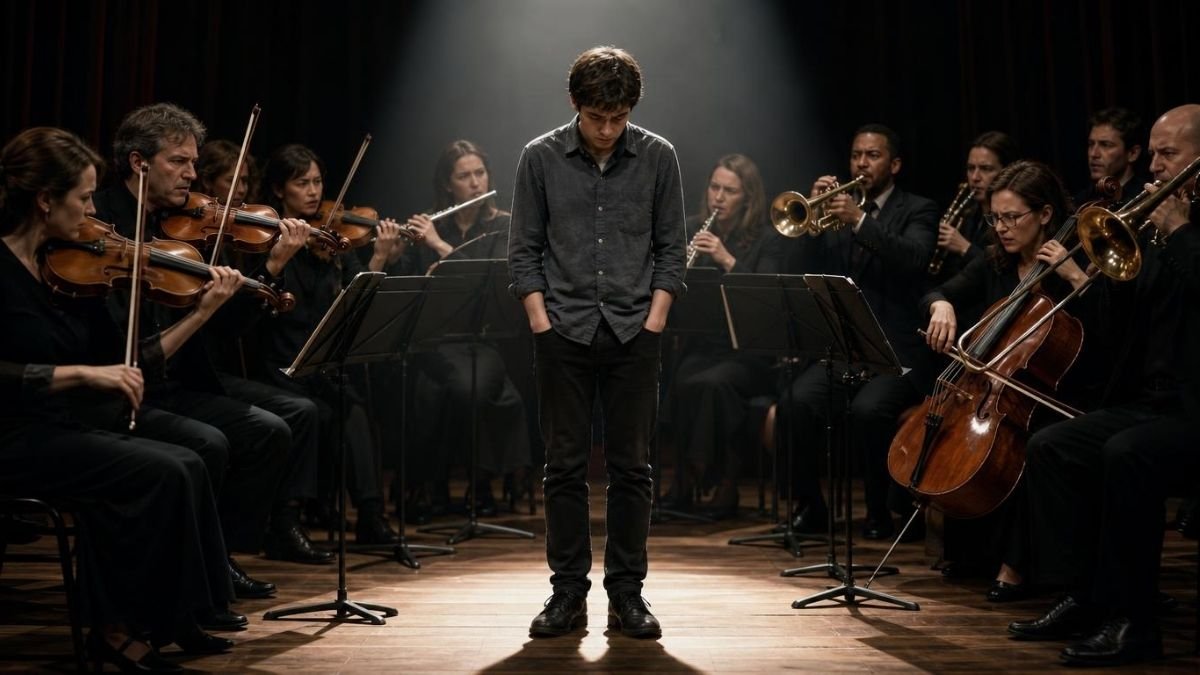
Why is the sound of consequences described as music?
Because that's what the phrase says, and it's genuinely strange when you slow down and hear it. Face the music. Not face the storm, or the fire, or the judge. Music — the thing we usually associate with pleasure.
The origins are disputed, and I like that all the leading theories point at the same picture. One says it comes from the theater: an actor stepping out to face the orchestra pit and the audience beyond it, whatever's coming, applause or otherwise. Another connects it to military dismissal — a soldier drummed out of the regiment to the beat of the drums, made to walk past the assembled ranks while the instruments played. Another to cavalry, and horses being trained to hold steady against the noise of a band rather than bolt.
Different stories, same image every time. Sound arrives. You do not run. You turn your body toward it and stand.
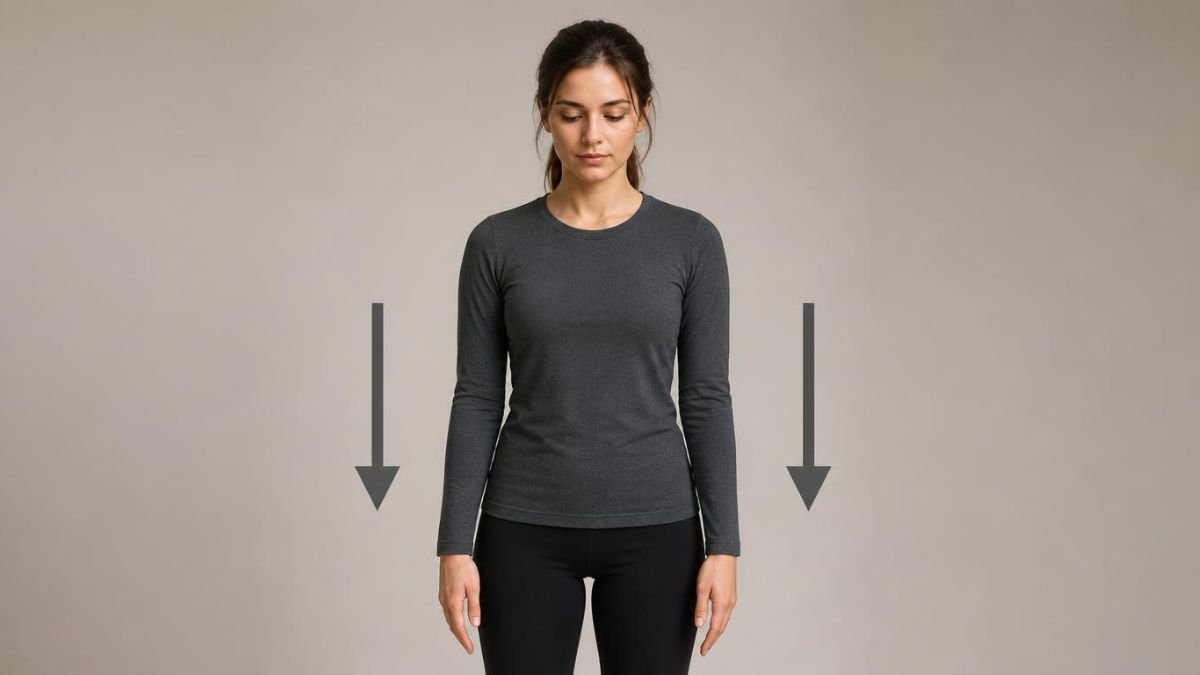
And face is the crucial verb. It's an anatomical instruction. To face something is to align your front with it — your eyes, your voice, the soft vulnerable side of you, the side without armor. Every animal knows the difference between facing and fleeing, and the difference is decided in the shoulders and hips before the mind gets a vote.
So this phrase describes a posture, not an attitude. It's not about feeling brave. It's about which direction your feet are pointed.
That's why I think it's more useful than most advice about courage. You cannot decide to feel unafraid — that's not available on demand. But you can decide which way to turn. And the strange thing, which anyone who has ever done it will confirm, is that the feeling tends to follow the body rather than the other way around. Turn toward the thing and something in you begins, slowly, to reorganize around dealing with it instead of escaping it.
Now — why music, though? I want to stay with that, because I don't think it's an accident that this image stuck when others didn't.
Music, unlike almost everything else you might face, has a defining property: it ends. It has a duration. A piece of music is a bounded thing — it begins, it proceeds, it finishes, and the room goes quiet. And crucially, the tempo is not yours to set. You can't hurry it. You can only be present for its length.
And that is exactly what a reckoning is like. The difficult conversation takes as long as it takes. The consequence has its own duration. You cannot fast-forward the meeting where you explain what you did, or the week of everyone knowing. What you can do is remain in the room for the length of the piece.
Which means this phrase contains a promise most fear-phrases don't. It says: this has an end. It's a piece of music, not a permanent climate. It will finish, and afterward there'll be silence, and you'll still be standing there.
But now the part that actually matters, and it's about what happens before.
Almost nobody's suffering, in these situations, is concentrated in the facing. It's concentrated in the avoiding. Ask anyone who has finally had the dreaded conversation and they will tell you the same thing, in the same slightly embarrassed tone: it wasn't as bad as the three weeks of not having it.
Because dread and consequence are two entirely different substances. A consequence is finite, specific, and usually smaller than imagined — it has actual dimensions. Dread is unbounded, non-specific, and runs continuously, including at night, including on days when nothing is happening. You can suffer more in a month of not facing something than the thing itself could ever cost you.
And here's the cruel arithmetic: avoidance feels like relief in the short term and is a loan at a very high rate. Every day you don't face it, you pay a small installment of dread, and the principal doesn't shrink. Usually it grows, because the situation compounds — the longer the silence, the more explaining there'll be about the silence.
So the phrase isn't really asking you to be brave. It's asking you to stop paying interest.
There's one more thing, and it's the most generous part of the image.
When you turn to face the music, you are also facing the people. In every version of the origin story there's an audience — the theater crowd, the assembled regiment. The music is never abstract; it's always playing in a room with other people in it. And what's actually being faced is being seen in the moment of your failure.
That's the real fear. Not the consequence — the witnesses. Being looked at while it happens.
And yet that's also where the phrase quietly turns, because facing people in the moment of your failure is precisely the act that ends it. The thing everyone respects is not the person who never erred; it's the person who came back into the room, stood in front of everyone, and said the true sentence. That act closes something. Whereas a person who never faces it stays permanently mid-piece, with the music playing somewhere behind them for years.
Because that's the alternative, and it's worth naming. The music doesn't stop when you turn away. You just have your back to it.
So here's what I'll leave you with. There's something you've been walking away from — you knew it before I finished this sentence, and you can hear it playing quietly behind you right now. So ask yourself the honest question: what have you already paid, in dread, to avoid a thing that has a fixed duration? And what would it cost, exactly, to turn around and let it play?



0 Comments