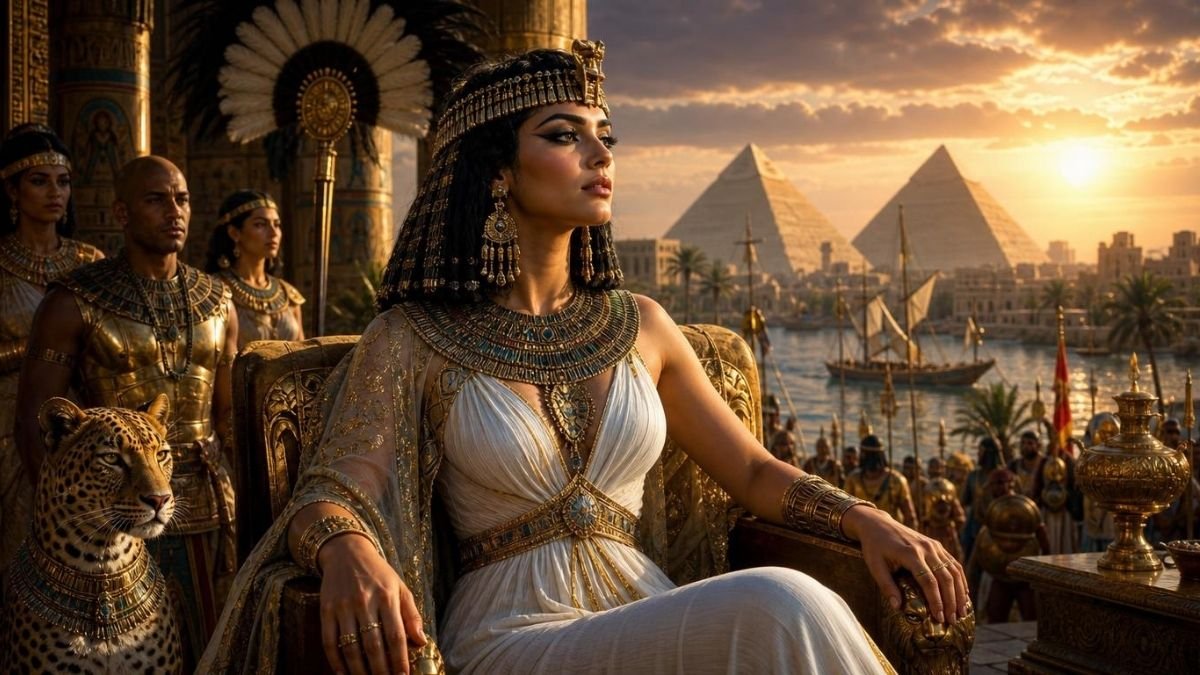
Let me start with something small.
Somewhere in the sand of the Egyptian Fayum, archaeologists found a papyrus. It's a royal decree from the year 33 BCE, granting a Roman businessman named Publius Canidius a generous tax exemption on his imports and exports. Standard bureaucratic stuff. The kind of document that survives by accident, in the thousands, from the ancient world.
But at the bottom of this one, in a different hand from the scribe's, someone has written a single Greek word: ginesthō.
"Make it happen."
Scholars have argued about it for years, and we can't prove it, but there's a real possibility that word was written by Cleopatra herself. Not a love letter. Not a curse. Not a dramatic last testament. A queen signing off on a tax break, the way a chief executive scrawls "approved" in the margin of a memo on a Tuesday afternoon.
Hold that image for a second, because I want you to notice something about your own reaction to it. Did it feel anticlimactic? A little disappointing, even? If it did, that's worth examining. It means the version of Cleopatra living in your head is not a working monarch. It's a character. And someone put her there on purpose.
So here's the question I want to build this around: how much of what you think you know about a famous person was written by the people who defeated them?
Take your time with that one. It's not just about Egypt.
The family firm was already failing
To understand Cleopatra, you have to understand that she was not, in any straightforward sense, Egyptian. She was Macedonian Greek, the descendant of Ptolemy, one of Alexander the Great's generals, who grabbed Egypt when Alexander's empire was carved up after his death in 323 BCE. The Ptolemies ruled from Alexandria, a Greek city on the Egyptian coast, in Greek, surrounded by Greek institutions, for roughly three hundred years.
They were also, and I say this with genuine affection for the historical record, a spectacular disaster of a family. The Ptolemaic dynasty ran on sibling marriage, assassination, and the kind of succession disputes that make modern corporate governance look tranquil. Brothers murdered sisters. Sons deposed fathers. At least one Ptolemy earned the nickname Physcon, which translates roughly to "Potbelly," and he'd probably have preferred the assassinations.
By the time Cleopatra VII was born around 69 BCE, the firm was in serious trouble. Her father, Ptolemy XII, had bought his throne back from Rome with borrowed money, at ruinous interest, from a Roman financier. Egypt was effectively a client state with a debt collector at the door. The independence was ceremonial. The bill was real.
This is the inheritance. Not a golden throne. A leveraged buyout gone wrong.
She came to power around 51 BCE, roughly eighteen years old, as co-ruler with her younger brother Ptolemy XIII, who was about ten. If you have ever had a work partner who was both unqualified and surrounded by people whispering that they should have your job, you have a faint, distant sense of the arrangement. Within three years, the whisperers won. Cleopatra was pushed out of Alexandria and into exile in the eastern desert, raising troops, out of options.
Pause here and put yourself in that position. You are twenty-one. You have lost the capital. Your brother's advisors control the treasury, the army, and the boy king. Rome is watching, and Rome does not intervene for free.
What's your move?
The bedsack, not the carpet
Her move was one of the most audacious pieces of political theater in recorded history, and almost everything you've heard about it is slightly wrong.
In 48 BCE, the Roman civil war spilled into Egypt. Julius Caesar had defeated his rival Pompey in Greece; Pompey fled to Egypt hoping for shelter; Ptolemy XIII's advisors, calculating that Caesar would reward them, had Pompey murdered on the beach and presented Caesar with his head. Caesar, by all accounts, was appalled rather than grateful. He occupied the palace at Alexandria and appointed himself arbitrator of the Egyptian succession.
Cleopatra was locked out of the city. Her brother's forces held the harbor. So she had a loyal Sicilian merchant named Apollodorus smuggle her past the guards and into the palace.
Not in a rolled carpet. That's Hollywood. Plutarch, our main source, describes a strōmatodesmon, a large sack or bedding-bag, the kind used to carry linens. Less glamorous. Considerably more clever, because nobody searches the laundry.
And here is the part that gets flattened in the retelling. She didn't do this because she was infatuated with Caesar. She did it because she calculated, correctly, that the single most valuable thing in Egypt at that moment was face time with a Roman general, and her brother's faction had physical control of every legitimate route to it. So she took an illegitimate one. She turned up in his rooms, uninvited, unarmed, and unannounced, and made her case in person before anyone could make it for her.
That is not seduction. That is a sales pitch delivered under conditions of extreme constraint.
Did romance follow? Almost certainly. Caesar was fifty-two, she was twenty-one, and their son Caesarion was born the following June. But notice the sequence, because Roman writers deliberately reversed it. The politics came first, and the relationship served the politics for both of them. Caesar needed Egyptian grain and Egyptian money to fund a civil war. Cleopatra needed Roman legions to win a throne. This was a deal that happened to also be an affair, and it has been remembered as an affair that happened to also be a deal.
The war that followed nearly killed Caesar. His men were pinned in the palace district; the fires he set to destroy the Egyptian fleet spread into the city and damaged part of the great Library's holdings, an act of collateral destruction we're still mourning. When reinforcements finally arrived, Ptolemy XIII drowned trying to flee across the Nile. Cleopatra was queen again, this time with the backing of the most powerful man in the Mediterranean.
What a working pharaoh actually does
Now let's talk about the part nobody makes films about, which is the twenty-one years of governing.
Cleopatra took over a currency in crisis and reformed it, reducing the silver content of the coinage and introducing a bronze system with marked denominations, a genuinely sophisticated move that let a cash-poor state keep an economy running. Modern economists would recognize it instantly: she was managing a devaluation.
When the Nile floods failed in the early 40s BCE and famine followed, she opened the royal granaries. When Alexandria and the countryside were in tension, she issued decrees in both Greek and Egyptian traditions, presenting herself simultaneously as a Hellenistic monarch to the Greeks and as the living Isis to the Egyptians. There's a relief at the temple of Dendera showing her and Caesarion in full pharaonic style, making offerings to the gods, indistinguishable in form from images carved fifteen hundred years earlier.
And she learned Egyptian. This sounds minor. It is not. Plutarch says she could speak with Ethiopians, Hebrews, Arabians, Syrians, Medes, and Parthians without an interpreter, and that she was the first of her line to actually learn the language of the people she ruled. Nearly three centuries of Ptolemies had governed Egypt in Greek, from a Greek city, without troubling to learn the local tongue. She broke that.
Stop and think about what that says about her strategic mind. Every one of her ancestors treated Egypt as a possession. She treated it as a constituency.
Have you ever worked somewhere where the leadership didn't speak the language of the floor, literally or otherwise? Where decisions came down from a room full of people who had never done the job? You already know the cost of that gap. Cleopatra closed it, and it bought her something no Ptolemy before her had: domestic legitimacy in a moment when she needed every ally she could find.
Antony, and the problem of picking a Roman
Caesar was assassinated in March of 44 BCE. Cleopatra, who had been staying in a villa across the Tiber in Rome, went home. The Roman world split, and she now faced the same problem she had faced at twenty-one, in a harder form: Egypt could not defeat Rome, so Egypt had to be useful to whichever Roman won.
She chose Mark Antony, who controlled the eastern half of the empire and needed exactly what she had: money, grain, and a base of operations for his planned campaign against Parthia.
Their first meeting at Tarsus in 41 BCE is where the legend really takes off, and she engineered it deliberately. She arrived by river, on a barge with gilded stern and purple sails, dressed as Aphrodite, with attendants costumed as sea nymphs and cupids, perfumed smoke drifting over the water. Antony had summoned her to answer charges of disloyalty. She turned the summons into a coronation.
Understand what she was doing. Antony styled himself as the new Dionysus. Cleopatra arrived as Aphrodite coming to meet Dionysus, which in the visual language of the eastern Mediterranean meant: this is a meeting of divinities, not a hearing. Before a word was spoken, she had reframed the entire encounter. That's not vanity. That's branding, executed with a precision most modern political consultants would envy.
The relationship lasted, on and off, for a decade. They had three children. And in 34 BCE, at the ceremony we call the Donations of Alexandria, Antony distributed eastern territories to those children and declared Caesarion the legitimate son and heir of Julius Caesar.
That last part was the fatal move, though not for the reason you'd think. Octavian, Caesar's adopted great-nephew, had built his entire claim to power on being Caesar's heir. A living biological son was an existential threat to him. From that moment, the war was inevitable, and Octavian had exactly the propaganda he needed.
The war of the narrative
Here is where I want you to pay close attention, because this is the mechanism by which Cleopatra the administrator became Cleopatra the temptress.
Octavian could not credibly declare war on Mark Antony. Rome had just clawed its way out of one civil war and had no appetite for another. So he didn't. He declared war on Cleopatra.
And to make that palatable, he ran what we would now recognize as a full disinformation campaign. Antony was not a rival Roman general; he was a good man unmanned by a foreign witch. Cleopatra was not a head of state; she was an oriental seductress who had bewitched a Roman into betraying Rome. She drank pearls dissolved in vinegar. She planned to rule from the Capitol. She was, in the poet Horace's phrase, a monster.
The genius of it, and it was genius, is that it converted a Roman civil war into a patriotic defense against a foreign woman. Same war. Completely different story. And the story was the point.
The Battle of Actium in September of 31 BCE ended it. Cleopatra's ships withdrew mid-battle, which Roman sources presented as cowardice and which modern historians tend to read as a planned breakout with the treasury when the position became untenable. Within a year, Octavian was at Alexandria. Antony killed himself. Cleopatra, held under guard and facing the certainty of being paraded through Rome in a triumph, killed herself in August of 30 BCE.
The asp is probably a story too. Plutarch, writing over a century later, reports the snake but admits nobody actually knows. Some modern scholars find a poison or an ointment more plausible. What we can say is that Octavian's version, in which Egypt's queen dies by an Egyptian serpent in a suitably exotic tableau, was extremely convenient for Octavian.
She was thirty-nine. Caesarion was hunted down and killed within days. Egypt became a Roman province, and the three-thousand-year story of the pharaohs ended.
Why this still matters, and why the search continues
Two things.
First, the pattern. Watch how often a capable woman in a position of power gets recategorized as a seductress, and how consistently that recategorization comes from the people she threatened. It happened to Cleopatra. It has happened, in softer forms, to women in politics and business within your lifetime and mine. When you hear a leader's competence explained away by their personal life, ask who benefits from that explanation. It's usually not hard to find out.
Second, the story isn't over. Cleopatra's tomb has never been found. Alexandria's royal quarter sank after earthquakes and a tsunami in the fourth century CE, and much of Cleopatra's city now lies under the harbor or under the modern one.
For more than twenty years, the Dominican archaeologist Kathleen Martínez has argued that Cleopatra was buried not in Alexandria but at Taposiris Magna, a temple complex to Osiris about thirty miles west, on the grounds that Cleopatra identified with Isis and would have wanted a burial beyond Octavian's reach. Mainstream Egyptology has largely disagreed with her.
Then in 2022 her team found a tunnel more than a kilometer long, cut deep through the sandstone beneath the temple and running toward the sea. And in September 2025, working with Bob Ballard, the oceanographer who found the Titanic, they announced a submerged port off the site, complete with anchors, columns, and polished flooring, apparently aligned with that tunnel. Egypt's antiquities authorities noted that no ancient source ever mentioned a harbor there at all.
None of this proves anything about a tomb. Martínez herself calls it a beginning rather than an ending. But it means that a woman who died in 30 BCE is still generating headlines in the 2020s, and that somewhere under the Mediterranean or under a street in Alexandria, there may still be a room nobody has opened.
One last question before we move on. If that room is found tomorrow, and it contains her, what do you think we'll actually learn? And what do you think we'll immediately start arguing about instead?
Give that a minute. Then let's go argue with everything I just told you.
Let's Get Critical
Alright. I spent quite some time telling you that Cleopatra was a serious administrator misrepresented by Roman propaganda. Now let me take that apart, because I think I was doing something to you and you should see the mechanism.
Start with the most obvious problem: I have been correcting one myth by building another.
There's a fashionable move in popular history right now, and I made it in front of you. It goes: "You think X was a scandalous figure, but actually X was a competent professional." It feels rigorous. It feels like debunking. But notice what it smuggles in. It assumes that "competent administrator" is the respectable category and "person of legendary appetites" is the disreputable one, and that rescuing someone means moving them from the second box to the first. That's a modern, middle-class, managerial value system, and I applied it to a Hellenistic god-queen without asking whether it fits. Cleopatra did not want to be remembered as a good manager. She staged herself as Aphrodite on a perfumed barge. The spectacle wasn't a distraction from her politics; in the ancient Mediterranean, spectacle was politics. By insisting she was really a sober policy wonk, I may have flattened her just as badly as Hollywood did, only in a direction that flatters my audience's taste.
Second problem, and this one is more serious: our sources are terrible.
I quoted Plutarch several times. Plutarch was writing around 100 CE, more than a century after Cleopatra died, in Greek, for a Roman-dominated readership, using sources that were themselves shaped by the winners. Cassius Dio is later still. We have no writing from Cleopatra herself beyond that single disputed word on a papyrus. Almost every colorful detail I gave you comes from hostile or distant witnesses.
So when I told you the bedsack was smarter than the carpet, or that she spoke nine languages, or that she was the first Ptolemy to learn Egyptian, I was doing something slippery. I was rejecting Plutarch's framing while keeping Plutarch's facts. That's not consistent. If the source is compromised on her character, why do I trust it on her linguistic skills? The honest answer is that I don't fully, and neither should you. The multilingualism story is plausible and widely accepted, but it comes from the same pen that gave us the pearls and the poison.
Third, let's interrogate the "she was a great ruler" claim on its own terms, using outcomes.
Egypt ceased to exist as an independent state on her watch. That's the bottom line. A three-hundred-year dynasty ended, a three-thousand-year tradition of pharaonic rule ended, her country was annexed, and her children were either killed or raised as trophies in the household of her enemy. You can argue, and I would argue, that the structural forces were overwhelming and that Rome was going to swallow Egypt eventually. But that defense is available to every failed leader in history, and we don't extend it to all of them equally. Would we be this generous if the ruler in question were a man with the same résumé? Some historians say we're overcorrecting, that in our eagerness to rescue her from misogyny we've quietly excused a series of catastrophic strategic bets, including backing Antony after his Parthian campaign collapsed, and including whatever actually happened at Actium.
And here's an uncomfortable extension. The currency reform I praised? Debasement is a tax on the poorest people who hold coins. The famine relief? It came with decrees that historians read as favoring Alexandria over the countryside. Cleopatra ruled an extractive, hierarchical state built on the labor of Egyptian peasants who saw very little benefit from any of her sophistication. When I called her a leader who "treated Egypt as a constituency," I was applying democratic vocabulary to an absolute monarch who was worshipped as a god. Learning the language of the people you tax is not the same as governing for them.
Fourth, I want to question my own tidy propaganda story, because it's a little too satisfying.
The narrative I gave you was: Octavian invented the seductress to justify a civil war. That's largely true, and it's well documented. But it lets Cleopatra off a hook she probably belongs on. She was not a passive victim of image-making. She was an exceptionally aggressive image-maker herself. The Aphrodite arrival, the Isis identification, the Donations of Alexandria, the claim that Caesarion was Caesar's true heir: these were all her productions, and several of them were provocations aimed directly at Roman anxieties. She played a high-stakes game of divine self-presentation and she was extremely good at it. Octavian didn't invent her mythology out of nothing. He took the mythology she had built and turned it around on her. That's a much more interesting story than victimhood, and it gives her more credit, not less.
Fifth, a word about the tomb.
I gave you the Taposiris Magna material because it's genuinely exciting and it's genuinely current. But I should flag that I presented a minority position with a lot of narrative momentum behind it. Most Egyptologists still think Alexandria is the likelier burial site, for the simple reason that ancient sources say she was buried near the palace and that's usually where monarchs go. Martínez has been searching for over twenty years without finding a tomb, and a tunnel and a harbor are not a tomb. There is also a structural problem in modern archaeology worth naming: documentary funding and public attention flow toward dramatic hypotheses, which creates real pressure to frame every find as a step toward the big one. That doesn't make the work dishonest. It does mean you should read the headlines with a small amount of salt.
So where does that leave us?
Roughly here. We know Cleopatra held power for twenty-one years in an almost impossible position. We know she was intelligent, multilingual, and a formidable political performer. We know she lost, and we know the victors wrote most of what survives. Beyond that, nearly everything is inference, and the confident portrait I painted for you, like the Hollywood one and like Octavian's, is partly a projection of what my own era finds admirable.
The useful takeaway isn't a corrected Cleopatra. It's the habit. When someone hands you a satisfying revision of a familiar story, including this one, the first question is not "is this more accurate?" It's "what does this version want me to feel, and who does that serve?" Apply that to me. Apply it to the next documentary you watch. It's a better skill than any single fact I could give you.
Language Focus: Vocabulary and Speaking
Word Power
Let's start with shrewd, which I used to describe Cleopatra's instinct for turning up in Caesar's rooms uninvited. Shrewd means sharply intelligent in a practical, worldly, slightly self-interested way. It's not the same as clever and it's definitely not the same as wise. A shrewd person reads a situation fast and sees the angle that other people miss, usually an angle involving their own advantage. What makes this word so useful is its moral ambiguity. If you call someone shrewd, you're paying them a compliment, but a slightly guarded one. "She's a shrewd negotiator" means she'll get the better deal and you should watch her. It works beautifully in business and politics: a shrewd investment, a shrewd judge of character, a shrewd move. Watch the pronunciation, because it trips people up: it rhymes with "food," not with "crowd." In French, perspicace or astucieux. In Spanish, astuto or sagaz. In Italian, accorto or scaltro. In Arabic, داهية (dāhiya) or حاذق (ḥādhiq).
That leads naturally to propaganda, which sat at the center of this whole episode. Propaganda is information, often true information, arranged and amplified to produce a political effect rather than to inform. Notice that definition carefully, because most people assume propaganda means lies. It often doesn't. Octavian's campaign against Cleopatra worked precisely because it was built on things she had actually done, reframed to look sinister. The word is almost always negative in English, and it's always uncountable, so you say "a piece of propaganda" or "propaganda campaign," never "a propaganda." A useful adjacent word is propagandist, meaning someone who produces it. In French, la propagande. In Spanish, la propaganda. In Italian, la propaganda. In Arabic, دعاية (diʿāya).
Now take leverage, which is one of the most quietly powerful words in professional English. Literally it's the mechanical advantage you get from a lever. Figuratively it means the power to influence an outcome because you have something the other side needs. Cleopatra had almost no military leverage and enormous economic leverage, and her entire reign was an exercise in converting one into the other. You'll hear it constantly in negotiation: "we have no leverage here," "that gives us leverage," "he was negotiating from a position of zero leverage." It also works as a verb, meaning to use an existing asset to get more: "she leveraged her contacts in Rome." Be aware that the verb form has become corporate jargon and can sound bloated if you overuse it. Stick to the noun and you'll sound sharp. In French, un levier or un moyen de pression. In Spanish, la influencia or la baza. In Italian, la leva or il potere contrattuale. In Arabic, نفوذ (nufūdh) or ورقة ضغط (waraqat ḍaghṭ), the second literally meaning "a pressure card."
Legacy appeared when we talked about what survives a person. A legacy is what you leave behind: influence, reputation, consequences, institutions. It can be concrete, as in money left in a will, but the figurative sense dominates in modern usage. What's interesting is that legacy is neutral in a way people forget. You can leave a devastating legacy just as easily as a proud one, and phrases like "the legacy of colonialism" or "a legacy of debt" are extremely common. There's also a technical use in computing, where "legacy systems" means old software you're stuck with, which tells you something honest about how the past actually operates. In French, l'héritage. In Spanish, el legado. In Italian, l'eredità. In Arabic, إرث (irth) or تركة (tarika).
Which brings us to dynasty, a word this lesson couldn't do without. A dynasty is a succession of rulers from the same family, and by extension any family that holds power across generations. The Ptolemaic dynasty ran for roughly three centuries and ended with Cleopatra. But you'll hear the word far outside monarchy: political dynasties, business dynasties, sporting dynasties. Americans talk about the Kennedy dynasty; sports commentators talk about a team that wins repeatedly as building a dynasty. The adjective is dynastic, as in dynastic marriage or dynastic politics, and it carries a slight whiff of unearned privilege. In French, la dynastie. In Spanish, la dinastía. In Italian, la dinastia. In Arabic, سلالة حاكمة (sulāla ḥākima) or أسرة حاكمة (usra ḥākima).
Here's a phrase worth adding to your active vocabulary: to play the long game. It means to accept short-term costs or delays in pursuit of an objective much further out. Cleopatra played the long game with her Roman alliances, positioning her children for a dynastic future she wouldn't live to see. In everyday use it's high-praise, implying patience and strategic discipline: "he's not worried about this quarter, he's playing the long game." The opposite formulation is "playing the short game" or, more idiomatically, "going for a quick win." It's conversational, natural, and it makes you sound thoroughly fluent. In French, jouer sur le long terme. In Spanish, jugar a largo plazo. In Italian, giocare sul lungo periodo. In Arabic, يلعب على المدى الطويل (yalʿab ʿalā al-madā aṭ-ṭawīl).
Now, spin. In its political sense, spin is the deliberate presentation of facts in the most favorable possible light. It's the milder cousin of propaganda. Governments have spin doctors; companies put a positive spin on bad results. What I like about this word is the metaphor underneath it, borrowed from ball sports: you don't change the ball, you change how it moves. That's exactly what Octavian did. Same civil war, different spin. As a verb: "they'll try to spin the layoffs as a restructuring." As a noun it's usually uncountable, though "a positive spin" and "a different spin" are perfectly natural. In French, l'enrobage médiatique or the phrase présenter les faits sous un jour favorable. In Spanish, el enfoque interesado or manipular el relato. In Italian, la manipolazione della narrazione. In Arabic, تلميع (talmīʿ) or لَيّ الحقائق (layy al-ḥaqāʾiq), literally "twisting the facts."
Downfall is what happened to Cleopatra at Actium. A downfall is a sudden, dramatic loss of power, status, or reputation, usually with the implication that it was in some way deserved or self-caused. That last part matters. You don't normally speak of the downfall of an innocent victim; you speak of the downfall of a tyrant, a company, a champion. The most common structure is "X was his downfall," meaning X was the cause of it: "arrogance was his downfall," "the Parthian campaign was Antony's downfall." Compare it with collapse, which is more structural and less moral, and ruin, which is broader. In French, la chute. In Spanish, la caída. In Italian, la caduta or la rovina. In Arabic, سقوط (suqūṭ) or انهيار (inhiyār).
To hold your own is a phrase I'd love you to steal. It means to perform well enough against stronger opposition that you're not overwhelmed. Cleopatra held her own against Rome for two decades, which is remarkable given that she could never have beaten Rome. The nuance is important: holding your own is not winning. It's surviving with your dignity and position intact against someone more powerful. "The junior lawyer held her own against three senior partners." "The team held their own for an hour before conceding." The possessive changes with the subject: I hold my own, she holds her own, they hold their own. In French, tenir tête or se défendre. In Spanish, defenderse or plantar cara. In Italian, tenere testa. In Arabic, يصمد (yaṣmud) or يثبت أمام (yathbut amām).
Finally, hindsight, which is really the theme of the entire critical section. Hindsight is understanding an event correctly only after it has happened. It appears almost exclusively in a handful of fixed phrases, so learn those rather than the bare noun: "with hindsight," "in hindsight," "with the benefit of hindsight," and the wonderfully dry "hindsight is twenty-twenty," meaning it's easy to see clearly backward. There's also hindsight bias, the psychological tendency to believe you predicted something you did not. That bias is exactly why judging Cleopatra's decisions is so treacherous: we know how the story ended and she didn't. In French, le recul, as in avec le recul. In Spanish, la retrospectiva, as in en retrospectiva. In Italian, il senno di poi. In Arabic, الإدراك بأثر رجعي (al-idrāk bi-athar rajʿī).
Speaking Challenge
Three discourse tips before the tasks, all drawn from how this episode was actually built.
Tip one: signal that you're about to disagree with yourself. Advanced speakers don't just state opinions, they navigate between them, and English has a whole toolkit for the turn. "That said," "having said that," "then again," "although, to be fair," and "I'd push back on my own point there." Using one of these mid-argument does something powerful: it signals to your listener that you've already considered the counterargument, which makes everything before it sound more credible. Try dropping one into your next disagreement and watch the temperature drop.
Tip two: hedge your sources, not your opinions. Learners often hedge the wrong thing. They say "I think maybe possibly Cleopatra was intelligent," which sounds unconfident. What they should say is "according to Plutarch, who was writing a century later, she was multilingual." Move the uncertainty onto the evidence and keep your voice firm. Useful frames: "the sources suggest," "as far as we know," "the evidence is thin, but," and "that's contested."
Tip three: use a concrete detail as an anchor. When you're explaining something abstract, lead with one small vivid fact and let the argument grow out of it. I opened with a single word on a papyrus. Do the same in a presentation or an interview. One specific image beats three general sentences every time.
Now the tasks. Speak out loud. Record yourself if you can, and listen back once before you judge yourself, because the first listen is always the harshest.
Task one, two minutes. Describe Cleopatra's situation in 48 BCE to someone who knows nothing about her, and make them care. Use at least four of these: shrewd, leverage, dynasty, to hold her own, to play the long game. Don't tell the whole story. Set up the problem and stop at the moment she gets into the sack.
Task two, three minutes. Argue the position I argued against in the critical section: that Cleopatra was ultimately a failed ruler, because Egypt fell on her watch. You don't have to believe it. That's the point. Use downfall, legacy, and at least one of the disagreement signals from tip one. Then, in the last thirty seconds, switch sides and give the strongest reply to yourself you can think of.
Task three, five minutes. This is the real one. Pick a public figure from your own country's history whose reputation was shaped mainly by their opponents. Explain who wrote the dominant story about them and what that story was designed to achieve. Use propaganda, spin, and hindsight, and try to include at least one moment where you hedge the source rather than the opinion.
If five minutes feels long, it's supposed to. Extended solo speech is the single most underpracticed skill in language learning, because it's uncomfortable and there's nobody to rescue you. That discomfort is where the fluency actually lives. Start with two minutes if you must, then push it out over the week.
And one small piece of encouragement to close on. Cleopatra's most impressive credential wasn't her fleet or her treasury. It was that she learned to speak to people in their own language when nobody in her family had bothered for three hundred years, and it changed what was politically possible for her. You're doing the same thing. Keep going.
If you want to take this even further, you don't want to miss the special Fantasy Interview in Danny Debates series where he interviews Cleopatra. You can read the entire interview: Cleopatra: The Queen Rome Had to Rewrite | Danny Debates.







0 Comments