- The Villain Who Wouldn't Stay Simple
- From Monster to Mirror — The Historical Arc
- The Psychology of Villain Fascination
- The Interactive Revolution — Villains as Characters You Build
- What the Villain's Evolution Tells Us About Culture
- Why This Matters Beyond Entertainment
- LET'S GET CRITICAL
- FANTASTIC GUEST — CARL JUNG
- EDUSTORY — THE NPC
- AUTHOR'S COMMENTARY
- LET'S DISCUSS
- WHAT NOW? — FRAMEWORK & 7-DAY ACTION PLAN
- LANGUAGE FOCUS: VOCABULARY & SPEAKING
- LANGUAGE FOCUS: GRAMMAR & WRITING
- Let's Play & Learn
- Check Your Understanding | The Quiz
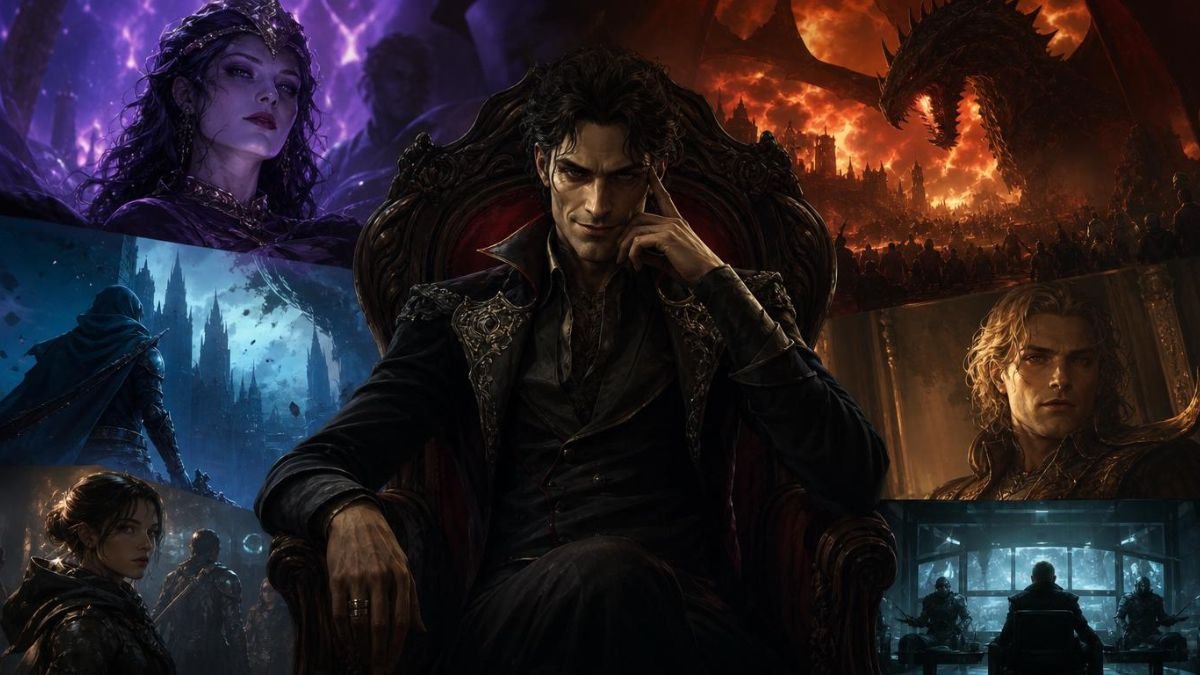
The Villain Who Wouldn't Stay Simple
There is a moment in almost every great contemporary story when you notice something that shouldn't be happening. You're watching a man poison his brother, manipulate his nephew, and plot the destruction of everything good in his kingdom — and somewhere in the architecture of your attention, you realize you're more interested in him than in anyone else on stage. You're more interested in Iago than Othello, in Milton's Satan than in God, in Hannibal Lecter than in Clarice Starling. You're not rooting for them, exactly, but you're watching them the way you watch someone doing something extraordinarily dangerous — with an alertness that is its own form of investment.
This is one of the oldest puzzles in literary criticism and one of the most revealing patterns in contemporary media consumption: the antagonist captures us in ways the protagonist often cannot. And as storytelling has evolved — from myth to novel to film to interactive game — the villain has evolved with it, from a simple embodiment of evil into something that the best writers and designers build with the same complexity they give to people they love.
From Monster to Mirror — The Historical Arc
The earliest antagonists in human storytelling were barely characters. They were functions. In myth, the dragon doesn't have an interiority. It has a hoard and an appetite. The giant is large and violent and that is the whole story. This isn't because ancient storytellers were unsophisticated — it's because those stories were serving a different purpose. The monster outside the firelight isn't a person to be understood. It's a category: everything that threatens, everything that must be driven back.
The shift toward psychological complexity begins, arguably, with the Greeks, who gave their villains — their Clytemnestras, their Medeas — motivations that the audience was expected to engage with rather than merely judge. These are people who do monstrous things for reasons that are, if you follow the chain of causation, comprehensible. Clytemnestra kills her husband because he sacrificed their daughter. The act is horrific. The cause is something a parent in the audience might recognize.
This movement — from monster to motivated person — accelerated through Shakespeare, who essentially invented the psychologized antagonist in its modern form. Iago is the first great villain of English literature not because of what he does but because of what we don't know about why he does it. His stated motives (jealousy, racism, wounded pride) seem disproportionate to the scale of his destruction, which is exactly the point. The space between motivation and action is where psychology lives, and Shakespeare left that space deliberately open.
The Romantic Turn and the Sympathetic Devil
The Romantic period in literature committed fully to the most radical move in the history of the antagonist: it made Satan the hero. Milton's Satan in Paradise Lost is magnificent, eloquent, and driven by a recognizable psychology of wounded pride and principled (if catastrophically misdirected) resistance to authority. The Romantics read him as the true hero of the poem, and the critical debate that followed — is Satan a hero, a villain, or something the poem refuses to resolve? — is still producing scholarship.
This Romantic inheritance runs directly into modernity. The anti-hero — a protagonist with antagonistic qualities — is in many ways the descendant of Milton's Satan: someone whose motives we understand, whose grievances we may share, whose methods we deplore, and whose story we cannot look away from.
The Psychology of Villain Fascination
Why does this work on us? The psychological literature on narrative engagement suggests several mechanisms that operate simultaneously when we encounter a well-constructed antagonist.
The Safe Laboratory of Dark Experience
The theory of narrative transportation describes how immersive story engagement temporarily changes our beliefs, attitudes, and emotions. When we're fully transported into a narrative, we can experience perspectives that would be inaccessible or intolerable in real life. The villain's perspective offers something the hero's cannot: it lets us inhabit a logic of self-interest, resentment, or nihilism without consequence.
There's research suggesting that engaging with dark fictional characters can actually function as a kind of emotional inoculation — we process and understand certain destructive impulses through the safety of fiction rather than encountering them for the first time in reality. The villain is a safe laboratory for understanding the part of human psychology that produces harm.
The Mirror Problem
There's a more uncomfortable explanation, and it's the one that makes the phenomenon genuinely interesting: we recognize villains because they are exaggerated versions of things we have felt. The rage. The sense that we've been underestimated or wronged. The wish to be feared rather than overlooked. The conviction that if only people understood our circumstances, they would understand why we did what we did.
Walter White's famous arc in Breaking Bad is built entirely on this recognition. He does not begin as a monster. He begins as a man who feels unappreciated — by his job, by his past, by the world. His transformation into Heisenberg is comprehensible precisely because the initial emotional grammar of his motivation is something most audiences have felt in a diluted form. The show does not ask you to approve of what he becomes. It asks you to understand how someone gets there.
This is the mirror problem: the most powerful antagonists show us a version of ourselves that we recognize without wanting to claim.
The Interactive Revolution — Villains as Characters You Build
The evolution of the antagonist in video games and interactive media represents something qualitatively new in the history of storytelling. In traditional narrative, you observe the villain. In games, you can become them.
From the earliest text adventures to contemporary narrative-driven games, interactive media has expanded the antagonist in two distinct directions. In some games, the player embodies a morally complex character whose actions — destructive, violent, ruthless — are the primary mode of engagement. In others, the game presents exceptionally rich villain characters whose backstories, motivations, and interiorities the player can choose to explore in depth.
The Lore Dimension — When Players Become Archivists
One of the most remarkable phenomena in contemporary gaming culture is what might be called villain archivism: the dedicated fan communities who assemble, analyze, and theorize about the backstories of antagonists in extraordinary depth. The lore communities around games like Dark Souls, Hollow Knight, or Hades involve players spending thousands of collective hours reconstructing the internal lives of characters the game describes only fragmentarily.
This isn't simply fandom — it's an extension of the reader's interpretive instinct into an interactive medium. The game withholds; the community infers. The villain's hidden psychology becomes a collaborative construction project.
Moral Agency and the Weight of Choice
The more sophisticated development in interactive antagonists is the rise of games that force the player to make choices about whether to understand, spare, or destroy a villain who has been rendered complex enough that neither choice is emotionally simple. Games like Undertale, which allows the player to spare every enemy including its final boss Flowey — a character whose arc is a masterclass in corrupted idealism — create a form of moral engagement with antagonists that purely passive media cannot achieve.
When you can choose whether to kill a villain you understand, the act of choosing becomes a moral examination. The game is not just telling you about the complexity of moral judgment. It is making you perform it.
What the Villain's Evolution Tells Us About Culture
The modern antagonist's psychological complexity is not merely a craft development. It reflects a cultural shift in how we think about moral responsibility, causation, and the nature of human evil.
The flat villain of earlier storytelling embodied a worldview in which evil was a category — something essentially different from the good. The complex villain of contemporary fiction embodies a worldview in which evil is a process — something that happens to and through ordinary people under specific circumstances. This is the worldview of modern psychology, of trauma studies, of criminology. The most destructive people in history were not monsters. They were human beings in conditions that produced monstrous behavior.
This is genuinely challenging to hold. It does not mean that terrible acts are excusable. It does not mean that understanding causation eliminates responsibility. It means that if we actually want to understand why harm happens in the world — rather than simply having someone to hate — we have to do the harder psychological work of the complex villain: following the chain of causation without either excusing or refusing to see.
The Risk of Glamorization
This is where the craft has to be careful, and where it sometimes fails. The more compelling a villain is made, the greater the risk of glamorizing the destructive worldview they embody. Some critics have argued that Walter White's ending — pursued with cool competence to the last — glamorizes the criminal mastermind in ways that undermine the show's ostensible critique. The discourse around certain "sigma male" villain archetypes in online spaces suggests that not everyone reading the mirror arrives at self-examination. Some arrive at admiration.
A well-crafted villain makes you understand how someone becomes what they are. A poorly-crafted one makes that transformation look attractive. The line between them is the difference between craft and irresponsibility.
Why This Matters Beyond Entertainment
The sophisticated antagonist matters not just as a formal craft achievement but as a cultural and psychological practice. Fiction has always been one of the primary means by which societies examine things that are too difficult to confront directly — violence, moral failure, the cost of ideology, the fragility of goodness.
The villain who is complex enough to reveal the chain of causation between ordinary human psychology and extraordinary harm is performing a function that flat evil can never perform: it makes visible the machinery of how bad things actually happen. This is not comfortable knowledge, but it is important knowledge.
Understanding the antagonist is, ultimately, a practice in understanding ourselves — the parts of ourselves that we keep safely in fiction, the parts we manage through story, and the parts that only become visible when a well-written villain turns the mirror the right way.
LET'S GET CRITICAL
The article makes a compelling case for the cultural and psychological value of the complex antagonist, and most of that case is well-supported. The psychological literature on narrative transportation is solid. The historical arc from functional monster to psychologized character is real and traceable. The argument that complex villains function as mirrors for human psychology is one of the more durable insights in narrative theory.
But let's push back on several places where the argument glosses over genuinely difficult complications.
First, the neuroscience and psychology of what actually happens when people engage with dark fictional characters is considerably more contested than the article's framing suggests. The "safe laboratory" theory — that engaging with dark characters through fiction allows us to process and understand destructive impulses safely — is one theory. There's also a body of evidence suggesting that heavy consumption of narratives featuring certain types of violence or moral corruption can normalize those patterns rather than inoculate against them. The cultivation theory of media effects, associated with George Gerbner's extensive research, argues that long-term exposure to media representations shapes our sense of what is normal in the world.
The research on this is genuinely mixed. Some studies show desensitization effects; others show no effect or even a clarifying effect on moral reasoning. What's conspicuously absent from the article's psychology section is any engagement with this contested literature. The "safe laboratory" framing is presented as established theory when it is, more accurately, one school of thought in an ongoing debate.
Second, the article's treatment of the interactive media dimension is interesting but overly optimistic. The argument that games which make you choose whether to spare or kill a complex villain "create a form of moral engagement that passive media cannot achieve" is genuinely compelling for the specific games cited. But the broader landscape of video game antagonists is considerably darker. The vast majority of combat in video games involves killing enemies whose interiority is designed to be ignored — enemies who are complex enough to move and threaten but not complex enough to create moral friction. The "lore archivism" phenomenon the article describes is real, but it applies to a relatively small subset of games. Most games that feature enemies treat those enemies as functional obstacles in exactly the same way that ancient myth treated the dragon.
Moreover, the games that actually do give players moral choice about complex antagonists frequently find that players do not engage with that choice the way the designers intended. Undertale — the article's primary example — is a case study in how a game can intend moral complexity and have large segments of its player base respond with genocide runs, systematic violence against characters the game has made emotionally available. This doesn't invalidate the design achievement. It does complicate the claim that the interactive form creates moral engagement in any reliable way.
Third, let's examine the claim about Walter White more carefully, because it's the article's key contemporary example and it has real complications. The argument is that White's arc is compelling because his initial motivation — feeling underappreciated — is something audiences can relate to, and the show asks us to understand how someone gets from there to Heisenberg. This is accurate. But there's a significant critical tradition that argues Breaking Bad glamorizes its villain in ways that undermine the stated moral argument. The show's cinematography, music, and editing treat Heisenberg's moments of competence with an aesthetic reverence that is hard to distinguish from admiration. The finale — in which White essentially wins, dies on his own terms, and is given a beautiful death scene — is difficult to read as a critique of Heisenberg's worldview. It reads more like a celebration of it.
Vince Gilligan, the show's creator, has said in interviews that he intended the audience to turn on Walt, and expressed surprise that many viewers remained sympathetic throughout. This gap between intent and reception is itself significant. A well-crafted villain, the article argues, makes you understand rather than admire. But the empirical evidence from audience reception is that understanding and admiring are not reliably separable.
Fourth, the article's claim that the complex villain "reflects a cultural shift toward understanding evil as a process" is worth interrogating carefully. Yes, this is one prominent cultural tendency — the therapeutic, psychological framing of harmful behavior in terms of causation and condition. But there's an equally strong countercurrent: the persistent demand in popular culture for flat villains who can bear the full weight of projected hatred. The rise of the complex anti-hero in prestige TV coexists with the continued dominance of uncomplicated villainy in franchise blockbusters, where the villain's simplicity is often a feature rather than a limitation because it allows the hero's violence to be morally uncomplicated.
The claim that complexity is the direction of cultural evolution is true for a specific tier of prestige storytelling. It is not a description of the mainstream. Most people's primary encounters with fictional antagonists are still with the flat variety.
Fifth, there's a class and cultural dimension to villain admiration that the article doesn't engage with. The "sympathetic villain whose grievances we recognize" narrative has an interesting distribution: it tends to cluster around villains whose grievances are individual and psychological (they were wronged; they were underestimated; they feel overlooked) rather than villains whose grievances are systemic and political. We get richly psychologized individual criminals and fallen idealists. We get considerably less sympathetic treatment of, say, revolutionary political villains whose motivations are collective rather than personal. The psychological framework of villain complexity implicitly centers individual psychology and individual moral failure, which is itself a culturally specific choice.
FANTASTIC GUEST — CARL JUNG
For this edition's Fantastic Guest, the choice is almost too obvious, but obvious for reasons worth examining. Carl Jung — Swiss psychiatrist, founder of analytical psychology, and the man who gave us the concept of the Shadow — spent his career arguing that the human psyche contains everything, including the parts we find most disturbing. His concept of the Shadow is arguably the most precise psychological framework for understanding why we're drawn to fictional villains. The Shadow is not just the dark side of the personality; it's the repository of everything the conscious self has rejected, suppressed, or refused to acknowledge. Villains, in Jungian terms, are projections of collective Shadow content — and our fascination with them is the fascination of the repressed recognizing itself. Jung would have a great deal to say about Walter White, about the "sigma male" phenomenon, and about what the specific villains a culture produces tell us about what that culture cannot admit about itself.
The Interview
Danny: Carl, welcome. I want to start with the most direct version of the question: from your framework, why do we find fictional villains so compelling?
Carl Jung: Because they are us. Or more precisely: they are the parts of us that we have spent enormous energy pretending don't exist. The concept of the Shadow is not metaphorical in the way people sometimes assume — it is a description of a real psychological mechanism. Every quality a person condemns, every impulse they suppress, every aspect of themselves they consider incompatible with their self-image, goes into the Shadow. It doesn't disappear. It accumulates. And when someone in fiction embodies those accumulated qualities with confidence and without shame — when the villain says, in effect, "I want what I want and I will have it and I don't care what you think" — the unconscious recognition is immediate and intense. What looks like fascination with the villain is, in Jungian terms, a recognition of one's own Shadow content.
Danny: That's a beautiful theoretical framework, but let me push on it practically. Most people who love Hannibal Lecter don't actually want to eat anyone. Isn't the gap between the Shadow content and the fictional villain enormous enough that the recognition you're describing is somewhat metaphorical?
Carl Jung: You're raising exactly the right question, and the answer is subtler than you're implying. The Shadow does not contain desires in their literal form — it contains their psychological essence. What Hannibal Lecter embodies for most audiences is not the desire to consume human flesh. It is something more abstract: the desire for absolute autonomy, for total disregard of social constraint, for the exercise of ruthless intelligence without apology. The extreme literalism of the action is the fictional amplification — the artist's way of making the abstract viscerally palpable. The recognition the audience feels is at the level of the psychological essence, not the specific act. And I would note: if you ask people what they actually find compelling about Hannibal Lecter, they never say "I admire his cooking." They say "his intelligence," "his composure," "his refusal to be diminished." These are Shadow qualities, not cannibalism.
Danny: You developed the concept of the Shadow while also writing about mythological and archetypal patterns. The article traces the villain from ancient monster to psychological complex. Does the ancient monster serve the same Shadow-recognition function?
Carl Jung: No, and this is an important distinction. The ancient monster is not a projection of the Shadow — it is a projection of fear. There is a fundamental difference between the Shadow (the disowned self) and the Other (the genuinely alien threat). The dragon at the firelight's edge represents the latter: it is not a distorted self, it is an external annihilation. The movement toward psychological complexity in antagonists that the article traces is, in my terms, a shift from monster to Shadow figure. The psychologically complex villain invites recognition. The monster invites only the relief of its destruction.
Danny: Let me ask you about the cultural specificity of this. The article suggests the complex villain reflects a broader cultural move toward understanding evil as a process rather than a category. What do you make of that claim?
Carl Jung: It is partially true and partially self-congratulatory. What I observe about cultures is that they project their collective Shadow onto specific groups and figures, and those projections tell you more about the culture than about what they're projected onto. A culture that produces complex, sympathetic individual villain narratives is not necessarily more enlightened about human evil — it may be more sophisticated at individual-level psychological insight while remaining profoundly unreflective about its collective Shadow. The things a culture cannot admit about its own systemic behavior, its historical crimes, its structural injustices — these are projected outward and encoded not in the complex villain but in the flat one: the foreign terrorist, the deranged outsider, the incomprehensible monster from elsewhere. The prestige television anti-hero and the franchise blockbuster villain coexist precisely because they serve different Shadow functions.
Danny: That is a remarkably sophisticated critique of the media landscape to be coming from someone born in 1875.
Carl Jung: The archetypes do not date. I will grant you the specific examples are newer. What I am describing is the difference between individual Shadow work and collective Shadow work — and most cultures that have become good at the former remain remarkably resistant to the latter. Your most celebrated complex villain narratives are usually about individual moral failure. They are rarely about institutional moral failure, or about the ways good people systematically produce bad outcomes through ordinary participation in unjust structures. The systemic villain is the Shadow that the current cultural moment least wants to look at.
Danny: Let's talk about the risk of glamorization that the article raises — the concern that rendering villains too compelling makes the destructive worldview attractive rather than cautionary. From your framework, what's the difference between Shadow recognition and Shadow seduction?
Carl Jung: This is the essential question. Shadow recognition is what happens when the unconscious content is made visible and can be integrated — when the individual, having recognized something in the fictional villain, can examine that recognition consciously and decide what to do with it. Shadow seduction is what happens when the content is made visible but the recognition stops at identification rather than proceeding to integration. The person who watches Walter White and thinks "this is how ordinary resentment can metastasize into catastrophic harm" has performed Shadow recognition. The person who watches Walter White and thinks "this is who I should be" has been seduced by Shadow content. The difference lies entirely in whether the conscious ego is engaged in the recognition. And this is partly the artist's responsibility: a well-crafted villain makes the Shadow visible without making it aspirational. The failure mode is a villain rendered so glamorously that the aesthetic experience overwhelms the moral one.
Danny: You've described the villain as a "Shadow figure" with great confidence. But isn't there a risk in reducing villain fascination to a single theoretical framework? The article also mentions narrative transportation, moral engagement through gaming, cultural mirrors — isn't Jungian Shadow projection one theory among several rather than the explanation?
Carl Jung: I did not say Shadow projection was the only mechanism. I said it was a real one, and that it was undertheorized in your article's framework. The mechanisms are not mutually exclusive. Narrative transportation is the experiential description of what happens. Shadow recognition is a psychological description of why that specific type of narrative content produces the specific type of engagement it does. They describe the same phenomenon at different levels of analysis. I would, however, note that the Shadow framework has the advantage of explaining not just why we are fascinated by fictional villains but why we are fascinated by these specific villains — why the qualities that recur in compelling antagonists (ruthless competence, freedom from social constraint, refusal to perform contrition, willingness to pursue self-interest without apology) are exactly the qualities that modern social life requires us to suppress most thoroughly.
Danny: One more question — and I should note this is one of the stranger interviews I've conducted, which is saying something. What villain do you think the current cultural moment most needs to examine?
Carl Jung: The most urgent Shadow figure is not a fictional one. It is the collective self-image of modernity — the story that civilization tells about itself as the culmination of history, the beneficial force, the rational corrective to what came before. That story has a Shadow of extraordinary size and darkness, and no narrative has yet found a form adequate to make it visible in the way that Breaking Bad made Walter White visible. When someone does, it will be the most important piece of storytelling of the age. Whether anyone will watch it is a different question.
Danny: Carl Jung, thank you for being simultaneously illuminating and profoundly unsettling, which I suspect is the intended effect.
Carl Jung: The Shadow does not comfort. It only clarifies.
EDUSTORY — THE NPC
Declan had been playing the game for six weeks, and he had not killed the Warden once.
This was unusual. The Warden was a boss. He was designed to be killed. His armor was worth 4,200 gold, and his sword — the Ashen Blade — was one of the three items required to unlock the game's true ending. Every walkthrough Declan had consulted said kill the Warden, take the sword, proceed. Nobody had written a walkthrough for what Declan was doing instead.
What Declan was doing was reading.
The Warden's dungeon contained fragments — environmental lore embedded in the game's text descriptions of items, messages scratched into cell walls, a journal found behind a loose stone in the Warden's own quarters. Most players looted the dungeon quickly and fought the Warden. Declan had been in the dungeon for six weeks reading, following threads, reconstructing a history the game had encoded but never explicitly told.
What he had found was this: the Warden was not always the Warden. Before the kingdom's civil war, he had been a guard — a guard named Aldric — whose letters to his sister, preserved in three separate cells, described a man who was decent, funny, worried about his family, and proud of small things: the way he'd learned to carve wood, the tavern near the barracks that served a particular dish he liked. Aldric's last letter, dated six months before the war, described a decision his commander had made that he knew was wrong. The next item chronologically in the game's timeline was the Warden: a silent, armored figure who tortured prisoners in service of the regime that had replaced the one he'd served.
Declan couldn't find anything in the game that bridged those two points. No item, no dialogue, no lore fragment explained how Aldric became the Warden. The game left that gap open.
He posted in the lore forum: "Has anyone found anything connecting the guard Aldric to the Warden's transformation? Seems like there should be something I'm missing."
The first response was from someone called VoidWalker77: "There's nothing. Gap is intentional. Dev confirmed in an interview it's meant to represent the unknowability of what happens to ordinary people in extreme institutional contexts."
Declan read this and stared at his screen for a moment.
"What developer," he typed, "confirms that a lore gap represents the unknowability of institutional transformation?"
VoidWalker77's response arrived three minutes later: "Okay fair point, I made that up. But it should be true."
---
Declan was twenty-seven and worked as a data analyst for a mid-sized logistics company. He lived in a second-floor apartment that contained a good computer, too many books in an inadequate number of shelves, and a coffee maker that he had become dependent on in a way that he acknowledged was slightly excessive. He had no particular reason to be as absorbed in the Warden's backstory as he was, except that the gap troubled him.
He had encountered gaps like this before — in real life, not in games. His colleague Marcus, who was relentlessly efficient and systematically cold and whom everybody at the company feared in a way they called "respecting" — Marcus had a photograph on his desk of himself as a teenager at what appeared to be a camping trip, laughing, arms around two people whose faces had been carefully cropped from the frame. Declan had never asked about the photograph. Something about it felt like the loose stone hiding Aldric's journal: here is the thing that, if you understood it, would explain everything.
He kept playing. He did not kill the Warden.
---
The lore forum had a dedicated thread for the Warden, and Declan discovered that the community was divided into two camps. The first camp treated the Warden as the game intended him to be treated: a boss to be defeated, his armor to be looted, his sword to be taken. The thread for this camp was titled "Optimal Warden Clear — No-Hit Run Guide." It was eight thousand words long and concerned itself entirely with attack patterns, stamina management, and damage thresholds.
The second camp treated the Warden as Declan was treating him: a character to be understood. The thread for this camp was titled "The Warden Was Right." It had attracted, in seven months, forty-three posts from about twelve regular contributors, and it was one of the more interesting corners of the internet Declan had occupied.
The "Right" in the title was deliberately provocative and immediately contested. VoidWalker77 (whose real contributions, Declan was discovering, were considerably more substantive than the made-up dev interview) had written a long post arguing that the Warden represented the consequence of complicity: Aldric's decision not to resist the commander's order was the hinge point, and everything that followed was the toll. The Warden wasn't right. He was the result of not making a choice that needed to be made.
A contributor called Saltlake_Paladin had responded with the counterargument: Aldric had a family. The resistance options available to a single guard in a military institution facing violent authoritarian change were not obviously good options. The choice you could theoretically make and the choice a person in that position could realistically make were not the same thing. The Warden was not a moral failure of individual will. He was a structural inevitability.
Declan read this exchange three times.
He started a reply and deleted it. He started another and deleted it.
The problem was that he agreed with both of them, which usually meant neither argument was complete.
---
Three weeks into the forum discussion, Declan drove his car across town to a storage unit his father rented and had asked him to clean out. His father was in a care home now, in the early stages of a condition that made the care home necessary and made the storage unit a task that had needed doing for two years.
The storage unit contained, among a great deal of ordinary detritus, a box of letters.
The letters were from the late 1970s and early 1980s, written to his father by a man Declan did not recognize by name. His father's replies were not in the box — only the incoming letters. They described a shared experience: a company where both had worked, something that had happened to a third person who was referred to obliquely as "the situation with K." The letters' tone moved, over their course of three years, from anguished to resigned to — in the final letter, dated 1984 — something that Declan could only describe as the absence of feeling: flat, practical, businesslike. The writer thanked his father for his assistance with something unspecified and said he thought it was better they didn't speak for a while.
Declan sat on the floor of the storage unit with the box for forty minutes.
He couldn't reconstruct what had happened. The letters were fragments — environmental lore. The conversation they were part of was missing. He had the Warden's armor without the history that explained the transformation.
He put the letters back in the box and took the box home.
---
Back in the game, Declan finally found something he'd missed. On the floor of the Warden's chamber — not in the cells, not behind the loose stone, but in the room where the Warden himself slept — there was a wooden carving. Small, badly made, the kind of thing someone learns as a hobby and never quite masters.
The item description read: "A wooden figure, roughly carved. The kind of thing made by someone with more patience than skill."
There was nothing else. No name, no date, no explicit connection to Aldric's letter about learning woodcarving. The game made no argument. It placed an object in a room and let you decide what it meant.
Declan stared at the item for a long time.
He did not loot the dungeon. He did not fight the Warden.
He opened a new tab and typed a message to VoidWalker77: "I found the carving. I think you're right about the hinge point. But I also think Saltlake_Paladin is right. Both things can be true at once and the game knows that."
VoidWalker77 replied twenty minutes later: "Yeah. That's why it's a good game."
---
Declan drove to the care home on a Tuesday. His father was in a chair by the window, recognizing him with the intermittent quality that was now normal — sometimes fully, sometimes as someone familiar without an exact name.
Today was a full day.
"You cleaned out the unit," his father said.
"I found the letters."
His father looked at the window. The window had a courtyard with a bird feeder that attracted pigeons and occasionally, unpredictably, something more interesting.
"K was good at his job," his father said, after a while.
"What happened?"
His father was quiet for the length of time it takes for a feeling to arrange itself into words.
"I made a choice," he said. "At the time I thought it was the only choice. I don't know anymore."
Declan sat with this.
"Was it wrong?" he asked.
"I don't know that either." His father looked at him with the quality of attention that memory had made intermittent and proximity had made sharp. "I was young. I thought I understood how things worked."
The bird feeder attracted a starling. Then it left.
"The game I've been playing," Declan said, "has this character. He was good once. And then circumstances—"
"That's most people," his father said quietly.
Declan looked at his father's hands, which were the hands of a person who had spent a life doing things — specific things, consequential things, things whose full shape he would never know.
"I know," he said.
They sat in the courtyard light and didn't say anything else, and the not-saying was its own kind of information — the kind you can't read without first learning to sit very still and stop looking for the rest of the text.
AUTHOR'S COMMENTARY
The title required defending from the moment I chose it, because it could easily have been misread as ironic or dismissive. An NPC — a non-player character — is, in game design terminology, a character controlled by the game rather than the player. The phrase has entered popular slang as a mild insult: someone who "acts like an NPC" is someone seen as lacking autonomous inner life, following scripted routines, accepting their circumstances without reflection. I wanted to use the term precisely because it is so easily applied in a diminishing way, and the story is entirely about what happens when you refuse to treat any character — fictional or real — as merely functional.
The Warden is the story's structural villain. He tortures prisoners. He serves a regime. He is designed to be a boss — to be defeated and looted. The story's central act is Declan's refusal to treat him as the game intends him to be treated, and this refusal is driven by the discovery of Aldric's letters: the evidence that the Warden was not always what he is now. The gap between Aldric and the Warden is the story's central absence — what the game cannot or will not tell you — and it is the same gap that appears in Declan's father's story.
I deliberately chose not to fill either gap. The story never explains how Aldric became the Warden. The story never explains what happened with K. This is not a narrative failure of resolution — it is a structural choice. The article argues that the most powerful antagonists function as mirrors, revealing something about the chain of causation between ordinary psychology and extraordinary harm. But the story takes that argument one step further: sometimes the most important thing a narrative can do is show you the gap itself — the point where explanation fails and accountability begins.
Declan's relationship with the lore forum is built around the two critical positions that appear in the article and its critical section: the VoidWalker77 position (the Warden is a moral failure of individual will — Aldric had a choice and made the wrong one) and the Saltlake_Paladin position (the Warden is a structural inevitability — the conditions made the outcome nearly certain). Declan arrives at the view that both are true simultaneously, which is the story's intellectual thesis. The game is good, VoidWalker77 agrees, precisely because it doesn't resolve that tension.
The wooden carving is the story's most deliberately restrained moment. It is the one connecting artifact between Aldric's letters and the Warden's life, and it proves nothing. It doesn't confirm the connection — it only makes it plausible. The game doesn't argue; it presents an object. I wanted the carving to function the way the best villain characterization functions in fiction: not explaining but gesturing, not arguing but making visible. You have to do the work.
The storage unit scene is the hinge of the story, and it required the most careful pacing. I needed Declan to move from the fictional gap (Aldric/Warden) to the real gap (his father/the letters) without the transition feeling like a lesson or an allegory being made explicit. The letters in the storage unit parallel the lore fragments in the dungeon — both are fragments of a history that Declan can only partially reconstruct, both involve a person who made a consequential choice during a period of institutional pressure, both end with a record of the aftermath rather than the event itself.
The care home scene required resisting the impulse to resolve what cannot be resolved. Declan's father says "I made a choice. At the time I thought it was the only choice. I don't know anymore." This is not a confession or an absolution. It is the language of someone who has lived with something long enough to have lost the certainty they once had about it. His observation that "that's most people" is the story's closest approach to a thesis statement, and it arrives as an aside — almost accidentally.
The starling on the bird feeder appears once and leaves. It is not symbolic in a heavy-handed way. It is simply the kind of thing that happens in a quiet scene with a window, and it happens with the specificity and arbitrariness that real life has. I wanted the story to feel like reality in its texture, whatever the article's themes were doing underneath it.
The final image — Declan sitting with his father in the "not-saying" — is an extension of the story's argument about what good narrative can do with gaps. Some understanding requires sitting still in the absence of text. The complex villain, and the complex person, and the complicated history — all of them teach you something only by making you tolerate the incompleteness long enough to receive what partial knowledge there is.
LET'S DISCUSS
Thinking privately about what you've read is only part of the work. The other part is speaking — articulating, defending, and having your ideas pushed and refined by someone else's. The topics in this article are exactly the kind that show their full depth only when you're forced to put them in words. Start a conversation. Disagree with something. You'll understand it better afterward.
Question 1
The article argues that complex antagonists function as "mirrors" — we recognize in them exaggerated versions of things we have felt. Jung extends this by arguing that villain fascination is essentially Shadow recognition: we're drawn to characters who embody the qualities we've been required to suppress. But is this a flattering or a troubling explanation? Does "I find this compelling because I recognize something in it" always lead to self-understanding, or can it just as easily lead to self-justification? Think about a specific villain you've found genuinely compelling and try to identify honestly what it was you recognized.
Question 2
The critical section argues that the "complex villain reflects evolved cultural understanding of evil as a process" claim is self-congratulatory — that prestige TV's psychologized anti-heroes coexist with franchise blockbusters' flat villains, and the cultural shift is real only within a specific prestige tier. Is the complexity of antagonist representation really increasing in culture broadly, or is it increasing in a specific socioeconomic niche? And does it matter? Can complex villain narratives in prestige media influence how a broader public thinks about moral causation, or do they remain inside a cultural bubble?
Question 3
The article raises the risk of glamorization — the possibility that a villain rendered too compellingly becomes aspirational rather than cautionary. The critical section notes that Vince Gilligan was surprised that many Breaking Bad viewers remained sympathetic to Walt through the finale. Is it possible for a story to intend a moral argument and have that argument systematically misread? Who bears responsibility in that case — the writer, the viewer, or the cultural context that shapes reception? And does a story's moral argument matter if the audience doesn't receive it?
Question 4
In the story, Declan never kills the Warden, refuses the gameplay loop the game was designed to produce, and instead spends six weeks reconstructing the character's backstory. This might be read as a more sophisticated engagement with the game's moral content, or it might be read as an avoidance of moral judgment — refusing to act when action is what the situation demands. The lore forum's two camps (VoidWalker77's moral failure argument and Saltlake_Paladin's structural inevitability argument) are both compelling. Can both be true simultaneously? And if they can, what does that mean for how we assign responsibility to real people in analogous situations?
Question 5
Jung argues that the most urgent Shadow figure for the current cultural moment is not an individual fictional villain but the self-image of modernity — the story civilization tells about itself. He suggests that complex individual villain narratives do sophisticated individual psychological work while leaving collective Shadow content largely unexamined. Do you agree that stories are better at examining individual moral failure than systemic or institutional moral failure? What would a story look like that did the latter as effectively as Breaking Bad does the former? Has anything come close?
WHAT NOW? — FRAMEWORK & 7-DAY ACTION PLAN
The Framework
The article and its critical section together build toward a position that is harder and more useful than either of its extremes. It is not "complex villains are good and flat villains are bad" — that's a craft conversation, not a cultural one. It is not "villain admiration is harmless entertainment" — the evidence on normalization effects is too mixed for that. The balanced position is this: our relationship with fictional antagonists is a significant site of cultural self-examination, and the quality of that examination depends on whether we engage with it actively or passively.
Passive consumption of villain narratives means watching the mirror without looking into it — being fascinated by the dark figure without asking what the fascination reveals. Active engagement means using the recognition — the pull, the sympathy, the unexpected admiration — as a question rather than an answer. The question is: what is this response telling me about what I've suppressed, what I've been required to suppress, what the culture around me systematically suppresses?
The five principles of the framework:
First: distinguish recognition from endorsement. You can recognize something in a villain — a grievance, a competence, a defiance — without endorsing their methods or conclusions. Recognition is data. What you do with it is a choice.
Second: pay attention to your aesthetic responses. When a villain does something destructive and you find it cinematically or narratively satisfying, that satisfaction is worth examining. The aesthetic pleasure is real; so is the question it raises.
Third: ask what the flat villains in the stories you consume are protecting. The cultural function of the flat villain is to allow violence to be morally uncomplicated. When violence in fiction is morally uncomplicated, ask what that simplicity is doing for you.
Fourth: apply the complexity lens to real situations. The framework that makes you understand how Aldric became the Warden — individual psychology, structural pressure, the specific choice at the specific hinge point — is the framework that makes human harm intelligible in the world. Using it on fictional characters is practice for using it on actual situations.
Fifth: hold the tension. Both things are true simultaneously: people make choices that matter, and circumstances constrain and shape those choices in ways that make some outcomes much more likely than others. The flat villain erases one side; the uncritical structural determinist erases the other. The full picture keeps both.
7-Day Action Plan
Day 1 — Identify your current antagonist relationships. Think of three fictional villains — from any medium — that you genuinely find compelling. For each: what specifically is compelling? Try to get past "they're well-written" to the actual quality you're responding to.
Day 2 — Apply the Shadow question. For one of the three antagonists, ask Jung's question honestly: what quality in this character am I responding to that I would not straightforwardly claim in myself? Name it specifically.
Day 3 — Find the gap. Read, watch, or play something in which a villain's backstory is told or implied. Look for the gap: the point where a person's history and their current destructive state intersect without a clean explanation. Sit with that gap rather than filling it.
Day 4 — Examine a flat villain. Choose something in mainstream media with a flat villain — a franchise film, a standard thriller, a video game with undeveloped enemies — and examine what the villain's flatness permits. What moral complexity does it avoid?
Day 5 — Read or watch something that treats institutional or systemic villainy. Find a story that engages with harm done through structures rather than individual psychology — Zola, institutional narratives, corporate horror, political dystopia. Evaluate whether it does the moral work of a complex individual villain narrative at scale.
Day 6 — Have a disagreement about a villain. Find someone who sees a compelling villain differently from you — someone who found sympathetic what you found monstrous, or vice versa. Have the argument fully. The disagreement will clarify both positions.
Day 7 — Write one paragraph. About a real person in your life, or a historical figure, or a public figure, who has done something harmful. Apply the full framework: individual psychology, structural conditions, the specific choice. Do not excuse; do not refuse to see. Hold both.
LANGUAGE FOCUS: VOCABULARY & SPEAKING
Let's look carefully at some of the language doing the heaviest work in this article, because these are words and phrases that appear constantly in literary criticism, cultural studies, and psychology — and being precise about them makes you a significantly more capable thinker and communicator in those domains.
The term "antagonist" is deceptively simple. Most people use it interchangeably with "villain," but in literary theory it has a specific function: the antagonist is the force (not always a person) that opposes the protagonist's goals. The antagonist can be a villain, but can also be a natural force, a social system, or even an aspect of the protagonist themselves. The article's title is careful to use "antagonist" rather than "villain" for this reason — it's interested in the broader phenomenon of opposition as a narrative function. In practice, when you use "antagonist" in a literary or analytical context, you're signaling that you're thinking about narrative structure rather than moral judgment. "The villain did something evil" is a moral statement. "The antagonist functions to expose the protagonist's weakness" is a structural one.
"Shadow" in the Jungian sense is worth mastering because it has entered general educated discourse in a way that is both useful and frequently imprecise. Jung's Shadow is not simply the "dark side" — that phrase implies a binary of light and dark that the actual concept resists. The Shadow is the repository of the self's rejected content — not just darkness but everything the conscious self has decided it cannot be. This includes qualities that are not straightforwardly dark: someone who was raised to suppress ambition will have their ambition in their Shadow alongside their rage. When you use "Shadow" in conversation or writing, be specific about what is being suppressed and why, rather than using it as a shorthand for "the bad parts."
"Narrative transportation" is a term from psychology (specifically from Melanie Green and Timothy Brock's research) describing the state of full cognitive and emotional absorption in a story — the experience of being "lost" in a narrative to the point where your real-world beliefs and attitudes are temporarily suspended. It is distinct from simple attention or engagement. Narrative transportation involves an actual measurable reduction in counterargument — transported readers are less likely to critique the narrative's claims while in the transported state. This is why the article argues that it matters who the villain is in a narrative: if you are transported into a story that glamorizes a destructive worldview, the transportation itself reduces your resistance to that worldview. Using this term in discussions of media effects signals that you understand the mechanism rather than just the observation.
"Anti-hero" is another term that has been so widely used it has lost some precision. Technically, an anti-hero is a protagonist who lacks conventional heroic qualities — not a hero who does bad things, but a protagonist who the narrative centers without endorsing the traditional heroic attributes of virtue, courage, and self-sacrifice. Walter White begins as an anti-hero (we're following him because of his situation, not his virtue) and transforms into something more properly villainous as the show progresses. Breaking Bad's craft achievement is partly this ambiguity: we continue following a character as protagonist long after he has stopped functioning as an anti-hero and become something closer to an antagonist to the people around him.
"Moral agency" is a philosophical and psychological term referring to the capacity to make choices based on moral reasoning — to be a morally responsible actor rather than simply a product of conditions. The article's discussion of video games' "weight of choice" is partly a discussion of moral agency: interactive media can force the player to perform moral agency in relation to a complex antagonist in a way that purely passive media cannot, because you must actually choose. This connects to the critical section's concern about structural determinism: if we understand harm entirely as the product of conditions, we risk eroding the concept of moral agency, which is necessary both for ethical life and for legal accountability. The tension between structural explanation and moral agency is one of the central tensions in moral philosophy.
"Glamorization" has a specific critical meaning that is broader than simply "making something look appealing." To glamorize something in a narrative context is to render it in a way that elicits admiration or desire for the qualities it represents, even when the explicit narrative is critical of those qualities. The cinematography and scoring of a scene can glamorize what the dialogue is critiquing. This is what the critical section means when it says Breaking Bad may glamorize its villain despite intending critique: the aesthetic mode of representation can produce an emotional response that contradicts the intellectual argument. Glamorization is a failure of form rather than of content — you can write a critical argument about a destructive worldview and then render it in a way that makes the destructive worldview look cool.
"Lore" in the context of gaming and interactive media refers to the body of background information, backstory, and world-building detail that enriches the primary narrative without necessarily being part of it. Lore exists at the edges of the story — in item descriptions, environmental details, fragments of history that reward thorough exploration. The article's "villain archivism" phenomenon — players collectively reconstructing the interiority of antagonists from lore fragments — is partly what makes certain games feel like literature: they reward interpretive labor with genuine insight rather than just decoration.
"Cultivated symmetry" is not a term from the article but a concept implicit in the discussion of the Romantic villain and worth naming. When a narrative gives a villain and a hero symmetrical qualities — the same intelligence, the same passion, the same origin — but directed in opposite directions, it creates a particular kind of moral complexity that makes judgment difficult. Shakespeare does this consistently, which is why his villains are so persistent in cultural memory. The symmetry forces you to ask: what is the difference between this villain and this hero, and is that difference one of nature or of circumstance?
"Interiority" is a literary criticism term for the representation of a character's inner life — their thoughts, feelings, memories, and subjective experience. The shift from the flat monster (no interiority) to the psychologized antagonist (rich interiority) that the article traces is fundamentally a shift in the scope of interiority granted to the villain. Giving a character interiority is, in narrative terms, an act of humanization — it acknowledges them as a subject rather than an object. The political implications of which characters receive interiority in any given cultural moment are significant.
Speaking Section — Discussing Morally Ambiguous Narratives
One of the most sophisticated speaking skills for literary, cultural, and psychological discourse is the ability to discuss morally complex material without either moralizing or being relativistic — to engage fully with the complexity of a character or narrative without losing the capacity for moral judgment. This balance is exactly what the best literary critics and psychologists model, and it is demonstrably hard to sustain in real-time conversation.
The technique is sometimes called "holding the tension" in psychotherapy contexts. In speaking terms, it looks like this: you make a statement that acknowledges both the sympathetic and the condemnable dimension of a figure or act, in a way that doesn't collapse into "they were just a product of their circumstances" or "they were simply evil." "Walter White's arc is compelling precisely because his initial motivation — the sense of being underappreciated — is so recognizable, and the show is at its best when it forces you to trace the path from that recognizable grievance to genuinely monstrous outcomes."
Your speaking challenge: choose one of the villains discussed in this article — or any complex fictional antagonist you know well — and speak for two minutes about them to an imaginary audience. Your speaking must: include one specific sympathetic element, one specific condemnable element, one analysis of how the narrative frames them, and one honest admission of your own emotional response to the character. Record yourself. Check whether you maintained the tension or whether you drifted toward either full sympathy or full condemnation. The drift is normal. Noticing it is the skill.
LANGUAGE FOCUS: GRAMMAR & WRITING
The Writing Challenge
Here is your prompt: Write a 400–600 word character study of a villain — fictional, historical, or drawn from a public figure — that neither excuses nor refuses to understand. Your goal is to trace, with specific evidence, how this person came to do what they did, while maintaining full moral clarity about the harm of what they did.
Making the Character Study Work — Grammar and Style Tools
The character study is one of the most demanding short-form writing exercises in literary and analytical writing, because it requires simultaneous management of multiple voices: the character's perspective, the narrative's perspective, and your own analytical perspective, often in the same paragraph. Here's how to make it work.
The first essential grammar structure is reported speech used to represent interiority without endorsing it. "He believed that his treatment by the institution justified any act of retaliation" gives you access to the character's psychology without adopting it as the narrative's position. Compare with "His treatment by the institution justified any act of retaliation" — the absence of the reporting clause ("he believed that") removes the narrative distance and inadvertently endorses the claim. In character studies of morally complex figures, reporting clauses are not optional hedge language. They are the grammatical mechanism of moral perspective.
The second structure is the temporal sequence using past perfect to establish causal chains. "By the time he made the choice that would define the rest of his life, he had already spent twelve years in conditions that systematically rewarded certain responses and punished others." The past perfect (had spent) places the prior conditions before the pivotal choice, making the causal chain visible without making it deterministic. This is the grammar of "circumstances mattered and choices still mattered" simultaneously.
Third, practice using appositive phrases to layer description with analysis. "The choice — a single omission rather than a dramatic act, the kind of decision that feels small at the time — carried consequences he spent forty years living with." The appositive (a single omission...that feels small at the time) does interpretive work while the main clause carries the narrative. Appositives allow you to embed your analytical perspective inside the description without interrupting the flow.
Fourth, the adversative conjunction "and yet" is your most important connective for holding the tension. "He understood exactly what he was doing, and yet the conditions under which he was making the decision made the alternative almost impossible to imagine." "And yet" acknowledges both sides of a tension without resolving it. "But" resolves toward one side; "and yet" keeps both in suspension. In character studies of morally complex figures, you will need "and yet" more than almost any other connective.
Finally, end the character study not with a judgment but with a question that arises from the evidence. The question should be genuinely open — not rhetorical. "What should we make of a choice that is both understandable and inexcusable?" is a better ending than either "he deserves condemnation" or "he deserves sympathy." The open question respects the complexity your study has built and invites the reader to continue the thinking.
Let's Play & Learn
Interactive Vocabulary Building
Crossword Puzzle
Word Search
Check Your Understanding | The Quiz
Part One: Comprehension Questions (Questions 1–15)
1. According to the article, what was the primary function of the antagonist in the earliest human storytelling?
A) To provide psychological depth and moral complexity
B) To represent a category — everything threatening that must be driven back — rather than a person to be understood
C) To give the hero a worthy opponent worthy of admiration
D) To explore the cultural anxieties of the society that produced the story
Justify your answer: ____________________________________
2. What does the article identify as Shakespeare's key innovation with Iago?
A) Making a villain more powerful than the hero
B) Creating the first villain who suffers a tragic downfall
C) Leaving a deliberate gap between Iago's stated motives and the scale of his destruction, where psychology lives
D) Making Iago sympathetic by giving him a compelling backstory
Justify your answer: ____________________________________
3. What does 'narrative transportation' do to a reader's engagement with morally complex material?
A) It makes readers more critical and analytical about what they're reading
B) It temporarily suspends counterargument, meaning the narrative's embedded values meet less resistance
C) It causes readers to identify exclusively with the protagonist rather than the antagonist
D) It prevents readers from fully inhabiting the villain's perspective
Justify your answer: ____________________________________
4. According to Jung in the interview, what is the difference between Shadow recognition and Shadow seduction?
A) Shadow recognition is a clinical process; Shadow seduction is a cultural phenomenon
B) Shadow recognition leads to integration — using the recognition to examine the unconscious content; Shadow seduction is identification without integration
C) Shadow recognition applies to literary villains; Shadow seduction applies to real-world harmful figures
D) Shadow seduction is more dangerous than Shadow recognition because it involves real rather than fictional content
Justify your answer: ____________________________________
5. What does Declan find in the Warden's chamber that connects Aldric to the Warden?
A) A letter from Aldric to his sister admitting what he had become
B) The full text of the order that led to Aldric's transformation
C) A roughly carved wooden figure — the kind made by someone learning to carve
D) The Warden's personal journal detailing his transformation
Justify your answer: ____________________________________
6. What are the two positions in the lore forum's 'The Warden Was Right' thread?
A) Whether the Warden's armor should be looted and whether the Ashen Blade is necessary for the true ending
B) VoidWalker77's 'moral failure of individual will' argument and Saltlake_Paladin's 'structural inevitability' argument
C) Whether the Warden was justified in his actions and whether the game deserved its critical reception
D) Whether lore archivism is a productive fan activity and whether the gap in the Warden's backstory was intentional
Justify your answer: ____________________________________
7. What does the article identify as the specific risk of 'glamorization' in villain narratives?
A) That audiences will attempt to imitate villain behavior in real life
B) That the aesthetic mode of representation — the way a villain is filmed or written — can make a destructive worldview look attractive despite critical narrative intent
C) That complex villain narratives will replace simple moral frameworks in public discourse
D) That glamorized villains attract more merchandising revenue than morally clear ones
Justify your answer: ____________________________________
8. What does Jung argue is the current cultural moment's most urgent Shadow figure?
A) The individual criminal rendered as a psychologized anti-hero
B) The flat villain of franchise entertainment who enables morally uncomplicated violence
C) The self-image of modernity — civilization's story about itself as the culmination of history and beneficial force
D) The political revolutionary whose systemic grievances go unexamined
Justify your answer: ____________________________________
9. What was Vince Gilligan's reported response to how Breaking Bad audiences received Walter White?
A) He was satisfied that audiences understood his moral argument about White's corruption
B) He was surprised that many viewers remained sympathetic to White throughout
C) He was frustrated that critics focused on White's competence rather than his moral failure
D) He deliberately structured the ending to ensure audiences would finally condemn White
Justify your answer: ____________________________________
10. According to the critical section, what is the class/cultural distribution problem with complex villain narratives?
A) Complex villain narratives are more expensive to produce and therefore limited to wealthy audiences
B) They tend to cluster around individual psychological grievances rather than systemic or collective ones, centering individual moral psychology as a cultural choice
C) They are primarily produced by male writers and directors, limiting the perspectives they represent
D) The complexity is available in English-language media but not in world cinema
Justify your answer: ____________________________________
11. In the author's commentary on 'The NPC,' what does the commentary say about the two lore forum positions (VoidWalker77 and Saltlake_Paladin)?
A) Saltlake_Paladin's structural argument is correct and VoidWalker77's individual will argument is a simplification
B) Both are true simultaneously, and Declan arrives at this conclusion, which the game's good design supports
C) Both are wrong, and the game's deliberate gap indicates that explanation is impossible
D) VoidWalker77's position is more sophisticated because it maintains moral accountability
Justify your answer: ____________________________________
12. What does the article argue is the broader cultural significance of the complex antagonist beyond entertainment?
A) It produces better-calibrated moral instincts in audiences over time
B) It makes visible the machinery of how harm actually happens — the chain from ordinary psychology to extraordinary damage
C) It provides a safe alternative to real-world moral engagement
D) It distinguishes sophisticated from unsophisticated media consumers
Justify your answer: ____________________________________
13. Why does Declan refuse to kill the Warden throughout the game?
A) Because he doesn't want the Ashen Blade, having found an alternative route to the true ending
B) Because he becomes so absorbed in reconstructing Aldric's backstory that the Warden ceases to feel like a boss and becomes a character whose history he's still investigating
C) Because the game rewards players who choose not to fight the Warden
D) Because he morally disagrees with the game's assumption that killing is the appropriate response to opposition
Justify your answer: ____________________________________
14. What parallel does the story draw between the storage unit letters and the lore fragments in the game?
A) Both involve communication between siblings about family matters
B) Both are environmental fragments of a history that can only be partially reconstructed, involving consequential choices made under institutional pressure
C) Both contain a reference to woodcarving that connects the two storylines
D) Both were found in places that required unusual effort to access
Justify your answer: ____________________________________
15. What is the story's title 'The NPC' referring to, and what is its irony?
A) It refers to the Warden as a non-player character and the irony is that Declan treats him as one
B) It refers to the popular insult of calling someone an NPC and the irony is that refusing to treat any character as merely functional is the story's central act
C) It refers to Declan himself who follows a scripted routine in his daily life
D) It refers to the lore forum community whose archivism makes NPCs into full characters
Justify your answer: ____________________________________
Part Two: Vocabulary Quiz (Questions 16–30)
16. 'The antagonist's motives were complex and sympathetic.' In literary criticism, 'antagonist' most precisely means:
A) A villain who does evil things
B) The force or character that opposes the protagonist, not necessarily evil but structurally opposed
C) A character who eventually repents and seeks redemption
D) The character who represents the story's moral warning
Justify your answer: ____________________________________
17. Jung says Walter White appeals to the unconscious 'Shadow content' of the audience. 'Shadow' in this context means:
A) The dark and evil aspects of a person's personality
B) The unconscious repository of everything the self has rejected — qualities that don't fit the self-image, positive or negative
C) The subconscious fears that generate nightmares and anxiety
D) The collective unconscious patterns that appear in myth and dreams
Justify your answer: ____________________________________
18. 'The film glamorized its villain despite the director's stated moral intent.' What does 'glamorized' mean here?
A) Made the villain more conventionally attractive in physical appearance
B) Gave the villain an unrealistically clean aesthetic environment
C) Rendered the villain in a way that made the destructive worldview aesthetically attractive despite narrative critique
D) Added a sympathetic backstory that wasn't in the original source material
Justify your answer: ____________________________________
19. 'The character's interiority was the novel's greatest achievement.' What does 'interiority' mean?
A) The character's internal conflict between good and evil impulses
B) The representation of the character's thoughts, feelings, memories, and subjective experience
C) The character's interior monologue during moments of decision
D) The psychological backstory that explains the character's present behavior
Justify your answer: ____________________________________
20. 'The game's lore revealed that the villain was once the kingdom's greatest protector.' 'Lore' in gaming contexts means:
A) The visual design and aesthetics of the game world
B) The game's official rules and mechanics
C) The background world-building, history, and backstory embedded in the game environment
D) The in-game dialogue and story cutscenes
Justify your answer: ____________________________________
21. 'Her admiration of the character's ruthless competence was a form of projection.' In psychology, 'projection' means:
A) Predicting how a character will behave based on established patterns
B) Unconsciously attributing to an external figure qualities that actually belong to one's own unconscious
C) Connecting with a character's experience through shared personal history
D) Extending a character's worldview into real-world applications
Justify your answer: ____________________________________
22. 'The villain archivism community spent thousands of hours reconstructing the character's backstory.' 'Archivism' in this context means:
A) The professional preservation of historical documents in official archives
B) The dedicated fan practice of collecting, analyzing, and reconstructing fictional character backstories from scattered fragments
C) The game developer's practice of documenting their design process
D) The academic study of media artifacts from a historical perspective
Justify your answer: ____________________________________
23. 'The narrative transportation reduced the reader's resistance to the story's moral framework.' This means:
A) The story moved quickly enough that the reader didn't have time to object
B) The deep absorption in the story temporarily suspended the reader's critical counterargument
C) The story's transportation metaphors made the moral framework feel physically real
D) The reader trusted the narrative because it was transported from a reliable source
Justify your answer: ____________________________________
24. 'The story refused to adjudicate between individual agency and structural determinism.' What is 'determinism' implying in this phrase?
A) A philosophical position that all events are predetermined by fate or divine will
B) The view that outcomes are determined by prior conditions and structures rather than by free individual choice
C) A scientific method of determining causal relationships between variables
D) A storytelling technique that signals outcomes from the beginning
Justify your answer: ____________________________________
25. Jung says the 'cultivation theory' of media effects suggests something quite different from the 'safe laboratory' theory. Cultivation theory argues that:
A) Audiences need gradual exposure to complex moral content to process it safely
B) Long-term sustained exposure to media representations shapes perception of social reality, potentially normalizing what is overrepresented
C) Media producers have a responsibility to cultivate moral reasoning through narrative design
D) Audiences cultivate preferred narratives by repeatedly seeking out the same type of content
Justify your answer: ____________________________________
26. 'Aldric's complicity in the regime's early abuses was the hinge of his transformation.' 'Complicity' here means:
A) His confusion and lack of understanding about what was happening
B) His physical presence during events he had no power to affect
C) His participation — through action or inaction — in wrongdoing, creating a shared responsibility for outcomes
D) His sympathetic attitude toward the people being harmed
Justify your answer: ____________________________________
27. 'The character's moral agency was intact even after thirty years in a corrupting system.' What does 'moral agency' mean?
A) The character's status as an agent of moral enforcement in the story
B) The capacity to make choices based on moral reasoning and be genuinely responsible for those choices
C) The character's moral superiority over the other characters in the narrative
D) The ability to judge other characters' moral decisions
Justify your answer: ____________________________________
28. 'The catharsis at the end of the tragedy came not from the villain's defeat but from a moment of unexpected humanity.' What is 'catharsis' in literary theory?
A) The logical resolution of the narrative's central conflict
B) The emotional release — pity, fear, recognition — that tragedy produces in the audience
C) The moral lesson extracted from the story's events
D) The moment when the audience's sympathy shifts from the hero to the villain
Justify your answer: ____________________________________
29. 'The narrative gave the enemy faction full interiority — the audience understood their grievances before the protagonists did.' This is significant because:
A) It makes the antagonists more dangerous by making them seem more competent
B) Granting interiority transforms characters from functional obstacles into subjects whose inner life has moral weight
C) It reduces the tension because fully understood enemies are less threatening
D) It signals that the narrative will eventually side with the antagonist faction
Justify your answer: ____________________________________
30. 'The story's archetype was the fallen guardian — the protector who becomes the oppressor.' 'Archetype' here means:
A) The character design template used by the game's development studio
B) A universal pattern of character and story that recurs across cultures and centuries
C) The specific role the character plays in the narrative's plot structure
D) The original version of the character from the source material the game adapted
Justify your answer: ____________________________________
Comprehension — Answer Key
Q1 — Correct: B B is correct — the article explicitly says the earliest monsters were 'functions,' not characters, representing everything threatening rather than psychologized individuals. A describes the modern development. C is partly true but misses the article's emphasis on function over character. D is an academic lens not used by the article at this point.
Q2 — Correct: C C is the article's specific claim about Iago. A is about power dynamics, not the article's argument. B describes tragic structure, which applies to other Shakespearean figures more directly. D is part of the Romantic tradition that came after Shakespeare, not Shakespeare's own technique.
Q3 — Correct: B B captures the article's and critical section's description of the mechanism. A is the opposite. C is not what transportation does. D is not described.
Q4 — Correct: B B accurately describes Jung's distinction as stated in the interview. A invents a clinical/cultural distinction not made. C invents a fictional/real distinction not made. D misidentifies what makes Shadow seduction problematic.
Q5 — Correct: C C is the specific object described in the story. A doesn't exist in the text. B would close the gap the story deliberately keeps open. D doesn't exist.
Q6 — Correct: B B correctly identifies both positions as described. A confuses gameplay discussions with the lore thread. C introduces a different debate not in the thread as described. D is a meta-discussion not contained in the thread.
Q7 — Correct: B B is the precise formulation — glamorization is a failure of form rather than of content, where aesthetics contradict explicit narrative argument. A is a concern but not the article's specific definition. C and D are different concerns.
Q8 — Correct: C C is Jung's specific argument in the interview. A is the type of villain he says we've already become good at examining. B is a category he mentions but doesn't identify as the most urgent. D is implied by his broader argument but not his specific answer.
Q9 — Correct: B B is what the critical section reports. A is the opposite of what the section says. C is not reported. D partially describes what the ending attempted but doesn't capture Gilligan's surprise.
Q10 — Correct: B B is the critical section's specific argument. A is a distribution problem but not the section's argument. C introduces a gender dimension the section doesn't raise. D introduces a linguistic/geographic dimension not in the section.
Q11 — Correct: B B is explicitly stated in the commentary. A and D each favor one position over the other, which the commentary deliberately resists. C misreads the gap — it doesn't indicate impossibility, it refuses false resolution.
Q12 — Correct: B B is the article's explicit cultural argument. A is a possible effect but not the article's central claim. C describes a function but misses the active value of visibility. D is elitist and not the article's argument.
Q13 — Correct: B B is the most accurate inference from the story. A suggests a gameplay alternative not described. C invents a game mechanic not mentioned. D may be implicit but is not how the story describes his motivation.
Q14 — Correct: B B is the structural parallel the commentary identifies. A is about sibling communication but misses the deeper structural parallel. C incorrectly suggests the woodcarving appears in both — it appears only in the game. D is about difficulty of access, which the commentary doesn't identify as the parallel.
Q15 — Correct: B B is the commentary's explicit explanation of the title's function. A is partially correct but misses the reversal. C is an interesting reading the commentary doesn't support. D is a creative reading but again misses the reversal the commentary identifies.
Vocabulary Quiz — Answer Key
Q16 — Correct: B B is the literary-critical precision. A is the common usage but not the technical definition — the antagonist may or may not be evil. C describes a redemption arc character. D describes a moralizing function.
Q17 — Correct: B B is the precise Jungian meaning — Shadow is not just 'the dark parts' but all rejected content. A is the popular misuse. C describes anxiety more than Shadow. D describes archetypes, which is related but different.
Q18 — Correct: C C is the film/critical use. A is about physical attractiveness. B is about production design. D is about adaptation choices.
Q19 — Correct: B B is the literary-critical definition. A describes internal conflict specifically. C describes a specific narrative technique (interior monologue) rather than the broader quality. D describes backstory rather than the full quality of interiority.
Q20 — Correct: C C is the gaming definition. A describes art direction. B describes game mechanics. D describes primary narrative delivery rather than the environmental/ambient background information that 'lore' specifically refers to.
Q21 — Correct: B B is the psychological definition. A describes prediction. C describes identification through experience. D describes ideological application.
Q22 — Correct: B B is the article's specific usage. A is professional archival work. C is development documentation. D is media archaeology.
Q23 — Correct: B B is the psychological research definition. A describes pacing. C is a literal misreading. D misreads 'transportation' as about source or origin.
Q24 — Correct: B B is the relevant philosophical meaning in context. A is theological determinism. C is a scientific method. D is foreshadowing.
Q25 — Correct: B B is Gerbner's cultivation theory as described. A describes a different approach. C is a normative claim about responsibility. D describes audience behavior but not the theory's argument about effect.
Q26 — Correct: C C is the correct meaning — complicity involves participation, often through omission. A describes ignorance. B describes physical presence without implication. D describes sympathy rather than participation.
Q27 — Correct: B B is the philosophical and narrative meaning. A misreads 'agent' as 'enforcement officer.' C conflates agency with superiority. D describes moral judgment, not agency.
Q28 — Correct: B B is Aristotle's definition as described in the activities. A describes plot resolution. C describes moral instruction. D describes a narrative turn.
Q29 — Correct: B B captures why interiority matters narratively and ethically. A conflates understanding with threat. C is sometimes true but not the significance of interiority as a concept. D is an overextension.
Q30 — Correct: B B is the Jungian/literary meaning. A is a product design term. C describes narrative function, related but more specific. D uses 'original' in the temporal sense rather than the archetypal sense.


0 Comments