Let me ask you a question that I’ve been asked at least a dozen times this week. It usually comes over a cup of coffee, or late at night when the television is glowing with the ominous red banner of “Breaking News,” or perhaps during one of those interminable traffic jams where you have nothing to do but stare at the smog and wonder if this is the week the world finally decides to fold in on itself.
The question is always posed with a bizarre, almost clinical curiosity, as if we are discussing a football match, rather than the systematic dismantling of our reality.
“So,” they ask, leaning in, their eyes wide with the voyeuristic thrill of living in the Middle East, “who do you actually want to win this war?”
It is a spectacular question. Truly. It is a question that requires you to ignore the smell of smoke in the air, the collective anxiety vibrating through the floorboards, and the sheer, unadulterated absurdity of our geopolitical existence. It asks you to look at a menu where every option is a different flavor of poison and demands that you pick your favorite with a smile.
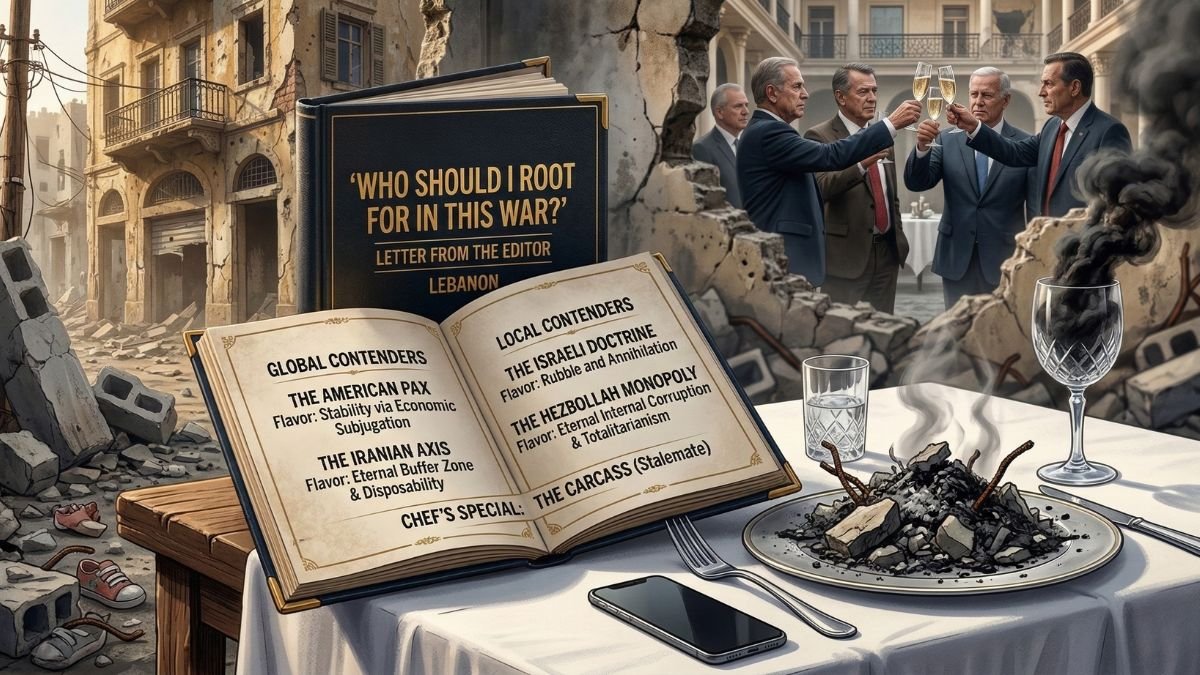
Who should I root for in this war?
It is a fascinating exercise in theoretical self-destruction, especially when you are sitting right here, in Lebanon, the eternal collateral damage of the universe. We are the designated battleground, the historic arena where other nations come to settle their scores, test their weapons, and practice their dramatic speeches, while we are expected to sweep up the glass and pretend everything is fine. So, let us indulge this question. Let us strip away the polite rhetoric, the diplomatic jargon, and the sanitized news anchors, and let us really look at the contenders in this grand, macabre tournament. Let us undress the hypocrisy of this war and see what is actually standing there in the cold light of day.
Should I root for the Americans to win this war?
There is, I suppose, a certain seductive simplicity to the idea of an American victory. It comes packaged with the shiny promise of Western stabilization, the vague illusion of democratic order, and the comforting, if entirely false, notion that the adults have finally arrived in the room to break up the fight. But let us be painfully honest with ourselves for a moment. What does an American victory actually look like in this part of the world?
If I root for them, I am essentially cheering for a system that views my entire hemisphere as nothing more than a giant gas station with an inconveniently large population of noisy locals. Would I really want to be paraded like a fool, completely humiliated by a superpower whose leadership frequently ridicules and mocks the entire world? We are dealing with a mindset that views international diplomacy as a reality television show, where the man at the podium snickers at those who stand in his way, treats ancient cultures with the profound disrespect of a bored tourist, and fundamentally believes that every natural resource beneath your feet is his divine birthright. Not even his country’s birthright, mind you, but his own personal ledger of assets.
An American victory means peace dictated from the deck of an aircraft carrier. It means a stability forged in the fires of absolute economic subjugation. It means we are allowed to survive, provided we sign over the rights to our dignity, our autonomy, and whatever hydrocarbons might be lurking off our coast. It is the peace of the conquered, wrapped in the cellophane of globalization.
I look at the prospect of this grand, corporate-sponsored Pax Americana, and I realize: I don’t hate you, America, but I deeply, profoundly hate where this is going. I hate the thought of my homeland becoming nothing more than a footnote in a defense contractor’s quarterly earnings report.
Well then, what about the alternative? Should I root for the Iranians to win this war?
Here we have the grand, sweeping narrative of the “Axis of Resistance.” It is a narrative steeped in the intoxicating poetry of defiance, a story that appeals to the historical grievances of a region that has been bullied for a century. But let us look past the poetic speeches and the dramatic waving of flags. Let us look at the mechanics of this so-called liberation.
If they win, if their vision for the region becomes the absolute reality, they will take this entire corner of the Earth into another decade—perhaps another century—of living perpetually in the shadow of their presence. To root for an Iranian victory is to accept the premise that your country, your home, your streets, and your children are nothing more than disposable pawns on a much larger, much darker chessboard. We become the permanent vanguard, the eternal buffer zone. We are told we are martyrs, heroes of a grand cause, but in reality, we are simply the shock absorbers for a nation sitting comfortably a thousand miles away.
They use your country as a disposable puppet, a marionette whose strings are pulled in Tehran, acting solely to further their own regional leverage under the guise of “liberating” us. But this begs a deeply logical, intensely human question: Why should anyone but ourselves decide who, and when, and how we should be liberated?
If I am to be free, shouldn’t it be on my own terms? Why must my liberation require my absolute submission to a shadow state that thrives on perpetual conflict? To win this way is to ensure that we never actually live; we merely survive in a state of constant, low-level mobilization, waiting for the next order to throw ourselves into the fire for a cause that was negotiated over our heads.
I look at the shadows stretching across the region, and I must say: I don’t hate you, Iran, but I entirely hate where this is going. I hate the idea that my country’s only allowed purpose is to be a glorious, burning shield for someone else’s empire.
Let us turn the prism again. Should I root for Israel to win this war?
There are those who, in the quiet, cynical corners of the world, argue that perhaps a decisive Israeli victory is the swift, brutal surgery needed to excise the conflict forever. But look at what that victory entails. Look at the sheer, unfathomable cost of their definition of “security.”
Here is a nation prepared—and actively proving its willingness—to kill thousands, tens of thousands, to lay waste to entire cities, to turn neighborhoods into powdered concrete and ash, all to defend themselves from everyone and anyone. To root for them is to validate a military doctrine where the ratio of acceptable collateral damage is essentially limitless.
We are looking at leaders who, blinded by their own trauma and drunk on their own technological superiority, seem completely incapable of seeing anyone else in this region as worthy of living equally alongside them. To them, we are all a latent threat, a demographic inconvenience, a problem to be managed from behind a wall or through the crosshairs of a drone. Their victory conditions are stark and uncompromising: they alone deserve absolute, unquestioned security, and everyone else in the region must either submit to their every wish, demand, and border adjustment, or face absolute, biblical annihilation.
There is no partnership in their victory. There is no shared future. There is only the victor, standing atop a mountain of rubble, wondering why the ghosts still resent them.
I look at the apocalyptic landscape they are willing to create in the name of safety, and I have to say: I don’t hate you, Israel, but I absolutely despise where this is going. I hate a world where my existence is viewed merely as a mathematical error in your security algorithm.
But what about our own backyard? What about the local champions? Should I root for Hezbollah to win this war?
They are the ones on the ground, the ones bleeding in the south, the ones who claim the absolute mantle of the defense of Lebanon. If they win, if they emerge totally triumphant and vindicated, what is our prize? I will tell you exactly what it is. If they win, they will unapologetically hijack Lebanon for another thirty years to come.
They will sit securely in their victory, go on every television station, command every radio wave, and endlessly teach everyone else about what it means to be patriotic. They will lecture us on dignity, on honor, and on sacrifice, speaking to the rest of the Lebanese population as if we were all bastards living without any moral compasses whatsoever. If you do not agree with their exact brand of resistance, you are a traitor. If you question their unilateral decisions to drag the entire nation into the abyss, you are an agent of the enemy.
And the darkest, most bitter hypocrisy of all? In the process of holding the monopoly on “dignity,” they provide the ultimate, impenetrable cover for the vast, systemic corruption that continues to eat every last piece of this country from the inside out. They form alliances with the most crooked, the most venal, the most thoroughly rotten politicians in the republic, granting them immunity in exchange for political cover for their weapons.
And where does that leave us? It leaves the citizens of this country feeling like those little, starving lions on the savanna, watching the kill. We are waiting for the alpha to finish eating. We wait while his friends, and their friends’ friends, tear chunks of meat from the state. We wait, and we wait, until finally, we are left with a carcass. It is a carcass that is not edible, completely stripped of meat, bone-dry and rotting in the sun. But they tell us to be proud, because it is our carcass. Even dead, even completely unlivable, it is still ours.
I look at the hollowed-out shell of my country, mortgaged to fund a perpetual war, and I say: I don’t hate you, Hezbollah, but I violently hate where this is going. I hate that your glorious victory requires the absolute, humiliating defeat of the Lebanese state and the starvation of its people.
So, where does that leave me?
If every victory is a catastrophe, if every victor brings a different set of chains, what is the logical conclusion?
Should I root for no one to win? Should I pray for the stalemate?
This is the great Lebanese coping mechanism. The belief that if we can just keep everyone perfectly balanced in their mutual hatred, we can slip through the cracks and survive. We stay in this stalemate forever, a perpetual purgatory where every few years the sky catches fire, the buildings fall, and then the dust settles. And when the dust settles, everyone—the Americans, the Iranians, the Israelis, Hezbollah—everyone holds a press conference and claims to have won a “divine,” “historic,” or “strategic” victory.
They all win. Every single one of them claims the trophy. And who loses? We do. Everyone else always loses. The shopkeeper whose store is gone loses. The mother who is burying a closed casket loses. The youth who are packing their bags to emigrate to a country where the sky doesn’t explode loses. The stalemate is not peace; it is just war operating on a slower, more agonizing timer. It is a slow asphyxiation instead of a sudden decapitation.
I look at this endless, cyclical theater of blood, where the final act is never written, and I sigh: I don’t hate the concept of balance, but I loathe where this result is going. I hate that “no one winning” simply means “everyone dying, just a little more slowly.”
This brings me to the darkest corner of the human mind. The place you go when the hypocrisy of war finally breaks your spirit.
Should I wish them all dead?
There are moments, late at night, when the despair is so thick you can choke on it, that the thought crosses your mind. Let them all wipe each other out. Let the arrogant empires, the shadow proxies, the uncompromising armies, and the sanctimonious militias all clash in one final, apocalyptic battle and erase themselves from the map. Let the hypocrites consume one another.
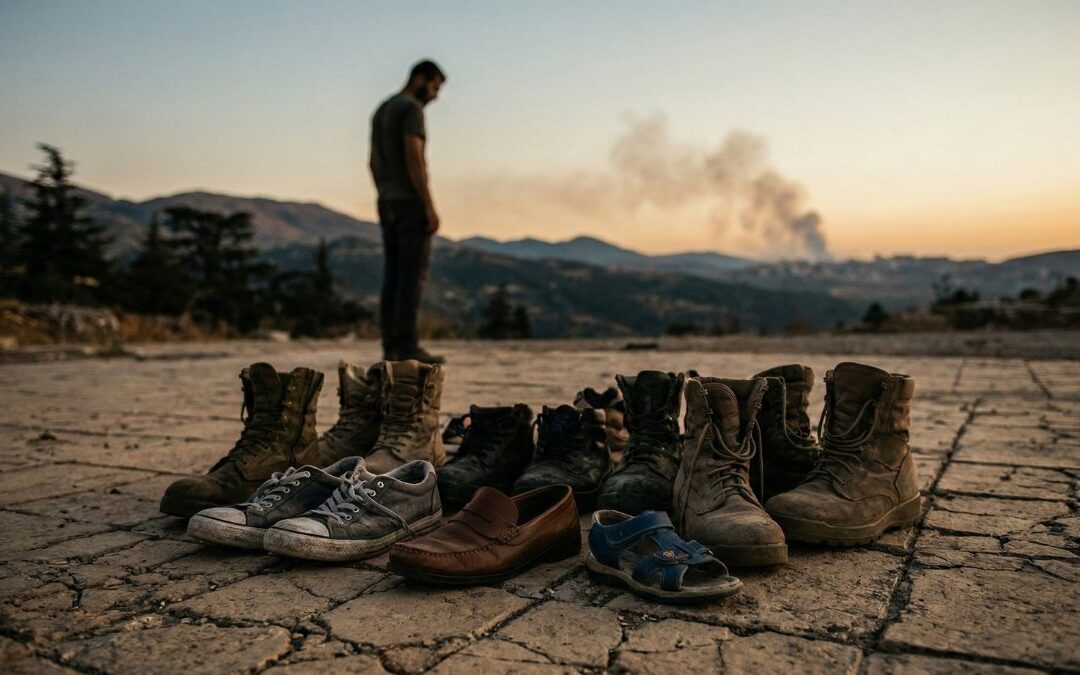
But then, the sun comes up. You see the baker opening his shop. You see the children walking to whatever school is still standing. You see the sheer, stubborn, beautiful persistence of life.
And you realize: I don’t want to live alone. I don’t want to inherit a graveyard. And, despite the overwhelming evidence to the contrary presented by the leaders of this world, I still fundamentally believe that no one deserves to die. I cannot adopt the very pathology I am criticizing. I cannot look at an Israeli civilian, or an Iranian youth, or an American soldier, or a Lebanese boy drafted into a militia, and say, “Your death is required for my peace.” Because the moment I do that, I have become exactly what they are. I have accepted the mathematics of war, where human lives are just currency to buy political real estate.
I look at the abyss of total nihilism, the desire to see the whole board flipped over, and I pull back. I say to the darkness: I don’t hate you, but I cannot accept where this is going. I hate the idea that the only cure for humanity’s madness is the eradication of humanity itself.
So, you ask me, looking at me across this table, waiting for a neat, soundbite answer: Who do you root for in this war?
My answer is that the question itself is a trap. It is a trap designed by the very people who profit from the slaughter. War is not a competition of virtues; it is a collision of hypocrisies.
The Americans fight for “freedom” by enforcing submission. The Iranians fight for “liberation” by demanding absolute obedience. The Israelis fight for “existence” by annihilating the existence of others. And Hezbollah fights for “dignity” by starving the very people they claim to protect.
Every single faction is fighting for its own gain, its own survival, its own ego, draped in the holy flags of religion, democracy, or resistance. They are all reading from the same script, just playing different roles.
I do not want any of them to win. Because their victory is my defeat. Their victory is the defeat of the mother in the south, the father in the suburbs, the student in the city. Their victory is the triumph of the machine over the human.
I don’t want a victor. I want an end. I want an awakening to the absurdity of it all. I want us to stop being the edible carcass for the lions, the disposable pawn for the shadows, the collateral damage for the empires.
God forbid, though, we consider the most terrifying prospect of all: a possible peace.
Do you think we could all meet tomorrow morning? Not in a bunker or a sterile conference room in Geneva, but just out here, on the street. We sit down, tear into a hot, delicious mankouche—a simple zaatar pastry right out of the oven—drink a steaming cup of tea, and for just one moment, entertain the delusion that we might all get almost what we want. Well, I have to admit, not exactly what the grand imperial brochures promised, but close enough. Close enough to go on living without having to kill each other for it.
I know I sound stupid. I know how hopelessly naive it is to say it out loud in a region where cynicism is the only reliable currency. But the tragic, undeniable truth is that it is definitely, physically possible.
But I know you can’t agree to it. I know you won’t. Because if the war ends, after the tea is drunk and the mankouche is finished, everyone will have to go home and actually start doing something that genuinely benefits humanity. You would have to build rather than destroy. You would have to fix economies rather than sanction them. You would have to serve your people rather than sacrifice them.
And looking at the smoldering state of our world, I am fairly certain that idea has never once crossed your minds.
I want to look at all of you—every warlord, every politician, every general, every foreign diplomat with a map and a red pen—and tell you the one truth you refuse to hear.
We see you. We see right through the noble speeches and the divine promises. We see the raw, naked greed underneath.
I don’t hate you, because hate is exactly what you need me to feel to keep your war going. But I absolutely, unequivocally, and with every fiber of my being, hate where you are taking us. And I refuse to clap for any of you when the curtain falls.
So, who should I root for in this war? What if, just for once, I root for us? I root for the people to finally win. Because let me tell you the one absolute truth I know amidst all this madness despite all what you think you know: we don’t want your war. WE DO NOT WANT YOUR WAR.
Danny Ballan
Editor-in-Chief
English Plus Magazine







0 Comments