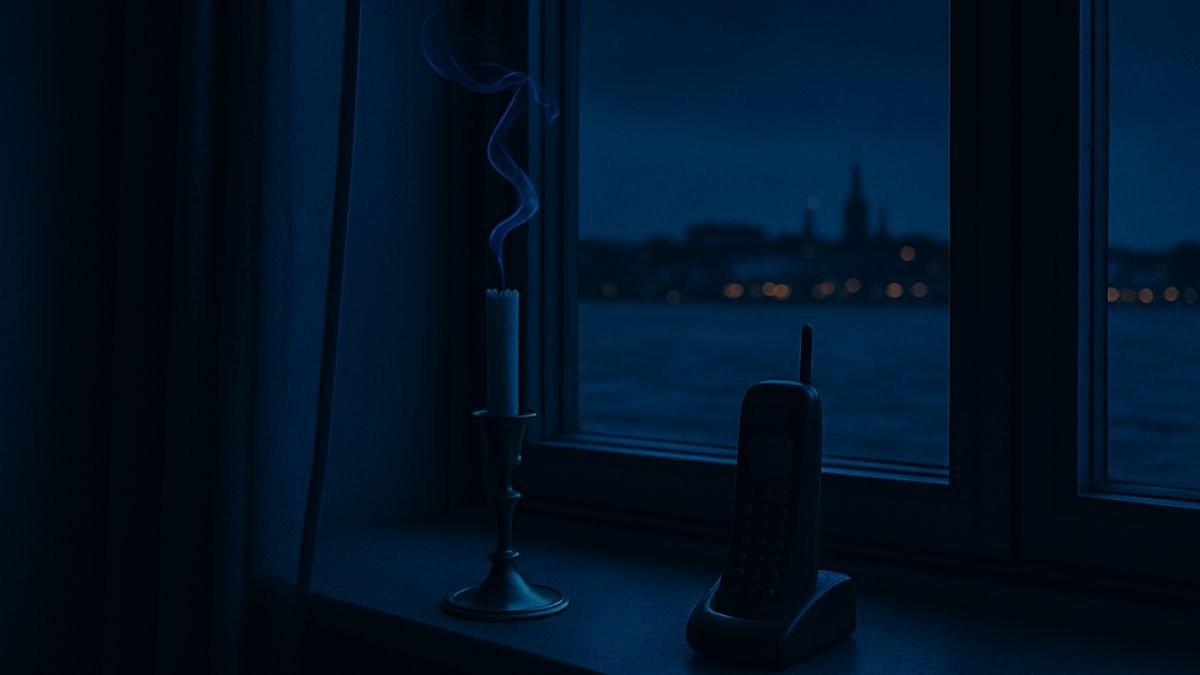
The darkness in Stockholm during December is not merely an absence of light; it is a physical weight. It arrives just after lunch, a heavy, indigo blanket that smothers the city’s archipelago, turning the Baltic Sea into a mirror of black glass.
Astrid sat by her window in Östermalm, watching the reflection of the room hover in the glass against the night outside. It was December 13th—St. Lucia’s Day. Down on the street, she could see a small procession of children from the local choir. A girl in the lead wore a crown of electric candles in her hair, a white gown sashed in red, singing the old Italian melody that the Swedes had claimed as their own.
Natten går tunga fjät… The night walks with heavy steps.
It certainly did.
On the windowsill in front of Astrid sat a single, white stearin candle in a brass holder. It was burning steadily, the flame upright and unwavering in the draft-free apartment.
It was a beacon. That was what she told herself. She was keeping a light in the window for Elias.
It had been two years. Two years of silence that had started with a sharp word over a Sunday roast—a criticism she hadn’t meant to be so cutting, a defensive retort from him that hit too close to home—and had hardened into a glacier. The argument was so old now that Astrid had trouble remembering the exact syntax of the insults, but she remembered the feeling perfectly: the burning heat of pride.
She was the mother. He was the son. By the ancient laws of family dynamics, he should come to her. He should apologize.
So she waited. She placed the candle in the window every evening of Advent, a silent signal that she was here. I am waiting, the flame said. I am benevolent. I am ready to forgive you once you grovel.
She took a sip of coffee. It was cold.
Below, the Lucia procession moved on, their song fading into the traffic noise of Strandvägen. The silence rushed back into the apartment, louder than before.
Astrid looked at the candle again.
For the first time in two years, she really saw it.
It wasn’t a beacon. It was just a stick of wax. It was slowly consuming itself, melting down inch by inch, dripping onto the brass. It wasn’t calling out to anyone. It was passive. It was immobile. It would burn until it had nothing left to give, and then it would sputter and die, leaving nothing but a scorch mark and a wisp of acrid smoke.
Is that what I am doing? Astrid thought. Burning myself down in silence, waiting to be noticed?
The realization hit her with the force of the winter wind. Her pride wasn’t strength. It was just fuel for a fire that warmed no one.
Elias didn’t know the candle was lit. He couldn’t see it from his apartment in Södermalm. He couldn’t feel her “benevolent waiting.” All he knew was that his mother hadn’t called him in seven hundred and thirty days.
Astrid’s hand trembled. The room felt suddenly suffocating. The perfectly arranged cushions, the dusted bookshelves, the silent phone on the side table—it was all a monument to her own stubbornness.
She stood up. Her knees popped—a sound of age that frightened her.
She leaned over the windowsill and blew.
Pfhh.
The flame vanished. A thin ribbon of gray smoke curled up, smelling of extinguished hope. The window went dark.
Astrid didn’t turn on the lamp. She walked through the gloom to the side table. She picked up the phone. It was a heavy, cordless landline—she had never gotten used to mobiles.
She dialed the number. Her fingers remembered the pattern better than her mind remembered his face.
Zero. Seven. Zero…
She pressed the green button and held the receiver to her ear.
The silence before the connection was a void.
Then, the ringing began.
Tuuuuut… Tuuuuut…
The Swedish ringtone is slow. Methodical.
The first ring was terrifying. It sounded like an accusation. Why now? Why not yesterday?
The second ring was an eternity. In that three-second gap between tones, Astrid lived a lifetime of worst-case scenarios. He wouldn’t answer. He would see the number and decline. He had changed his number. He was dead. He was happy without her.
Tuuuuut… Tuuuuut…
The third ring. Her heart was hammering against her ribs, a frantic bird trapped in a cage. She almost hung up. The panic of rejection was rising, a bile in her throat. It was too late. She had waited too long. The candle had burned too low.
She pulled the phone away from her ear, her thumb hovering over the red button to end the call, to retreat back into the safety of her pride.
Click.
The ringing stopped.
The silence on the other end was different. It wasn’t the void of the network. It was a living silence. The sound of a room. The sound of breath.
“Mamma?”
The voice was deeper than she remembered. It was cautious, guarded, stripped of the anger she had replayed in her head for two years. It was just a young man, sounding surprised.
Astrid closed her eyes. The tears came instantly, hot and fast, spilling over her cheeks. She gripped the phone with both hands, as if it were a lifeline thrown into the dark sea.
She had to clear her throat twice before she could speak. She had to swallow the pride, which tasted like ash, to make room for the love.
“Hej, Elias,” she whispered. “It’s… it’s St. Lucia. I just… I wanted to hear your voice.”
There was a pause. A hesitation. And then, the sound of a guard being lowered.
“I’m glad you called, Mamma,” he said softly. “I was just thinking about your saffron buns.”
Astrid let out a breath she felt she had been holding since that Sunday roast two years ago. The room was dark, the candle was out, but for the first time in a long time, she wasn’t cold.
“Come over,” she said, the words rushing out. “I have dough rising. Come over.”
The miracle wasn’t that he answered. The miracle was that she had blown out the candle and picked up the phone.
A Prayer for the Space Between Us
Let us speak now to the silence that sits on the line. Let us speak to the pride that masquerades as strength.
To the arguments we have memorized and the wounds we keep fresh, convinced that forgiveness is a surrender we cannot afford. We are the architects of the standoff. We are the ones who wait for the other to blink, to bend, to break, while the days turn into years and the distance between us grows into a country we no longer know how to cross.
Let us confess the heavy truth to one another: We are not waiting for an apology. We are waiting for permission to love again. We tell ourselves we are teaching a lesson, but we are only teaching ourselves how to live without the people we need. We build monuments to our own rightness, cold and perfect, while the warmth of connection burns down to ash in the window.
Let us ask for the courage to be the one who folds first. To realize that the first person to reach out is not the loser of the war, but the winner of the peace. To understand that pride is a poor companion on a dark night, and that “being right” is a cold comfort when the table is set for one.
May we have the strength to blow out the candle of our own stubbornness. To stop waiting for a sign and start sending one. To pick up the receiver, even when our hands are shaking, even when we are terrified of the silence on the other end.
Let us learn the lesson of the ringing phone: The sound of connection is terrifying, but the sound of permanent silence is worse. The risk of rejection is real, but the risk of regret is absolute.
So, let us dial the number. Let us clear the throat that is tight with years of unsaid things. Let us say the simple, difficult words: I am here. I miss you. Come home.
May we find that the bridge back to each other is shorter than we thought. And may we discover that love, when it is finally allowed to speak, does not care who was right; it only cares that we are together.
The line is open. The heart is waiting. Make the call.










0 Comments