Berlin in December was a city of shadows and lights. The sun set before four in the afternoon, leaving the streets draped in a heavy, damp twilight that seemed to cling to the wet pavement.
Fatima walked briskly past the Weihnachtsmarkt at Gendarmenmarkt. The air was thick with the smell of Glühwein—mulled wine—and roasted sausages. To the tourists and locals, it was the scent of joy. To Fatima, it was the scent of exclusion.
She was twenty-four, but she felt a hundred years old. It had been two years since she left Aleppo, two years since the bombs turned her neighborhood into dust, and two years since she had felt the specific, dry warmth of the Syrian sun.
Here, the cold was wet. It seeped through her coat and settled in her chest. She adjusted her hijab, pulling it tighter against the wind, and hurried toward her apartment block in Neukölln. The building was a Plattenbau, a gray concrete slab from a different era, functional and ugly.
She climbed the four flights of stairs to her apartment. The hallway smelled of cabbage and floor wax—the smell of Germany.
Inside, she locked the door and leaned against it. Silence.
It was Christmas Eve. Outside, families were gathering. She could hear the muffled sounds of a television from the apartment next door and the clinking of silverware.
Fatima felt the ache of homesickness rise in her throat, a physical lump. She needed to banish the grayness. She needed color. She needed home.
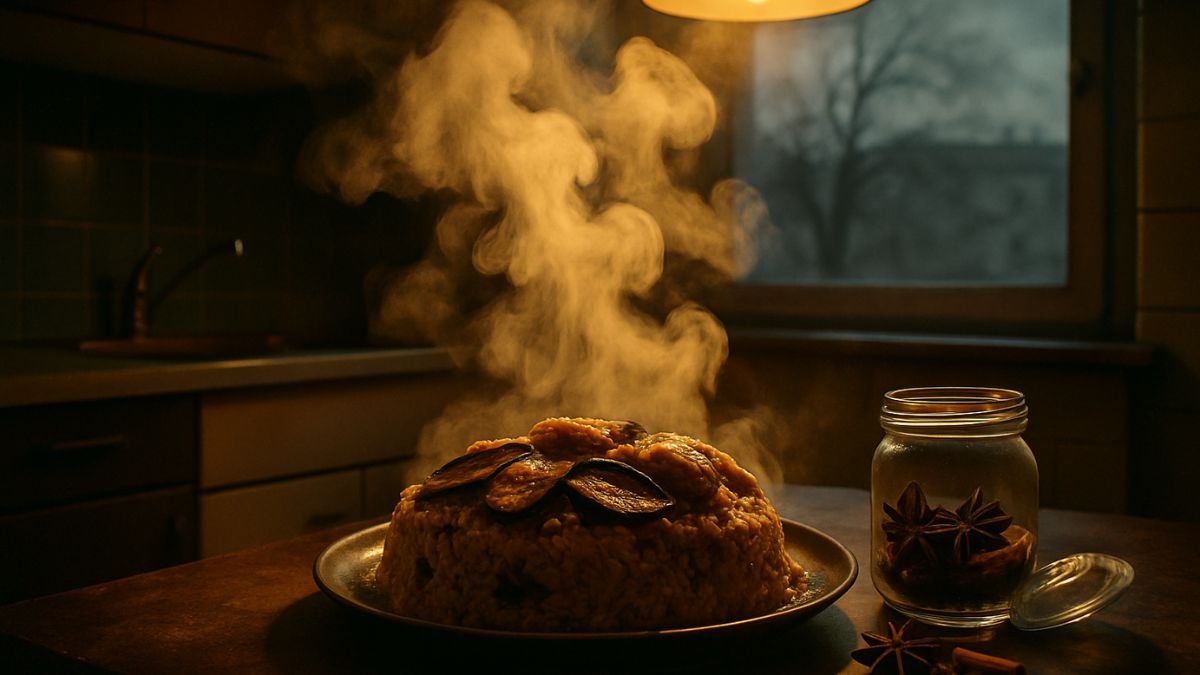
She went to the small kitchenette. On the counter sat a small jar of Baharat—the seven-spice blend her mother had taught her to make. Black pepper, coriander, paprika, cardamom, nutmeg, cumin, and cloves.
She opened the jar. The scent hit her like a physical memory. Suddenly, she wasn’t in a gray apartment in Berlin; she was in her mother’s kitchen, the sunlight streaming through the window, the sound of the street vendors calling out below.
She began to cook.
She didn’t have much money, but she had chicken thighs, rice, and an eggplant. She would make Maqluba—”Upside Down.” It was a dish of patience and layering.
She fried the eggplant until it was golden and soft. She seared the chicken with the spices, the oil sizzling and popping, releasing clouds of aromatic steam. She layered the meat, the vegetables, and the rice in the pot, then poured in the broth.
As the pot simmered, the apartment transformed. The smell of cardamom and allspice pushed back the smell of damp wool and floor wax. It filled the small room, heavy and rich. It leaked under the door and into the hallway, a defiant declaration of existence.
Fatima sat by the stove, closing her eyes, letting the steam warm her face. For the first time all day, her shoulders dropped.
Knock. Knock. Knock.
The sound was sharp, authoritative. Three raps on her door.
Fatima froze. Her heart hammered against her ribs. In this building, a knock usually meant a complaint. The music is too loud. The trash is in the wrong bin. The smell is too strong.
She looked at the pot. The smell was strong. To a German nose, accustomed to potatoes and bread, the heavy spice of the Levant might seem offensive.
She stood up, her hands trembling slightly. She smoothed her apron and walked to the door. She prepared her apology in broken German. Entschuldigung. Es tut mir leid.
She opened the door.
Standing there was Frau Weber.
Frau Weber was her neighbor from across the hall. She was a woman of sharp angles and iron-gray hair, always dressed in sensible beige cardigans. She was the kind of neighbor who left notes if the hallway wasn’t swept on the correct day.
Fatima braced herself. “Entschuldigung,” she whispered. “I am cooking… I will open the window.”
Frau Weber stood in the doorway, her nose twitching. She inhaled deeply, her eyes closing for a brief second.
“Open the window?” Frau Weber asked, her voice raspy. “Why would you let it out?”
Fatima blinked, confused.
Frau Weber opened her eyes. They weren’t angry. They were… curious. Maybe even a little wet.
“What is that smell?” Frau Weber asked. “It smells like… like a story.”
“It is Maqluba,” Fatima said, stumbling over the word. “Chicken. And… spices. Cardamom. Zimt.”
“Cardamom,” Frau Weber repeated. She looked past Fatima, toward the stove. She looked at the lonely table set for one. “You are eating alone?”
Fatima nodded, looking down. “Yes. My family is… away.”
Frau Weber stood there for a moment, the silence stretching in the hallway. Then, she nodded abruptly. “Wait.”
She turned and marched back into her own apartment, leaving her door open.
Fatima stood frozen. Wait for what? The police? The landlord?
A minute later, Frau Weber returned. In her hands, she carried a plate covered with a paper napkin.
“I am alone too,” Frau Weber said matter-of-factly. “My husband died five years ago. My son lives in Munich and is too busy to drive up.”
She stepped into Fatima’s apartment without waiting for an invitation, but her movement wasn’t invasive; it was decisive. She walked to the small kitchen table and set the plate down.
She pulled back the napkin. Inside were thick slices of a dense, white-dusted loaf.
“Christstollen,” Frau Weber announced. “It is heavy. It has marzipan and dried fruit. It is traditional. It is… how do you say… necessary.”
Fatima stared at the woman, then at the bread, then back at the pot on the stove.
“Please,” Fatima said, gesturing to the chair. “Sit.”
The flipping of the Maqluba is the most important part. Fatima placed a large serving platter over the pot. With a prayer under her breath, she flipped it. She tapped the bottom of the pot—tap, tap, tap—and lifted it.
The cake of rice, eggplant, and chicken held its shape for a perfect second before settling into a steaming, golden mound.
“Wunderbar,” Frau Weber whispered.
They sat across from each other. Two women separated by fifty years, a language barrier, and an ocean of culture.
Fatima served the rice. Frau Weber ate slowly, savoring the spice.
“It warms the blood,” the old woman said, pointing to her chest.
“Yes,” Fatima smiled. “It is the sun.”
When the rice was gone, they ate the Stollen. It was dense, sweet, and buttery, coating the mouth in sugar. It was the opposite of the sharp, savory rice. It tasted of winter comfort.
“It is good,” Fatima said.
“It is heavy,” Frau Weber corrected with a small smile. “Like all German things.”
They didn’t speak much. They didn’t need to. The wind rattled the windowpane, and the snow began to fall outside, but in the small kitchen, the air smelled of Aleppo pepper and Dresden sugar.
Fatima looked at her neighbor. She realized that Frau Weber’s sternness was just like the hard crust of the Stollen—a way to protect the softness inside from the cold.
“Merry Christmas, Frau Weber,” Fatima said softly.
The old woman reached across the table and patted Fatima’s hand. Her skin was dry like paper, but her grip was warm.
“Frohe Weihnachten, Fatima.”
Fatima took a sip of tea. The ache in her chest hadn’t vanished—she still missed her mother, her city, her life—but the sharp edge of it was gone, dulled by the presence of another human being. She wasn’t eating alone. And in a city of shadows, she had found a kitchen that glowed.
A Prayer for the Scent of Home
Let us speak now to the invisible ghosts that drift through the cracks beneath our doors. Let us speak to the memory that lives not in the mind, but in the nose.
To the cardamom and the cinnamon, the cumin and the dill. To the heavy, stubborn scents of the places we have left behind, rising like prayers from our pots to settle in the hallways of foreign cities. We are all carrying the maps of our mothers’ kitchens in our blood, aching for the sun that tasted different, for the air that smelled of dust and jasmine instead of damp wool and concrete.
Let us confess the bitter truth to one another: We are afraid of the smell of the stranger. We want our neighbors to be ghosts—silent, odorless, invisible. We build our apartments like fortresses of neutrality. We embrace the gray because it is safe. We fear that if we let the spices in, if we let the noise in, if we let the difference in, it will overwhelm the fragile order we have built. We ask the newcomer to whisper, to shrink, to boil their history until it is tasteless, so that we may feel comfortable in our isolation.
Let us ask for the courage to be the one who cooks the loud food. To refuse to be erased by the grayness. To reclaim the right to take up space, to make a smell, to announce to the hallway: I am here. I am alive. And I have brought the sun with me.
And let us ask for the grace to be the one who knocks. Not to complain. Not to police. Not to demand silence. But to follow the scent of life back to its source. To stand at the threshold of a stranger’s world and say, Teach me what sustains you.
May we realize that the table is the only border that matters. It is the place where the walls come down. Where the “Upside Down” rice meets the heavy winter bread, and neither is asked to apologize for its nature. Where the language of hunger and the language of comfort need no translation.
Let us honor the bravery of the open door. The terrifying risk of inviting the “other” into our sanctuary. The humility of accepting a slice of bread that is dense and strange, and finding that it tastes of welcome.
So, let us turn the pot upside down. Let us upend our expectations. Let us mix the spices of the Levant with the sugar of the North, and in that chaotic, fragrant mess, let us find the flavor of a new family.
May our kitchens never be silent. May our hallways never be empty of the smell of cooking. And may we find that when we break bread with a stranger, we are not losing our home; we are making it bigger.
The door is unlocked. The plate is full. Let us eat.









0 Comments