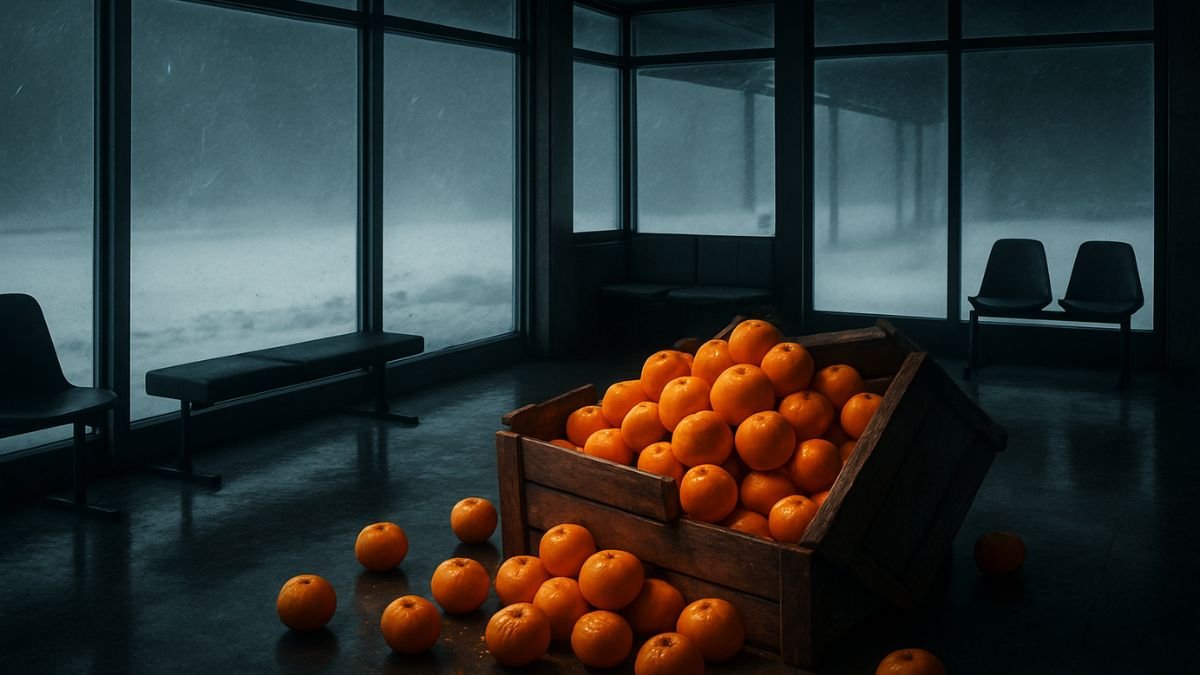
The snow in Hokkaido did not fall; it accumulated, a white silence that erased the world one inch at a time.
Kenji gripped the steering wheel of his ten-ton Hino truck, his knuckles white against the leather cover. The windshield wipers were fighting a losing battle, slapping frantically against a wall of swirling gray and white. The highway lights of the Dō-Ō Expressway were gone, swallowed by the blizzard, leaving him navigating by the faint rumble of the rumble strips beneath his tires.
He checked the GPS. The ETA had changed from 8:00 PM to “Calculating…”
He was hauling a perishable load from the orchards of Wakayama, driving north to deliver sunshine to the frozen markets of Sapporo before Christmas morning. But the storm had other plans.
Ahead, brake lights bloomed like red dye in water. Traffic had stopped.
The radio crackled. “Tsukou-dome,” the announcer’s voice said, calm and apologetic. Road closed.
Kenji sighed, the sound heavy in the cab. He saw the sign for the Michi-no-eki—the roadside station—glowing faintly through the drift. He downshifted, the engine growling as he guided the massive beast of a truck off the highway and into the parking lot.
The station was a low, modern building of glass and timber, usually a place for tourists to buy soft-serve ice cream and stamped souvenirs. Tonight, it looked like a life raft floating in a white ocean.
Kenji pulled the parking brake. He grabbed his coat and his thermos, patted the dashboard in a silent apology to his truck, and stepped out. The wind hit him like a physical blow, trying to knock him off the metal step.
Inside, the automatic doors slid open with a reluctant hiss.
The main hall was bathed in the harsh, buzzing glare of fluorescent lights. It was crowded. A tour bus had been grounded, its passengers—a group of retirees from Tokyo—clustered near the windows, looking out at the storm with anxious faces. A businessman in a sharp suit sat on the floor near a wall outlet, aggressively typing on a laptop, muttering into a headset about deadlines. A young family huddled near the restrooms, the father trying to distract a crying toddler with a set of keys.
The air was thick with the smell of wet wool, damp pavement, and rising panic.
Kenji shook the snow from his coat and walked toward the vending machines. He wanted a hot coffee.
He stopped. The machines were dark. A handwritten note was taped to the glass: Power fluctuations. Out of Order.
He looked at the konbini—the convenience store counter. The shelves were decimated. No onigiri, no sandwiches, no bento boxes. Just a few packets of dried squid and some breath mints. The clerk, a young girl who looked terrified, was explaining to an angry woman that the delivery truck hadn’t made it through the pass.
“This is unacceptable!” the businessman shouted, ripping his headset off. “I have to be in Sapporo by morning. I have a flight!”
“Sir, the road is closed,” the clerk whispered.
“Do something!” he snapped.
The room went quiet. The tension was a wire pulled tight, vibrating in the air. The retirees stopped whispering. The toddler stopped crying. Everyone looked at the businessman, and then at the empty shelves, and then at the snow piling up against the glass walls.
It was Christmas Eve. And they were trapped, hungry, and turning on each other.
Kenji walked to a corner and sat down. He was used to waiting. Truck drivers knew how to wait. But he watched the room. He saw the mother shivering, wrapping her coat around her child. He saw the retirees sharing a single bottle of water. He saw the businessman slumped against the wall, the anger draining out of him to reveal a profound exhaustion.
Kenji looked out the window at his truck. It was a dark shape in the storm, beaten by the wind.
He thought about his cargo.
Technically, the cargo was sealed. Breaking the seal meant paperwork. It meant a deduction from his pay. It meant explaining to his dispatcher why the shipment was light. It was property of the supermarket chain, tallied and accounted for.
But Kenji looked at the crying toddler.
He stood up. He didn’t say a word. He zipped his coat, pulled his cap down, and walked back out into the blizzard.
The wind was worse now, a whiteout that made it hard to breathe. Kenji fought his way to the back of the truck. He unlocked the heavy latch of the cargo hold and heaved the door open.
The smell hit him instantly. Even in the freezing cold, it was potent—the scent of summer, of green leaves and sunshine.
He climbed in. The crates were stacked to the ceiling. He took a pry bar from his tool belt and wedged it under the lid of the nearest crate. Wood splintered with a sharp crack.
He lifted the lid. Inside, nestled in protective foam, were hundreds of Mikan—Japanese mandarin oranges. They were vibrant, shockingly orange against the darkness of the trailer.
Kenji grabbed a smaller cardboard box from his supplies and began to fill it. He filled it until the cardboard bowed. Then he hoisted it onto his shoulder, kicked the door shut, and trudged back to the station.
When the automatic doors slid open this time, Kenji didn’t just bring snow with him. He brought color.
The bright orange of the box was like a flare in the gray room. Every head turned.
Kenji walked to the center of the room, near the heater where the people had congregated. He set the box down on a low table.
He didn’t make a speech. He didn’t ask for money. He simply reached in, grabbed a mikan, and tossed it to the businessman.
The man caught it by reflex. He stared at the fruit in his hand. It was cold from the truck, but the skin was bright and waxy.
Kenji grabbed another and handed it to the toddler’s mother. Then he took two handfuls and walked over to the retirees.
“Eat,” Kenji said, his voice rough from the cold. “It’s Christmas.”
The room hesitated. And then, the businessman peeled the fruit.
The sound was soft—the tearing of the zest—but the smell was explosive. The sharp, sweet, acidic tang of citrus zest misted into the air, cutting through the smell of wet coats and anxiety. It smelled of festivals, of childhood winters sat under a kotatsu (heated table), of warmth.
The businessman took a segment and put it in his mouth. His eyes closed. The tightness in his jaw vanished.
Suddenly, everyone was moving. The retirees came forward, bowing in thanks as they took the fruit. The father peeled one for his child, the baby’s eyes going wide at the burst of juice.
Kenji stood back and watched.
The atmosphere in the room broke. It didn’t just shift; it shattered.
“These are from Wakayama, aren’t they?” an old woman asked, holding the peel to her nose. “The skin is so thin. They are the best.”
“Yes,” Kenji said. “Picked two days ago.”
“I haven’t had a mikan this good since I was a girl,” she said, smiling at him.
The businessman walked over to the young family. “Here,” he said, offering them a wet wipe from his briefcase to clean the sticky juice from the baby’s hands. “I have plenty.”
The tour guide found a thermos of hot water, and people began to share cups. The box of oranges became a hearthfire. People sat around it, peeling and eating, their hands stained yellow and smelling of zest.
They talked. Not about the storm or the delay, but about where they were going. The businessman spoke of his daughter in Sapporo, how he was terrified he would miss her violin recital. The retirees shared stories of their grandchildren. The young couple talked about their first year of marriage.
Kenji leaned against the wall, peeling a mikan for himself. The taste was sweet, sharp, and cold—a shock to the system that made him feel alive.
The businessman approached him. He looked different now—less like a suit, more like a father.
“You’re going to get in trouble for this,” the man said, gesturing to the broken crate. “The inventory.”
Kenji shrugged. “It’s just fruit. It rots if it sits too long.”
The businessman reached into his pocket and pulled out a business card. “I work for a logistics firm in Sapporo. If your company gives you trouble about the seal… you have them call me. I’ll cover the crate. And the delivery fee.”
Kenji smiled. “Thank you.”
“No,” the man said, looking around the room at the smiling faces, the bright peels scattered on the tables like confetti. “Thank you.”
The storm raged all night. The windows rattled, and the snow buried the cars outside. But inside the station, the air was perfumed with citrus. Strangers slept on benches, using coats as blankets, their bellies full of sweet fruit.
Kenji watched them sleep. He missed his own bed, and he missed the nabe pot his wife would be cooking tomorrow. But as he looked at the orange peels resting on the table, he realized he had delivered his cargo after all.
He hadn’t just hauled fruit. He had hauled a memory.
And as the first gray light of dawn touched the snowbound world outside, Kenji knew that this, the quiet communion of strangers sharing the simplest of gifts, was the only Christmas that really mattered.
A Prayer for the Breaking of the Seal
Let us speak now to the moment when the plan fails. Let us speak to the white silence that erases the road ahead.
To the schedules we worship and the deadlines we fear, buried now under the indifferent snow. We are people of the route, of the itinerary, of the sealed cargo. We believe that if we keep moving, if we keep the inventory intact, if we follow the map, we will arrive at happiness. But the storm does not care about our arrival times. The storm cares only about stopping us long enough to make us look at who is sitting next to us.
Let us confess the hungry truth to one another: We are starving in the midst of abundance. We sit in rooms full of strangers, clutching our own supplies, guarding our own hearts, terrified that if we share, we will not have enough. We seal ourselves tight. We treat our joy like a perishable good that must be hoarded for a destination we may never reach.
Let us ask for the courage to break the seal. To take the crowbar to the crate of our own reserve. To realize that the cargo was never meant to be saved; it was meant to be eaten. It was meant to be tasted. It was meant to be the thing that turns a waiting room into a banquet hall.
May we be brave enough to offer the orange to the angry man. To offer the patience to the crying child. To offer the grace to the one who is slowing us down.
Let us learn the lesson of the blizzard: When the world stops, we must start. When the machines fail, the human hands must work. When the heat dies, the stories must begin. We are not trapped; we are gathered. We are not stuck; we are placed.
So, let us peel back the skin of our own hesitation. Let the sharp, sweet scent of generosity cut through the stale air of our isolation. Let us discover that the miracle is not the clearing of the road, but the clearing of the distance between us.
May we eat the fruit while it is fresh. May we share the sweetness before it rots in the dark. And may we find that in the breaking, and the peeling, and the giving, we are finally, truly, home.
The road is closed. The heart is open. Let the feast begin.







0 Comments