The darkness in a small street in Beirut did not fall; it seized the city.
It happened at 6:00 PM on Christmas Eve. There was no flicker of warning, no brownout to signal the end. Just the sudden, violent clack of the master breaker, followed by the groan of the refrigerator dying and the silence of the electric heaters fading.
Nour stood in the middle of the living room, holding a tray of meghli she couldn’t see. She waited for the familiar roar of the neighborhood generator to kick in—the mechanical heartbeat of the city.
One minute passed. Then two. The roar never came.
Outside the window, the streetlights were dead. The building across the street was a towering monolith of shadow against the rainy sky. The silence that followed was heavy, pressing against the glass. It was the silence of a city running on empty.
“Kahraba maqtoo’a,” her mother sighed from the kitchen, her voice tired. The power is cut.
Nour set the tray down on the table. She was twelve years old, part of a generation that had learned to navigate their own homes by touch. She knew exactly where the matches were. She knew which drawer held the flashlights (mostly dead batteries) and which held the candles.
She opened the sideboard. deep in the back, wrapped in soft linen, was her grandmother’s stash. Teta had passed away the winter before, but she had left behind a box of beeswax candles, thick and golden, smelling faintly of honey and incense. “For a night when the world forgets to shine,” Teta used to say.
Nour struck a match. The flame flared, illuminating her small, determined face. The beeswax caught, casting a warm, golden halo that pushed back the gray gloom of the apartment.
But looking around the room, Nour felt a chill that had nothing to do with the temperature. It was the isolation. In this building, people lived behind triple-locked iron doors. They nodded in the elevator but rarely spoke. The darkness would only make the walls thicker.
Nour looked at the bundle of candles. There were twelve.
“I’m going to the neighbors,” Nour announced.
“Nour, no,” her mother said, fumbling for her phone flashlight. “It’s freezing in the stairwell. Stay here.”
“Teta wouldn’t stay here,” Nour said simply. She grabbed the bundle and a box of matches before her mother could argue.
The stairwell was a cavern. The marble steps were cold enough to seep through her slippers, and the air smelled of damp concrete and old dust. Nour climbed to the fourth floor, her candle flickering in the draft.
She knocked on the first door. Mr. Haddad.
Mr. Haddad was a man who wore his scowl like a uniform. He lived alone, complained about the noise of children playing, and guarded his privacy fiercely.
The door creaked open. Mr. Haddad peered out, his face a floating mask in the gloom.
“What is it?” he grunted. “I don’t have cash for charity today.”
“It’s not charity,” Nour said, her voice shaking slightly. She held out a candle. “It’s light. So you don’t trip.”
Mr. Haddad stared at the candle. “I have a flashlight.”
“Batteries die,” Nour countered. “This smells like honey.”
He looked at her, then at the candle. He didn’t take it. He just huffed and started to close the door. “Go home, kid. It’s cold.”
Nour didn’t leave. She knelt and placed the candle on his doormat. She lit it, shielding the flame with her hand until it stood tall and bright, a defiant beacon against his iron door.
“Merry Christmas, Mr. Haddad,” she whispered to the closed wood.
She moved to the next floor. Then the next. At each door, she knocked. Some didn’t answer. Some opened just a crack, suspicious eyes peering out. But when they saw the light—soft, organic, living light, so different from the harsh blue of phone screens—they softened.
Mrs. Khoury on the third floor took one with trembling hands. The young couple on the second floor took two.
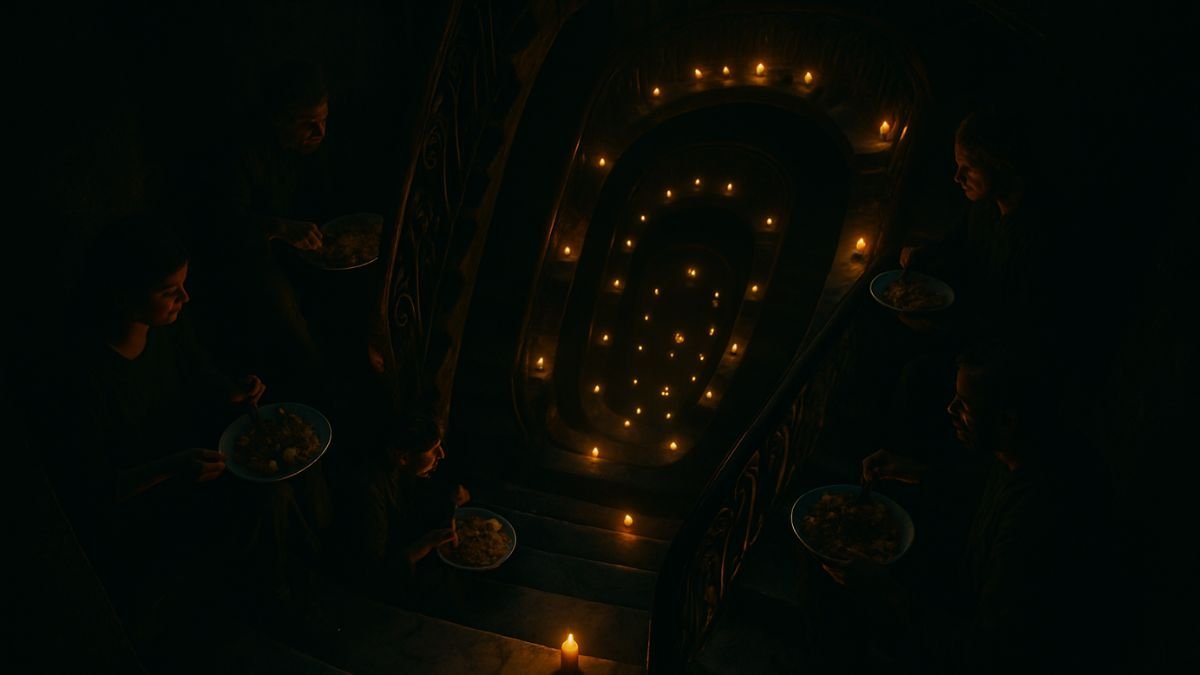
By the time Nour returned to her own floor, the stairwell had changed. It wasn’t a dark void anymore. It was dotted with golden stars, a constellation rising through the concrete.
And then, a door opened above her.
“The cheese is going to rot,” a voice boomed. It was Mr. Haddad.
He was standing on the landing, holding a large platter of halloumi and kashkaval. He looked down at Nour, his face lit by the candle she had left him.
“The generator isn’t coming back,” he grumbled, descending the stairs. “My fridge is warming up. If I don’t eat this now, it’s waste. I hate waste.”
He sat down on the marble step of the landing. He placed the cheese between them.
A door opened below. Mrs. Khoury peeked out. “Did someone say cheese? I have a tabbouleh that won’t last the night.”
“Bring it up!” Mr. Haddad shouted, his voice echoing. “Bring spoons!”
It started as a trickle, then a flood. The logic was undeniable: without power, the feast they had prepared for tomorrow would spoil. So, the feast had to happen now.
Doors that had been locked for years swung open. People emerged, carrying pots of stuffed vine leaves, trays of kibbeh, bowls of hummus, and bottles of arak. They gathered in the wide hallway of the third floor.
There were no tables. They sat on the stairs. They sat on the floor mats. They placed the food in the center, a banquet laid out on the cold tile.
But it wasn’t cold anymore. Nour ran up and down, placing the remaining candles along the banisters. The beeswax burned steady and slow, filling the air with that sweet, sacred scent of honey.
Nour sat between her mother and Mr. Haddad. The grumpy old man was currently tearing a piece of pita bread and laughing at a joke Mrs. Khoury had made about the government. He caught Nour looking at him.
He didn’t smile—that would be too much—but he nudged the plate of cheese toward her.
“Eat,” he said gruffly. “It’s good cheese. Better by candlelight.”
Nour took a piece. She looked around the hallway. The shadows danced on the walls, not menacing, but lively, mimicking the gestures of the neighbors eating and talking. They weren’t strangers anymore. They were a village, huddled together against the dark.
The power didn’t come back that night. The city remained black, a sea of shadows. But inside the building, on a marble staircase lit by Teta’s candles, there was light. There was laughter. And as Nour watched the flames flicker in the eyes of her neighbors, she realized that the darkness hadn’t taken Christmas away. It had just forced them to come close enough to find it in each other.
A Prayer for the Lights We Must Become
Let us speak now to the moment when the hum of the world stops. Let us speak to the sudden, heavy silence of the grid going dark.
To the cities that have grown used to the shadows, where the light is a luxury and the darkness is a neighbor who moved in and never left. We are the children of the switch and the socket, and when the current fails, we feel the failure in our own chests. We retreat. We bolt the iron doors. We sit in the gloom, waiting for a mechanical savior—a generator, a repair crew, a miracle—to give us permission to live again.
Let us confess the cold truth to one another: We have let the darkness separate us. We have used the shadows as an excuse to become islands. We tell ourselves that it is safer to stay behind the lock, to hoard the heat, to guard the silence. We look at the gap beneath our neighbor’s door and, seeing no light, we assume there is no life worth engaging. We have forgotten that the walls between us are thin, and that the shivering on one side is identical to the shivering on the other.
Let us ask for the courage to be the friction that creates the spark. To reject the paralysis of the blackout. To remember that long before there were wires and turbines, there was fire, and there was community.
May we be brave enough to climb the stairs in the dark. To trust that the hand knocking on the door is not a threat, but an offering. To realize that the most valuable thing we possess in the cold is not our silence, but our presence.
Let us learn the lesson of the spoiling feast: What we hoard will rot. The food we save for a better day, the kindness we hold back for a perfect moment, the love we store for a time when things are easier—it will all sour if we do not share it now. The crisis is the invitation. The breakdown is the breakthrough.
Let us bring our bowls to the landing. Let us sit on the cold marble steps and make them warm with our bodies and our stories. Let us discover that the true power source of a city is not the substation, but the shared breath of its people laughing in the face of the void.
So, let us light the beeswax. Let us light the wick that smells of memory and honey. Let us stop waiting for the lights to come back on, and decide, instead, to be the light.
May we see that the darkness does not hide us from each other; it forces us to seek each other out. And in the soft, flickering glow of a shared meal, may we find that we have everything we need to survive the night.
The grid may fail. The heart must not.







0 Comments