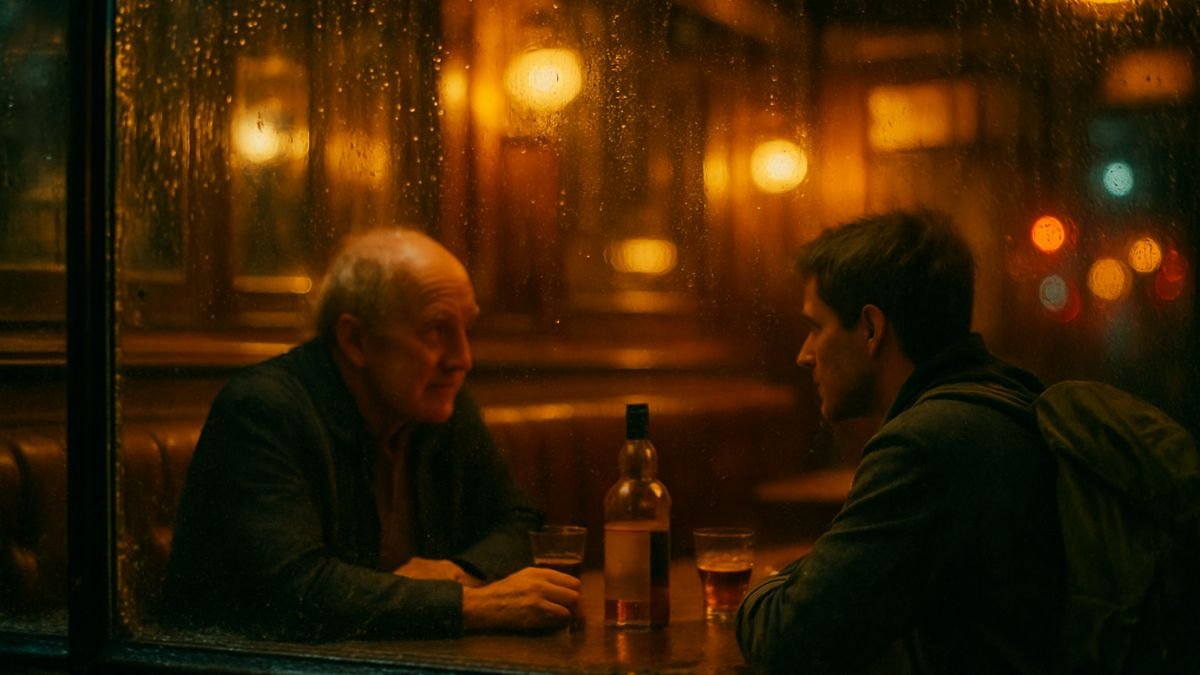
The rain in Dublin on Christmas Eve didn’t fall; it drifted. It was a soft, relentless mizzle that turned the streetlights of Temple Bar into blurred halos of amber and gold.
Cillian sat in the corner of The Stag’s Head, nursing a pint of stout that had gone room temperature twenty minutes ago. He wasn’t drinking it. He was just holding the glass, grounding himself against the terrible, suffocating gravity of his own home.
It was the silence that had driven him out.
For forty years, the house on Rathmines Road had been a symphony of noise. Siobhan was a woman who couldn’t boil a kettle without humming, who couldn’t walk through a room without rearranging a cushion or calling out a question. She was the kinetic energy of his life.
Now, six months after her funeral, the house was a museum. The clock on the mantelpiece ticked with a violence that made Cillian’s teeth ache. The roast beef he had put in the oven earlier—out of habit, or perhaps out of a stubborn refusal to let the day defeat him—smelled delicious, but the aroma only highlighted the fact that there was no one there to say, “Smells grand, Cillian.”
So, he had turned off the oven, put on his coat, and walked to the pub.
The pub was warm, smelling of damp wool, old mahogany, and yeast. It was crowded with last-minute revelers, men in Santa hats and women with flushed cheeks, shouting over the noise of a fiddle player in the corner.
Cillian watched them from his booth, feeling like a stone in a rushing river.
Then, the door opened. A gust of wet wind blew in, followed by a young man. He looked soaking wet. He was carrying a backpack that looked heavy enough to break his spine, and he stood by the door, scanning the room with wide, panicked eyes. He checked his phone, then looked at the bartender, then back at his phone.
He slumped against the wall, sliding his pack to the floor. He looked defeated.
Cillian watched him. He knew that look. It was the look of a plan gone wrong.
Go ask him, Siobhan’s voice whispered in his head. It was so clear Cillian almost turned around. Siobhan had been a collector of strays. If a cat sneezed three streets away, she’d have a saucer of milk ready. If a tourist looked lost, she’d have them in the kitchen with a map and a cup of tea within five minutes.
Leave him be, Cillian thought. I’m not you, Shiv.
But the boy looked miserable. He wiped rain from his eyes and checked his phone again, his shoulders shaking slightly.
Cillian sighed. He picked up his pint and stood up. His knees clicked—another reminder of the year’s toll—as he walked over to the door.
“The buses are gone, son,” Cillian said.
The boy jumped. He looked up, startled. He had dark eyes and an accent that sounded Spanish or maybe Italian. “Sorry?”
“The buses,” Cillian repeated. “It’s Christmas Eve. Dublin shuts down early. No Dublin Bus, no Luas. You’re stuck.”
The boy’s face crumbled. “Stuck? But… I have a hostel in Smithfield. It is far?”
“Too far to walk in this weather with that load,” Cillian said, nodding at the backpack. “And you’ll not get a taxi tonight for love nor money.”
The boy closed his eyes and leaned his head back against the wall. “Madre mía,” he whispered.
Cillian stood there. He had done his part. He had given the information. He could go back to his booth and his flat stout.
But the image of the dining table back home flashed in his mind. It was set for two. He hadn’t been able to stop himself from laying the second place setting. The china gleamed under the lights, waiting for a guest who would never arrive.
An empty chair is a terrible thing to waste, Siobhan used to say.
Cillian looked at the boy. “Have you eaten?”
The boy shook his head. “I was going to find a shop.”
“Shops are closed too,” Cillian said. He hesitated, the words feeling heavy and strange on his tongue. “I have a roast beef. It’s resting on the counter. And I have potatoes. Too many potatoes.”
The boy looked at him, confused.
“I live just down the road,” Cillian said, his voice gruff to hide the vulnerability of the offer. “It’s warm. There’s food. And I… I could use the company. To be honest.”
The boy studied Cillian’s face. He must have seen the grief there, etched into the lines around Cillian’s eyes, because his expression softened from fear to understanding.
“I am Mateo,” the boy said, extending a cold, wet hand.
“Cillian.”
Twenty minutes later, the silence of the house on Rathmines Road was broken.
It wasn’t Siobhan’s humming, but it was the sound of life. It was the thud of Mateo’s backpack hitting the floor, the sizzle of gravy being reheated, the clink of cutlery.
Mateo was a student from Argentina, traveling Europe on a shoestring budget. He talked about his family back in Buenos Aires, about the heat of a December Christmas there, about how much he missed his mother’s cooking.
Cillian listened. He found himself pouring wine and laughing—actually laughing—at Mateo’s description of trying to understand a Cork accent.
When they sat down to eat, Cillian looked across the table. The second setting was no longer a monument to loss. It was occupied. The chair was filled.
Mateo raised his glass. “To kindness,” he said softly. “And to Siobhan. You told me she would have invited me. So, to her.”
Cillian felt a lump in his throat, but it wasn’t the choking weight of grief. It was warmer. It was gratitude.
“To Siobhan,” Cillian whispered, clinking his glass against the stranger’s.
Outside, the Dublin rain continued to fall, washing the streets clean. But inside, the fire was lit, the plates were full, and for the first time in months, the house didn’t feel empty. Cillian realized that while he couldn’t bring the past back, he could honor it. He could keep the door open.
And as he took the first bite of the meal he hadn’t wanted to eat alone, Cillian knew that Siobhan was right. There was no such thing as an empty chair, as long as you were willing to let someone sit in it.
A Prayer for the Empty Chair
Let us speak now to the silence that sits at the head of the table. Let us speak to the void that shape-shifts into the people we have lost.
To the chair that has become a monument. To the place setting we lay out of habit, or the one we refuse to lay at all because the ache of seeing it untouched is too sharp a blade to bear. We are the keepers of the museum of memory, dusting the artifacts of a life that has moved on, while we remain frozen in the doorway, afraid to enter the room.
Let us confess the lonely truth to one another: We hoard our grief like a treasure. We wrap ourselves in the heavy coat of our loss because it feels like the last embrace we will ever get. We tell ourselves that moving forward is a betrayal, that laughter is an insult to the dead, and that filling the space they left behind means forgetting them. So we close the curtains. We lock the door. We let the soup go cold and the wine go sour, believing that our isolation is a form of loyalty.
But let us ask for the wisdom to see that a chair is not a shrine. A chair is an invitation. A table is not a display case; it is a bridge.
May we have the courage to unlock the door when the rain is falling. To look out into the street, past our own reflection, and find the one who is stranded. The one who is wet, and tired, and far from home. The one who needs the seat we are guarding so fiercely.
Let us realize that the greatest honor we can pay to those who loved us is to continue their work. If they were kind, let us be kind. If they were welcoming, let us open the door. If they loved a full house, let us not insult their memory with an empty one.
Let us stop worshipping the absence and start celebrating the presence. The presence of the stranger who becomes a friend. The presence of the story we haven’t heard yet. The presence of life, stubborn and messy and beautiful, demanding to be fed.
So, let us set the extra plate not for a ghost, but for a guest. Let us pour the wine. Let us break the bread. And in the clatter of cutlery and the murmur of new voices, may we find that the silence is broken, not by magic, but by the simple, terrifying, wonderful act of letting someone in.
The chair is empty only if we choose it to be. Fill it.




0 Comments